

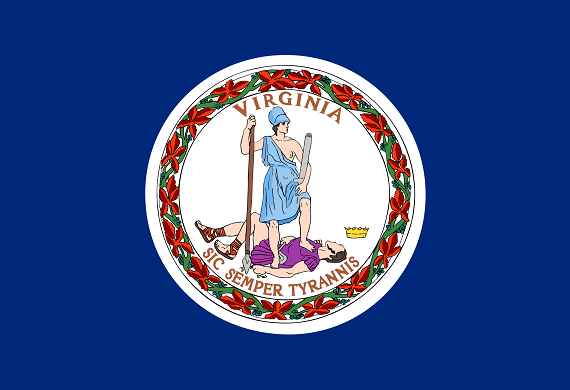
For Virginia, the Mother of States and Statesmen, things are looking bleak. Even during the darkest moments of the War between the States, Virginians had the Army of Northern Virginia, led by the remarkable General Lee, along with Stonewall Jackson, Jeb Stuart, and others, to give them hope that their difficulties would give way to better times. Together they were, to use a Greek term, an elpidophoros, a hope-bearer.
Today, there is a new army of northern Virginia, led by very different kinds of people. Rather than the Christian gentlemen typical of the South, the new leaders are a trans-friendly female governor, a female Muslim lieutenant governor, and a black man so morally disfigured he has declared his desire to see violence visited upon his political opponents and their children. And the army they lead is a horde of Yankeefied invaders that infests the bureaucracy of the federal government and has settled into the once-splendid northern part of the State. Together they are the opposite of General Lee and his army: They are an elpidoktonos, hope-killer.
The victory of those three Leftists in Virginia’s 2025 elections is dispiriting in itself. However, the depression is magnified when one realizes that, as we have seen in many recent elections, all of these Leftist candidates won their races by winning only a minority of the State’s counties (typically, the heavily urban counties).
Abigail Spanberger defeated Winsome Earle-Sears in the popular vote 57.2% to 42.6%. However, the former won only 49 counties out of 133. Thus, Ms Spanberger was declared governor despite winning only a little better than one-third of the State’s counties, 36.8%, to Ms Earle-Sears’s 63.2%. The elections for lieutenant governor and attorney general had similarly disproportionate results.
This is an injustice to the conservative rural counties that make up the great bulk of Virginia, suppressing their voting power in favor of the urban counties, and it must remedied.
There are two options for red county Virginians. They can fight to amend their State constitution to include a concurrent majority rule for State-wide elections, meaning that a State-wide candidate can only be considered duly elected if he wins both the majority of the popular vote and the majority of counties (the same would apply for State-wide ballot measures like constitutional amendments). Given the ideological make-up of the Virginia government, that does not seem likely to succeed.
The second option is one that red counties in other States are currently exploring – seceding from their respective States that are dominated by blue urban counties:
‘Welcome to the Greater Idaho Movement. Unlike fleeting political movements, this one is gaining momentum with constitutional pathways to success. In Eastern Oregon, counties are voting to secede from Portland’s Antifa influence, aiming to join the neighboring red state of Idaho. Thirteen counties have passed measures requiring local officials to initiate the secession process, although two counties face obstruction from clerks blocking signature gathering—a blatant abuse of democracy. The push for secession stems from political alienation. In the 2022 gubernatorial election, despite the map being predominantly red, the Democratic candidate won. The Republican candidate lost despite winning 80 percent of counties, highlighting the political disenfranchisement felt by over 80 percent of Oregon’s regions.
‘ . . . This movement is part of a larger trend across the nation. In Illinois, 27 counties have passed pro-secessionist referendums, and some lawmakers propose separating Chicago from the rest of the state. Maryland counties are eying a union with West Virginia, and San Bernardino County in California is exploring secession from the state. Independence referendums tend to draw out voters in droves, often voting for separation. This sentiment is evident in Oregon and could spread to other states where rural populations clash with urban centers. These movements embody the Founding Fathers’ vision of redrawing boundaries to reflect traditional rural values’ (‘Oregon’s Bold Move: Redrawing Borders for Freedom,’ turleytalks.com).
There is a section in the federal constitution for managing situations like this:
‘Is this constitutional? Absolutely. Article IV, Section 3 of the U.S. Constitution allows states to form from existing states with legislative and congressional consent. There are historical precedents: Kentucky’s separation from Virginia, Maine’s from Massachusetts, and West Virginia from Virginia’ (Ibid.).
Turning back to the red counties of Virginia, we must ask if this option of secession is realistic. If it is to go through the normal channels, receiving permission from the federal legislature and the State legislatures involved, then, no, it will be doomed to failure, as Ms Spanberger and her fellow-travelers in Richmond and in the federal government wouldn’t hesitate to veto the request for independence.
What option is left to them? The folks at Turley Talks have the answer:
‘The question isn’t whether state borders should change but whether we still value consent, representation, and self-governance’ (Ibid.).
In other words, secession is the correct course of action, but the conservative counties would have to bypass the current governing authorities. But there is strong precedent for their doing so.
One of the foundational principles underlying the union of the States (prior to Lincoln’s centralizing revolution, at any rate) is that a community is free to leave a political union that has become abusive or for other weighty reasons, even if the governing power objects. Virginia was once the leader of implementing this principle. She was the first colony to secede in June of 1776. She was the State who issued the call for a constitutional convention in 1787, which led to all the States eventually seceding from the union created by the Articles of Confederation and forming a new one under the Philadelphia charter.
Now Virginia’s red counties are once again faced with a difficult trial, emanating from the anti-West, anti-Christian Leftists in Richmond, more reminiscent of the existential threats of 1776 and 1861 than the more placid, philosophical debates of 1787. They stand in the shadow of extraordinary men – Washington, Mason, Jefferson, Henry, and the rest – yet they are men who are of the same lineage as themselves, men of Virginia. If they wish to retain and revive what is left of their Southern Christian culture, they will have to muster the courage of their ancestors, call a convention of their own, and declare themselves a new State (South Virginia, perhaps).
Such an act will be met with howls of denunciation from the usual circles. They must ignore them. They must push onward to new Statehood. If they do not, their culture, their families, their livelihoods, most anything worthwhile, will be destroyed by the Leftists in the blue counties.
These are not normal times, and the choices before them are likewise unusual, much more stark. Life or death; a future or obliteration. The red counties of Virginia must choose which they want.
Ordinary political processes aren’t likely to extricate the red counties of Virginia, or any other State, from the morass of blue urban county governance. Secession and new Statehood offer much better possibilities (just ask the folks in the new city of St George in Louisiana, which recently seceded from Baton Rouge). They ought to give it a try, and conservatives, traditionalists, etc., in other red States and counties and in the federal government should help them in any way they can.
The views expressed at AbbevilleInstitute.org are not necessarily those of the Abbeville Institute.







Secession implies ownership and stewardship of the means of production of the area in question.
Does rural Virginia have this? Or is it too deep in debt to virginianproper, which is obviously in debt to the USA, which is in run by debt.
Secession is not so simple when the area in question is a forced member of a union based on a fiat money tjat is the world reserve currency
But it’s not a legal member, of such a legal union.
Legally, Virginia is clearly written in the 1783 Treaty of Paris, as being a free, sovereign and independent state.
Meanwhile the US government’s sole legal claim of national union over it, alleges that the states were never without a legal superior; claiming that they never declared independence of one another or “the Union–” thus irrationally claiming SOVEREIGN dependence…. of FREE AND INDEPENDENT STATES.
This is wholly invalidated by the argument alone.
So the debt is illegal. And thus it can be repudiated, legally.
Thus any property that has been collaterized with this illegal debt can be freed up to citizens of Virginia.
Sounds easy.
“Even during the darkest moments of the War between the States, Virginians had the Army of Northern Virginia, led by the remarkable General Lee, along with Stonewall Jackson, Jeb Stuart, and others, to give them hope that their difficulties would give way to better times.”
But they did so in the name of a revolution they could not win, against a national union which never existed; which was actually the simple defense of a sovereign nation (Virginia), against foreign acts of terror and empire (since the peoples of the northern states never authorized their officials, to engage any military action by their respective states).
From Lincoln’s July 4, 1861 Message to Congress:
• What is a “sovereignty” in the political sense of the term? Would it be far wrong to define it “a political community without a political superior”?
• Tested by this, no one of our States, except Texas, ever was a sovereignty; and even Texas gave up the character on coming into the Union, by which act she acknowledged the Constitution of the United States and the laws and treaties of the United States made in pursuance of the Constitution to be for her the supreme law of the land. The States have their status in the Union, and they have no other legal status.
…
• [B]y the Declaration of Independence… the “United Colonies” were declared to be “free and independent States;” but even then the object plainly was not to declare their independence of one another or of the Union, but directly the contrary, as their mutual pledge and their mutual action before, at the time, and afterwards abundantly show.
…
• If they break from this, they can only do so against law and by revolution.
Here Lincoln blatantly equivocates between two definitions of “independence;” with the first meaning sovereign independence of one state from another, yielding separate sovereign nations (which they did); vs. simple generic dissociation of members from a particular group.
This was a hopeless attempt to construe the states, as declaring themselves to be dependent states, of a single free and independent STATE called “The Union.”
And of course this argument is wholly invalidated; by the simple fact that by definition, “free and independent states” have no sovereign dependence on any other state.
(Meanwhile their “mutual pledge and their mutual action before, at the time, and afterwards,” fully prove the full and separate national sovereignty of each state.)
And therefore every state was always a “sovereignty,” by Lincoln’s definition; with the original thirteen states being expressly established as such, by the American Revolution; while the newer states were recognized as such under the Founding principle of popular sovereignty, via the equal and inalienable right of all persons to self-govern their respective state.
Clearly this principle was hijacked during the Lincoln Administration, by industrial oligarchs, under pretense of a national union that never existed; but which reserved them absolute power under the illusion of democracy.
So my point, is that there’s no hope while continuing to recognize this “national union,” since this simply accepts corruption as normal, while continuing to deny Virginia’s own sovereignty (along with that of every other state and its respective people).
I LOVE this article, and it gives me hope.
I always said the Shenandoah Valley and other rural counties should just join West Virginia and rename it Old Virginia! I would pack up and move the next day.
Virginia is for Secession Lovers
https://cdn.filestackcontent.com/VtIncrSMQTGAhLFOsZDQ
“If western Virginia wanted to secede from Virginia, eastern Virginia would neither seek nor desire to coerce her to remain; nor do we believe that if eastern Virginia should wish a division western Virginia would employ coercion toward the East. When the consent of the governed is withdrawn from this government, it claims and will exercise no other power.” – The Richmond Dispatch.
“…It is said that the admission of West Virginia is secession and tolerated only because it is our secession. Well, if we call it by that name, there is still difference enough between secession against the Constitution and secession in favor of the Constitution. I believe the admission of West Virginia into the Union is expedient.” – Abraham Lincoln
“The rural districts, where three fourths of the people resided, had no opportunity to take part in the movement and many indeed were unaware that any organized effort was being made to neutralize the effect of the ordinance of secession. Since the convention was not called by any authority recognized by the state constitution, each county was a law unto itself. The feeling prevailed that the more delegates there were present the more impressive would be the effect, not so much in West Virginia as throughout the North. Thus the four hundred and twenty-nine men who assembled in Wheeling May 13, 1861, made an effective appearance and deceived the newspaper correspondents as to the real situation in the interior of the state.” – The Disruption of Virginia
“Carlile declared that none of the Wheeling conventions had been representative of the people of the new state and that a majority of the voters had never expressed their opinion on the question by electing delegates to the conventions or in referenda on convention decisions.” – West Virginia, A History
“The strength of the Confederates was shown when the Convention chose as its president Samuel Price, lieutenant governor of Confederate Virginia.” – West Virginia, A History
“By contrast, the 1872 Convention featured Democrats buoyed by their recent political takeover and bullish about their prospects. In place of ministers, the second convention had lawyers – 40 percent of the delegates had practiced law – and in place of staunch Unionists, it had former Confederates. The Wheeling Daily Intelligencer lamented the developments: The Democratic party has fallen hopelessly under the domination of the old secession element, and a Democrat who was not a rebel during the war … is to be in future as completely under the ban as if he were a Republican. True, the Prices, the Faulkners, and the Fitzhughs will fellowship with him, but henceforth they are to be the ruling class in their party, and Union Democrats are to be hewers of wood and drawers of water, mere retainers and henchmen, as it were, in the party household.
The Parkersburg Journal reported that the convention “‘was the slaughterhouse of the moderate man. It was evident in this body, from the beginning that no man would stand the ghost of a chance for any position unless his record as an adherent to the Confederacy was like the virtue of Caesar’s wife, “not only pure but above suspicion” – The West Virginia State Constitution, Oxford Commentaries
“I live in Boone Co Va 1O miles from the C. H. when at Home; but have not bin thare sense the 21st of May last. I have bin tring to preach in the MEC for 16 years, and travling in the Western Va Conferance 7 years. I am well acquainted in that Reagon. but the disunion party is too strong for us. all Judges, J P Lawer Shareffs Cont. Clarks Meranchants, politions slave holders and drunkerds outnumber us considerable and are to strong for us.” – Robert Hagar, Gallipolis, Ohio
I can’t help but agree with author with his observations.
However, here are some realities to consider. Red State leadership has been actually no better than our Blue State leadership. They are all corrupt or we wouldn’t see elections of such lunatics as Lindsey Graham, Mike Johnson, Tom Cotten, among others.
Blue State leadership has been just as bad in recent times as the city of Chicago has demonstrated. My own state of New York has just elected Mamdani, who to me is just another slick-talking hustler, bu who were his opponents? It doesn’t bother me that he is a Socialist. Given that Capitalism hasn’t done our citizenry much good in the past decades, a new economic path may be what we actually need. However, until Mamdani proves himself, I just can’t help thinking that he is just another snake-oil salesman.
Curtis Sliwa, the Republican candidate, appeared to be best suited for the job given his innate knowledge of the city and his concern for the average resident’s safety over the years. However, I never heard anything about his economic plans. Andrew Cuomo, who was probably the most effective New York governor in my lifetime was run out office on the basis of suspicious claims of sexual harassment after a 40 year run in public service with no such claim ever being made previously. Nonetheless, Cuomo aligned himself with the worst representatives of the Israel-First community in the city for his campaign. Mamdani became a shoe-in when the race should have actually been between far more rigorous between Mamdani and Sliwa. However, Republicans in the city have very little power.
Out here on the Island where I live, we are mostly Red, with both Nassau and Suffolk counties having Republican leadership. However, our own county executive is one step above a moron, just like Trump. Though he has done well on the public safety side of things, he has been a relative failure everywhere else. Our finst county executive was a Democrat who rooted out a lot of corruption. However, she couldn’t deal with the political nastiness of everything and basically stepped down after her first term, running such a tepid campaign that she was sure to lose.
The only bright spot is our governor, Kathy Hochel. And though I disagree with quite a few of her decisions for the state, she has done a good job of keeping the state rather calm within the current tsunami of trauma that the Trump Administration keeps hurling at us all.
Yet, even here out on Long Island, we have a movement to declare ourselves as a new state. However, I just don’t see that getting anywhere.
The overall problem with all these secession movements is that they are too small and if they are successful, they will only fracture our nation further. The idea that we can return in some way to the Jeffersonian vision of a small government, agricultural environment at least culturally, is simply not going to happen.
What we actually need is a complete reformation of the political structure of our nation, where regional-blocks would provide more stability than just a lot of additional fracturing of our states, with the individual states providing more robust, political engagement for their citizens than we have now. And yet, I can’t even get a response to my queries from own village government. You can’t make an omelette without breaking a few eggs. But what happens when all the eggs are rotten?
Of course, this would require new constitutions and much more equitable voting regulations for all involved, as the author suggests in his piece.
However, none of this is going to happen because the majority of Americans still believe in our vaunted Constitution because most are not very intelligent while also being very lazy. Unfortunately, our Constitution never really worked from the start. And it is the reason we have come to this point with the Lincoln Presidency cementing the Constitution’s failures under his own administration. If the Constitution was actually a sound document with sound institutions within it, Lincoln would have never been able to carry out his illegal war on The South and he would have been thrown out of office.
There is no one to really vote for anymore and the vote is just a veneer for states and the federal government to manage in their own favors. This much has been well documented. So ideas regarding secession may sound tempting but they are unrealistic in the current environment. People have to think bigger…