

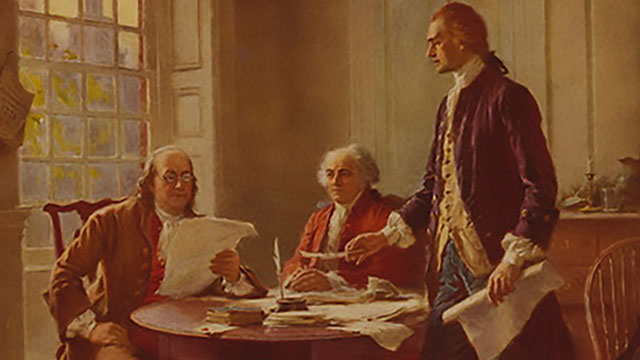
When Thomas Jefferson submitted his fair copy of the Declaration of Independence to the Second Continental Congress, he was unnerved at the prospect of members of the Congress, scrutinizing his document and suggesting changes. While the Congress was mulling over Jefferson’s Fair Copy of the Declaration of Independence, Benjamin Franklin (1706–1790)—who himself was part of the Congress-appointed, five-member committee to draft the document—noticed Jefferson’s uneasiness and related to the young Congressman from Virginia the following story. I leave it in Jefferson’s own prose.
“I have made it a rule,” said he “whenever in my power, to avoid becoming the draughtsman of papers to be reviewed by a public body. I took my lesson from an incident which I will relate to you. When I was a journeyman printer, one of my companions, an apprentice Hatter, having served out his time, was about to open shop for himself, his first concern was to have a handsome signboard, with a proper inscription. He composed it in these words ‘John Thompson, Hatter, makes and sells hats for ready money,’ with a figure of a hat subjoined. But he thought he would submit it to his friends for their amendments. The first he shewed it to thought the word “Hatter” tautologous, because followed by the words “makes hats” which shew he was a Hatter. It was struck out. The next observed that the word “makes” might as well be omitted, because his customers would not care who made the hats. If good & to their mind, they would buy by whomsoever made. He struck it out. A third said he thought the words “for ready money,” were useless as it was not the custom of the place to sell on credit. Every one who purchased expected to pay. They were parted with, and the inscription now stood “John Thompson sells hats.” “sells hats?” says his next friend. “Why nobody will expect you to give them away. What then is the use of that word?” It was stricken out, and “hats” followed it,—the rather as there was one painted on the board. So his inscription was reduced ultimately to ‘John Thompson’ with the figure of a hat subjoined.”
The episode that Jefferson recounts is noteworthy in that all the critical comments seem aidful, but that is not what Franklin aimed to communicate to Jefferson. The lesson was that everyone asked to comment on the sign would find some flaw in the sign—each would have something to say, for that is what each was asked earnestly to do—so it is best never to put oneself in such a position. In other words, Jefferson should never again draft any document that is to be submitted for critical inspection by others.
Franklin, of course, was a noted anecdotalist. He had stories—some allegorical, some amusing, some humorous, all educative—for all occasions. All in all, the kindly fellow Congressman, some 34 years Jefferson’s senior and perhaps somewhat of a father-figure to the 33-year-old Virginian as well as to many other members of that Congress, was merely trying to calm his bright young colleague. “Let them add certain touches. All will be well enough.”
At day’s end, the Continental Congress did edit much of the document. Nonetheless, despite the misleadingly untoward claim by Pauline Maier that the edits were so heavy that it is absurd to consider Jefferson to be its sole author, the line of reasoning in the Declaration was untouched and the document in gist was unaltered. Excrescences were excised, the document was streamlined, and discussion of the divisive issue of the problem of slavery was removed and shelved for a more apposite time.
Jefferson, of course, always considered himself to be the Declaration’s author—he added that achievement to his gravestone—despite plaints of others (e.g., John Adams, Richard Henry Lee, and Timothy Pickering) in his day that the document was highly unoriginal or even copied. The document was not supposed to be original, otherwise Jefferson could not have captured, as he said in a late-in-life letter to Richard Henry Lee (8 May 1825), the prevailing sentiments of his day.
When forced, therefore, to resort to arms for redress, an appeal to the tribunal of the world was deemed proper for our justification. This was the object of the Declaration of Independence. Not to find out new principles, or new arguments, never before thought of, not merely to say things which had never been said before; but to place before mankind the common sense of the subject, in terms so plain and firm as to command their assent, and to justify ourselves in the independent stand we are compelled to take. Neither aiming at originality of principle or sentiment, nor yet copied from any particular and previous writing, it was intended to be an expression of the American mind, and to give to that expression the proper tone and spirit called for by the occasion. All its authority rests then on the harmonizing sentiments of the day, whether expressed in conversation, in letters, printed essays, or in the elementary books of public right, as Aristotle, Cicero, Locke, Sidney, &c.
Enjoy the interview below with Dr. Luigi Marco Bassani, a good friend of Abbeville….
The views expressed at AbbevilleInstitute.org are not necessarily those of the Abbeville Institute.





Thank you, Dr. Holochak. One of the things I love about this site is that we learn so much of American history that was left out of our public education.