

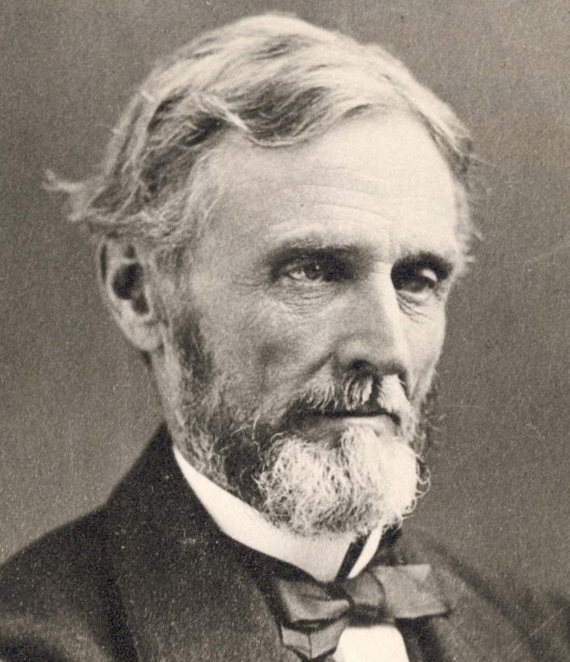
There is a rosewood Knabe piano at Beauvoir, the Jefferson Davis home on the Mississippi Gulf Coast, that has survived more than most Americans could bear. Hurricane Katrina lifted it from the front parlor and deposited it in the limbs of an oak tree on the grounds. Restorers could not save it. But there it sits still, in the presidential library, a damaged and silent witness to what once filled those rooms with life. The piano belonged to Varina Anne Davis — Winnie — the youngest child of Jefferson and Varina Davis, born in the last year of the war and called, for the rest of her brief life, the Daughter of the Confederacy. That she played it, and that her harp stood beside it, tells us something important: that music was not incidental to the Davis household. It was woven into the fabric of who they were.
This is not a trivial observation. The musical life of a family reveals its inner character in ways that political biography rarely can. We know Jefferson Davis as statesman, soldier, prisoner, and memoirist. We know him as the man who bore a burden no American before or since has carried — the presidency of a nation fighting for its existence against overwhelming odds. What we know less well is the man who came home in the evenings, who sat in the parlor while his daughter played, who had grown up in a Mississippi that understood music as naturally as it understood the rhythms of planting and harvest. To find that man, we must go back to the beginning.
The South into which Jefferson Davis was born in 1808 was a musical culture in the deepest sense. Music in the antebellum South was not a performance reserved for concert halls and trained professionals. It was domestic, participatory, and communal. Families gathered around the piano after supper. Young women were educated in music as a matter of course — it was considered as essential to a proper upbringing as reading or needlework, and considerably more pleasant than either. Gentlemen were expected to appreciate it, and many could sing or play themselves. The parlor was the stage, and the family was the audience and the ensemble both.
The young Jefferson Davis at West Point was emphatically not the grave statesman of later legend. Far from being the serious public servant of his adulthood, he was, by all accounts, a carefree and fun-loving student who accumulated demerits at a remarkable rate — for long hair at inspection, for firing his musket from his window, for the unpardonable offense of enjoying himself. He was among the first cadets ever arrested for slipping off to Benny Havens’ tavern, the forbidden establishment just outside the academy walls where generations of cadets sought relief from military discipline. Music was woven into that world. The tavern’s regulars sang together in its low-ceilinged rooms, and the tradition of communal singing was as much a part of cadet life as drill and inspection. Then came Christmas Eve of 1826. Dozens of cadets smuggled whiskey into the North Barracks and the night spiraled into what history remembers as the Eggnog Riot. Davis was among the ringleaders of the drinking party, and the record places him singing with his companions in the early hours of the festivities. He was placed under room arrest before the night’s worst violence erupted — a piece of luck that saved his military career, since the nineteen cadets who faced court-martial were those caught in the full chaos of the riot. Davis escaped dismissal. He graduated in 1828, carrying with him the habits of a man who knew how to enjoy an evening.
It is in the story of his first marriage, however, that music enters Jefferson Davis’s life in the most haunting way. Sarah Knox Taylor — Knox, as everyone called her — was the daughter of his commanding officer at Fort Crawford, Colonel Zachary Taylor, the future president. She was described by those who knew her as vivacious and charming, “witty, clever, graceful as a nymph, and the best dancer in the State of Kentucky.” Davis fell in love with her in 1832, fought her father’s opposition for three years, and finally married her in June 1835, having resigned his army commission to do so. They spent the early weeks of their marriage at Davis Bend on the Mississippi, but malaria was a constant summer threat in the low country, and a physician advised them to seek higher ground. They traveled by steamboat to Louisiana, to the plantation of Davis’s sister Anna at Locust Grove, and there both fell gravely ill.
For a time it appeared that Jefferson Davis would be the one to die. He was the sicker of the two. But he rallied, and Knox grew worse, and they lay in adjoining rooms in the summer heat. One night, too ill to rise from his bed, he heard her singing through the wall. The song was “Fairy Bells,” a voice-and-piano ballad by the English poet and songwriter Caroline Norton, and it had been their song during courtship. Its opening line — “I dreamt ’twas but a dream thou wert my Bride” — had been fashionable parlor music in England since 1829 and had crossed the Atlantic quickly enough to be circulating in America in the early 1830s, precisely when Davis and Knox were courting at Fort Crawford. Whether Norton intended anything so cruel, that opening line was what Knox Taylor sang in the dark of a Louisiana sickroom in the summer of 1835, delirious with fever, having been someone’s bride for not quite three months. Davis struggled from his bed and reached her room in time to hold her as she died. She was twenty-one years old.
Davis retreated to Brierfield and remained in something close to seclusion for nearly a decade. The grief he carried from that Louisiana sickroom never entirely left him. What he had last heard from his first wife was her voice, singing their song in the dark, not knowing where she was or that he was listening. It is one of the most desolating musical moments in American biography, and it casts a long shadow over everything that followed.
When Davis finally remarried in 1845, he chose Varina Howell of Natchez, eighteen years old and already remarkable for her intelligence and social gifts. She had been educated in Philadelphia and brought with her a cultured sensibility that encompassed literature, conversation, and music. In the years that followed, as Davis rose through the Senate and then served as Secretary of War under Franklin Pierce, Varina became one of the acknowledged leaders of Washington society. The world she presided over was one where musical entertainment at evening parties was simply expected — orchestras, dancing, singing around the piano after dinner. Varina moved through all of it with the ease of someone who understood that music was not decoration but the medium in which a society conducted its most important business of knowing itself.
That understanding was tested to its limits during the war. When wartime shortages stripped the Confederate capital of almost every luxury, Varina organized what she and others called “starvation parties” — gatherings bountiful in music, dancing, and games, if not in food or drink. The fiddle and the piano kept playing even when the larder was bare. The White House of the Confederacy in Richmond was, by the accounts of those who attended Varina’s receptions, a place where music was integral to entertainment at every level. Orchestras played for official functions; the parlor was alive with singing and playing in more intimate gatherings. Varina understood instinctively what the South had always understood: that hospitality without music is mere feeding, and that music is the language through which a people tells itself who it is. Through four years of war, with her husband working himself toward exhaustion and her children sleeping upstairs, she maintained that musical life as an act of cultural will. That was not a trivial act. It was a declaration that civilization, Southern civilization, would not be surrendered along with the cornmeal.
The war ended, the house fell, and the Davises spent years in displacement — in England, in Canada, in Memphis — before Jefferson Davis found his way at last to the Mississippi Gulf Coast, to Beauvoir. It was there, in the long, quieter years of his retirement, that the musical life of the household settled into its most characteristic form. Winnie came home from her German boarding school in 1882 as a young woman of twenty, educated and accomplished. She brought with her the European musical training that the German schools excelled in, and she brought it home to the Gulf Coast. The rosewood Knabe was hers. The harp was hers. Music in the Beauvoir parlor, in those last years before Jefferson Davis’s death in 1889, was Winnie’s gift to her aging father.
Jefferson Davis himself had little privacy at Beauvoir. Veterans came to pay their respects. Newspaper men came to ask questions. Curious strangers appeared at the door simply to lay eyes on the man. Varina, who had always preferred the city to the country, bore all of this with what patience she could muster. But in the evenings, when the door was closed and the Gulf breeze came in off the water, the family was simply a family. The music book open on the Knabe, the harp standing in its corner, the man who had carried the weight of a nation’s hopes sitting in his parlor while his daughter played — this is the Davis that history has not quite managed to record, because it left few documents behind. What it left was the piano, the harp, and the memory embedded in the walls of the house itself.
Winnie Davis was in many ways a tragic figure — the Lost Cause incarnate, as some historians have called her, a woman whose entire identity was conscripted into a symbol she had not chosen. She became the Daughter of the Confederacy in April 1886 when former Confederate general John B. Gordon introduced her to a crowd of veterans at a train platform in West Point, Georgia, and the title followed her for the rest of her life. Her attendance at Confederate reunions became effectively obligatory. She fell in love with a Northern man, Alfred Wilkinson of Syracuse, whose grandfather had been the prominent abolitionist minister Samuel Joseph May, and the resulting public outcry drove her to periods of deep distress. She died at thirty-four, having published two novels and a biographical monograph, and left Beauvoir to her mother.
But before all of that — or rather, underneath all of that — she was a girl who played the piano and the harp, and whose music was, as her mother said, the harp of her parents’ lonely hearts. That phrase carries a freight of meaning that no political biography can quite reach. Jefferson Davis had first heard music as grief, a young wife singing their courtship song into the dark of a Louisiana sickroom as she slipped away from him. He had heard it as endurance through the starvation parties of a besieged capital. And he heard it at last as consolation, in the quiet evenings at Beauvoir, while his youngest daughter played. The music was love made audible, across an entire lifetime. It was the South’s oldest understanding: that what matters most in a life is not what you accomplish in the public world, but what you bring to the people gathered around you in the evening.
The rosewood Knabe cannot be restored. But it sits in the library at Beauvoir, and those who look at it carefully enough will understand that they are not looking at a broken instrument. They are looking at the record of a life’s full arc — of a young cadet singing in a barracks room on a forbidden Christmas Eve, of a dying woman’s voice coming through a wall, of a people keeping their civilization alive with fiddle and piano through four years of war, and of a great and burdened man who found his peace, in the end, in the music his daughter made for him on a Mississippi evening, while the Gulf of Mexico moved quietly beyond the oak trees and the world outside left them, for a little while, alone.
The author encourages readers interested in the Davis family papers to consult the Mississippi Department of Archives and History in Jackson, which holds the extensive correspondence of Varina and Winnie Davis, and the Papers of Jefferson Davis project at Rice University.
The views expressed at AbbevilleInstitute.org are not necessarily those of the Abbeville Institute.




Wow. An awesome article. My mom grew up in Mississippi, taking piano lessons of course.
Presently I”m en route to a family reunion in Louisiana, and am hoping to stop by Beauvoir on my drive back home.
Thanks for the haunting, lyrical piece.
JP, thank you for the kind words. I still have a hard time thinking about Knox and “The Fairy Bells” without getting choked up.
Beautiful article.
As a 78-year-old musician, singer, writer, and dreamer, I have leaned on music and God through the loss of three young children, 14,116, and 118 years old; through the loss of my wife at 53 years of age; two younger brothers, nieces and nephews; through depression and anger about those losses, and, at times, anger at myself for still being llive when those I loved so much are no longer with me.
Music is truly universal, even in wartime and depression, a balm for the soul of man, given freely by God.
Thanks, Mr. Daniel, for this beautiful and in some ways, very poignant and heart-rending piece.
Those ages of the children should be 14, 19, and 27.
Nicki, God bless you.