

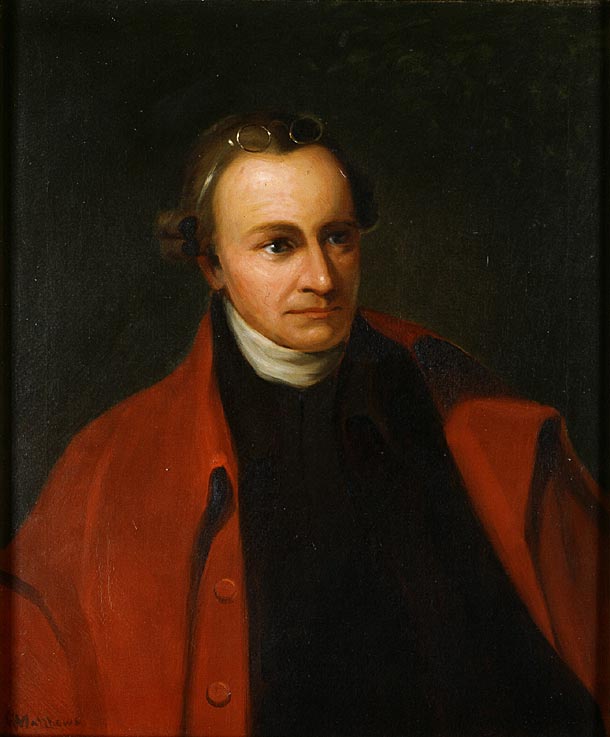
On the eve of the federal convention, and following its adjournment in September of 1787, the Anti-Federalists made the case that the Constitution makers in Philadelphia had exceeded the mandate they were given to amend the Articles of Confederation, and nothing more.
The Federal Constitution augured ill for freedom, argued the Anti-Federalists. These unsung heroes had warned early Americans of the “ropes and chains of consolidation,” in Patrick Henry’s magnificent words, inherent in the new dispensation.
Two hundred years into just such “consolidation”—in the magisterial —constitutional scholar James McClellan distilled the Anti-Federalist argument with the respect it deserves.
As “strong advocates of States’ Rights,” Anti-Federalists held that “self-government, independence, and individual liberty were best protected at the local level. A distant and powerful central government,” the kind cooked up at the Philadelphia convention, was anathema to these “cherished values.” To that end, Anti-Federalists fought to preserve the “loose-knit relationship” that had existed between the “Confederation government and the States.”
Should the Federal Constitution be ratified, there would be “no checks, no real balances,” thundered Patrick Henry. Instead, the country would live under a “powerful and mighty empire.”
Writing under the assumed name “Agrippa,” yet another Anti-Federalist scoffed at the idea of an enormous “uncompounded republic,” then containing six million inhabitants, all “reduced to the same standard of morals or habits and of laws.” This “in itself is an absurdity,” mocked “Agrippa.”
Twenty-first century America is home not to six but 350 million alienated, antagonistic individuals, philosophically diverse to the point of distrust. These modern-day Americans, some of whose ancestors were brought together by a “profound intellectual and emotional attachment to individual liberty,” possess little by way of “social capital” to unify them.
Surveys say Americans today avoid one another and hunker down unhappily in front of the TV, instead. This would have hardly surprised “Agrippa.”
So, too, did Anti-Federalists predict the problem of representatives who had been imbued with excessive power. “Once elected, representatives would be far from home, comfortable in their jobs, enjoying a big salary … living in some distant, yet-to-be-built city far removed from the watchful eye of the people they represented.”
Sound familiar?
From “Brutus” came perhaps the most “perceptive and far-reaching examinations of congressional power from the Anti-Federalist perspective.” Writing in the New York Journal, “Brutus” observed that “the ‘most natural and grammatical construction’ of the General Welfare Clause in Article I is that it authorizes the Congress ‘to do anything which in their judgment will tend to provide for the general welfare, and this amounts to the same thing as general and unlimited power of legislation in all cases.”
“If only the high-minded Framers had written the Constitution with crooks in mind,” I lamented in 2008. “Brutus” was not nearly as charitable. Bitterly did he complain about a Constitution that was “written ‘in general and indefinite terms, which are either equivocal, ambiguous, or which require definition.’”
The Commerce Clause, for example, was the focus of scathing Anti-Federalist critique. “What is meant by ‘the power to regulate?” they demanded to know. “What, precisely, is ‘commerce’”? The new Constitution, argued the prescient Anti-Federalists, is mum on these matters, providing little by way of precision in definition.
Brilliant too was “Brutus” in his prediction that, if instituted, the “new system of government” would see the Federal judiciary “swallow up the State courts.” Back then, “Brutus” saw Article III, Section 2, of the Constitution as vesting the judicial branch with the kind of power that would bring about “the entire subversion of the legislative, executive, and judiciary power of the individual states,” to say nothing of the individual human being.
As the saying goes, “a prophet is not without honor save in his own country.”
To observe our rulers in action is to realize that Massachusetts delegate Elbridge Gerry and New York Anti-Federalist “Cato” were prophets who deserve a lot more honor in their own country. Both forewarned of an imperial presidency in the making. “‘The president,’ wrote “Cato,” has so much power that his office ‘differs very immaterially from the establishment of monarchy in Great Britain.’”
Correction: The power vested in the American presidency dwarfs that of the largely titular, ceremonial British monarchy.
Indeed, presidents have habitually used executive orders to circumvent federal legislation. They have also exempted their “friends or political cronies” from laws their subjects must obey. And they have ordered the suspension of “duly enacted law”—even “barring enforcement”—because they disliked said law.
A propagandized population has a hard time choosing worthy heroes. It is high time Americans celebrate the Anti-Federalists, for they were correct in predicting the fate of freedom after Philadelphia.
To deny that the Anti-Federalists were right is to deny reality.
Having prophesied that Philadelphia was the beginning of the end of the freedoms won in the American Revolution, our Anti-Federalist philosophical fathers fought to forestall the inevitable. They failed.
The views expressed at AbbevilleInstitute.org are not necessarily those of the Abbeville Institute.




While I can understand, say, a Washington, frustrated with a fractious Continental Congress during the War, when he’s trying to save the Army and the confederation itself, would want to see a strengthened general government. However, I wish they had listened more to the likes of Patrick Henry, Richard Henry Lee, and the rest of the Anti-Federalists, and merely made some adjustments to the Articles, as needed.
Still, if the original intent of the Constitution, especially as enumerated in the Bill of Rights, had been followed – a framework founded in our ancient Rights of Englishmen, we would have been MUCH better off! Instead of law students learning this absurd idea of a “living and breathing” document, they would be better served “reading” the law, to include history and what should be the indispensable Judge Blackstone!
SIGH!!!
“Still, if the original intent…a framework founded in our ancient Rights of Englishmen, we would have been MUCH better off!”
There were rights of Englishmen. So then, perhaps things would have gone well and a whole lot of hurt avoided if the Colonist’s had controlled their passions a little better and had been more patient with the Crown.
“Jonathan Boucher held that men are more likely to be guided or governed by their passions or their temper than by their judgement: ‘They find the Movement of the Passions a more easy and agreeable Exercise than the Drudgery of sober and dispassionate Enquiry.’
“Boucher is critical of the ‘loose notion’ that government is ‘the mere creature of the people’ to ‘erect and pull down’ at their whim.”
“… governments do not aim at any particular good; rather, order and stability are characteristic of all good governments. The purpose of government is thus not some positive notion of a common good but rather a negative role of restraining evil so that man can live in an orderly fashion.” Yes.
One can almost get the picture that the Federalist were playing the long game. With the far too numerous ‘elastic’ clauses that permeated the 1787 constitution, it was only a matter of precious little time before the ‘expansive’ or better yet ‘loose’ interpretation of the constitution took hold. (Judiciary Act of 1789 to start) Since Hamilton, Wilson and their ilk could not get what they wanted in Philadelphia, they bided their time and started the centralization of the general government once they got into power. Was it their plan all along would be a good question to ask.
Exactly so. Jefferson wrote that Hamilton believed the present government was “a shilly‑shally thing of mere milk and water,” and that we must “go further.”
Jefferson in so many words said that Hamilton thought the Constitution was good enough for now, but only until “the people would be ready for something better.”
And of course immediately in the 1790s Hamilton contradicted many of the promises he made to sell the Constitution. To sell it, he said the Federal govt could ONLY do what the Constitution specified. After ratification, he argued the Federal govt could do anything that the Constitution didn’t explicitly prohibit.
Jefferson recounted a private cabinet conversation in which Hamilton openly declared that the Constitution was only a temporary, insufficient framework:
“Hamilton said that the present government was a shilly‑shally thing of mere milk and water, which could not last; that we must go further.”
“He said that the people were not yet ripe for the kind of government he wished, but they would soon be so.”
In one respect, one should never meet their heroes. My studies continue to lead me to conclude that many of the greatest generation, as Professor McClanahan refers to the founding generation, were very ‘human’ human beings. But, knowing they ‘put their pants on one leg at a time’ makes it easier to read, relate to and understand them. Makes it easier knowing they were human like I myself. So I will walk with these men and listen to their words and build on their foundation. Their plans had merit but as always, it is human nature that fails. (Self included!)
You can’t get something for nothing…rule number one of the universe.
Strong central government is a must when faced with organized threats. When these threats recede, individual liberty must be promoted. Freedom is what sets the republic apart from all others…that…and two merciful oceans and two inept neighbors…and the blessing of God.
The US has only been in one war it HAD to win…that was the American Revolution…and then we were the united STATES. The remainder of our wars haven’t been wars…they’ve been profit centers for the MIC…especially the one from 1861 til now.
Really excellent essay!!! Realize when you write “They failed” that the Anti-federalists–they were actually anti-nationalists–were extremely limited in the reach of their voices. Most people in most states never saw an article by an Anti-federalist. None were ever printed in Connecticut for instance before their ratification vote. Few of the few newspapers printed their view at all.
Another bit of prescience from Brutus: [The Supreme Court is] empowered, to explain the constitution according to the reasoning spirit of it without being confined to the words or letter.” “…from this court there is no appeal. Accordingly, there will be a strong propensity within the Constitution to lead to the establishment of a consolidated rather than a confederated government… by way of the power of judicial review. In fact, the judicial power enables the [Supreme Ct.] “to mold the government, into almost any shape they please.”
and hamilton gets a shitty play in nyc while a dubious film still makes Jefferson with Hemings the runt. maybe the shittynes will seep through to some to stop this crap.
“It is high time Americans celebrate the Anti-Federalists, for they were correct in predicting the fate of freedom after Philadelphia.”
Then, in addition, it should be high time to go back to what the Loyalists had to say:
“Patriot preachers tapped into the theories of John Locke (Hobbesian); Loyalist ministers delved into law, reason, and history. The decisive factor for the clergy…was…Romans 13, 1 Peter 2, and other passages…they warned about the cost of such a revolution and the cost of running an independent America if they happened to be victorious…How would they keep fighting among themselves?”
And then it might be high time to go back even more, to Genesis 1, 3, 6, 9, 10, 11, 12 and on through the rest of O.T. which includes Matthew, Mark, Luke and John. And then to the gargantuan drama in Acts. One writer appropriately titled a study: “The Crisis of Acts 1-7…”
One here described America as being under “the blessings of God.” That can be debated. What cannot be debated and what must be desperately understood, is that when that “crisis” in Acts reached fever pitch in Acts 7, the Creator of the Universe called a “time-out.” God then unexpectedly installed grace, an amnesty. That means it’s temporary. It is that all of us need to look into and to receive the generous offer of God’s grace.
“To deny that the Anti-Federalists were right is to deny reality.”
To deny or to ignore the Bible and what is going on in it is to deny reality. God’s original plan, tabernacling with man on Earth, is going to come into fruition. And it’s going to be monarchy rule, not a Republic.