

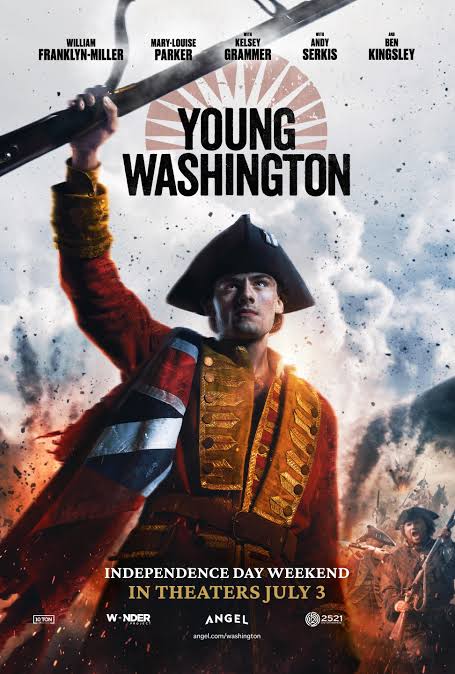
The movie covers George Washington’s life from the death of his father at age 11 through The Battle of Monongahela and its aftermath. Having read the 7-volume George Washington Pulitzer Prize book by Douglas Southall Freeman I will review the events depicted in the movie. The movie was enjoyable, but liberties were taken with the dates of some events, and other scenes were embellished.
George Washington as surveyor – The movie depicts Washington being given his father’s surveying instruments at age 11 by his half-brother Lawrence. That’s an embellishment. Washington inherited them from his father and started playing with them around age 14 to teach himself the math and geometry required to map the frontier.
Lawrence’s Role – Lawrence Washington was George’s much older half-brother. Following the death of their father, Lawrence stepped in as a major mentor and father figure. Lawrence, who was well-connected with the wealthy Lord Fairfax family, encouraged George to pursue a professional career as a surveyor. Washington first met the Fairfax family at age 15 through his half-brother, Lawrence. In 1743, Lawrence had married Anne Fairfax—daughter of Colonel William Fairfax and sister of George William Fairfax—an alliance that elevated the Washingtons’ social standing and allowed young George to frequent the family’s estate, Belvoir. The following year, at age 16, Washington traveled to the western frontier of Virginia as part of a surveying party with George William Fairfax.
Washington and Sally Fairfax – Their relationship in the movie is 100% bunk. She married George William Fairfax in December 1748 when Washington was 16. Because Washington lacked the formal overseas education of other wealthy Virginians, Sally (who was well-read and socially poised) became a mentor. She introduced him to high-society culture, philosophy, and literature (such as the play Cato), and taught him the social graces. Washington and George William became great friends, but Washington also developed a deep infatuation with Sally.
Lawrence Washington’s death – The movie has Lawrence dying after the events at Fort Necessity. Historically, however, Lawrence died of tuberculosis on July 26, 1752—two years before the Battle of Fort Necessity in 1754.
The December 1753 Allegheny River crossing – How it happened in the movie is pure Hollywood storytelling. How it actually happened is while trying to pole a crude raft across the freezing river, Washington was struck by a block of ice and knocked overboard into the icy currents. He managed to grab hold of one of the logs on the raft and held on for his life. Christopher Gist then pulled him back up.
Neither man was fully submerged on the raft. If they had been, they would have both succumbed to fatal hypothermia in minutes. Instead, they survived the night on an island (now Washington’s Landing near Pittsburgh) before walking across the frozen river the next morning.
The Jumonville Glen incident on May 28, 1754 – The movie version depicts Washington trying to prevent the bloodshed and telling his men not to fire at the French.
The Real History (Jumonville Glen)
After his scouting party discovered the location of a small French force in the Ohio wilderness, Washington, thinking they were spies, explicitly ordered his Virginia militiamen and their Indigenous allies to take up arms and fire.
Washington’s rank – Washington was a Lieutenant Colonel (not a major) when he was sent to the Ohio Valley in early 1754. However, the promotion to full Colonel did happen right before the Fort Necessity campaign, though it wasn’t a battlefield revelation. On June 9, Washington received word that the Virginia Regiment’s commander, Colonel Joshua Fry, had died after a fall from his horse. Washington officially assumed command and became a Colonel.
Christopher Gist’s death – He survived the Battle of Fort Necessity but died of smallpox in July 1759 while serving as a Deputy Agent of Indian Affairs.
Washington at the Battle of the Monongahela – When British regulars panicked and broke under Franco-Indian fire, Washington’s retreat was strategic. He rallied the survivors and formed a rear-guard, saving the remaining forces. The portrayal of Washington in the movie diverges from the historical record. The cinematic version tends to heighten drama by showing Washington desperately trying to rally troops to continue the fight, while in reality, the British force was entirely routed and an organized retreat was his primary accomplishment.
His actions during the chaos of that day were instrumental in preventing a total massacre:
- Chaos on the Monongahela:The British force was ambushed by a much smaller coalition of French and Native Americans. European linear tactics failed miserably against enemies fighting from the cover of the woods.
- Targeting the Officers:Because British officers on horseback made obvious targets, Washington had two horses shot out from under him and four bullet holes in his coat (but not two bullet holes in his cap as portrayed in the movie).
- The Retreat:He helped carry the mortally wounded General Braddock from the field and coordinated a rear-guard action across the river, keeping the French and Native Americans from pursuing the shattered remainder of the army.
The meeting with the Indians after the Battle of Monongahela –It wasn’t immediately after the battle as portrayed in the film. Prominent Seneca or Ohio Country chief who, during Washington and Dr. James Craik’s 1770 expedition into the Ohio wilderness, reportedly recounted that he personally fired at Washington 17 times with his rifle. Believing no one could survive that amount of focused fire without the protection of the “Great Spirit,” he ordered his warriors to stand down.
A separate Native American chief present at the same battle, often identified as Red Hawk, claimed that he and his men had specifically targeted Washington and fired at him 11 times without hitting him, leading to the same conclusion that Washington was under the care of heaven.
The views expressed at AbbevilleInstitute.org are not necessarily those of the Abbeville Institute.




Thank you, Jeff Wolverton for breakdown of the events of the movie. I still intend to watch it but now I have a better understanding of what to look for.
Thank you. Was the movie at least worth seeing ?
Martin,
My wife and I saw the movie a couple of weeks ago. I thought it was good, although I am not as thoroughly knowledgeable and well-read on Washington’s early life as is Jeff.
I thought the movie told a good story and revealed George Washington’s strength of character and courage, traits that would serve him, and our fledgling nation, during the Revolutionary War and his presidency.
Hope this helps!