

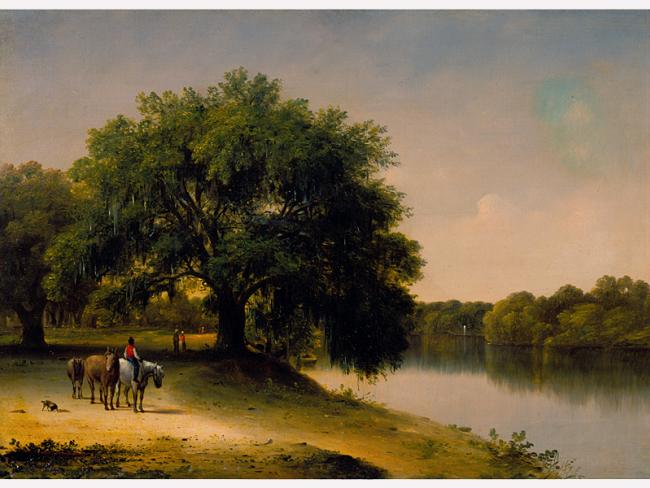
“There are great defects in that character—peculiar defects of accident; but there is also the sum of many virtues. The people of the South are brave to a fault; they are generous to credulity, polite, hospitable, cherishing many noble virtues which the commercial spirit of the age has elsewhere outgrown; but they have all the peculiar faults of an untraveled people—a people who pass their lives in local neighborhoods, and who, having but little knowledge of how large and various the world is, easily take conceit of their own powers and virtues.”
~ E.A. Pollard
The South is a “backwards” civilization; it always has been and, Lord willing, the progress will be swiftly retarded, that it always will be. Thomas Jefferson once wrote a letter to his nephew in which he exhorted him that, “Young men, who travel… do not acquire that wisdom for which a previous foundation is requisite, by repeated and just observations at home… These observations are founded in experience. There is no place where your pursuit of knowledge will be so little obstructed by foreign objects, as in your own country, nor any, wherein the virtues of the heart will be less exposed to be weakened.” In summation, “Traveling,” says Jefferson in a rare instance of brevity, “makes men wiser, but less happy.”
It is an undeniable fact that Antebellum and Postbellum Southerners alike shared an ignorance of the big wide world; albeit, the latter did experience what the outside world was like and found it bitter to the last musket ball. Far from isolating themselves to cultivate a feeling of pride, Southerners understood that exposure to the world through travel and the learning of abstract knowledge was largely useless to them. C.K. Marshall in 1855 “concluded that it was… impossible for southerners to be safely educated at the North. They cannot come back with proper feelings towards their families and people.” What good was it to learn the skills of a “scribbler, reader, and figurer —so necessary to trade and industry—” when they were of “small concern to the average Southerner,” rather, “he admired more the skills of the hunter, fisher, fighter, and fiddler. These and other leisurely activities were considered by him to be fun and worthwhile, fun to learn and practice, and consistent with honesty and honor.”
This ignorance was intentional. The Southron since, at least, the time of Jefferson instinctively knew that “What outsiders taught, under the guise of enlightenment and knowledge, was merely subservience to alien ways and values.” What good was trigonometry to the Southern Yeoman if he forgot that “evening red and morning gray, sets a traveler on his way. But evening gray and morning red, pour[s] down rain upon your head”? What benefit was it to the planter, for that matter? What actually constitutes knowledge is brought under severe scrutiny when the Yankee mounts his horse after a night spent enjoying the hospitality of the Southern “white trash” to the tune of his backwoods accent reciting that very saying; just for the enlightened Northerner to ignore the warning and find himself and his horse swiftly washed away in a flashflood. Watching from his front porch with a hat dry enough to catch fire, we can imagine that the uneducated Southerner might feel himself to be a damn wise man.
The accusation of “backwardness” of the Southerner is the very same that the Tsar Nicholas was condemned with when he and his family were slaughtered in their basement, and the same inability to progress was shared by King Louis XVI and his aristocracy during the French Revolution. “Backward,” “uneducated,” and “unenlightened” are the universal cries of the cheering crowd as the guillotine falls or Sherman treads on Georgia. What good is this enlightenment? What good is this all-devouring tree of knowledge? Who, or what, can extinguish Prometheus’s fire?
What if Pollard’s criticism of the Southern man was merely the veil of the highest praise? The Southerner knows his Bible, and Jesus Himself often concealed his true meaning through allegory, analogy, parable, and irony; doubtless this intimate knowledge formed the writing of Southern authors since the Colonials first landed in Virginia. But rather than pontificate on Pollard’s true meaning, we need only look to history for proof of his praise —unintentional though it may have been.
Understand, reader, that the “commercial spirit of the age” did not “outgrow” the Southern virtues of bravery, generosity, credulity, politeness, hospitality, and other “noble virtues”; the spirit of the age —that damnable principality whose hand guides the industrialism and commercialism— has killed them. It has taken them and exchanged them for those negative virtues so praised in the capitalistic and competitive world of industry; un-virtues such as “fraud, deception, and bribery” have replaced honesty, politeness, and hospitality. The Southerner knew that “Moral deterioration is a progressive process. Just as a worn part of a machine will affect contiguous parts and finally destroy the entire mechanism, so the loss of one moral value must ultimately undermine the sense of morality.” If this is progress, may we all be backwards. If this is winning, may we lose with the grace of General Robert E. Lee.
However, the question is begged: winning what? And what is the prize waiting for us across the finish line? Perhaps a better question is, what race are we running? are we racing for a “perishable” or an “imperishable crown”? Yes. That question gets to the heart of the matter. General D.H. Hill, reflecting on the War, said that the South’s “conservatism, her love of the Constitution; her attachment to the old usages of society, her devotion to principles, her faith in Bible truth—all these involved her in a long and bloody war with that Radicalism which seeks to overthrow all that is venerable, respectable, and of good repute.” The Yankee can kill the body, but the soul that filled her territory, that he could never touch. Robert Lewis Dabney says that “It is only the atheist who adopts success as a criterion of right. It is not a new thing in the history of men that God appoints to the brave and the true the stern task of contending, and falling, in a righteous quarrel.” This pragmatic “criterion of right” guided the North in her path to industrialism, commercialism, and ultimately, filling the void of the alter razed by the puritans with economic prosperity. The Northerner had long since given up the “practice of judging men’s actions by a divine deliverance, or by any code superior to what he himself could frame,” and “Southern writers tried as best they could to point out the dangers in this rising tide of empiricism.”
To be an empiricist, one must reject the backwards un-education of the Southerner who knew that: “in giving up the religious sanctions of his laws and institutions, man hands himself over to the chaos which must always proceed from passion unchecked by higher discipline. To substitute a sentimental optimism and humanitarianism for the old and proved doctrine of man’s natural depravity is to prepare the way for a new fall.” The tree of knowledge found rich soil in the North; its fruits were an all-consuming and all-producing industry; a fruit which was eaten by the Northern money men. These men were eager to spread this fire, and in just a few generations, Cain was once again found with the blood of Abel on his hands; the razed land, brave men, and gentle women and children of the South crying out.
If the knowledge lacking in the Southerner is the same upheld as salvation by the Northerner, then I don’t think we will travel, and I don’t think we ought to be learned in the ways of the industrial world; it appears to us that a Southerner “traveling… for education, loses in his knowledge, in his morals, in his health, in his habits, and in his happiness.” The Southerner, for all of his “backwardness” knew his land and was intimately tied to it. He knew that “cultivators of the earth are the most virtuous and independent citizens,” and he was unwilling to separate himself from his land and all her blessings if it meant knowledge, riches, and fame. The Southerner or Celtic visitor to Boston would echo the words of this German visitor to England who questioned “the spiritual state of a country which estimates a man’s value in terms of his income, as witness the expression: he is worth a hundred thousand pounds”; this being in stark contrast to the Southerner who “distained people who devoted their lives to the making of money…”
The Southerner and the Northerner were antagonistic to one another in almost every way. It would be ludicrous for Pollard to judge his own people by the standard set by the Yankee moneyman and educator (who was paid by the former). And whether or not it was a compliment veiled in a critique to make the apologetic palatable to the Yankee is irrelevant since we can never be sure. What we can be sure of is that when tried by the scale of God and reason, the South, still to this very day, is found to fly above the Northerner despite all his haste and unceasing labor. Marriage is revered here, children are born, church pews are full, and some semblance of sanity can be seen in the overall disposition of the people. Yes. It would seem as if the Northern industry has not yet, and cannot ever, kill the soul of the South; and we would be foolish to exchange the virtues that have sustained us for the vice that has made the North rich.
The views expressed at AbbevilleInstitute.org are not necessarily those of the Abbeville Institute.






We Rebels know our Bible. The red sky saying is from the Bible…as is this one…”greater love hath no man than to lay down his life for a friend.” Booker T. Washington proclaims this in his first chapter of UP FROM SLAVERY when he lovingly states the slaves would have laid down their lives to protect the women and children left in their care. I challenge all here to read the first chapter and not come away changed for the better and with the realization nearly every northern account to describe slavery in the past 150 years has been a lie.
UP FROM SLAVERY…free to read on the web…do so before the controllers remove it from public viewing.