

Is Israel Jefferson’s 1873 Account of Jefferson’s Paternity of Sally Hemings’ Children Worthful or Worthless?
It is commonplace for many Jeffersonian scholars, uncritically accepting Jefferson’s paternity of all of Sally Hemings’ children, to speak of slave Israel Gillette’s 1873 comments on Jefferson’s paternity as being corroborative or confirmatory evidence for that paternity—e.g., the Thomas Jefferson Foundation’s account of Gillette’s published memoirs.
To confirm or corroborate a hypothesis, plainly stated, is to provide evidence for it that is relevant to its truth-value. In the main, if a hypothesis can be said to have a truth-likelihood of 0.98 (All puffins are birds that fly), then confirmatory evidence of that hypothesis (discovery of an island of puffins all of which fly) will increase that truth-likelihood (say, 0.981). Evidence disconfirmatory or dis-corroborative will either reduce that likelihood or refute the hypothesis. For instance, discovery of certain puffins on a heretofore undiscovered island that cannot fly refutes the hypothesis and reduces its truth-likelihood to 0.0.
The Thomas Jefferson Foundation, under the direction of former president Leslie Greene-Bowman, has gone on record as saying that the hypothesis of the Jefferson-Hemings’ affair has been so well-confirmed that it must be treated as fact.
While there are some who disagree, the Foundation’s scholarly advisors and the larger community of academic historians who specialize in early American history have concurred for many years that the evidence is sufficiently strong to state that Thomas Jefferson fathered at least six children with Sally Hemings. In the new exhibit exploring the life of Sally Hemings, her choices, and her connection to Thomas Jefferson, as well as in updates to our related online materials and print publications, the Foundation will henceforth assert what the evidence indicates and eliminate qualifying language related to the paternity of Eston Hemings as well as that related to Sally Hemings’s three other surviving children, whose descendants were not part of the 1998 DNA study.
The elimination of qualifying language—e.g., there are plausible alternative hypotheses—is tantamount to treating Jefferson’s paternity as factual. The issue is closed to further scrutiny. Everything substantive speaks for it; nothing substantive speaks against it.
Of the countless scraps of “corroborative evidence,” there is Israel Jefferson’s recollections of his life at Monticello, which were published in a Pike County newspaper (Ohio). This memoir, nearly 2350 words in length, was published by Samuel Wetworth, editor of Pike County Republican. It was the third in a series of essays titled “Life among the Lowly.” The first was slave Madison Hemings’ testimony, published on March 18, 1873. Madison presumably wrote:
During that time [while Jefferson was minister to France] my mother became Mr. Jefferson’s concubine, and when he was called back home she was enciente [sic; Fr. enceinte; pregnant] by him. Soon after their arrival, she gave birth to a child, of whom Thomas Jefferson was the father. It lived but a short time. She gave birth to four others, and Jefferson was the father of all of them. Their names were Beverly, Harriet, Madison (myself), and Eston—three sons and one daughter.
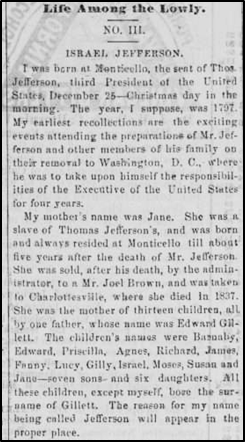
On December 25, 1783, editor Wetmore was again at the throat of Thomas Jefferson. He published the memoir of Jeffersonian slave Israel Gillette, who had then changed his name to Israel Jefferson. Among the numerous claims made by Israel, there was the assertion that Madison Hemings and his siblings were fathered by Thomas Jefferson.
I know that it was a general statement among the older servants at Monticello, that Mr. Jefferson promised his wife, on her death bed, that he would not again marry. I also know that his servant, Sally Hemmings, (mother to my old friend and former companion at Monticello, Madison Hemmings,) was employed as his chamber-maid, and that Mr. Jefferson was on the most intimate terms with her; that, in fact, she was his concubine. This I know from my intimacy with both parties, and when Madison Hemmings declares that he is a natural son of Thomas Jefferson, the author of the Declaration of Independence, and that his brothers Beverly and Eston and sister Harriet are of the same parentage, I can as conscientiously confirm his statement as any other fact which I believe from circumstances but do not positively know.
Here we have another Buk missile, which is additional evidence that Jefferson had hanky-panky with Sally Hemings.
Yet the missile can be shown to be a probative dud. How did Israel know that Jefferson was intimate with Sally Hemings? First, he was intimate both with Madison Hemings and with Thomas Jefferson (or Sally Hemings?). Thus, “when Madison Hemmings declares that he is a natural son of Thomas Jefferson … and that his brothers Beverly and Eston and sister Harriet are of the same parentage, I can as conscientiously confirm his statement as any other fact which I believe from circumstances but do not positively know.”
Yet the italicized statement bedazzles any discerning reader. What is a “fact” that is believed “from circumstances”? They cannot be the circumstance of direct sensory evidence. I know “My dog Jefferson sleeps on a chair on the front porch” is true by looking out the window of my study and seeing him asleep on a chair. If it were a fact of direct sensory experience, Israel would not puzzlingly add, “but [I] do not positively know.” And so the epistemological, waters are muddied.
Why is it that Israel Jefferson does not positively know of Jefferson’s paternity? Why is there doubt and does that doubt call into question his inculpatory assertion of paternity?
The testimony of Israel reached Jefferson’s grandson, Thomas Jefferson Randolph, who took up his quill to refute many aspects of Israel’s testimony in a letter to Editor Wentmore.
First, Israel claims to have been born on December 25, 1797. He claimed also to have “earliest recollections” of “Mr. Jefferson and other members of his family on their removal to Washington, D.C., where he was to take upon himself the responsibilities of the Executive of the United States for four years.” He adds, “His final term closed in March, 1809, when he was succeeded by James Madison. At that time I was upwards of twelve years of age.”
Randolph remonstrates:
Israel is made to say that he recollects distinctly the departure of Mr. J and family for Washington D.C. when he went to assume the duties of President. Mr. Jefferson left home alone. Taking not even a servant with him. Dec 1st, 1800 to preside over the senate as vice president, where he was March 5th 1801. Israel by the record was born Dec 28 1800. He is thus made to recollect events occurring nearly a month before his birth.
The day of Israel’s birth is given by Thomas Jefferson on the “Roll of Negroes” in Albemarle in his Farm Book. He writes, “Israel. 1800. Dec. 28” and Israel is listed as an asset of the farm, not of the house, so he was likely not close to Thomas Jefferson. If we do the arithmetic, when Jefferson left the presidency in 1809, Israel was eight, not “upwards of 12 years of age.”
Israel continues. He was postilion at around 10 and an intimate of Thomas Jefferson. Sally Hemings was his chambermaid and he liberated her upon his death.
Randolph continues his refutation.
He [Israel] is made to say that he commenced the duties of life as waiter at Monticello and attendant on Mr. J’s person at the commencement of his second term March 1805. He was then at the mature age of four years and his whole family on the list of slaves on the farm leased to Mr. Craven 1801–1809.
The record [Farm Book again] 1810 Feb. places him on the farm not on the list of those attached to the house. …
He is made to say that in an establishment where there was a super abundance of servants he was called on, a mere boy to discharge the duties of coachman waiter and attended on his masters person kindling his fires &cc. Mr. Jefferson rose at dawn and always kindled his own fire. His confidential servant Burwell Colbert was the only one who placed his wood and water and had access to his room besides the person who cleaned it and made up his bed. And this was punctually done while he was at breakfast and making the round of his workshops and garden immediately after. Israel was never employed in any part of trust or confidence about the house at Monticello.
Of Israel’s confirmation of Madison’s testimony of Jefferson’s paternity, Randolph writes:
Israel is made to revive and confirm of his own knowledge a calumny generated in the hot bed of party malice. Mr. Jefferson and his daughter with her large family occupied the same wing of the building: the private access to their apartments ever contiguous; every member of this family repelled with indignation this calumny. Mr. J did not liberate this woman and her family as Israel is made to state. To my knowledge and the statements other gentlemen made to me 60 years ago the paternity of these persons was admitted by two other persons. He liberated his servant Burwell and four of his mechanics. Two of them were of the family. Mr. J’s mechanics kept under his own eye and his entire household servants were the descendants of Betty Hemings, born 1735 died 1805 or their wives, except as under cooks and his drivers. Israel was not one of this family. It was a source of bitter[,] bitter jealousy to the other slaves who were always anxious to assign for it any reason but the true one, very superior intelligence capacity and fidelity to trusts. To John Hemings, Joe Fossett and Burwell Colbert, he gave small annual salaries. Not one of this family were ever punished in their lives.
Randolph repeats often the sentiment, “He is made to say….” Why? Israel returned late in life to a decaying Monticello, met with Randolph, and the exchange was pleasant, not hostile. Thus, Jefferson’s grandson is convinced that the numerous assertions Israel has crafted pertaining to Thomas Jefferson were the fabrications of a hostile and greedy Samuel Wetworth, not of Israel Jefferson.
All in all, there is nothing confirmatory or corroborative of Jefferson’s paternity, as Monticello and many others claim. Israel admits that what he knows of Jefferson’s paternity he knows only because of Madison’s prior testimony in the same year. His corroboration, thus, is worthless. The testimony has zero probative worth.
Randolph ends his letter to Editor Wentworth—the letter was never published—thus.
If this charge was true, why revive it, for what purpose. Similar charges have been recently published against Mr. Jefferson’s younger grandson upon somewhat similar evidence. Men who lived and died without reproach. What is the motive of such calammies [sic]? It cannot be personal hostility, because these writers never know these persons. Can it be that they felt the necessity of pondering to a ferocious hate of the southern white man—which devours with depraved appetite every invention of calumny, and ever circulation of malignity that can blacken or degrade his character.
Enjoy the video!
The views expressed at AbbevilleInstitute.org are not necessarily those of the Abbeville Institute.





One of my earliest recollections about Am. history and Jefferson was that numerous people of his time were very jealous of him and hence asserted all kinds of negative things about him. I was under ten years old when I first became aware of this. That it still continues 200+ years later just gives proof that human nature doesn’t really change. Haters gonna hate as they say.
Adams was especially jealous–e.g., of his celebrity from his Declaration. Adams also claimed to be massively misunderstood for his political views in his two books: Constitutions and Davila. why not be appreciative and supportive instead?
Yes, exactly.
Samuel Wentworth was obviously a trafficker in lies, a not uncommon attribute of the trade of public ‘journalist’ or professional ‘scandalmonger’, and clearly just a re-cycler of old slanders from James Callender’s pen. Whether this was motivated by “a ferocious hate of the southern white man” or just the expedient self-interest of the hawker of a local rag trying to boost circulation is a justification/excuse that is nevertheless an entirely separate matter from the truth of the accusations. I, for one, remain unconvinced by these lies, none of which stands the test of rigorous examination irrespective of their repeated propagation by Callender, Wentworth or The Thomas Jefferson Foundation (at least they have dropped the inappropriate ‘Memorial’ part of the name).
I agree. Thanks!
That is a wonderfully-constructed cabin. My ancestors would have been fortunate to have lodged in such.
Yes, mine as well. Thanks for the observation.
It beats the house I have in Flint!!!
Jefferson is my favorite Founder. I have 30 books on him (including yours) and a book of his selected writings. Ironically it was the book “Sally Jennings and Thomas Jefferson – An American Controversy” by Gordon-Reed which spurred my interest in that great man.
In my opinion, on the Hemings/Jefferson affair there are three groups of people -those who say *it did happen,” those who say “it might have happened,” and those who say “it did not happen.” Count me in the “it did not happen” group.
Thank you for this article.
The clipping says he claimed to be born in 1797, not 1787. Not that it increases the truthfulness of his claim.
thanks, a simply type-o on my part. My roving fingers don’t always hit the right key!