

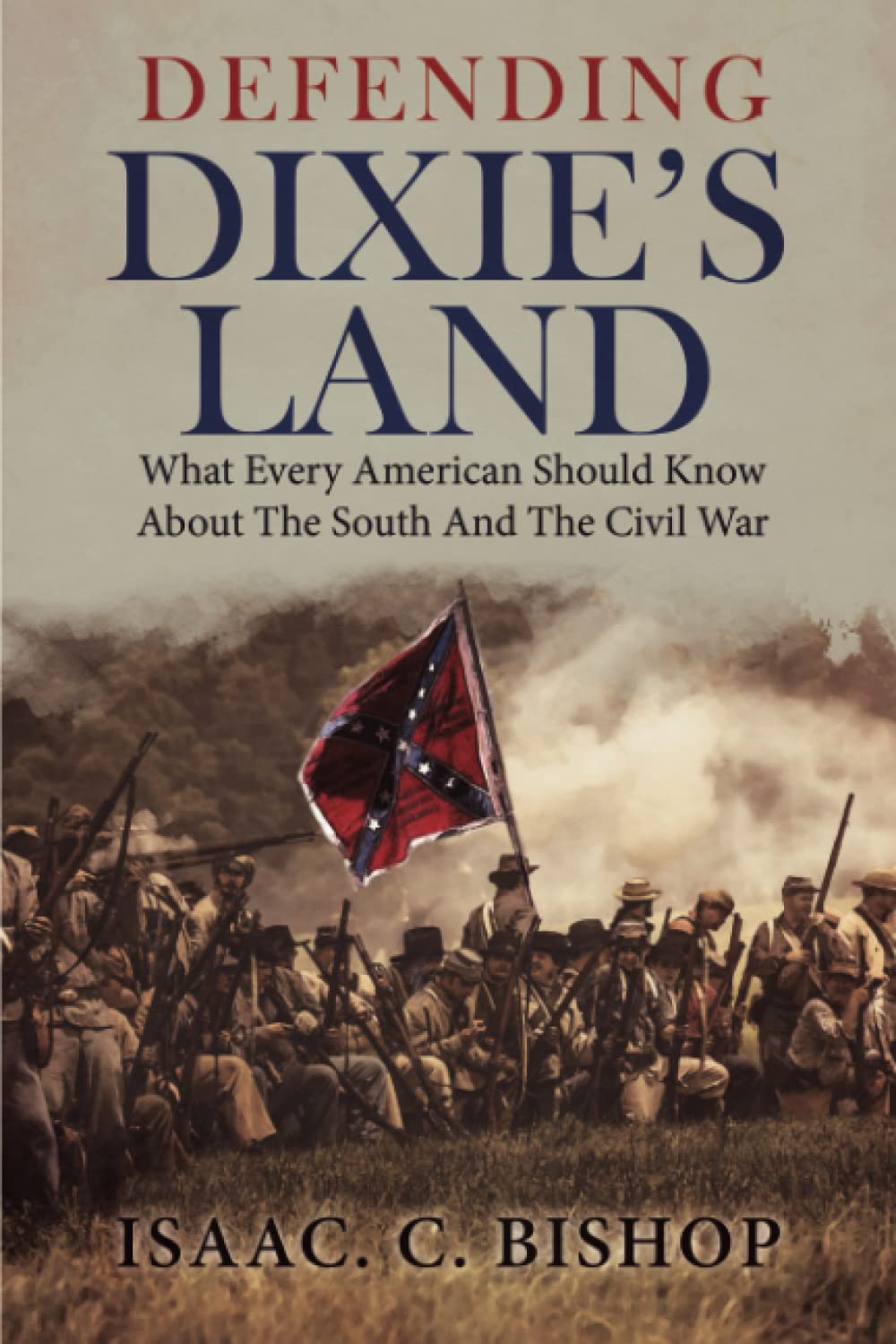
A review of Defending Dixie’s Land: What every American should know about the South and the Civil War (Shotwell, 2025) by Isaac C. Bishop/Jeb Smith
To read a new book which is not only difficult to put down but compels one to urge others to read, is a rarity these days. Indeed, so rare that one is inclined to think that insightful books have become a thing of the past, such is the lamentable and dreadful state of scholarly works today in the Western world.
However, amidst the darkness, a gem can emerge. A gem forged by an extremely well-versed, respectful, and courageous author (that I say “courageous” is indicative of how grave the situation is today for free speech in Western countries, especially in my own country, Britain). A gem forged by an author whose vast primary source research informs the reader that this is a very serious author who has a very serious story to tell. And a gem forged by an author who is enduring the potent environment which has been imposed on the Western world by the malignant forces which rule it and who is, subsequently, fighting for his and his family’s very existence for simply expressing an opinion which runs contrary to the official narrative foisted on Western countries by its despotic rulers. Defending Dixie’s Land: What every American should know about the South and the Civil War, by Jeb Smith, is one such gem.
Jeb Smith, who goes by the pen name Isaac C. Bishop for reasons we will shortly learn, is a born and bred New Englander, a native of Vermont, who has the humility to say, in the opening pages of the book, that although he has long been intrigued by the South, he once firmly subscribed to the official narrative which is taught in American schools about the war of 1861-1865; namely, that the conflict was due to the South wanting to preserve slavery, the North wanting to abolish it, and the North seeking to defend the Founding Fathers’ Republic. That all changed, Smith tells us, when he acquired a copy of Walter D. Kennedy’s Myths of American Slavery. From that point on, Smith began extensive and rigorous research into the origins of the North-South war, the character of slavery in the South, Abraham Lincoln, and the politically incorrect history of slavery in the world, demonstrating not only his scholarly talent but his ability to think independently and critically, a cornerstone in the preservation of mankind and the encouragement of innovation. Smith came to the conclusion that all he had been taught in school and had heard elsewhere in society, such as from mainstream media, was the product of New England nationalism – a violent, racist, and intolerant foe of the South that continues to this day to loathe everything about the South – and the all-powerful, all-domineering, states’ rights-trampling US Federal Government which was given birth to by the self-serving, opportunistic tyrant, Abraham Lincoln. In essence, what is taught in America about the war has been written by the victors. Accordingly, the die was cast and a book by Smith inevitable.
In a truly democratic and free society, where people are allowed to change their opinion when, for example, new evidence comes to light, Smith’s transition would be respected, tolerated, and, indeed, encouraged, reflecting the fundamental tenet of democracy and freedom: the right of a person to hold and express an opinion without firstly, the threat of abuse and violence against them or their loved ones, and secondly, detrimental consequences for them in relation to earning a living and pursuing a career relating to their areas of expertise and/or their passions. But, alas, for Smith, he does not live in a true democratic and free country, though it should be said that America is infinitely more free than Britain is, especially concerning free speech, where the infamous UK police routinely hounds Britons who hold and express opinions which the monarchic British state disapproves of. Anyhow. Returning to the case at hand. Given that the official narrative in America pertaining to the 1861-1865 war serves as a major justification for the US Federal Government to do as it pleases at home and abroad (not to mention the billion dollar industry which exists as result of the narrative, with vast numbers of politicians, journalists, academics, lawyers, human rights activists and so on adhering to it so that they can be on the gravy train), anyone who dares question this narrative will be on the receiving end of the US Federal Government and its tentacles, as well as violent individuals who are encouraged by the language of incitement by, for instance, mainstream journalists. Thus, it is for that reason why Smith has had to go by the pen name of Issac C. Bishop in writing his book.
In an irrefutable and respectful manner, Smith demonstrates that the life of a slave in the South was far removed from how it is presented today and how it was presented by Lincoln and his henchmen. Smith says that all forms of slavery – be it “wage labor” or “indoctrination” or “ownership of human property” – are evidence of a “fallen world”. That is an important observation to make because slavery is very much present today in America as it is in Britain, taking the guise of free market economics, whereas in reality a more fitting name is oligarchic capitalism, where the masses (slaves) are held tight in what I describe as an economic vice with the slave masters (monarchies, aristocracies, banking elites, financial elites, media barons, and the rest of their ilk) constantly ensuring that the vice turns ever tighter.
Smith demonstrates, through the use of interviews with former slaves in the South and the observations of Northerners and foreigners who toured Southern slave plantations before and after the war, that the life of a slave was not one of neck shackles. The diet of a slave was very good, and to corroborate this Smith quotes Frederick Law Olmsted, the famous architect and social reformer from Connecticut, who said: “I think the slaves generally (no one denies that there are exceptions) have plenty to eat; probably are better fed than the proletarian class of any other part of the world.” Smith also quotes the words of former slave Isaac Johnson of North Carolina: “I had plenty to eat, good clothes, a nice place to live an’ a good time.” Regarding the living quarters of slaves, Smith informs the reader that the majority of slaves owned land which comprised an area for their cottage, their garden, and their livestock, coupled with an area where they grew cotton, corn, and peas and which they would sell to their local community, including white people. The reader learns that many a Union officer during the war came to realise that they had been hoodwinked by the US Federal Government and Lincoln regarding slavery. One such officer was Charles Francis Adams junior (great-grandson of President John Adams) who, while fighting in the South, wrote a letter to father in which he conceded that: “The conviction is forcing itself upon me that African slavery, as it existed in our slave states, was indeed a patriarchal institution, under which the slaves were not, as a whole, unhappy, cruelly treated or overworked. I am forced to this conclusion.” Smith also quotes from an edition of the British publication Blackwood’s Magazine in 1862 which observed that: “That the condition of the slave has been painted in ridiculously exaggerated colours by sentimentalists and writers for effect, no candid inquirer can doubt.”
Why did the South secede from the Union? According to the official narrative, which has been relentlessly blared at the American people by the US Federal Government and its tentacles, including mainstream journalists and mainstream historians, ever since the Southern states declared independence and established the Confederate States of America 164 years ago, the South seceded because it wanted to preserve slavery. Of all the lies told about the war of 1861-1865, the one about the South wanting to keep slavery going is the easiest to refute because it is the dumbest of all. So, for example, Smith, citing US Federal Government figures, informs us that only 4.8 per cent of people in the South owned slaves.
Smith methodically dismembers the official narrative concerning why the South left the Union, and his use of primary source evidence in doing so is potent. He demonstrates that the constitution of the Founding Fathers, which guaranteed states’ rights and a power-limited government in Washington D.C., became crippled as a result of the emergence of the Republican Party in 1854, which sought a centralised Union and favoured the establishment of a powerful federal government in Washington D.C., both, of which, the reader learns in depth, contravened everything that the Founding Fathers believed in. The situation became compounded with the election in 1861 of a dangerous, power-hungry individual as president: Lincoln. According to Smith, then, and only then, did the South decide that secession was a necessity because the Republic of the Founding Fathers was dead.
Smith quotes Jefferson Davis during his inaugural speech in Richmond in 1862: “The experiment instituted by our revolutionary fathers, of a voluntary Union of sovereign States for purposes specified in a solemn compact, had been perverted by those who, feeling power and forgetting right, were determined to respect no law their own will…to place us under the despotism of numbers…The tyranny of an unbridled majority, the most odious and least responsible form of despotism.” Smith says that: “This new Republican party only concerned itself with representing Northern interests. Knowing this, many accused the Republican voters of causing disunion. The South would no longer have a representative government but would become servants to a foreign national party they did not elect.” Smith goes on to say that: “The South and the Constitution were just barriers that the North needed to remove in order to achieve their political agenda…Had the North maintained the South’s constitutional rights, there would have been no need to separate. There would never be the need for any contention, since all sections would be allowed to live as they and the Founding Fathers desired. But the North no longer cared for a limited central power; instead, they wanted coercive power. They wanted to expand its capabilities to mold the country for their benefit. This transformation was accomplished through democracy, king numbers.”
Who really was Abraham Lincoln? The US Federal Government’s official narrative, which has been spread across the world and consumed by large numbers of either simpletons or naïve, gullible individuals, says Lincoln was almost godlike for he stood up to two of the greatest evils of all – slavery and racism – and vanquished them, and became a martyr in the process. In essence, he died so that others could be free and equal. Well, Smith demonstrates, with analytical precision, that “Lincoln the emancipator and defender of all” is one of the greatest lies ever told in human history.
Consider the following quote by Lincoln, from 1858, which Smith unearthed and cites: “I will say then that I am not, nor ever have been in favor of bringing about in anyway the social and political equality of the white and black races – that I am not nor ever have been in favor of making voters or jurors of negroes, nor of qualifying them to hold office, nor to intermarry with white people; and I will say in addition to this that there is a physical difference between the white and black races which I believe will forever forbid the two races living together on terms of social and political equality. And inasmuch as they cannot so live, while they do remain together there must be the position of superior and inferior, and I, as much as any other man, am in favor of having the superior position assigned to the white race.” So much for, “Lincoln the emancipator and defender of all”.
Now, in light of Lincoln’s personal hostility towards black people, an obvious question arises: Why then did he abolish slavery? Smith informs us that Lincoln was an abolitionist when it suited him. We learn that Lincoln opposed the introduction of slavery in the newly acquired western territories of the Union because he wanted these lands to be free of blacks. Smith quotes Lincoln who said of the new western territories that he did not want these to become “an asylum for slaves and niggers”. Smith quotes Lincoln further: “The whole nation is interested that the best use shall be made of these territories. We want them for the homes of free white people.” In concluding, Smith says that, “Lincoln never intended to end slavery where it already existed…Southern agrarians were to be fenced into the South; otherwise, they would bring their despised black slaves with them.”
The myth of Lincoln the emancipator is not difficult to dismantle if you think independently and critically. Because Lincoln only announced the abolition of slavery in late 1862, well into his war with the Confederacy, and only after the Union Army had incurred numerous battlefield setbacks. And the reason for Lincoln’s announcement was an attempt to encourage a black insurrection in the South to force the Confederate Army to fight on two fronts. Smith quotes the London Spectator which observed, on 11th October, 1862, that: “The Union government liberates the enemy’s slaves as it would the enemy’s cattle, simply to weaken them in the conflict. The principle is not that a human being cannot justly own another, but that he cannot own him unless he is loyal to the United States.” Further to that, Smith tells us that Lincoln’s Emancipation Proclamation (EP) did “not apply to slavery within the United States, and it did not free a single slave.” So, for example, slavery in Missouri continued unaffected by Lincoln’s EP. Thus, the EP only applied to the states which comprised the Confederacy. And Lincoln hardly concealed his motive for the EP; Smith quotes him as saying: The EP was “merely a war measure…and an exercise of war power.”
The word “slavery” has become a highly-charged political weapon in the Western world courtesy of the Western ruling elites, with the aim of attacking and subduing the white race and Christianity, which is a reprehensible affront to all victims of slavery. Because firstly, the overwhelming majority of white people had nothing to do with a practice which has existed throughout human history, and secondly, as many blacks, Arabs, and Jews were involved in this heinous practice as whites were. Indeed, slavery was already in existence in Africa long before European slave traders joined in on the practice. As Smith says: “The slavery of blacks originated in Africa many centuries before the first white man purchased a black slave. When American slave ships first came to Africa, slaves were already a booming African export. Africa’s number one export was slaves, even before any white men came to purchase slaves. Most African slaves had been sold and sent west to Arab Muslims and Asia. In Central Africa in 1860, it is estimated that there was a ratio of 3 to 1 slaves to free men. Zanzibar’s population was 75% slaves. Some countries in Africa had as much as 75-90% of their population enslaved by fellow blacks.”
Returning to the subject of slavery in the context of America, the owning of slaves there was not confined to whites. As Smith informs the reader, Native Americans such as the Cherokee Indians, blacks, Jews, and Mulattoes were all immersed in the practice. Accordingly, the owning of slaves is not a stain on the white race but, rather, a stain on all of humanity.
For some people, the veil of ignorance is impossible to remove. They are people who would place their lives and that of their families lives in the hands of BBC News or The Daily Telegraph, or CNN or The Washington Post, and, as such, they cannot be saved. But, for many other people, questioning and reevaluating all they have ever been told has become the order of the day in the Western world as a result of the mammoth lies surrounding the Covid narrative. The pursuit of truth is now in vogue and cannot be suppressed by the Western ruling elites.
Jeb Smith is one such teller of the truth – and a very courageous one at that. For he has confronted and exposed in his book some of the greatest of hoaxes told in human history; specifically, hoaxes pertaining to the origins of the North-South war, the character of slavery in the South, and Abraham Lincoln. And he has done so with humility and respect, along with a reservoir of primary source evidence. Smith has provided a masterclass on how to research, analyse, and tell history, shaming, in the process, mainstream academics who care only about staying on the gravy train.
I cannot commend highly enough Jeb Smith and Defending Dixie’s Land: What every American should know about the South and the Civil War. For those who seek to know the truth, Smith’s book is an imperative read.
I also wish to commend Shotwell Publishing, which has published Smith’s book, for the crucial service it renders in the telling of history – real history. Shotwell Publishing does the job that Penguin Random House, Bloomsbury, Macmillan Publishers, HarperCollins, and Simon & Schuster would do if they truly cared about the preservation, sharing, and discussing of history.
One final thought: Perhaps Hollywood can produce a film based on an aspect of Jeb Smith’s book and commission an American global popstar to provide a soundtrack for it. The title of such a film could be: Bad Old Abe.
The views expressed at AbbevilleInstitute.org are not necessarily those of the Abbeville Institute.





Here, here! Thank you for contributing this article.
“For some people, the veil of ignorance is impossible to remove. They are people who would place their lives and that of their families lives in the hands of BBC News or The Daily Telegraph, or CNN or The Washington Post, and, as such, they cannot be saved. ”
“None are so blind as those who will not see. ”
unknown (to me) author
From the article:
“But, alas, for Smith, he does not live in a true democratic and free country, though it should be said that America is infinitely more free than Britain is, especially concerning free speech, where the infamous UK police routinely hounds Britons who hold and express opinions which the monarchic British state disapproves of. ”
Sadly, I must disagree.
The UK is a legitimate sovereign nation; while the US is not; but claims to be such through Total War, rather than freedom and democracy.
This means that the American states remain sovereign nations, under hostile occupation by the rogue US government.
This is seen in the above passage that ” slavery is very much present today in America as it is in Britain, taking the guise of free market economics, whereas in reality a more fitting name is oligarchic capitalism”; because a true free-market economy, requires a free PEOPLE who consent to their government as equals.
And this is what the states originally had under the Constitution, where each state was a separate sovereign nation that was supremely ruled by its respective electorate; but as franchise rose from the initial 6%, to 44% by 1860, then oligarchs began plotting to claim “national union,” where supreme power was wielded by the majority of government officials– who were naturally the best-funded candidates, and thus the Cronies of oligarchs.
So to carry this out, the oligarchs supported puppet-candidates such as Andrew Jackson and Abe Lincoln; who began re-writing history to claim that the states had never been 13 separate sovereign nations, but that “the Union” had always been their political superior from the Declaration of Independence onward.
And this claim was ultimately used by Jackson, to establish federal law authorizing federal military force against individual states, to enforce federal law; while of course Lincoln made this same claim, to exercise military force against individual states– with both claiming that the states always had a political superior in “the Union.”
And in this way, the oligarchs seized political supremacy over all of the states via Crony Capitalism, since elected officials became official and final supreme rulers– and oligarchs determined elections, through supporting candidates. And that is how destroying state sovereignty, destroyed freedom.
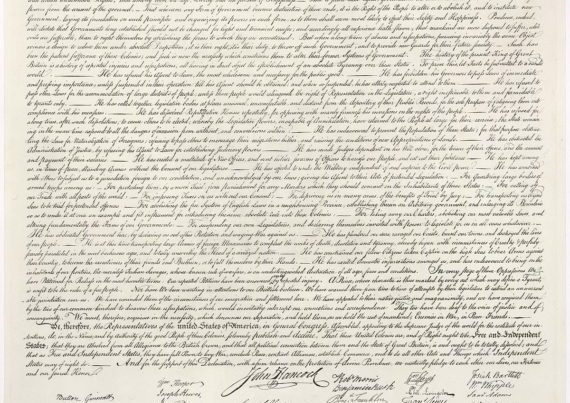
Meanwhile research proves, that the states indeed were 13 separate, fully-sovereign nations under the Declaration of Independence; and this was never legally changed, so each state legally remains a sovereign nation to this day.
The people of at least one state, simply need to prove it, and they can re-claim it.
The proposed method is at at http://TakeBackSovereignty.com
Even the former lincolon-lover-levin has removed his photo of the destroyer of the Republic of Sovereign States from his workspace. Lincolon demanded the military change the oath of office for military officers…perverting support for the United States into support for the Constitution. The Ironclad Oath…the reason for the war…the smoking gun.
bout time
The Union as founded was plainly stated by Jefferson in The Kentucky Resolutions. All else is totalitarian pettifoggery.
The problem with plain speaking for political parties (and such ilk) is that they are as Aristotle said (my paraphrasing): “Fools contribute nothing worth hearing and take offense at everything.”
Today (And I have heard them) the Republicans compare the CSA to the Bolsheviks, while Democrats claim that men can have babies.
These people are liars or fools. There is NO third way.
Worse… Such people are simply clinically insane…
A most beautiful review. I saw this book on Amazon and didn’t know whether to purchase or not. This review here sold me on it.
Caesar Lincoln’s narrative only survives because no one makes him answer to the Constitution he shattered. History looks different once you’ve lived on the side that was ‘reconstructed’ at bayonet point.
Im getting this book, sir. Thank you so very much and much.
My Southern heritage was denied me as a child, growing up in Suburban Chicago.
But I learned at the knee of my Grandfather. Just listening to his stories where he spoke in a tongue that Combined Southern drawl, Elizabethan and African English, as though they were one Tongue.
Our common patriot ancestor being Dr. Thomas Walker. Whose furniture I miraculously possess
Who was the same level, comfortably with Washington, Jefferson and Madison.
We owned 25 slaves when War came. We are fine people. I am so grateful for Abbeville
I have Issac Bishop’s book in my library and read it last year.
It was a phenomenal read and I enjoyed the book immensely.
My only question regarding some of the source material in the book, which appears to be all primary sourced, were the testimonies provided by former Black slaves in that such testimonies made it clear that American slavery in the South was more akin to the manor-system in England, whereby the tenant farmers and the like, were treated like extended family and were cared for by the manor house itself.
However, is it not possible that there was testimony by other slaves who recounted a tormented style of living? Bishop makes it clear that there were such cases, but the majority of such cases were found under northern plantation owners who were in the South merely for the exploitation of profit.
I would have found it helpful if such testimonies could have been provided as well.
In any event, Bishop’s book helps to confirm what a lot of us researchers have already concluded regarding the sociology of the South during the pre-Civil Years and during.
In fact, William Davis’ brilliant, but difficult to read study on the sociology and politics of the Confederacy, “Look Away”, provides a complete chapter on the South/s position and urging to all plantation owners to treat all slaves with Humanity and care so that they can produce and live equitable lives under the system of slavery.
This is supported by the simple fact that even Bishop points out, that had the majority of plantation owners not treated their slaves with Humanity, care, and a certain amount of dignity, they would have been replacing their slave populations on a regular basis as such people were simply worked to death in the increasing inhuman, hot conditions, as one went deeper into the South.
I am hopping that Issac Bishop writes a new book that discusses the Reconstruction years after the war, which is what gave us the subsequent horrors for Black people as well as all Southerners that finally burst out in the 1950s and 1960s.
In a war started by the yankee in which millions of yankees invaded the South, dying by the hundreds of thousands, leaving tens of thousands of weapons on battlefields policed primarily by slaves while encouraging said slaves to rise up and kill their masters’ wives and children, there were ZERO slave uprisings. This tells you all you need to know about the nature of Southern slavery.
As BT Washington stated in the first chapter of UP FROM SLAVERY, ” when the White Men went off to war, we would have died to protect the women and children left in our care”.
There are thousands of Slave Narratives…accounts gathered by fdr’s previously-unemployed yankee journalists during the “Great” Depression which give great detail as to the conditions of slavery in the South. You have never heard of these Narratives because they do not fit the “narrative”. The truly GREAT DEPRESSION was that forced upon the South after the War. Yankee war crimes didn’t end just because the War ended.
There were two hundred and fifty thousand free blacks in the South prior to the War. If Southern Whites had been so oppressive, surely all these blacks freed through the Christian generosity of their former owners would have fled to the north. Ha…if only they had been allowed to flee north…and not prevented from doing so by northern law.
Oregon entered the yankee-controlled union in 1859 as a WHITES-ONLY STATE…how’s that for a Jim Crow law?
Pat Buchanan also quotes Lincoln’s words from 1858 about [in]equality in Suicide of a Superpower (2011). He goes on to say,
“For a candidate to make such a white-supremacist statement today would mean the end of his career. Four years earlier, at Peoria on October 16, 1854, Lincoln confessed his ambivalence regarding what should be done with the freedmen, were slavery to be abolished: ‘If all earthly power were given me, I should not know what to do regarding the existing institution. My first impulse would be to free all the slaves and send them to Liberia—to their own native land… [But] free them and make them politically and socially our equals? My own feelings will not admit of this; and if mine would, we well know that those of the great mass of white people will not… A universal feeling, whether well or ill-founded, cannot be safely disregarded. We cannot then make them equals.'”
So, he seemed to be okay with freeing the slaves, but he did not want to make them equals.
In any case, slavery wasn’t the issue for which the war was fought. They used slavery to precipitate the war and negate the very concept of a republic.