

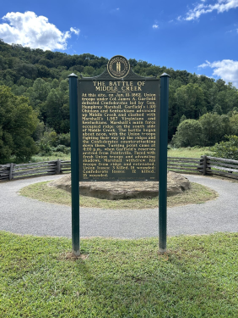
I grew up going to Civil War reenactments and commemoration events. As far back as I can remember, I always had an interest in the solemn pageantry of it all and loved talking with the men who were honoring their own ancestors in uniform. Having ancestors on both sides of the conflict myself, I had a sincere respect for what the reenactors were trying to portray and I have always appreciated their enthusiasm and commitment to accuracy. I have gone to many reenactments over the years, including being present at the 150th Gettysburg Celebration in 2013, but I recently attended the reenactment of the battles of Ivy Mountain and Middle Creek in Prestonsburg, Floyd County, Kentucky this month. The Battle of Middle Creek took place on January 10, 1862, near the Forks of Middle Creek, approximately two miles west of Prestonsburg in Floyd County, where Confederate Brigadier General Humphrey Marshall had established a defensive position along the ridges overlooking the creek. The Union force was commanded by Colonel James A. Garfield, a relatively inexperienced officer who would later become the twentieth president of the United States. Confederate forces included the 5th Kentucky Mounted Infantry, the 29th Virginia Infantry, and the 54th Virginia Infantry. Union forces included the 42nd Ohio Infantry, 40th Ohio Infantry, 14th Kentucky Infantry, 22nd Kentucky Infantry, and 1st Kentucky Cavalry.
The Confederates were positioned in the hillside along Middle Creek, where they had an excellent vantage point and set up defenses. When Garfield’s troops approached the Confederate forces about 1:00PM, they were exposed in an open field adjacent a farm and forced to attack uphill while Humprey’s Confederates reigned fire down on Union lines. Humprey had artillery at their disposal, but much of it was useless in the wet, cold winter weather and the steep incline provided difficulty in aiming. At points, combat was hand-to-hand; and sadly, Kentuckian against Kentuckian. Despite the Confederate’s superior ground, much of Humprey’s forces were ill-equipped and were comprised of recently enlisted men who did not have adequate supplies. Furthermore, when Union reinforcements arrived from nearby Paintsville, the Confederates began to retreat, suffering the loss of 12 men and losing the battle. The Battle of Middle Creek is one of the largest battles fought in the hollers of eastern Kentucky with a total estimate of around 3,000 soldiers engaged.
While this was a small-scale reenactment compared to others I’ve attended, this one holds special meaning for me. I had two known ancestors who served in the 5th Kentucky Mounted Infantry (CSA) and were present at the Battle of Middle Creek on January 10, 1862. Their names were Richard Branham and Doctor “Doc” Ison. The former was my great-great-great grandfather, and the latter was his brother-in-law and my third great uncle. They lived in Carter and Morgan counties, respectively, which bordered each other. They were simple subsistence farmers. In the winter of 1861-62, they both enlisted at Prestonsburg. They saw action within a couple weeks at Middle Creek.
There really is something sacred about being on the same ground your forefathers were on; and even more so when you understand the context in which they were there. While reenactments are fun and can be rather thrilling at times, this one had me holding back tears of pride as I thought about my ancestors taking part in what I was watching unfold before my eyes. To smell the gunpowder, the smoke of the 6-pounder field gun, hear the blast of the rifles, and the officers providing orders to their units, I tried imagining where Richard and Doc would’ve been volleying at the approaching Yankees. You can often feel the intensity at many reenactments, and it provides distinct memories. Not only does it provide an individual with memories of their own, but it recalls memories past; tales heard by kin around the hearth. Even larger than that, it recalls cultural memory and asks us not to forget our duty in remembrance.
Reenacting has taken a serious hit in terms of committed members who routinely attend events. It certainly is not the same as it was 35 years ago, nor when I was a child. The woke crowd, I believe, sucked all the fun out of it and trampled on the sacred honor of those who were being portrayed. Many older reenactors have passed away, and younger generations are not filling the ranks like they used to, largely due to cultural amnesia and slothfulness in regard to historical literacy. I am not sure about the future of reenacting, to be frankly honest. Perhaps there are some larger groups here and there that make appearances for more notorious battles, but, at scale, it seems to be dwindling….and quickly. I find it rather sad that this form of cultural memory is actively disappearing from our society. In addition to more monuments being removed, it seems reenactors are in retreat, hesitant to reclaim their role in preserving our heritage.
That is why I think it’s crucial to attend events like these, donate to their cause, and even join a reenacting unit, if you feel inclined. It always amazes me how the small things always add up. There are so many hidden gems of historical importance in your own backyard that most people do not even realize. I had the pleasure of visiting the Big Sandy Heritage Center Museum in Pikeville, Kentucky while on my excursion. Having deep roots in this area, I wanted to see what they had on display and learn more about the area my ancestors lived in for so many generations. While not a huge enterprise, the exhibits they have are incredibly important and meaningful to the people that live in the region and give outsiders a glimpse into the native history of the locale. They have an incredible collection of paleo-items detailing the area’s geological history as well as many pioneer and American Indian artifacts. Their collection on Civil War history features items retrieved from the Middle Creek Battlefield as well as photos and items from local soldiers whose families kindly donated them. Their pride and joy, however, is the Hatfield-McCoy collection which features an array of family heirlooms and memorabilia, including the gun used by William Anderson “Devil Anse” Hatfield during his service in the Confederate Army and as patriarch of the Hatfield family during the feud. And to top it off, the Director of the museum, upon hearing my surname, began inquiring if I was related to this Branham or that Branham, up one holler and back down another. It was an all-around, down-home Appalachian welcome. That’s the fun in visiting historical places, especially in an area you have a connection to; you never know what may present itself.
So, make the effort to engage locally and attend a heritage festival, a historical reenactment or encampment, visit your museum in town, ask about your family history. Learn the stories that have impacted your life before you even existed because they will make you appreciate what you have and who you are.
I can’t stress enough the importance of learning one’s past, especially one’s own heritage. Having even a rudimentary grip on your genealogy provides you with a sense of place and purpose that other things just cannot give. It’s an act of remembrance at an incredibly fundamental level. It’s how you came to be and why you are situated in the way that you are. If more people understood their own roots, I think they’d have a greater appreciation for historical accuracy and truthfulness. I also would like to believe it’d humble folks a bit and reconnect them with what matters; ground them a bit in something tangible, rooted, and meaningful. We desperately need more people telling local stories, preserving local customs, and cherishing them for future generations to learn and enjoy. It’s a work that never really is done, because history is always happening, even in the small and seemingly mundane. So much of life goes unrecorded, either physically or mentally. Folks in the past were blessed with a slower pace of life where they had time to genuinely reflect on their thoughts and actions, sometimes recording them in writing or in a familial oral tradition. I’ve been blessed to inherit stories, tall-tales, and legends about my own family that, whether true or not, provide a sense of belonging in a world that has forgotten how to remember. In many respects, our stories are what define us to many people; it’s how folks remember their loved ones. That is why connecting my family’s stories with an actual historical event through, in this case, a visit to a battlefield and attending a reenactment, is important to me. It is a way to interact with the stories we do know in ways we can. I am an avid admirer of the recently passed Wendell Berry, and I think he sums up this idea when he says, “Telling a story is like reaching into a granary full of wheat and drawing out a handful. There is always more to tell than can be told.”
The views expressed at AbbevilleInstitute.org are not necessarily those of the Abbeville Institute.





“There really is something sacred about being on the same ground your forefathers were on; and even more so when you understand the context in which they were there.”
Yessir, thanks to a PCS move back to the Ft. Campbell area back in ’09 (I’ve been out of the Army since 2011), I happen to live in the general area of Tennessee my ancestors settled well over 200 years ago. Family cemeteries dot the map all over three or four counties. I had the privilege to walk the ground 150 years to the day (31DEC22) at Murfreesboro (aka Stones River) along with my son that my Great Great Grandfather stood on with the 1st Tennessee Infantry.
Yep, there’s something about it that you just can’t get out of a book!
You are correct about the apparent lack of interest in historical reenactment, at least in terms of participation. Compared with the 1990s, when the hobby enjoyed a large following, current events are noticeably smaller; however, attendance, at least here in NC is still pretty impressive.
I attended the Battle of Bentonville reenactments in 2024 and 2025 and am happy to report that the large area roped off for spectators was filled to capacity.
I also attended the Rev War reenactment in Camden, SC last October and it too was well-attended. Heading out to the Battle of Charlotte (NC) reenactment this Saturday for more Revolutionary War immersion.
I completely agree with you. We all need to support these events. The reenactors and living history folks that devote their time and efforts to this endeavor are a wealth of knowledge and are enthusiastic about sharing it with the public. A battle reenactment or living history demonstration is, next to visiting a battlefield park, a great way to connect with our past!