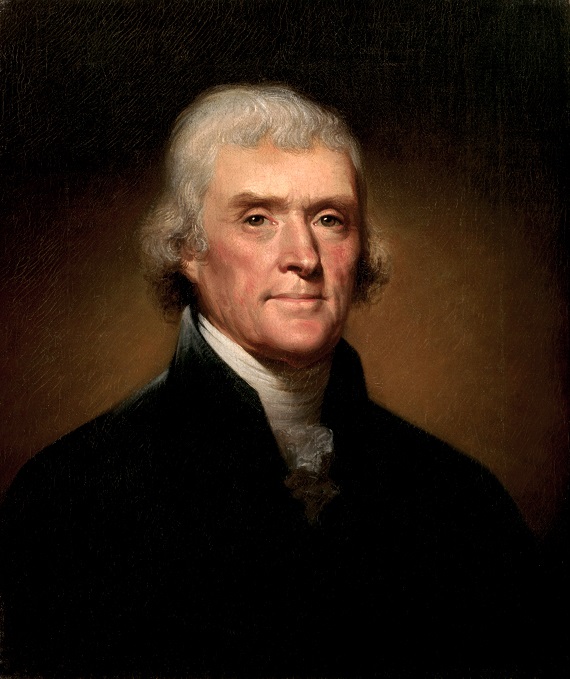
Thomas Jefferson today is often castigated by “manly” scholars for not being more like George Washington or his aide-de-camp Alexander Hamilton. Though an excellent horseman, those skills were never on display during the American Revolution—especially during the British assault on Virginia during Jefferson’s tenure as governor (1779–1781).
Yet that is like criticizing a puffin for being a puffin. Jefferson was a grand hero of the American Revolution, but he was a hero with his pen—an intellectual hero. It was a pen that eviscerated George III with his Summary View (1774) and Declaration of Independence two years later. Through incisive and penetrative language, he put his and his family’s lives on the line as much as did Washington or Hamilton.
Barbary Pirates, stationed on the coastal regions of North Africa in cities such as Algiers, Tripoli, Morocco, and Tunis—aka, the Barbary Coast, under the sovereignty of the Ottoman Empire—were noted for piratical activities from the sixteenth century. From there, they plundered and raided coastal towns of Europe (Portugal, Spain, France, Italy, and even England and other more remote states engaging in Mediterranean commerce) and they also assaulted commercial vessels for goods and slaves. They too monetized by ransoming captured persons and selling slaves. So great a problem such assaults had become that Europe established its Trinitarian Order, which collected funds to be later used for ransoming European prisoners.
In Jefferson’s day, the effects of Barbary raids had diminished, though the pirates were still pestiferous. Pestiferousness was the key to their success. They aimed to interrupt and agitate, not to debilitate. A city debilitated severely or destroyed could no longer pay tribute or be plundered. That also was the modus operandi behind the Mongolian invasion of Europe in the thirteenth century: sack a few (and use terrorist tactics), force the surrender of most. Consequently, states, instead of dealing with the nodus, tended to pay tribute to the pirates. Paying tribute was commonly practiced throughout Europe for centuries. Small polities often paid tribute to larger polities, like Kyiv, in exchange for protection from the barbarism of tribes. Small polities also paid tribute to neighboring tribes in exchange for the promise of no raiding and plundering for a set period of time.
There was also a religious aspect to the tensions: Muslimism versus Christianity. That was evident especially in the sixteenth and seventeenth centuries when Christian forces—Knights of St. Stephen and Knights of Malta—raided the Barbary Coast and took thousands of prisoners. Muslim pirates responded in like.
Commercial nations uninterested in warring, like Portugal which was for many decades the object of Barbary raids, were forced to build a navy to address the amaranthine problem. That too would be the fate of the fledgling United States. The difficulties were decupled as the Barbary states were united by a common profession, while each state was an independent threat. A treaty with one, thus, did not guarantee security from raids of others.
The position of the US, once it began to establish itself as an economic power in Europe, was typically to capitulate to the demands of the Barbary Pirates and pay a suitable tribute. US commerce was too fragile and the US had no navy to challenge the Barbary Pirates.
Americans quickly experienced the wrath of Moroccan pirates soon after the Treaty of Paris ended the Revolutionary War. On October 11, 1784, the US’s merchant ship Betsey was seized. Secretary of State, Thomas Jefferson, sent emissaries to Morocco, and Algiers, to negotiate. Jefferson, situated then in Paris as minister plenipotentiary till 1789, then writes to James Madison (11 Nov. 1784):
We have taken some pains to find out the sums which the nations of Europe give to the Barbary States to purchase their peace. They will not tell this: yet from some glimmerings it appears to be very considerable: and I do expect that they would tax us at one, two, or perhaps three hundred thousand dollars a year. Surely our people will not give this. Would it not be better to offer them an equal treaty. If they refuse, why not go to war with them? Spain, Portugal, Naples, France & Venice are now at war with them. Every part of the Mediterranean therefore would offer us friendly ports. We ought to begin a naval power, if we mean to carry on our own commerce. Can we begin it on a more honorable occasion, or with a weaker foe? I am of opinion Paul Jones with half a dozen frigates would totally destroy their Commerce: not by attempting bombardments as the Mediterranean states do wherein they act against the whole Barbary force brought to a point, but by constant cruising & cutting them to pieces by piecemeal.
Jefferson here anticipates the construction of six frigates to protect US merchants’ interests that would happen some 10 years later.
On January 12, 1785, Jefferson writes to Nathanael Greene that Portugal has shown large interest in trade with the US, but piracy will be an obstacle. Jefferson writes:
Portugal shews a disposition to court our trade, but this has for some time been discouraged by the hostilities of the pyratical states of Barbary. The Emperor of Morocco who had taken one of our vessels, immediately consented to suspend hostilities, & ultimately gave up the vessel, cargo & crew. I think we shall be able to settle matters with him, but I am not sanguine as to the Algerines. They have taken two of our vessels, and I fear will ask such a tribute for the forbearance of their piracies as the U.S. would be unwilling to pay.
When this idea comes across my mind my faculties are absolutely suspended between indignation & impotence.
I think whatever sums we are obliged to pay for freedom of navigation in the European seas, should be levied on European commerce with us, by a separate impost, that these powers may see that they protect these enormities for their own loss.
Piracy thus continues to inhibit trade between the US and prospective European nations. Jefferson proposes to make up the loss of revenue through tributes to pirates by an impost on exported US goods, so that those desirous of trade for US goods will see the enormousness of the problem of piracy and commercial exchange.
Jefferson writes to James Monroe in February 1785 that the Barbary states demand tribute from the US, but he does not know if they ask more or less from the US than from other nations. Ever one to play with numbers, Jefferson then discusses the strength of each of the piratical states.
These pyrates are contemptibly weak. Morocco who has just dared to commit an outrage on us owns only four or five frigates of 18 or 20 guns. There is not a port in their country which has more than 13 feet water. Tunis is not quite so strong (having 3 or 4 frigates only, small and worthless) is more mercantile than predatory, and would easily be led to treat either by money or fear. Tripoli has one frigate only. Algiers alone possesses any power, & they are brave. As far as I have been able to discover she possesses about 16 vessels from 22 up to 52 guns, but the vessels of all these powers are wretched in the last degree, being mostly built of the discordant pieces of other vessels which they take and pull asunder, their cordage & sails are of the same kind, taken from vessels of different sizes & powers, seldom any two guns of the same bore, & all of them light.
Thus, the Barbary states, perhaps Algiers excepted, are numerically and qualitatively vulnerable.
Another issue apropos of their vulnerability is their divisiveness.
These States too are divided, & jealous of each other, & especially of Algiers the most powerful. The others would willingly see her reduced.
The US, Jefferson sums, can decline commercial exchanges with Europe or they can aim to exchange goods as fully as possible. If the latter, then there is need of a navy to protect US ships.
Treaties are of little avail, for they typically have been conducted with great exertions, and the reclaimed men and vessels are customarily much worse for the delays.
Other nations have attempted to destroy the Barbary states “at one blow,” but “they are too numerous and powerful by land for that”—hence, such attempts have failed. For illustration, the city of Tripoli had some 150 pieces of heavy artillery and some 25,000 soldiers. It also at the time had 31 chips of various kinds.
A small effort, but long continued, seems to be the only method.
Doing nothing and continuing to pay tribute will lead to disgrace.
Be assured that the present disrespect of the nations of Europe for us will inevitably bring on insults which must involve us in war. A coward is much more exposed to quarrels than a man of spirit (use of italics [bold text] indicates use of a cipher).
A year and one-half later, Jefferson again writes to Monroe (11 Aug. 1786) and broaches possibility of a confederacy of nations—excepting England, France, Spain, and Holland—and turns to building a navy to protect US commercial overseas interests. Mention of dissenting nations is suggestive of commercial benefits to larger nations (e.g., England) with large tributes paid by smaller nations to the piratical states. There is expense to building and sustaining a navy, but there is expense in continuing to pay tributes to pirates.
It is not in the choice of the states whether they will pay money to cover their trade against the Algerines. If they obtain a peace by negotiation they must pay a great sum of money for it; if they do nothing they must pay a great sum of money in the form of insurance.
Algiers would continue to be a problem for US vessels and sailors. Its first piratical action against the US occurred on July 25, 1785, with seizure of the schooner Maria. The schooner Dauphin was captured one week later. Envoys would be given 40,000 dollars for ransom of the sailors and return of the ships, yet Algiers demanded 160,000 dollars. There was profound disagreement, and the sailors would remain prisoners.
Jefferson crafts a resolution in December 1791—he is now secretary of state under Washington—concerning the ransom of the same US sailors jailed in Algiers for nearly six years. He proposes a yearly tribute of 40,000 dollars. Talks got nowhere.
The imprisoned sailors would finally be released in September 1795. The dey of Algiers agreed to a ramson of 642,500 dollars as well as other gifts to the dey and his family and friends. He also agreed to an annual tribute of 21,600 dollars.
With Jefferson’s blessing, the US would start a navy of six frigates in 1794. That to many Jeffersonians was money spent for European trade when the same money could be used for westerly expansion.
In March 1801 and just prior to Jefferson assuming the presidency, the US Congress passed legislation that asked for the construction of six frigates to be “officered and manned as the President of the United States may direct.”
With Jefferson’s election bashaw of Tripoli Yusuf Karamanli, demanded 225,000 dollars from the US government. It was the custom of Tripoli to demand a tribute and gifts with a change in governmental officials as a renewed show of trust. Jefferson refused the demand. On May 10, 1801, Karamanli symbolically declared war on the United States by cutting down the flagstaff in front of the United States Consulate.
Jefferson states in his First Annual Address:
Tripoli, the least considerable of the Barbary States, had come forward with demands unfounded either in right or in compact, and had permitted itself to denounce war, on our failure to comply before a given day. The style of the demand admitted but one answer. I sent a small squadron of frigates [three frigates and one schooner under Commander Richard Dale as a conciliatory gesture] into the Mediterranean, with assurances to that power of our sincere desire to remain in peace, but with orders to protect our commerce against the threatened attack. The measure was seasonable and salutary. The bey had already declared war in form. His cruisers were out. Two had arrived at Gibraltar. Our commerce in the Mediterranean was blockaded, and that of the Atlantic in peril. The arrival of our squadron dispelled the danger.
There was a confrontation between two ships, initiated by the Tripolitan vessel, with the US frigate winning. Not one US sailor lost his life. The president made it clear that the posture of his squadron was defensive, not hostile. Despite Congress authorizing formally Jefferson to use the six US ships as he saw fit to use them, Jefferson still deferred to Congress. Being “unauthorized by the constitution, without the sanction of Congress, to go out beyond the line of defence, … the [piratical] vessel [was] disabled from committing further hostilities.”
The bravery exhibited by our citizens on that element, will, I trust, be a testimony to the world that it is not the want of that virtue which makes us seek their peace, but a conscientious desire to direct the energies of our nation to the multiplication of the human race, and not to its destruction.
There would be other success in Jefferson’s tenure as president—an act in 1802 against Tripoli, deployment of some of the US’ finest ships to patrol the Barbary ports, an attack on Tripoli in 1804, and the battle and capture of Derna (Tripolitan city) in 1805.
The problem of Barbary piracy would continue after Jefferson’s presidency. What Jefferson showed was resolve. The problem of Barbary piracy needed to be addresses and at some point solved. Continual pay of tribute was no resolution.
Enjoy the video below….
The views expressed at AbbevilleInstitute.org are not necessarily those of the Abbeville Institute.