Kentucky never voted to leave the Union, yet it produced an entire rival government, thousands of Confederate soldiers, and a star on the Confederate battle flag. That contradiction makes it one of the strangest states during the Civil War—a place where roughly 25,000 to 40,000 men fought for the Confederacy while somewhere between 74,000 and 125,000, including approximately 24,000 to 25,000 Black Kentuckians, fought for the Union. The state’s ambivalence grew out of its position as a slaveholding society tied economically and culturally to both halves of a fracturing nation. As Anne Marshall writes in Creating a Confederate Kentucky, the state “developed a Confederate identity seemingly at odds with its historical past.” Despite sending nearly four times as many men to fight for Lincoln as for Jefferson Davis, it erected more than 50 Confederate monuments against only three for the Union, and its story refuses to fit the clean North vs. South narrative most court historians have disseminated for well over a century.
The roots of that ambivalence run back to Henry Clay. Kentucky’s dominant antebellum political culture was Clay’s brand of Whiggery— a nationalist, pro-Union philosophy built around sectional compromise and internal improvements. Historian Christopher Phillips argues in The Rivers Ran Backward that Kentucky belonged to a cohesive Middle Border region alongside Missouri, Ohio, Indiana, and Illinois. They only developed a distinctly southern identity because of the war itself, which was shaped by the violence of the conflict and the cultural politics of its aftermath, as both Confederate incursions and Union military overreach forced residents to choose sides.
Clay’s political heir, Senator John J. Crittenden, tried to extend that compromise tradition all the way to secession’s edge, introducing the Crittenden Compromise on December 18, 1860. This compromise consisted of six proposed constitutional amendments and four congressional resolutions meant to restore and extend the old Missouri Compromise line to the Pacific, protecting slavery south of 36°30′ latitude while prohibiting it north. Congress rejected it, with the Senate defeating the proposal on January 16, 1861 by a vote of 25 to 23, every opposing vote cast by a Republican following President-elect Lincoln’s private instruction to hold firm. Crittenden’s own household became a living symbol of the state’s split: his son Thomas became a Union major general while his son George became a Confederate one.
The 1860 election results captured the same tension in raw numbers. Kentucky voters gave John Bell of the Constitutional Union Party 66,058 votes, Breckinridge 53,143, Stephen Douglas 25,651, and Abraham Lincoln just 1,364. Ironically, Lincoln finished last in his own birth state, winning fewer than 1 percent of the vote. Combine the Bell and Douglas totals and nearly 63 percent of Kentucky voters chose candidates who rejected secession as a first resort. Slavery still ran deep through the state’s economy, with 225,483 enslaved people making up about 19.5 percent of the population in 1860, concentrated heavily in the hemp- and tobacco-growing Bluegrass counties and the western river counties.
When Fort Sumter fell, Governor Beriah Magoffin, personally sympathetic to secession, refused Lincoln’s call for troops, declaring Kentucky would furnish none “for the wicked purpose of subduing her sister southern states.” Rather than secede outright, the legislature chose a peculiar path, formally declaring neutrality on May 16, 1861. That neutrality satisfied two very different camps at once—Unionists who opposed both secession and federal coercion, and secessionists who hoped a delay might eventually swing the state south. Special elections that summer shattered any illusion of an even split, with Unionists winning nine of ten congressional seats and roughly two-thirds majorities in both legislative chambers.
Neutrality could not survive contact with two armies that badly wanted Kentucky’s rivers and railroads. The Union built Camp Dick Robinson in Garrard County that August to recruit troops, and when Magoffin demanded Lincoln shut it down, Lincoln refused, noting the camp “consists exclusively of Kentuckians” and that closing it was not “the popular wish of Kentucky.” Confederate General Leonidas Polk broke the standoff first, occupying Columbus on September 3 and 4, 1861. Ulysses Grant answered within two days by seizing Paducah, and on September 18 the Kentucky legislature voted to abandon neutrality and align formally with the Union, overriding Magoffin’s veto. The unintended consequence pushed pro-Confederate men south into Tennessee in greater numbers than ever.
Kentucky’s secessionists did not simply accept defeat. After the August elections buried their party at the ballot box, men like Congressman Henry Burnett and George W. Johnson organized a Sovereignty Convention at Russellville. On November 18, 1861, 116 delegates from 68 counties—representing counties that had mostly just voted Unionist—met at the William Forst House in Russellville and passed an ordinance of secession, drafted a rival constitution, and elected Johnson as provisional governor.
The convention declared it was “severing forever our connection with the Federal Government,” and Confederate-held Bowling Green became the new capital. Jefferson Davis admitted this shadow Kentucky as the Confederacy’s 13th state on December 10, 1861, earning it the central star on the Confederate battle flag—the final state admitted to the Confederacy. In practice, this government controlled nothing beyond the reach of Confederate bayonets. Once Confederate forces evacuated Bowling Green in February 1862, the government fled with the army, traveling with the Army of Tennessee for most of its existence. Johnson died of wounds at Shiloh on April 8, 1862.
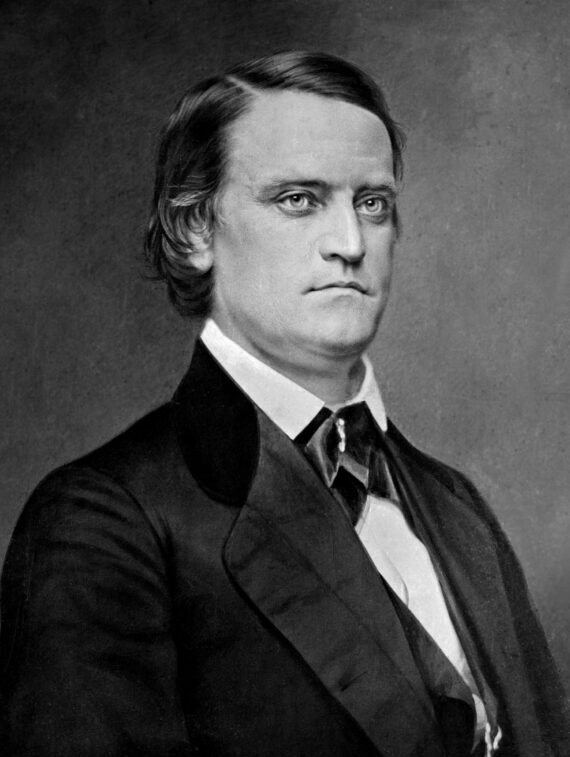
The state produced Confederate figures of genuine national stature. John C. Breckinridge had been Buchanan’s vice president—the youngest in American history, inaugurated at age 36—and the Southern Democratic presidential nominee in 1860. He took his U.S. Senate seat in March 1861 and pushed for compromise until Kentucky committed to the Union, then fled south on October 2, 1861 to avoid arrest, earning formal expulsion in December. He rose to Confederate major general and eventually became the Confederacy’s last Secretary of War. Simon Bolivar Buckner, the West Point-trained commander of the Kentucky State Guard, favored neutrality, but resigned his post once the Unionist legislature moved against his militia and accepted a Confederate commission in September 1861, later surrendering Fort Donelson to his old friend Grant.
John Hunt Morgan, a Lexington hemp manufacturer, crossed into Tennessee after neutrality’s collapse and transformed himself into the Thunderbolt of the Confederacy. His 1863 raid pushed over 2,000 troopers a thousand miles through Kentucky, Indiana and Ohio, the farthest north any organized Confederate force ever reached. Because Confederate recruiting inside Kentucky remained illegal for most of the war, thousands of these men enlisted across the border at Camps Boone and Burnett, cut off from home and resupply for the war’s duration, which is why they adopted the name the Orphan Brigade.
The state’s regional map explains much of this splintering. The Jackson Purchase in the far west, bounded by the Mississippi River, the Ohio River, and the Tennessee River, its early settlers tied by rail and river to Memphis rather than Louisville, produced eight times more Confederate soldiers than Union ones, earning the nickname “the South Carolina of Kentucky,” according to Berry Craig’s Kentucky Confederates: Secession, Civil War, and the Jackson Purchase. The Bluegrass counties, dense with slaveholding plantations, leaned south, while the mountainous southeastern counties, with almost no enslaved population and long-standing resentment of the planter elite, stayed fiercely Unionist and remained loyally Republican for generations afterward.
Historian Aaron Astor’s research in Rebels on the Border found the tightest predictor of Confederate loyalty was the density of slaveholding in a given county. Yet motivations for Confederate enlistment went beyond property, including hatred of Lincoln, wounded Southern honor, and a sense of duty to what men had come to see as their own country.
The most peculiar twist came after Appomattox. Historian E. Merton Coulter famously observed that Kentucky “waited until after the war was over to secede from the Union.” Harsh martial law under General Stephen Burbridge—including his Order No. 59, which mandated the execution of four Confederate prisoners for every Unionist murdered by guerrillas—alienated wartime loyalists and pushed the state toward its postwar Confederate sympathies. The legislature refused to ratify the Thirteenth Amendment in February 1865 and did not do so symbolically until March 18, 1976. Former Confederates soon dominated Kentucky’s postwar Democratic Party, with multiple governors between 1867 and 1894 holding Confederate ties. Most notable among them being Confederate General Simon Bolivar Buckner.
The paradox of Kentucky’s wartime history ultimately resolves in the crucible of Reconstruction, where federal betrayal and military overreach stripped away any remaining Unionist illusions, ensuring that the blood spilled by the Orphan Brigade would finally take root in the hearts of a people who realized, too late, that their true kin lay south of the Ohio.
The views expressed at AbbevilleInstitute.org are not necessarily those of the Abbeville Institute.




The union forced those blacks into their armies…as it did in all of the Border States. The myth there were piles of black volunteers willing to die for a union that despised them is another of the unearthed lies of the post-narrative, modern era.
Thank you for another interesting article.
Yes indeed. You are absolutely right.
It wasn’t just the blacks that were forced to fight for the Union. Many leaders of northern states didn’t want to participate in forcing the southern states to stay in the Union and didn’t want union troops in their states. Mr. Lincoln made a bloody demonstration of his will in New York and Maryland and the rest, as they say, was history.
Their true kin lay south of the Ohio.
Perfectly stated. Thank you for the great post.
The Missouri and Maryland legislatures had similar experiences. In 1861, each of those two legislatures wanted to vote to secede from the Union. Knowing their intent, Lincoln and the Union army chased them out of their State Capitols. Lincoln/Union army actually jailed some of the Maryland officials.
Lincoln was a pen pal of Karl Marx. And probably the illegitimate son of John C. Calhoun. He would jail any newspaper publisher who wrote anti Lincoln stories. Colored troops fought for the South as they were defending their homeland,too.
My great grandfather rode with John Hunt Morgan as his lieutenant. He was educated at Centre College and University of PA law school. He was a grandson of KY’s first lieutenant governor.
Great grandfather rode with Morgan. He was a grandson of KY’s first lieutenant governor.
The Unionist illusion was thanks to Ohio Gov. Dennison.