

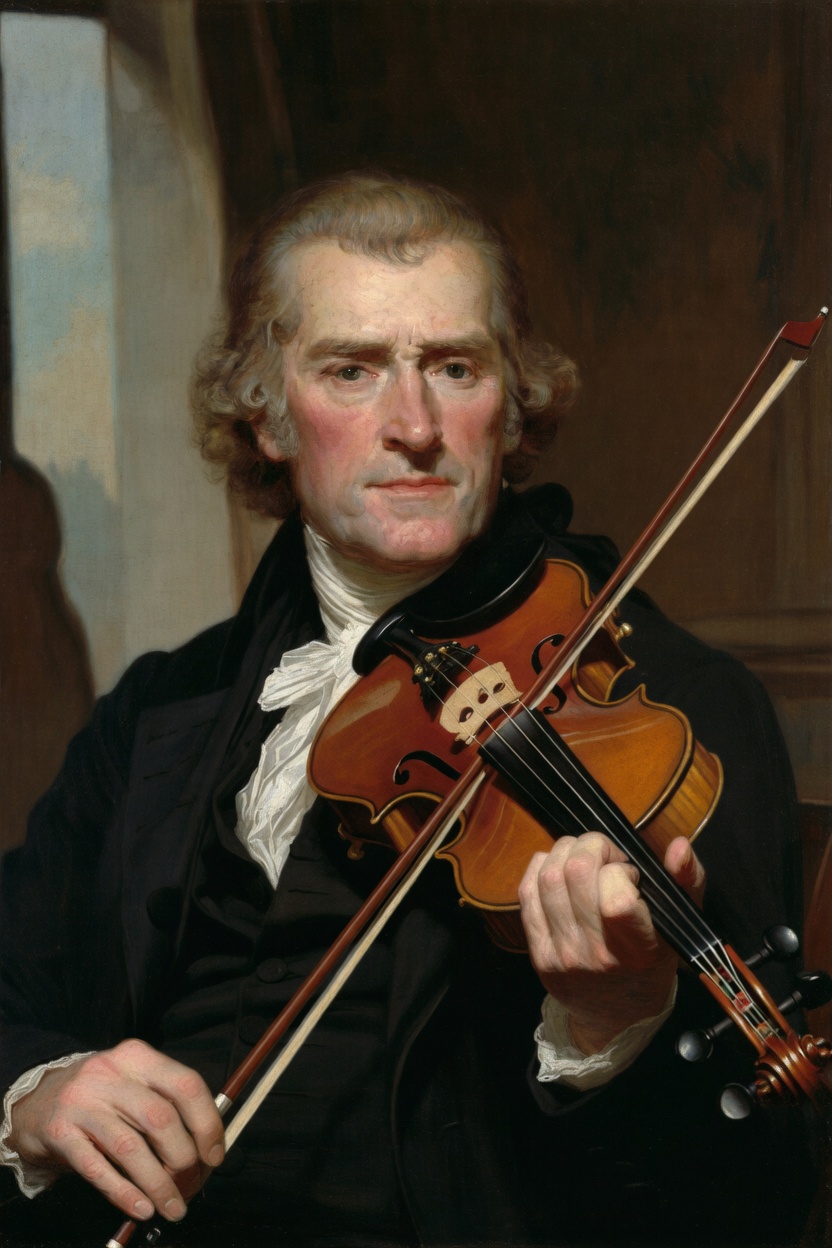
We love to affectionately remember Thomas Jefferson as a mind detached from the body. Many accounts present him as a man of paper, of correspondence, of carefully arranged ideas set down in elegant prose. The familiar image is that of the “Sage of Monticello,” seated at a writing desk, producing language that would echo across the centuries. That image is not wrong, but it is incomplete. It omits a quieter and more revealing truth about music and the fact that Jefferson could play. The man could jam.
Whenever I attend Abbeville conferences, I’m usually surrounded by people with incredible depth and breadth of knowledge about Thomas Jefferson. They could be having a knock-down, drag-out debate, and someone would call to me, “What do you think about Jefferson’s authorship in The Kentucky Resolutions?” After stuttering and stammering for a few seconds, I would try to rescue my dignity by saying something like, “I’m not entirely sure about that, but I know that Jefferson played a wicked violin.”
I’m not interested in presenting my opinion of what Thomas Jefferson represented in a psychological sense, or what he likely stood for in a political sense. I want to talk about what Jefferson actually, physically did in the world of music. I won’t romanticize him by turning him into some kind of musical genius, a proto-modern artist, or a musically symbolic figure. Instead, I will keep him correctly grounded as a disciplined, educated musical amateur with decent chops. Thomas Jefferson didn’t compose music nor invent instruments. He did not leave behind a catalog of works to be studied by scholars or performed by professionals. What he did, consistently, seriously, and at a high level, was play the violin. He practiced regularly and rigorously, and performed in domestic settings, relying on his substantial personal library of European repertoire. In Jefferson’s world, music was not a commodity to be consumed but an activity to be inhabited, and it belonged to the household, to the regular evening gatherings, and to the cultivated individual. The significance of his musical life doesn’t lie in what he produced, but in the fact that he could play, and that this ability was understood as an essential component of what was considered to be an educated man.
To modern ears, the word amateur is a derogatory term that suggests deficiency. It stinks of a lack of training, a lack of seriousness, and a lack of skill. However, in Jefferson’s time, it meant precisely the opposite. An amateur loved art deeply enough to devote time, discipline, and study to it without requiring a professional reward. The amateur ideal assumed cultivated ability, not casual interest. It assumed that a person of education would participate directly in the arts rather than stand at a distance from them. Jefferson fits squarely within that ideal as a disciplined practitioner whose musical life demanded the same seriousness he applied to his intellectual work, and not just some lightweight enthusiast.
Thomas Jefferson began studying the violin as a boy and continued throughout his life, practicing for hours at a time until arthritis eventually curtailed his playing. He was not an average, run-of-the-mill player with superficially ornamental training. Instead, his musical education was highly formative, and contemporary accounts describe him as a very skilled and expressive player. The violin, in particular, was the most demanding of instruments in the 18th century, requiring precise control of intonation, bowing technique, and tone production. There is no hiding on a violin. Every flaw is exposed immediately, and every improvement must be earned through repetition. If Jefferson the musician was anything like Jefferson the scholar, he would not have tolerated personal incompetence.
The discipline required to play the violin actually reveals quite a bit about the kind of mind Jefferson possessed and the kind of culture in which he lived. The Enlightenment didn’t separate intellect from action. They were grounded, practical people who assumed that knowledge required embodiment, and that ideas were not merely to be articulated but to be enacted and lived. The same man who drafted the Declaration of Independence also submitted himself to the daily physical demands of musical practice, where nothing could be abstract, and nothing could be faked. Tone was either centered or it was not. Intonation was either true or it was not. There was no rhetorical escape.
What makes the title “Sage of Monticello” so quietly misleading in this context is that it suggests a life of pure contemplation. It leaves out the physical discipline that shaped Jefferson’s daily existence. This “sage” spent hours with a violin under his chin, shaping tone with his hands, correcting pitch by ear, and working through repertoire that demanded control and patience. His intellectual life and his musical life were not separate domains, but were parallel expressions of the same underlying habits: precision, order, and expressive restraint.
Jefferson’s musical world was also not confined to solitary practice. He frequently played in social settings, such as small gatherings where music was shared rather than displayed. At Monticello, music was not a detached performance, but functioned as a form of joyful participation. His two daughters were trained musicians, and guests were frequently drawn into evenings of shared playing. The purpose was not to present a stiffly formal finished product to an indifferent audience, but to encourage immersion in making music together. It is difficult to overstate how different this is from the modern relationship to music, which is overwhelmingly passive. Today, music is something we access, stream, and consume from a distance. However, prior to the existence of recorded audio, the only way to ever hear music was to experience it live. In Jefferson’s world, music was something one did.
The contrast within Jefferson’s own family makes the point even more clearly. His younger brother, Randolph Jefferson, was fondly remembered as a fiddler who played for dancing and moved easily within informal social settings, including gatherings that crossed the boundaries of the planter household, mixing freely with the enslaved people. This was not the cultivated violin culture of Vivaldi and Mozart, but something older, earthier, more immediate, and more functional. Within this single family, one finds both the disciplined amateur ideal and the vernacular practice of dance music, each serving a different role but each fully embedded in daily life. The distinction is not between music and its absence, but between different ways of keeping it.
Another area that needs to be explored is that Jefferson did not merely participate in music; he cultivated the whole environment in which it could flourish. During his years in Europe, he purchased instruments and had them shipped back to Monticello, including keyboard instruments such as the relatively new pianoforte and the curiously odd glass harmonica. These acquisitions were not indulgences but investments in an overall household culture of music. In this respect, Jefferson functioned not only as a musician but as a curator of musical life, shaping the conditions under which music could be learned, practiced, and shared within the home.
Jefferson’s musical life was not confined to his own practice, nor was it an isolated accomplishment. His daughters, Martha (Patsy) and Maria (Polly), were both carefully trained musicians, particularly on the pianoforte, and their education was neither casual nor ornamental. While in Europe, Jefferson ensured they received instruction consistent with the highest standards of the day, and he returned to Monticello with instruments suited to sustain that training. The result was not a household that admired music from a distance, but one that lived it. Music was played and shared within the family, reinforcing the expectation that cultivation favored active participation over passive observation.
His time in Europe, particularly in Paris, was musically formative. There, he attended concerts and operas and experienced elite performance culture at its highest level. He absorbed continental taste, repertoire, and standards of performance, which he then carried back across the Atlantic. His personal music library reflects this transatlantic exchange, as it was filled with works by composers such as Corelli, Vivaldi, Handel, Geminiani, Tartini, Locatelli, Leclair, and de Mondonville. These were not abstract names on a page, but were the living repertoire of a musician who had heard, studied, and internalized the sound of European art music. Perhaps most importantly, Jefferson’s library leans heavily toward violin-centered Italian and French Baroque composers, which might explain why he likely did not own any music by the greatest composer of the Enlightenment, Wolfgang Amadeus Mozart.
In an age before the widespread availability of printed music, Jefferson also engaged in the laborious but essential practice of copying music by hand. He transcribed violin pieces into notebooks, creating a personal archive of repertoire that could be returned to, studied, and performed. This easily overlooked detail is, in fact, central and highly significant. Music, in Jefferson’s world, was not something one accessed on demand. Music was something one physically kept and preserved, and the act of copying music was itself a form of study, binding the musician to the material in a way that modern convenience has largely erased. Oddly enough, copying music by hand causes the notes to stick in the memory as easily as playing it.
Jefferson’s musical interests extended even into the more curious corners of the Enlightenment. While in Europe, he encountered the glass harmonica, the delicate and otherworldly instrument invented by Benjamin Franklin. Captivated by its ethereal tone, he acquired one and had it shipped to Monticello, likely for his two daughters. The instrument occupied a curious position in 18th-century culture, as it was simultaneously scientific and artistic. It was also deeply unsettling. Its sound was described by contemporaries as beautiful to the point of unease, and it would later acquire a reputation—fair or not—for inducing melancholy in its listeners. Have you ever run your wet finger around the rim of a wine glass? Now, imagine 37 nested glass bowls rotating on a spindle, with each one shaped and sized to be tuned to a specific pitch. They were arranged in a similar pitch order as the piano, with the high notes on the right end and the low notes on the left. That Jefferson would bring such an instrument into his household reflects not merely an interest in music, but an attraction to the full spectrum of cultivated sound, from the disciplined clarity of the violin to the experimental strangeness of the harmonica.
Underlying all of this was Jefferson’s explicit belief that music belonged within the framework of education and moral development. He never regarded music as a decorative addition to life, but as part of a well-rounded education, consistent with Enlightenment assumptions that the arts contribute to the cultivation of taste and sensibility. To Jefferson, music was a necessary component of intellectual life. The Enlightenment ideal did not produce specialists alone. It produced individuals who were expected to engage with multiple forms of knowledge, including the arts, in a disciplined and meaningful way.
This distinction serves to highlight the modern disadvantages of a larger cultural shift. Today, the amateur ideal has largely and unfortunately been replaced by professional specialization. Music has moved from the household to the stage, from participation to observation, from lived experience to recorded artifact. Instead of encouraging people to participate in the joyful performance of amateur music, society unfortunately seeks to specialize and leave music up to only those few individuals who “have a future in it.” In Jefferson’s time, a cultivated person was expected to play. In ours, a cultivated person is expected to listen.
But y’all, Jefferson could play. That fact, simple as it is, carries more weight than any hypothetical compositions he might have written. It reminds us that music was once understood as a practice inseparable from daily life, from education, and from the formation of character. It suggests that the distance we now maintain from music, specifically our reliance on others to perform it for us, is not inevitable, but historical. The “Sage of Monticello” was not simply a thinker. He was a participant in a world where knowledge had to be lived, where art had to be practiced, and where even the most abstract ideals were grounded in the disciplined habits of the body.
The views expressed at AbbevilleInstitute.org are not necessarily those of the Abbeville Institute.



Thanks. Very interesting. Is there any reference to Mozart in any Jefferson writings of which anyone is aware? Was his not having music of Mozart perhaps a matter of timing? Mozart was relatively modern & in Vienna when Jefferson was in France (& approaching middle aged). Jefferson was probably back in America before Don Giovanni or Così fan tutte were performed in Paris.
Although I haven’t seen any references to titles by Mozart in Jefferson’s possession, I haven’t personally scoured his library, so I might be guilty of overconfidence. While I recognized the names in his musical library as being Baroque, an absence of evidence does not equal an explanation. I believe you are exactly correct that it was a matter of timing, as Mozart’s pieces would have likely premiered in Paris too late for Jefferson to attend.
I asked a colleague who is a Mozart fanatic, and she said that Mozart never returned to Paris after 1778, so their physical proximity was off. However, she also said that Mozart’s music was highly popular in Paris throughout the time that Jefferson lived there, so he certainly would have been capable of hearing it performed frequently. Although nothing new premiered in Paris during Jefferson’s residency, Mozart’s earlier works remained part of the regular Paris performance repertoire. This is really a fascinating topic to explore.
Tom, I have a section in my book Jefferson on the Fine Arts on TJ and music. Mail me at [email protected] and I shall send it to you.
Nice piece. He was quite good with his violin, while Patrick Henry was merely an improvisational fiddler.
Some excellent points. As part of the Virginian gentry, TJ was never expected to perform for $$$. that would have been beneath him. So too would have been a career in music. The direct participation in music was typically a part of every family to some extent.
Excellent piece!
Love the article. You say something about Jefferson holding the violin under his chin. Actually, the violin is held under the jaw. I tell my violin students that the “chin rest” should more properly be called the “jaw rest.”
Russell, you are so right, and I should have known better!