

Jefferson’s most significant writing apropos of freedom of religion is his Bill for Religious Freedom, Bill 82 of the 126 bills proposed by him, Wythe, and Pendleton for the revisal of Virginia’s code of laws in 1776.
Dumas Malone states in Jefferson and the Rights of Man, “Belief in the freedom of religion—which to him meant freedom of the mind—lay at the heart of his philosophy and he was always proud to be identified with it.”
Merrill Peterson adds in Thomas Jefferson and the New Nation: “More than a statute, it was an eloquent manifesto of the sanctity of the human mind and spirit. It gave mature expression to convictions that, though they might have been reached wholly along the untroubled path of reason, were, in fact, tempered and formed in the crucible of religious controversy in Virginia. In denouncing the establishment and in advocating the fullest freedom in religious concerns, Jefferson drew on his experience as well as his philosophy.”
Malone and Peterson are right to note that the bill is substratally philosophical, not political. Jefferson begins in Section I with a complex and broad statement of the philosophy undergirding his politics. He starts with a statement of human rationality, turns to a statement of the freedom of the human mind, and follows with a statement of the futility of coercion concerning freedom of the human mind. It is plain
that Almighty God hath created the mind free, and manifested his supreme will that free it shall remain by making it altogether insusceptible of restraint; that all attempts to influence it by temporal punishments, or burthens, or by civil incapacitations, tend only to beget habits of hypocrisy and meanness.
Jefferson then turns to several other claims—some of which are political implications of his undergirding philosophy. First, ecclesiastical and civil rulers who have established their own opinions concerning religion as law has “established and maintained false religions over the greatest part of the world and through all time.” Second, compelling anyone “to furnish contributions of money for the propagation of opinions which he disbelieves and abhors, is sinful and tyrannical.” Third, forcing anyone to support a particular pastor of his own religion that is not of his own choosing is wrongful. Fourth, “our civil rights have no dependance on our religious opinions, any more than our opinions in physics or geometry.” Fifth, prohibiting anyone from public office because of his religious convictions is wrongful, and so is allowing a person to hold public office only on condition of disavowing non-sanctioned religious opinions. Sixth, it is not the object of civil government to tell men how to think.
Truth is great and will prevail if left to herself. She is the proper and sufficient antagonist to error, and has nothing to fear from the conflict unless by human interposition disarmed of her natural weapons, free argument and debate; errors ceasing to be dangerous when it is permitted freely to contradict them.
In Section II, Jefferson summarizes the political implications as a proposed code of law:
We the General Assembly of Virginia do enact that no man shall be compelled to frequent or support any religious worship, place, or ministry whatsoever, nor shall be enforced, restrained, molested, or burthened in his body or goods, or shall otherwise suffer, on account of his religious opinions or belief; but that all men shall be free to profess, and by argument to maintain, their opinions in matters of religion, and that the same shall in no wise diminish, enlarge, or affect their civil capacities.
The final statement of Section III grounds religious freedom in natural rights.
We are free to declare, and do declare, that the rights hereby asserted are of the natural rights of mankind, and that if any act shall be hereafter passed to repeal the present or to narrow its operations, such act will be an infringement of natural right.
As natural, God-given rights, one can ignore them, but no act can nullify them, just as one can fail to recognize Isaac Newton’s principle of inertia or Galileo Galilei’s law of falling bodies, but failure to recognize them does not mean that such laws cease to obtain.

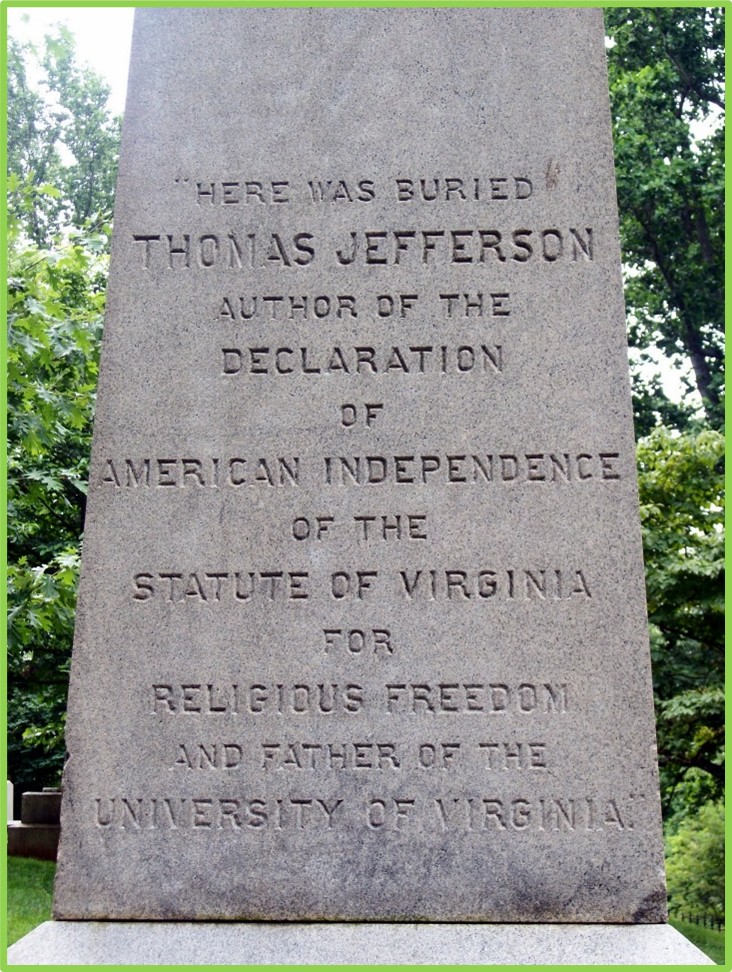
Bill 82 was, Jefferson recognized, one of his greatest services to humankind—one of three services to humankind listed on his obelisk at the cemetery behind Monticello. About that bill, he writes in a Summary of Public Service, written sometime in or around 1800:
I proposed the demolition of the church establishment, and the freedom of religion. It could only be done by degrees; to wit, the Act of 1776, c. 2, exempted dissenters from contributions to the church, and left the church clergy to be supported by voluntary contributions of their own sect; was continued from year to year, and made perpetual 1779, c. 36. I prepared the act for religious freedom in 1777, as part of the revisal, which was not reported to the Assembly till 1779, and that particular law not passed till 1785, and then by the efforts of Mr. Madison.
When the bill passed in 1785, it made Jefferson, who already had celebrity status due to his Summary View of the Rights of British America (1774) and Declaration of Independence (1776), a larger celebrity. He had put into law, with much help from James Madison, what visionaries like Frenchmen such as Mercier and Condorcet had merely envisaged. Jefferson, while in France, writes to Madison (16 Dec. 1786) of its reception abroad:
The Virginia act for religious freedom has been received with infinite approbation in Europe & propagated with enthusiasm. It is comfortable to see the standard of reason at length erected, after so many ages during which the human mind has been held in vassalage by kings, priests & nobles: and it is honorable for us to have produced the first legislature who had the courage to declare that the reason of man may be trusted with the formation of his own opinions.
The sentiment implies that kings and politically ambitious religious figures have been using religion for centuries for political ends.
Enjoy the video below….
The views expressed at AbbevilleInstitute.org are not necessarily those of the Abbeville Institute.





Mark, it’s always informative to get your insight, and especially on Jefferson’s birthday.
“…and politically ambitious religious figures have been using religion for centuries for political ends.”
And they continue to do so.