

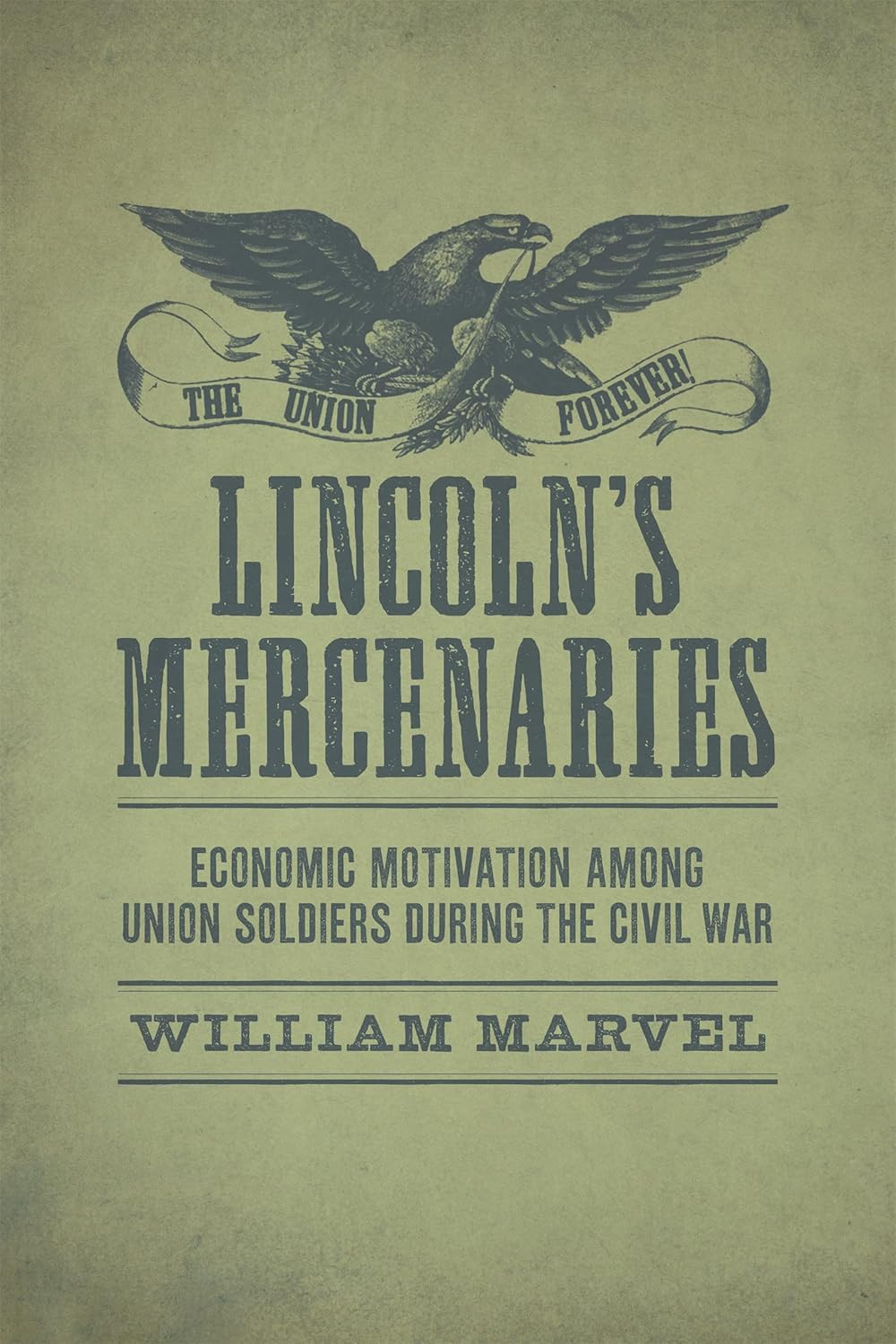
A review of William Marvel, Lincoln’s Merenaries: Economic Motivation Among Union Soldiers During the Civil War (Louisiana State University Press, 2018)
As the eminent historian John Lukacs observed, causation and motivation are the two most difficult historical phenomena to prove and explain. In part, this is due to the complexities of human nature; men and women are rarely, if ever, motivated to action by a single motive. Human actions are most often the result of mixed motives. A second difficulty concerns the biases and point of view of the scholar. It is often too tempting to fit the data and evidence, or its lack, into a preferred narrative rather than let the evidence and data tell the story. James McPherson, perhaps the best-known historian of the Civil War, wrote two acclaimed books on the motives of the men in blue and gray, What They Fought For (1994) and For Cause and Comrades (1997). McPherson’s extensive reliance upon letters, diaries, and other primary source literature demonstrated that soldiers on both sides were primarily motivated by patriotism, in the case of Southerners defense of home and hearth, and competing visions of liberty. When asked why there was a paucity of references to slavery in the Southern sources, McPherson reportedly responded that the defense of slavery needed no widespread explicit mention, “it was just understood.” McPherson’s fallacy is a variant of the argument from ignorance, but it is also a good example of fitting a lack of evidence into one’s preferred narrative.
William Marvel, himself a prominent historian of the Civil War, is unafraid to go where the evidence takes him. Though a native of Norfolk, Virginia, his adopted home is New Hampshire; he describes his politics as “Green,” his religion as “Greener.” Perhaps these affiliations gave him a revisionist streak, not a bad thing for a historian to possess. The genesis of his book, Lincoln’s Mercenaries, seems to been a correspondence with McPherson. Marvel did not find the high-minded commitment to patriotism among the Union soldiers who came from his local county in New Hampshire, but for a time he accepted McPherson’s suggestion that the men of his locale were an outlier. Further research by Marvel suggested that patriotic motives took a backseat to economic motivations in the decisions of most Northern men to join the Federal army. Marvel is too good a historian to suggest that Northerners (or Southerners) were motivated by a single factor when deciding to enlist. Using terms like “unilateral impetus” and “overriding motive,” he does, however, view economic distress as the catalyst that prompted a significant majority of Union soldiers to enlist.
Marvel’s argument is simple, most Union soldiers were drawn from the poorer parts of Northern society, and economic distress or opportunity brought them into the army. Marvel relies upon both quantitative and qualitative sources to support his argument. The University of Minnesota’s Integrated Public Use Microdata Series (IPUMS) is especially important as it makes possible the establishment of median wealth levels for each state based on the 1860 census. Marvel did exclude border states and African American troops from his analysis, the former due to complex political situations that skewed motive, and the latter due to the lack of reliable data on the wealth of individual African American soldiers. Marvel recognizes the limits of his method: not every man whose family fell below the median wealth line was necessarily poor, but previous reliance upon average wealth produced research easily skewed by outliers on the wealthy or poor sides of the mean. Using this methodology, Marvel found that enlistees in the first year of the war predominately came from families below the median wealth for their respective states. Marvel’s qualitative evidence consists of a wide array of primary sources, letters, diaries, newspapers and periodicals, federal and military records, and regimental histories that lend crucial support to his quantitative analysis. He weaves together these disparate sources and methods, supported by many local studies, to provide a compelling narrative of Billy Yank’s reasons for going to war.
Marvel’s research found that poorer Northerners were present in large numbers in the seven major periods of Union recruitment during the war. Wealthier individuals do not show up in the muster rolls in larger numbers until wartime inflation took hold and bounties for enlistment were more attractive to wealthier Northerners. Some of Marvel’s findings were surprising. The three-month troops called up in the Spring of 1861, in that first supposed flush of patriotism, were composed of an overwhelming majority, 71% to be exact, of men whose families fell below the median wealth in their states. In other recruitment periods, men below the median wealth line made up 67%-70% of enlistments, except for the nine-month regiments of 1862 where 57% of the men who enlisted fell beneath the median wealth line. Marvel’s findings are well supported by his excellent analysis of the lasting effects of the Panic of 1857 upon the Northern economy, coming on the heels of a depression in real wages from 1848-1855, due in large part to mass immigration from Ireland and Germany. Secession delayed the North’s economic recovery as Southerners cancelled credit line payments and contracts, and the winter of 1860-1861 proved especially brutal for an already depressed agricultural sector. (One wonders what role this Northern economic distress played in the government’s insistence on prosecuting the war against the South.) Marvel suggests that one piece of compelling evidence for the economic distress in the North was the desperate denials of the existence of an economic crisis from Republican newspapers.
Marvel’s account is well supported by many accounts of federal soldiers citing economic distress as their reason for joining up. McPherson either ignored or did not find these sources; Marvel did find them and chose not to ignore them. Some of these accounts are humorous or tragic. In the summer of 1861, the 6th Pennsylvania decided to return to Washington, D. C. as their ninety-day enlistment expired. The 6th Pennsylvania was part of a larger force of mostly ninety-day men tasked with blocking the conjunction of General Joseph Johnston’s force with General P. G.T. Beauregard’s in Manassas. Heedless of the pleas of their commander, Major General Robert Patterson, to remain, the men left only to later form a society they called First Defenders of the National Capital. More tragic were the incidents of looting among ninety-day Iowa militia in Missouri, including a regimental chaplain, and the murder of a teenaged and unarmed Maryland boy by a member of the 1st New Hampshire for protesting the looting of his family’s farm. The court martial records are all too full of such accounts, suggesting that Marvel’s title for his book was not exaggerated.
One way in which Marvel’s account could be strengthened is to better ascertain through statistical analysis the level of actual poverty and economic distress present among the soldiers of the Union army. The figures Marvel reports for the median wealth for each state varied, from a low of $325 in New York to $1,300 in Vermont, suggesting that one could certainly fall below the median wealth line but not be poor, a point Marvel concedes. A cost of living index for each state or for the states in aggregate that Marvel studied might shed some light on what wealthy and poor truly were, but this may not be possible to do. Nevertheless, Marvel tends to equate men whose families were below the median wealth line as “poor.” Granted, the term “poor” is conveniently concise, but how accurate is it? In some of the accounts he cites, men do enlist for the chance of better financial prospects, but they may not be poor. Is it also possible to ascertain the dominant motive of the Irish and German immigrants who filled Union ranks? The ones who entered the North after 1860 were not included in the 1860 census, but one suspects that they too were motivated to enlist for economic reasons, and they seem to have swelled Union ranks
Marvel’s book indicates strongly the key role of the economic motive for the soldiers in Union service. While Marvell makes some pro forma concessions to the existence of other motivating factors, he is correct when he asserts that “the bottom has fallen out” of the argument that the Civil War in the North was not a rich man’s war and a poor man’s fight. There is, however, a larger significance to Marvel’s work. Since the 1960s a neo-abolitionist narrative has dominated the scholarly and public discourse on the War Between the States, fundamentally distorting our understanding of that conflict. This narrative of the Righteous Cause, to be believable, needs the motives of the boys in blue to be driven by the highest sense of patriotism and fidelity to the Union, and for some, the freedom of the enslaved. Marvel has punched an important hole in that interpretation and reminded us of the complex conditions, restraints, and incentives to which all humans are subject. And he has demonstrated that the majority of the ordinary fighting men in the Federal army did not view themselves as crusaders in a righteous cause; more often they were just down on their luck. Marvel has done the work of a historian; he has let the evidence tell the story in the service of enlarging our understanding of an important aspect of a conflict which remains the defining event in the history of the United States. More revisionist history of this sort is badly needed.
The views expressed at AbbevilleInstitute.org are not necessarily those of the Abbeville Institute.






Great review of a worthwhile book. A much lesser known book published in the 1960s, Patriotism Limited, is a good study of the Northern draft, bounty jumpers, substitutes, etc. It’s out of print but also worthwhile, as well as another book by the same author (Eugene C. Murdock), titled One Million Men: The Civil War Draft in the North.
I expect that the composition of the military has in all ages including the present, when done by choice, have been more accurately explained as attempts to procure a stable employment and attain social approbation. The reasons of patriotism and ideological nobility are just a gloss to paint the expedient practical choices with more agreeable subsequent justifications.
In pretty much all wars, the mass of fighting and dying is done by those with the least and with the least to gain.
(Thank you Dr. Devanny for the excellent and interesting review.)
African American is cultural misappropriation…not everyone who comes from Africa is a negro.
“ More revisionist history of this sort is badly needed.”. I had previously learned that “revisionist” history was written by a group of Yankee biased authors beginning in the 1960’s? Authors like Bruce Catton, Ken Burns, James McPherson and others…. Can anyone verify this one way or the other?
“More tragic were the incidents of looting among ninety-day Iowa militia in Missouri, including a regimental chaplain, and the murder of a teenaged and unarmed Maryland boy by a member of the 1st New Hampshire for protesting the looting of his family’s farm. The court martial records are all too full of such accounts, suggesting that Marvel’s title for his book was not exaggerated.”
To me this anecdote from history is characteristic of so much of the entirety of history which is simply forgotten. It is a stark reminder of the reality of war in general and of the so-called “Civil War” in particular.
Thank you for this excellent review, Mr. Devanney.