

Woe to those who call evil good and good evil, who put darkness for light and light for darkness, who put bitter for sweet and sweet for bitter. Isaiah 5:20
Tucker Carlson recently conducted an interview with Marjorie Taylor Greene, the representative of the 14th congressional district of Georgia, in the context of the bombing by United States forces of the nuclear facilities of Iran. A significant number of highly vocal individuals were vociferously urging further military action. Carlson and Greene were both appalled by the calls for further war. But a certain segment of the interview was to me noteworthy, perhaps more for what was missing than what for what was said.[1]
Carlson [20:20]: It’s always been that way to some extent, of course. What I find different from what I thought it was anyway is this obsessive love of violence.
Greene [20:33]: Mm-hmm.
Carlson [20:34]: That, like Tom Cotton, you could have dinner with him and disagree on anything. If you raise a voice against bombing people, like Tom Cotton is upset. Like he wants to be able to kill people, period.
Greene [20:49]: Yeah, I know a lot of my colleagues want to kill.
Carlson [20: 51]: What is that?
………..
Greene [21:23]: [We’ve] grown up with Hollywood telling us who the foreign bad guys are. Yes, and making these people our complete enemies and never humanizing them. And so, yes, and there’s just this obsession with war and killing and murder. Yes, that is sick.
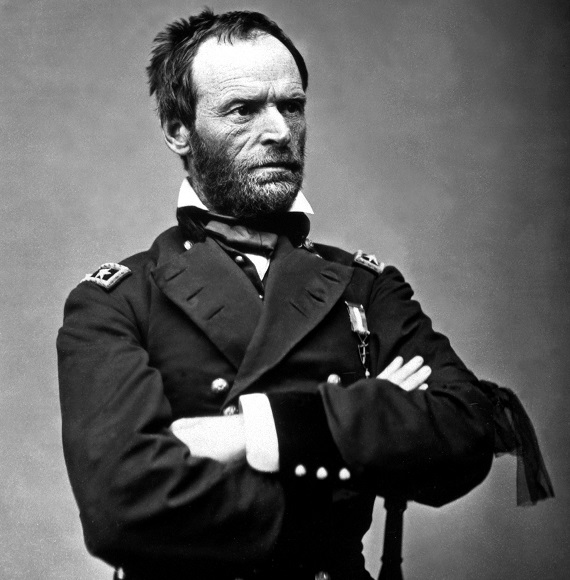
So what was missing from the interview? Ms. Greene’s district is in the northwestern corner of Georgia. Dalton, Georgia is within that district. In May, 1864 William T. Sherman set out from Chattanooga, Tennessee on his way to Atlanta. Opposing him was Joseph E. Johnston and his forces at Dalton. We know that after some protracted fighting Sherman reached Atlanta, burned it, and then set out on his “March to the Sea” through the rest of Georgia and South Carolina. Ms. Greene blamed Hollywood for fostering a barbaric attitude in parts of the populace regarding armed conflict between peoples but said nothing about Sherman who began his rampage through the South by going through her district. Let us look at Sherman’s record. This account is taken mostly from Russell Weigley’s The American Way of War[2], in my view a scholarly and mainstream account of its subject.
In Weigley’s account Abraham Lincoln had at first sought to wage war against the South with as little injury to noncombatant persons and property as possible in hope of promoting reconciliation between the combatant sections after a northern victory. Weigley notes that “[t]he image of Napoleonic war with its brief, climactic battles had impressed itself upon the popular mind as well as upon soldiers younger than [Winfield] Scott [Commanding General of the United States Army] …”[3] The classic Napoleonic strategy was to accomplish a decisive “battle of annihilation” whereby the entire enemy army would be destroyed which would result in the enemy suing for peace. This was the dominant idea of strategy at the beginning of the war and probably the motivating one for most of the confederate commanders (Robert E. Lee in particular) throughout the war. Note that the Napoleonic strategy of “annihilation”, though increasing the scale of military actions, was directed at the military resources of the enemy. But as the war went on Lincoln felt that he needed to take more desperate measures to bring it to a swifter conclusion. For example, there was rising dissatisfaction in the North as “[t]he Democratic party in the North … tended increasingly to fear that the war was both subverting the Constitution as written by the founding fathers and becoming a partisan effort to assure Republican political ascendancy.”[4] Lincoln proceeded at first somewhat slowly by appointing a series of commanders in the Virginia theater who began to target civilians in their military operations. Weigley comments, “Lincoln acquiesced in measures involving the civil population of Virginia announced by General Pope [for example], though General Lee and other Southerners considered these measures barbarous.”[5] Thus Lee referred to “the miscreant Pope”.[6]
When this change did not bring the success that Lincoln wanted, he brought in Grant who took things up (or down) a notch. Weigley observes that “… Grant accepted a Napoleonic strategy of annihilation [of the opposing army] as the prescription for victory in a war of popular nationalism.”[7] Yet Grant did not think this alone would be sufficient to subdue the South so he added economic war, or war against the opponents’ resources, which was a new element in western warfare. Weigley notes, “[i]n the modern western world, however, war by land armies waged directly upon the enemy’s economic resources had been attempted only very charily and within narrow limits imposed by the accepted rules of war.”[8]
This was not the end of it, however. While Grant and Henry W. Halleck[9] had developed a strategy to wage war against the Confederacy’s resources, it was Sherman who “… not only carried on war against the enemy’s resources more extensively and systematically than anyone else had done but he developed also a deliberate strategy of terror directed against the enemy people’s minds.”10 (emphasis added)
… [Sherman] made of his marches campaigns of terror and destruction, with his armies urged to forage liberally on the country, with all war industries and transport his target, and with greater depredations by his men treated leniently.[10] (emphasis added)
Weigley comments, “If Sherman had had the airplane, then he might indeed have been able to deprive the confederate armies of economic resources they needed to continue the fight, while destroying popular morale as well … his design for war reflected his stark belief that ‘war is simply power unrestrained by constitution or compact’: ‘You cannot qualify war in harsher terms than I will. War is cruelty, and you cannot refine it.’”[11] After three years of war the South had stoutly resisted the effort to conquer it. With Sherman the North adopted a strategy of deliberate cruelty to achieve its objective. Human suffering would not be taken into account if it hindered the objective to conquer the South.
We get an even clearer picture of the extent to which Sherman would go only a couple of years after his operations around Atlanta when Sherman was in command in the West. After a detachment of eighty men under Captain William Fetterman were wiped out by the Sioux on December 21, 1866, Sherman responded with a long-range proposal to deal with the Sioux: “We must act with vindictive earnestness against the Sioux, even to their extermination, men, women, and children.” Weigley observes that “Sherman spoke in anger and embarrassment over Fetterman’s defeat, but his subsequent policies made it clear that despite later denials he was not speaking in the heat of the moment.”[12]
In the fall of 1868, prior to Philip Sheridan’s campaign against the Plains Indians, Sherman told his brother, “The more we can kill this year, the less will have to be killed the next war, for the more I see of these Indians the more convinced I am that they all have to be killed or maintained as a species of paupers. Their attempts at civilization are ridiculous.”14 Of course, Sheridan’s cruelty to civilians was close to Sherman’s with the devastation that he wrought in the Shenandoah Valley. Sheridan’s sojourn there is still referred to by long-term residents as “The Burning”.[13]
Let us contrast this northern view on war with the traditional southern view enunciated by Richard Weaver in his article, “Southern Chivalry and Total War”.[14] For Weaver, chivalry comprised the set of values established during the Middle Ages that “was the form taken by the code of self-discipline which produced Western civilization.”[15] These European values made their way across the Atlantic to America where in the South “… the order of chivalry took the form of a gentleman caste.”[16] The manifestation of this was a “code of honor” among the members of this caste that governed their behavior, particularly in times of personal combat. The importance of this is noted by Weaver,
Since civilization is in essence a struggle for self-control, the nobility in every civilized community, by whatever name they may go, and all who contribute to the cultural life, are somehow identified with the restraining forms. Those who are ignorant of the forms are not, properly speaking, members of civilization … Warfare is assumed to be inevitable, but civilized people will conduct it as they conduct all else, with self-control – in other words, they will make it a game.[17]
Weaver summarizes well the moral and psychological shock experienced by the South when she realized not just that the rules had changed but that there were now no rules at all.[18] Perhaps it was the shock itself which was the fatal blow from which the South never recovered. The brutality of the northern move to total war was a spiritual betrayal that killed what Weaver called “the last nonmaterialist civilization in the Western world.” It would have been spiritually impossible for the South to have matched the North in this respect even if it had possessed the material resources required. The northern move to total war set the spiritual stage that enabled the curtain to rise on the barbaric twentieth century:
Realization that the North as a whole did not propose to regard the war as a game came as a shock to the Southern people, who had always counted the Yankees out of chivalry, but who seemingly had never reckoned what this would mean in practice. For the North had already become industrial, middle-class, and bourgeois, and if it began the war with old-fashioned conceptions, they vanished after the removal of the dramatic and colorful McClellan. Thereafter the task of conquering the South became a business, an “official transaction,” which cost a great deal more in dollars and lives than had been anticipated, but which was at length accomplished by the systematic marshalling of equipment and numbers. When John Pope’s Virginia campaign gave the South its first intimation that the North was committed to total war, the reaction was indignation and dismay. Perhaps it is not too fanciful to read in Lee’s brief sentence, “Pope must be suppressed,” a feeling that he was fighting not so much against an individual enemy as an outlawed mode of warfare. And when Sherman, Sheridan, and Hunter[19] began their systematic ravaging and punishing of civilians, it seemed to the old-fashioned South that one of the fundamental supports of civilization had been knocked out, and that warfare was being thrown back to the barbarism from which religion and chivalry had painfully raised it in the Middle Ages.22
The long-reigning narrative is that the northern victory achieved by Lincoln, Grant, and Sherman marked the full advent of Enlightenment values23 into American life. In fact it did accomplish this. But the ultimate effect was not an enlightening but a darkening. Chivalry! What a hopeless fantasy! If you[20] want your way in the world you need to kick ass to get it. That’s the American way! The Nashville Agrarians are mocked for being naive idealists, just as Jesus is taunted in many quarters for his naive idealism regarding something called the Kingdom of God. Was Jesus an idealist? I think he might be called the consummate realist, being the literal embodiment of the ultimate reality.
The recitation here of Sherman’s view of war was not undertaken for its own sake. Most readers of this piece will be quite familiar with it. The point is rather that the deliberate omission of the southern side of the story leaves us blind with respect to a vital dimension of moral reality. President Trump’s restraint in not pouring more resources into the destruction of the Iranian regime after the bombing attack on their nuclear facilities was commendable.[21] I am not faulting Carlson[22] or Greene, both professed Christians, for neglecting to make the southern connection in their abhorrence at the desire of many to use massive military force regardless of the cost of life.[23] That is simply the sign of the times. The chasm of popular ignorance about the American reality now regnant is simply a bridge too far for many to cross. For example, when Francis Fukuyama announced shortly after the end of the Cold War that the end of history was at hand, that the Hegelian Dialectic was fulfilled with the triumph of the American Way over Soviet Communism, he was celebrated as a [false] prophet. But it did not turn out quite that way and the world is now on the brink of a cataclysm that would surpass the horrors of the twentieth century. Perhaps we need to think again how we got here.
Trump’s action was contrary to the American way of war viciously pursued by so many. As often with Trump, you never know exactly what is motivating him though he does seem to have some feeling for the South.[24] In this case his restraint hearkens back to a doctrine of war that respected the opponent as human beings and did not willfully visit terror and destruction on noncombatants. This moral imperative might have remained in the American mind if the Southern tradition still occupied a place there. Instead, it has been distorted beyond recognition, labeled an outmoded barbarism, and banished. But the actual barbarians are the ones that have been running the show for quite some time now.
************************************************
[1] The interview is not to my knowledge publicly available but the segment quoted runs from 20:20 to 21:40. The interview is available at tuckercarlson.com. The transcript is reconstructed from closed caption captures.
[2] Russell Weigley. 1973. The American Way of War. Macmillan Publishing Co., Inc.
[3] Weigley, p. 93.
[4] Ibid., p. 129
[5] Ibid., p. 137
[6] Ibid., p. 146
[7] Ibid., p. 141
[8] Ibid., p. 146
[9] Grant’s predecesssor as Commander-in-Chief 10 Ibid., p. 149
[10] Ibid., p.149
[11] Ibid., p. 152
[12] Ibid., p. 158 14 Ibid., p. 160
[13] John L. Heatwole. 1998. The Burning: Sheridan’s Devastation of the Shenandoah Valley. Rockbridge Publishing.
[14] In The Southern Essays of Richard M. Weaver, George M. Curtis III and James J. Thompson, Jr (eds.), Liberty Press International, 1987, pp. 159 – 170.
[15] “Southern Chivalry and Total War”, p. 160.
[16] Ibid., p. 161.
[17] Ibid., p. 164.
[18] Weaver himself noted that the lack of restraint had developed further to the point where, for the participants of the Manhattan Project, their “ … efforts were being directed to the slaughter of noncombatants on a scale never before contemplated …” Weaver, Ideas Have Consequences: Expanded Edition (p. 64). The University of Chicago Press. Kindle Edition.
[19] David Hunter was also instrumental in the depredations of the Shenandoah Valley 22 Ibid., p. 166.
[20] These are the same “Enlightenment values” that have come to fruition, for example, with the participation of biological males in women’s sports and the mutilation of youth simply because they have entered the perilous journey from childhood to adulthood while encountering along the route the dangerous minefield planted there by the same “enlightenment values”. On the former issue, the absolute failure of the so-called “feminists” (another creation of “enlightenment values”) to come to the defense of young women has been notable. On the latter issue it is unacceptable that individual states cannot move with alacrity to ban such barbarities without waiting for years to have the problem dealt with by a glacial political process that “may” produce Supreme Court judges adequate to the problem.
[21] As is his consistently deploring the loss of life in the Ukraine war and seeking a settlement to resolve the conflict.
[22] Carlson in particular has made disparaging comments about the Confederacy from time to time.
[23] Let me just note off the top of my head that the “cost” in human lives of the Vietnam War was something like two million, the Iraq and Afghanistan wars was perhaps half a million, and the Ukraine war is something like a million on each side. These are horrifying numbers but seemingly taken in stride as just “statistics” and part of the “cost” of war.
This is reminiscent of Weaver above noting that the WBTS became just an “official transaction”.
[24] As with his comment after the Charlottesville, Virginia fracas over the removal of the Lee monument there: “… there were very fine people on both sides” referring to the issue of monuments, not the incident itself. This is not that surprising as there have been periods when Confederates, such as Lee, have been popular in certain parts of the North, even New York City.
The views expressed at AbbevilleInstitute.org are not necessarily the views of the Abbeville Institute.






Most of the war crimes committed by Sherman and others of his ilk were against Southern civilians. If some courageous filmmaker were to make a movie realistically depicting events during Sherman’s “March” through South Carolina viewers would be shocked and horrified. Most Americans have no idea how ruthless the North was during the war. The North had more money, more men, more munitions, and more ruthlessness.
Given MTG’s age and background I am not surprised she has no/very little knowledge of Sherman’s actions, her district, and the war. That is what this site is for, to educate Southerners and spread the word.
Excellent, informative article. Thank you Mr. Goodloe!
We want to know why Sen. Greene didn’t mention Sherman’s March to the sea.
Isaiah 5:20 was used to open this article. Do we want to know why God said that; what was going on at the time? There’s a great need out there for understanding what’s going on in that Book. Too many today just use it for their own ends, which is really showing disrespect toward the Bible. Recently, another Georgian, Stacy Abrams, in an interview used the Bible to try and affect public policy. “She…told NPR that true Christians should be progressive…” Book, chapter and verse?
In a group ministry letter my wife and I recently received, the Pastor, a fellow Alabaman Mr. Goodloe, said: “…a famous religious figure recently interviewed a so-called ‘prophet’ on national TV. This ‘prophet’ declared that…there would not be another Presidential election in the U.S. He said this had been confirmed by an angel! This type of nonsense is a red flag that something is desperately wrong.” A big Yes to that.
Isaiah was a 5th course of punishment prophet of Israel. Leviticus 26 details these 5 courses which concern Israel. One can count them, it’s not difficult. That chapter is critical to be aware of for the Bible believer to understand God’s program with Israel. When Isaiah wrote the chapter and verse Mr. Goodloe quoted, Israel, the divided kingdom, had entered captivity and their fifth and final course (they weren’t doing good). Note “final.” When Israel’s Messiah came hundreds of years later, the nation was still in the 5th course and very, very close to the end and climax of it (Armageddon). In the post-resurrection ministry the imminent crescendo of that 5th course was abruptly postponed. That crescendo, by the way, would have, and still will, affect the whole world, not just Israel. For 2K some years we have been in a period of amnesty. The gospel’s and early Acts was near the end of something. It was not the beginning of anything, until the mystery was revealed to Paul. That, truly, is something important to think about. God put His wrath on hold.
Psalm 2:12 “Kiss the Son, lest he be angry, and ye perish from the way, when his wrath is kindled but a little. Blessed are all they that put their trust in him.”
“Was Jesus an idealist?” No.
“I think he might be called the consummate realist…” When things like this are said, the nuts and bolts are missing about who Jesus is and what He was accomplishing in His earthly ministry. “…he might be called the consummate realist.” No offense, but that’s coffee table living room verbiage.
And so, because few are reading and studying the Bible (it needs to be the KJB), what we hear and read today about the Lord in heaven are things like, “Jesus was a refugee.” No, He wasn’t. And, “He gets us.” Yes, He does I suppose, but not in the way that goofy and sappy organization wants people to understand it. Some months ago, a man on the street in Florida told Liberty Hangouts Kaitlyn Bennett that “Jesus was an immigrant.” No, He wasn’t.
The Lord Jesus Christ is God. He came to fulfill the five Davidic mandates of the Davidic covenant for Israel. To be their A) Redeemer. That’s been fulfilled. The other four have not been fulfilled, yet. They are: B) Deliverer. C) Avenger. D) King. E) Blesser.
That’s who this Jesus is, and that’s what His work was when He came here. That work will be finished. “Where is Christianity?” one might ask. Few are, unfortunately. Anyway, as far as what’s been going on since the stoning of Stephen in Acts 7, the apostle Paul explains it in his epistles, and he’s the only one who does.
Thank you all for your comments. Let me address the comments that refer to my scriptural allusions (not illusions I hope). I realize that many people who follow the Abbeville Institute have strong Christian affiliations and I am grateful for that. I also realize that there are many different interpretations of the meaning of the scriptures. One account I just read said that in the US there are more than 200 different church denominations. It is a good thing that we seek the truth and passionately defend our beliefs. It is also the case that scriptural references are misused and there are many false prophets. I recognize that we need to understand the scriptures, to the greatest extent possible, in terms of what they meant at the time they were written to the people to whom they were addressed. But we also need to apply them to our current circumstances. This is a difficult and complex task. I was referring specifically to Richard Weaver’s interpretation of the impact of the Christian Middle Ages on antebellum southern society. The citation of Isaiah was intended to show that the scriptures have meaning and application outside of the context in which they were first proclaimed. If they don’t then what is the point? But how we accomplish that application will always be a challenge. I cite the scriptures because I think it is important to bring them into our conversation about the Southern tradition. I try to select things that seem relevant to current circumstances but are not unfaithful to their original meaning (to the extent that I know that). I also realize this can be a hazardous occupation at times! Thank you again for your comments,
“I also realize that there are many different interpretations of the meaning of the scriptures.”
In my whole (long) life I have discovered the above to be true, and with the agreement of some people who have studied scripture far, far more than I have.
One of my personal choices for both beauty and confusion from Jesus Christ Himself, are the Beatitudes; whether Luke or Matthew.
PS
I enjoyed your article
I wonder sometimes if the Yankee isn’t so much like today’s leftist. They see their “dominance” slipping so they become blinded and violent.
And/or the Yank understood on a deeper level that had the Southland won its independence, that nearly every new State, and some old States would also abandon the United States for the CSA. I think, living among them as I do, that they just did not want competition.
Thousands of free blacks and the Five Civilized Tribes fought voluntarily for the Confederacy…for a reason.
ABSOLUTELY