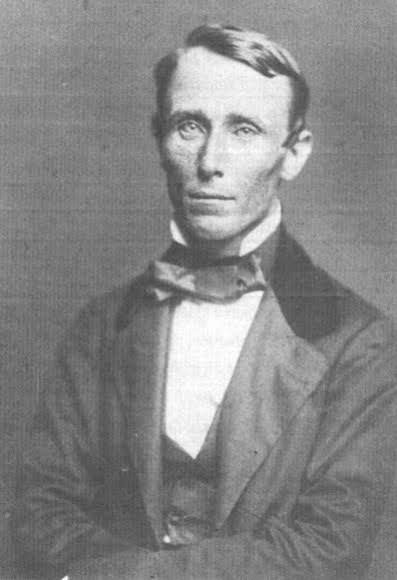
Long before the world knew him as a conqueror, William Walker was a small, quiet, almost bookish boy on the streets of Nashville. He entered the world on May 8, 1824, the son of a Scottish immigrant merchant, and grew up inside a prosperous and politically connected Tennessee family. His mind raced far ahead of his years. According to The Pennslyania Gazette, he graduated from the University of Nashville at the astonishing age of 14, passed through the universities of Edinburgh and Heidelberg, and obtained a medical degree from the University of Pennsylvania by 19. This slight, precocious Tennessean would one day earn the eerie nickname “Grey-Eyed Man of Destiny.”
Medicine soon bored him. He abandoned the physician’s trade, took up law in New Orleans, and threw himself into journalism as an idealistic newspaper editor. Then grief rewired the man. The death of his fiancée Ellen Galt Martin, a deaf woman he loved deeply, radically transformed his personality around 1849 and set him on the reckless road he would follow to his grave.
Walker carried his grief west to Gold Rush San Francisco, where he edited a newspaper, survived a string of duels, and absorbed the swaggering creed of Manifest Destiny. He came to believe that White Americans were fated to spread their institutions across the hemisphere. Journalist and author Scott Martelle captured the ideology that animated men like Walker: “There was this idea that white Anglo-Saxons were the ones who were going to civilize these areas that were not under America’s sway at that point.” Walker fused his imperial desire with colder calculations—in Martelle’s telling, he “had dreams of empire” and saw power vacuums as invitations to fill.
In 1853, Walker turned his gaze toward Mexico. He slipped out of San Francisco on October 16 with 45 men, seized La Paz in Baja California by early November, and proclaimed the Republic of Lower California with himself as president. By January 1854, he had declared the annexation of neighboring Sonora and renamed his paper nation the Republic of Sonora. The whole enterprise collapsed under hunger, desertion, and stiff Mexican resistance. As Martelle recounted, “Men started deserting by the fistfuls.” Walker and fewer than 35 survivors surrendered at the California border, stood trial in San Francisco for violating the Neutrality Act, and walked free when a sympathetic jury rapidly acquitted him.
Defeat sharpened rather than discouraged him. Nicaragua’s Democratic faction, desperate in the middle of a civil war, contracted Walker to bring armed “colonists” south, and there the Tennessean finally found the stage his ambitions required. He landed at Realejo in June 1855 with roughly 57 soldiers and within months had effectively taken over the country. A decisive victory at La Virgen established his force as a feared presence; the capture of Granada in a surprise assault on October 13 sealed his dominance. He ruled initially through a puppet president, then engineered an election and had himself inaugurated president of Nicaragua on July 12, 1856. English became an official language and economic policy was redrawn to attract American settlers. His grip depended entirely on reinforcements from home.
To secure those reinforcements, Walker made a calculated appeal. Walker overturned Nicaragua’s constitutional prohibition against slavery, gambling that slaveholders across the American South would bankroll his throne. He courted Southern money, published his own newspaper, and briefly became a celebrity across the region, his exploits chased by American papers that cast him as either hero or pirate.
Walker’s survival ran entirely through the steamships of Cornelius Vanderbilt’s Accessory Transit Company. Walker made the fatal mistake of transferring the company’s charter to Vanderbilt’s business rivals, a betrayal that turned the Commodore into a lethal enemy. Vanderbilt sent agents to fund Walker’s opponents and choke off his supply line.
Central America then closed ranks. Costa Rican troops invaded first, and Salvadoran, Guatemalan, and Honduran armies followed. A Costa Rican soldier named Juan Santamaría played a celebrated role in the defense at Rivas and became a national hero in his country. A cholera epidemic swept through the region in the wake of the fighting, devastating Costa Rica’s population. Hemmed in on every side, Walker eventually surrendered to a U.S. naval officer on May 1, 1857.
Walker could not release his grip on the dream. He mounted fresh expeditions, published The War in Nicaragua in 1860—an account in which he refers to himself in the third person and frames his Central American campaign as a righteous undertaking—and traveled through the South to raise funds for another attempt. His final venture pointed toward Honduras, where British colonists on the Bay Islands had approached him with an offer. The expedition collapsed on arrival. Walker fell into the custody of Commander Nowell Salmon of the British Royal Navy, who handed him over to Honduran authorities rather than repatriate him to the United States. A Honduran court tried him, and on September 12, 1860, a firing squad ended his life in the port city of Trujillo. He was 36 years old. He lies buried in Trujillo’s Cementerio Viejo.
History delivered a quiet final irony back in Tennessee. Years later Vanderbilt endowed a Nashville university that still bears his name, standing a short walk from the birthplace of the gray eyed adventurer who had once dared to cross him. Forgotten by most Americans, Walker remains among the most reviled figures in the memory of Central America, a Nashville prodigy who chased a quixotic empire in the tropics of Central America.
The views expressed at AbbevilleInstitute.org are not necessarily those of the Abbeville Institute.




He was certainly an interesting fellow. I’ve got a book on him on the shelf that I have yet to read.