

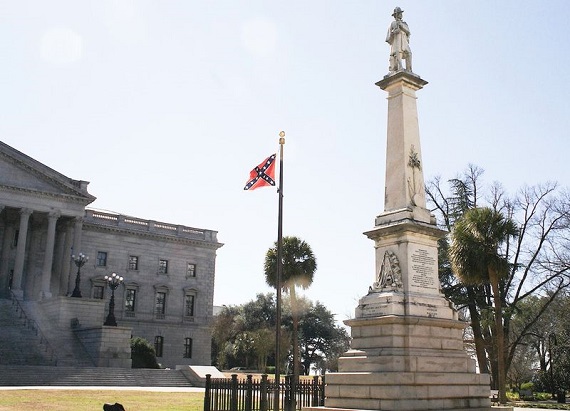
When debating the causes of the War to Prevent Southern Independence, sometimes a Southern partisan will argue the Confederacy fought for “States’ Rights.” Partisans on the other side will almost always respond that it was states’ rights to own slaves. An immediate objection to this was that States did not own slaves, people did. The second and more substantive objection is that such a comment indicates a lack of understanding of what “States’ Rights” meant.
States’ Rights was a framework for interpreting the nature of the Constitution and the federal Union created by it. The Encyclopedia of Virginia defines States’ Rights as “a political philosophy that emphasizes the rights of individual states to fight what proponents believe to be the encroaching power of the United States government.”[1] The Encyclopedia of the Confederacy says that argues that “in the United States, the ultimate source of political authority lay in the separate states.”[2] The peoples of the states were the agency that ratified the Constitution and there was no other power to whom to appeal that decision. When North Carolina said “no” to the Constitution on August 1, 1788, for example, there was no body or agency to whom that decision could have been appeal. The decision of the people of North Carolina was conclusive. Thus, the people were the sovereign power. And since any state could have decided exactly as North Carolina did, the people of each state was sovereign. There is a difference between sovereignty itself and powers sovereigns delegate.
We live in a federal system of government, in which there are federal powers and state powers. In the first four score years of the republic, the essential question boiled down to the relationship between the States’ Rights and federal powers. Federal powers are the forgotten side of the States’ Rights equation. Let us begin there.
The powers of the federal government, according to States’ Rights framework, are limited to those enumerated powers in Art. I, Sect. 8 of the U.S. Constitution. The Section begins, “Congress shall have the power to …” and then enumerates all of the legitimate federal powers. These include, for example, the power “to lay and collect taxes, … borrow money on the credit of the United States, … provide and maintain a navy.”[3] The “necessary and proper” clause at the conclusion of the list, in itself, delegates no power. It is simply an enabling clause for “the foregoing powers.”[4]
In 1787-1790, advocates of ratification tried to show their cautious colleagues that it was safe to ratify the Constitution. Advocates urged that the federal government could legitimately exercise only those powers expressly delegated to it. Under such an interpretation of federal powers, it was safe to ratify the Constitution.
Some examples of statements from Founders will illustrate the point. James Wilson of Pennsylvania said, “the powers of Congress, being derived from the people in the mode pointed out by this Constitution, and being therein enumerated and positively granted, can be no other than what this positive grant conveys.”[5] Gov. Samuel Johnston of North Carolina said, “The Congress cannot assume any other powers than those expressly given them, without a palpable violation of the Constitution.”[6] So according to Johnston, the federal government declaring it has the power to erect a protective tariff, for example, is a palpable violation of the Constitution. Congress can only impose tariffs to raise revenue. Edmund Randolph of Virginia told his fellow delegates, “We should be at liberty to consider as a violation of the Constitution every exercise of a power not expressly delegated therein.”[7] Massachusetts, in her ratification instrument, declared that “all powers not expressly delegated [to the federal government] by the aforesaid Constitution are reserved to the several states, to be by them exercised.”[8]
This interpretation has two implications. First, when the federal government acts beyond the enumerated powers, it violates the Constitution. What happens next, and who decided, was an open question. States’ Rights advocates had an answer. When the federal government acts beyond the enumerated powers, it brings into question whether the people can limit their own government.
The other side of the States’ Rights question is powers reserved to the states. As stated above, Section 8 enumerates powers delegated to the federal government. Section 9, on the other hand, lists actions prohibited to the federal government. This would include prohibiting “Bill[s] of Attainder or ex post facto Law[s]” and the granting of “title[s] of nobility.” Section 10 lists powers denied to the states by virtue of having ratified the Constitution.[9] For example, “No State shall … pass any Bill of Attainder, ex post facto Law, … or grant any Title of Nobility.” States can do anything not prohibited by Art. I, Sect. 10. (and that state’s Constitution). If Article I, Section 10, for example, does not forbid a state from recalling its delegated powers and leaving the Union, then it is a State Right.
No powers are delegated to the states in the federal Constitution. They already had plenary powers when the Union was formed. To test the hypothesis, if a state had declined to ratify, it would have held full sovereignty and independence as North Carolina and Rhode Island were prior to ratification.[10]
The questions of the boundary between federal and state powers, who decides where that line is, and what to do about it was the central question of antebellum American history. Throughout American history, violations have occurred and people of the states have reacted to those violations. One of the early violations was the assumption of state debts. Another early case was the chartering the 1st Bank of the United States. Another case, the Sedition Act, outlawed speech directed at the president, members of Congress intended “to bring them, or either of them, into contempt or disrepute.”[11] Clearly unconstitutional, this precipitated about the Virginia and Kentucky Resolutions. Thomas Jefferson’s Kentucky Resolutions declares that the states “delegated to [the General] government certain definite powers, reserving, each State to itself, the residuary mass of right to their own self-government; and that whensoever the General Government assumes undelegated powers, its acts are unauthoritative, void, and of no force.” This is one of the best statements of States’ Rights doctrine. James Madison’s Virginia Resolutions declared, “the powers of the federal government, [are] limited by the plain sense and intention of the [Constitution].” Further, Virginia declared that “in case of a deliberate, palpable, and dangerous exercise of other powers, not granted by the said compact, the states who are parties thereto, have the right, and are in duty bound, to interpose for arresting the progress of the evil.” According to Madison, states have a duty to protect their citizens from unconstitutional federal acts. Southerners on the eve of the war, frequently cited both of these as “the Spirit of 1798.”
More crises followed 1798. The Missouri Compromise in 1820 caused Jefferson to describe it as a “Fire bell in the night,” not because it was a death-knell of slavery, but because a moral line, coinciding with a political and geographic one, pitting most people on one side against those on the other, was dangerous for a republic. Tarriff fight 1828-1833 pitted South Carolina against those wishing to impose a protective tariff. The Nullification Crisis almost brought the two sides to blows. The 1850 admission of the state of California as a free state (even though much of the state was south of the Missouri Compromise Line and should have been admitted as a state tolerating slavery) resulted in the Nashville Convention in which Southern secessionists met to discuss how best to resist.
The eve of the War to Prevent Southern Independence brought new cases. When northern Republican governors refused to extradite John Brown’s Harper’s Ferry accomplices. Virginia had a “State’s Right” to expect her sister states to arrest and extradite someone wanted for murder, treason, and inciting servile insurrection. Southerners were left to wonder what a Republican in the White House would do,[12] but southerners waited for the election of 1860 to see if northerners would repudiate the Republicans. When northern voters embraced the Republicans in the election of 1860, the Deep South seceded, which was the state right of the people of those states. Forcing states to remain in the Union is not amongst the federal powers enumerated in Article I, Section 8, so when Lincoln violated the Constitution by attempting to exercise that undelegated, unconstitutional (and antidemocratic) power of invading states to overthrow their elected governments, the Upper South seceded as well.
Numerous examples of antebellum statements of the States’ Rights philosophy exist. Here are a few. William D. Porter of South Carolina, in an address at the Citadel in April, 1860, said that the states existed before the Union. Speaking of “the old Thirteen States,” Porter said, “Before the Union was, they were.”[13] The states pre-existed the Union, despite Lincoln’s allegations to the contrary. Further, Porter argued that, “upon a dissolution of Government, of whatever kind and in whatever way, its powers and authorities fall back upon the source from which they sprang; … to the State or people from whom they were originally derived, and for whom they were held in trust.”[14] Thus, when South Carolina seceded, the “powers and authorities” of government fell back on the people of South Carolina, from whom they had originally sprung. South Carolina was then free to remain independent, to join a different confederation, whatever the people of South Carolina wished.
Porter went on to argue that the peoples of the states are sovereign. Porter asserted “the great political truth, that constitutions do not make peoples, but peoples make constitutions.”[15] Federalists, Whigs, and Republicans asserted that South Carolina had permanently surrendered her sovereignty by joining the Union. Not so, Porter answered: “If the right of a State to independence cannot be lost … by a free and voluntary delegation (i.e. by ratifying the Constitution) … [then] its sovereign character [is not] in any degree impaired or diminished by such act of delegation.”[16] Porter was asserting that the political community known as a “state” was the final arbiter which got to decided matters. The federal government was merely a servant of that community.
Another States’ Rights principle was that the federal government has powers, not sovereignty. “The powers of Government are derivative, delegated, and held in trust; the powers of the State, as contra-distinguished from mere Government, are original, self-existent and incommunicable, save and except so far as they may be given in trust for the safety and happiness of the people.”[17] In a political struggle between the states and their servant, the federal government, the servant is always wrong and the principal is always right. If a man issues another man a power of attorney, and a dispute arose as to whether a particular power is delegated or not, no one would argue with his attorney. The principal would simply terminate the relationship.[18] Porter described it this way: “the unceasing strife has been between liberty and power; in despotic countries, on the part of the many to reclaim their liberties from the one or the few; in republican countries, on the part of the rulers to extend, by usurpation or construction, the powers committed to them.”[19] Porters saw that, by small degrees, liberty has been wrested from the people.
Another southerner asserting States’ Rights philosophy before the war was Robert Lewis Dabney, Presbyterian minister and soon-to-be Chief of Staff to Stonewall Jackson. In April 1861, Dabney argued that the Northern interpretation of the reserved rights of the states asserted some dubious positions: “If … a ruthless majority may perpetrate unconstitutional wrong, may trample on the sacred authority of the Supreme Court, and may pervert all the powers of the federal government, instituted for the equal good of all, to the depression of a class of rights as much recognized by the constitution as any other, and the minority have no remedy except submission; … If you mean that one party is to keep or break the compact as his arrogance, interest, or caprice, may dictate, and the other is to be held bound by it at the point of the sword; If you mean that a sovereign State is not to be the judge of its own wrong and its own redress, when all constitutional appeals have failed; Then … this much lauded federal compact a monstrous fraud; a horrid trap and we do well to free ourselves and our children from it.”[20] Dabney here presented a statement infused with States’ Rights philosophy.
The States, according to Dabney, had reserved rights, and Virginia had expressly reserved the right to resume delegated powers should the powers delegated be perverted to her injury or oppression. Virginia, Dabney wrote, “expressly reserved to herself, the right to sever its bonds, whenever she judged they were used injuriously to her covenanted rights. It was on this condition she was received into the family of States.”[21] Dabney wondered whether Virginia would “be called covenant-breaker, because she judges that the time has come to exercise her right expressly reserved?”[22] Dabney felt that Virginia’s right to determine whether the Constitution had been violated, as well as “the mode and measure of redress.” This comes right out of the Kentucky Resolutions. Virgina’s “right to go out of [the Union] whenever she judged herself injured by it, was expressly reserved, and conceded from the first.”[23] Reserved rights do not have to be expressly reserved, but Virginia had, for additional caution, expressly reserved the right to recall delegated powers. In April 1861, Virginia recalled her delegated powers and left the Union.
Finally, Dabney argued that the states had created the federal government as their servant. The “sovereign States, [were] the creators by their free act, of these federal authorities.”[24] Dabney asked his northern friend, if the states “are to be the helpless slaves, in the last resort, of their own servant?”[25]
After the war, Dabney continued these States’ Rights themes in his book The Life of Jackson. The states created the federal government: the “former colonies of Great Britain … voluntarily formed a covenant, called the Constitution …a government which was the creature of the sovereign States, acting as independent nations in forming it.”[26]
The states delegated certain enumerated powers to the federal government. “This compact conferred certain defined powers and duties upon the Central Government, for purposes common to all the States alike, and expressly reserved and prohibited the exercise of all other powers, leaving to the States the management of their own affairs. … By compact, they conceded some of the functions of an independent nation,[27] particularly defined, to the Central Government, retaining all the rest as before.”[28]
The States reserved everything not delegated to the federal government. “They did not,” according to Dabney, “sacrifice their nature as sovereignties, by acceding to the Federal Union.”[29] Echoing Jefferson, Dabney stated, “The States themselves must be the judges whether the covenant was destroyed, and judges too of the necessity and nature of their redress.”[30]
When we speak of “States’ Rights” today, we should define our terms. The principles of the States’ Rights political philosophy are honorable and worth defending. Among these are the idea that the states existed before the Union. The peoples of the several states created the federal government, and delegated to it certain enumerated powers. The peoples of the several states are the proper judges to determine whether their agent, the federal government, has violated the limits placed on it, and what to do about that violation. By stating these accurately, we defend the States’ Rights principles defended by the Confederate soldier.
***************************************************************
[1] https://encyclopediavirginia.org/entries/states-rights/, accessed June 15, 2026.
[2] “State rights” in Richard N. Current, (ed.), Encyclopedia of the Confederacy (New York: Simon & Schuster, 1993. 4:1531.
[3] Constitution of the United States, Article I, Section 8.
[4] In the Pennsylvania Convention, James Wilson said of the necessary and proper clause, “gives no more or other powers; nor does it, in any degree, go beyond the particular enumeration; for, when it is said that Congress shall have power to make all laws which shall be necessary and proper, those words are limited and defined by the following, “for carrying into execution the foregoing powers.” It is saying no more than that the powers we have already particularly given, shall be effectually carried into execution.” Elliot’s Debates, (Philadelphia: J. B. Lippincott, and Co., 1836), 2:468.
[5] Elliot’s Debates, 2:540.
[6] Elliot’s Debates, 4:142.
[7] Elliot’s Debates, 3:575.
[8] Elliot’s Debates, 2:131.
[9] James Madison in the Virginia Convention said of states prior to ratification, “If Virginia was separated from all the states, her power and authority would extend to all cases.”
[10] D. Jonathan White, (2013). The ‘Wayward Sisters’ and Constitutional Interpretation. Humanitas: Interdisciplinary Journal (National Humanities Institute) 26 (1-2):51-70.
[11] Pichard Peters (ed.), United States Statutes at Large, (Boston: Charles C. Little and James Brown. 1845), 596.
[12] Staunton (Va.) Vindicator, February 17, 1860, p. 2, col. 1.
[13] Porter, State Pride, 14.
[14] Porter, State Pride, 18.
[15] Porter, State Pride, 13.
[16] Porter, State Pride, 11.
[17] Porter, State Pride, 10.
[18] Several delegates to the state conventions of 1787-1790 cited the power of attorney analogy.
[19] Porter, State Pride, 18.
[20] Robert Lewis Dabney, “Communications,” Central Presbyterian, April 27, 1861, p. 2, col. 2-5.
[21] Dabney, “Communication,” 2.
[22] Dabney, “Communication,” 2.
[23] Dabney, “Communication,” 2.
[24] Dabney, “Communication,” 2.
[25] Dabney, “Communication,” 2.
[26] Dabney, Jackson, 125.
[27] For example, the power to declare war, contract alliances, etc., powers only sovereign states could exercise in the international arena.
[28] Dabney, Jackson, 125-6.
[29] Dabney, Jackson, 126.
[30] Dabney, Jackson, 125.
The views expressed at AbbevilleInstitute.org are not necessarily those of the Abbeville Institute.





Slavery was a blessing for US blacks.
Read the first chapter of UP FROM SLAVERY by Booker T. Washington. It’s only a dozen pages or so, and it’s free to read on the interwebs. Quit feeding the “slavery was horrible” narrative. If slavery was “horrible” there would have been at least one slave uprising during the War Between the States when millions of yankee invaders were dying by the hundreds of thousands, committing war crimes against their “countrymen” and begging the slaves of their countrymen to rise up and kill the wives and children of said “countrymen” with rifled weapons lost by the tens of thousands on battlefields policed primarily by slaves.
“Slavery was a blessing for US blacks.”
I agree. But to sell this to today’s class of “national” intellect is as difficult as forcing water to run uphill. It can be accomplished but it takes a lot of engineering,
The Federal government not honoring the rights of the states is one of the most important ways in which the Constitution proved to be falsely sold. A bait-&-switch. It is analogous to the tyranny that would characterize marriages in which one of the 2 sexes was not permitted to initiate divorce, regardless of the abuse of the other.
“Dabney…’former colonies of Great Britain …'”
Dabney should have said “EX colonies of Great Britain.”
“Ex” leaves less doubt that there was a forcing out of something. “Former” works, but the word just passively implies what something was before.
Ex: “Signifying out of…as in exhale…” Webster 1828.
Former: “Before in time…Past…” Webster 1828.
And they were “colonies.” What is a colony?
“The very status of ‘colony’ made no sense apart from the subjection to the constitutional authority of the mother country.”
After the revolt and bloodshed the “states” then were concerned about what a constitution stated?
“The Loyalist engaged in extensive analysis of the Colonial charters and the relationship between colonies and their mother country. They found the Patriot position to be lacking any legal standing…they maintained that because the Americans claimed their rights as Englishmen, they had an obligation to fulfill their duties as Englishmen.”
The English lost, then a new country was found. Ok. From that point on, I do think Jefferson Davis and “The South Was Right.” However, the Revolution, that’s another matter.