

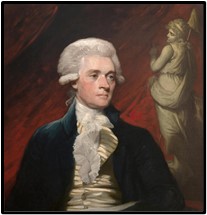
The American Revolution, those who were the major movers in it recognized, was an event singular in the history of the world. That the colonies could have both come together in unanimity to uprise against England and win its independence from their mother country through a sanguinary war were sufficiently singular happenings. After winning the war, the problem the Colonists faced was the problem that all revolutionary leaders face when their actions are successful: What now are we to do?
Most politically savvy Colonists conceded that the British manner of government, howsoever defective, was the best manner of government on the globe. Yet even the best government on the globe had its problems. The king and the parliament had passed numerous acts pertaining to the colonies without Colonists having any say in those matters. Jefferson limns, in his Summary View of the Rights of British America (1774) and Declaration of Independence (1776), the king’s “long train of abuses & usurpations pursuing invariably the same object”: despotism or treating the Colonists as slaves, not citizens. The American Revolution, thus, was for the sake of human rights, grounded on liberty and equality. Jefferson writes noteworthily in Notes on the State of Virginia:
Every species of government has its specific principles. Ours perhaps are more peculiar than those of any other in the universe. It is a composition of the freest principles of the English constitution, with others derived from natural right and natural reason.
To Jefferson, the American Revolution was an experiment concerning that “boisterous sea of liberty.” For republicanism to work, there needed to be many significant reforms so that all vestiges of artificial aristocracy needed to be removed for there to be government for and of the people. Their elected representatives would be culled on behalf of their genius and their virtue. To guard against corruption due to the bait of power, Jefferson mandated that the citizenry needed to be watchful of their representatives, each of whom governed for fixed terms. Again, there would be periodic constitutional renewal to be brought about by suitable delegates, not by those governing. The citizenry could be the chief governing body, because Jefferson assumed that all persons, born with a moral sense, were possessed both of an equal capacity for virtue and of adequate rationality to conduct their own affairs without governmental intervention. He was mating a Christianized ancient virtue ethics with the liberalism of his day, hence liberal eudaimonism and not just Classical republicanism or Lockean liberalism.
Republicanism was an experiment for Jefferson because it was not known if the people could, as it were, self-govern. Jefferson writes to Dupont de Nemours (24 Ar. 1816):
Experience has proved it safer, for the mass of individuals composing the society, to reserve to themselves personally the exercise of all rightful powers to which they are competent and to delegate those to which they are not competent to deputies named, and removable for unfaithful conduct, by themselves immediately.
The “experience” to which Jefferson refers is not that of the mass of individuals exercising all the powers of which they are capable. That has never yet been tried. It instead concerns what happens when the people do not govern themselves. Anyone in a position of power uses the masses to his advantage.
John Adams, Alexander Hamilton, and High Federalists insisted that they the hoi polloi could not self-govern. We return to Adams’ celebrated thought experiment. Let any 100 people begin a society and give each an equal vote/role. In due time, 25 of those persons will have handed over their vote to 25 others, whom Adams calls the natural aristoi. Jefferson makes it clear to Adams (28 Oct. 1813) that the real natural aristoi is of genius and virtue, not of wealth and blood. Jefferson adds that
that form of government is the best which provides the most effectually for a pure selection of these natural aristoi into the offices of government.
Wise and virtuous federal governors will govern with utmost disinterest and attend only to such matters to which the Constitution mandated that they attend: chiefly matters related to securing citizens’ rights and to conducting foreign affairs.
So committed was Jefferson to a weak federal government that he sometimes cared little about its necessity. He writes in 1783 to Barbé-Marbois (Dec. 5):
The constant session of Congress can not be necessary in time of peace, and their separation will destroy the strange idea of their being a permanent body, which has unaccountably taken possession of the heads of their constituents, and occasions jealousies injurious to the public good.
The sentiment seems to be that the need of the federal government was merely to conduct war with England. With the surcease of the war, it will be best for surcease of the federal government. There needs to remain only such a bond between the states to rally them to unity in the event of another major war.
Yet the Congress did not surcease, and while Jefferson was in France from 1784 to 1789, there was in America discussion of a constitution to supplant the Articles of Confederation. Jefferson’s two concerns, when given a draft of the proposed constitution, were no limit to the tenure of the executive and lack of any explicit expression of the rights of American citizens.[1]
The key to implementation of government of and for the people was thin, ramified government: a Constitution-bound federal government comprising states, state governments comprising counties, counties comprising wards which are self-governed. Citizens’ thirst for liberty was the trunk of ramified government.
“Liberty” in the civic sense, even if a derivative concept, occupied the most privileged place in Jefferson’s political philosophy, though it was ever heterotelic—that is, for the sake of human thriving or happiness, not for its own sake. Moreover, as we have seen, liberty in America was uniquely linked with land, hence Jefferson’s link of “liberty” and “empire” in certain letters apropos of America.
Jefferson first links “empire” with “liberty” in a letter to George Rogers Clark (25 Dec. 1780). The backdrop is Clark’s valiant efforts as leader of American troops in the Illinois Campaign (1778–1779) of the Revolutionary War, and his battles at and around Detroit thereafter.
If that Post [i.e., the fighting in the territory to the northwest of the colonies] be reduced we shall be quiet in future on our frontiers, and thereby immense Treasures of blood and Money be saved; we shall be at leizure to turn our whole force to the rescue of our eastern Country from subjugation, we shall divert through our own Country a branch of commerce which the European States have thought worthy of the most important struggles and sacrifices, and in the event of peace on terms which have been contemplated by some powers we shall form to the American union a barrier against the dangerous extension of the British Province of Canada and add to the Empire of liberty an extensive and fertile Country thereby converting dangerous Enemies into valuable friends.
Clark’s efforts in the Northwest Territory led the way for the Treaty of Paris (1783), which formally marked the end of the American Revolution, and a large parcel of land ceded to the United States by Britain. Jefferson writes Clark concerning future quiet on western frontiers. In the event of peace with garrulous European nations, the American union of states will become a “barrier against the dangerous extension” of British Canada, “intended … as a bulwark against republicanism.” It is here not so much what the fledgling “Empire of liberty” is, it is rather what it is not: an imperial power like England, which employs economic and naval coercion to sustain and distend its empire.
Jefferson’s next links “empire” and “liberty” vis-à-vis the United States in a letter, during term two of his presidency to Benjamin Chambers (28 Dec. 1805). The reference concerns acquisition of the Louisiana territories. He states:
The addition of a country so extensive, so fertile, as Louisiana, to the great republican family of this hemisphere, while it substitutes, for our neighbors, brethren & children in the place of strangers, has secured the blessings of civil & religious freedom to millions yet unborn. by enlarging the empire of liberty, we multiply it’s auxiliaries, & provide new sources of renovation, should it’s principles at any time, degenerate; in those portions of our country which gave them birth. the securing for you the peace & friendship of the various Indian tribes is among the highly valued advantages of this acquisition.
Last, Jefferson conjoins the two terms in a letter, just after his presidency, to President James Madison (27 Apr. 1809). Jefferson discusses acquisition of the Florida lands and Cuba.
That he [Bonaparte] would give us the Floridas to withold intercourse with the residue of those colonies cannot be doubted. But that is no price, because they are ours in the first moment of the first war, & until a war they are of no particular necessity to us. But, altho’ with difficulty, he will consent to our recieving Cuba into our union to prevent our aid to Mexico & the other provinces. That would be a price, & I would immediately erect a column on the Southernmost limit of Cuba & inscribe on it a Ne plus ultra as to us in that direction. We should then have only to include the North in our confederacy, which would be of course in the first war, and we should have such an empire for liberty as she has never surveyed since the creation: & I am persuaded no constitution was ever before so well calculated as ours for extensive empire & self government.
There are 17 states at the time—Vermont, Ohio, Kentucky, and Tennessee have been added to the original 13 states. Jefferson imagines here acquisition of Cuba and the Florida lands to the south and then the lands to the north, and bounded by the eastern part of the Mississippi River, in possession of the U.S. since the war: what are now Michigan, Indiana, Illinois, Wisconsin, and the northeastern part of Minnesota.
What of the objection that acquisition of Cuba will whet the hungriness for future acquisitions?
Cuba can be defended by us without a navy. & this developes the principle which ought to limit our views. Nothing should ever be accepted which would require a navy to defend it.
The sentiment is that need of a navy will necessarily fatten government by increase in federal expenditures, which is at odds with Jeffersonian republicanism, and also involve the country in the broils of Europe.
How would the new territories, ultramontane (and the mountains here are the Allegheny Mountains), best be zonated?
Jefferson addresses that question in an earlier letter to James Monroe (9 July 1786). He phrases the nodus in the form of this question:
How may the ultramontane territory be disposed of so as to produce the greatest & most immediate benefit to the inhabitants of the maritime states of the union?
That question is reduceable to another:
How may the territories of the Union be disposed of so as to produce the greatest degree of happiness to their inhabitants?
Would it be best to limit them to some 30,000 square miles, roughly the size of Pennsylvania, or allow them to be as large as 160,000 square miles, which is larger than today’s Texas?
Jefferson, upon considering the American people generally and circumstantially, asserts that such a large state would soon “crumble into little ones,” as is the case with small Native American societies.
They will not only be happier in states of a moderate size, but it is the only way in which they can exist as a regular society.
They certainly will not be happy that way, and so such enormous states, each sovereign, will tend to divide themselves. Thus,
they will end by separating from our confederacy & becoming it’s enemies.
Why is that the case, for it is certainly unclear how such enmity will follow from size and the need to divide?
If the Congress lays off them into small or moderate states, they will acquiesce, and we shall have the advantage of arranging them so as to produce the best combinations of interest.
The intimation here is that such divisions will be according to local interests, whereas in large states, various sectors will have different interests and that will force tensions and divisions. He continues,
Upon this plan, we treat them as fellow citizens, they will have a just share in their own government, they will love us, & pride themselves in an union with us. Upon the other [plan of allowing for large states,] we treat them as subjects, we govern them, & not they themselves, they will abhor us as masters, & break off from us in defiance.
Why must the federal government dictate over large states?
Jefferson does not fully explain, but the suggestion is that large states will be difficult to manage, because they will be riven by the tensions of the local passions of its various “districts,” here not used in a formal sense. That is the argument given in his Second Inaugural Address.
Enjoy the video below….
[1] E.g., TJ to James Madison, 31 July 1788, and TJ to William Short, 20 Sept. 1788.
The views expressed at AbbevilleInstitute.org are not necessarily those of the AbbevilleInstitute.





Jefferson’s concept of an empire of liberty made sense in view of the technology and superstructure of his era. His belief that the various sectors of large states would have different interests, and therefore would not combine into a threatening force, was nullified by better roads, trains, and the telegraph, which brought the various sectors together.
It was not nullified, but made much more difficult. What has been nullified is a way of thinking: states first v. nation first. Thanks.