

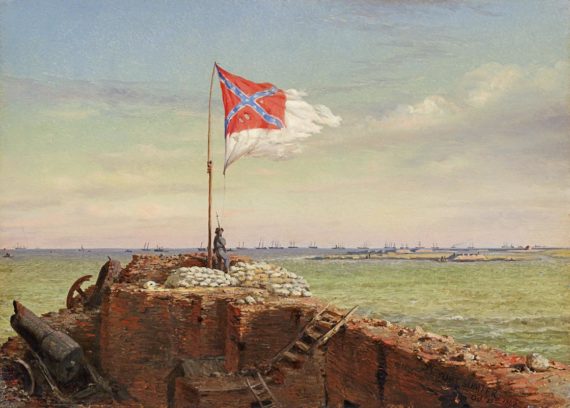
What does it mean to be “Southern”?
This question has vexed Americans since the founding.
Every American knew that sectional differences existed. George Mason, for example, worried that the “Eastern States” would plunder the agricultural States further south. He drafted an amendment that would have prevented “navigation laws,” i.e. protective tariffs, for that reason. Gouverneur Morris openly suggested that if the differences between the States were too great to reconcile in 1787, they should immediately part ways and abandon any hope of union.
That might have been a good thing, but with only around four million people huddled along the coast and threatened by hostile neighbors—both European and American—most Americans argued that some form of Union was necessary. So, Southerners and Northerners embraced federalism as a necessary component of sectional harmony.
The South could remain “Southern.” That reflected both economics and culture.
For some Americans, Southern revolved around the institution of slavery, though in 1776, every American State was a “slave State.” South Carolina and Georgia seemed to be wedded to the institution more fervently than the other States. Yet, George Washington openly complained that Great Britain did not return captured New York slaves at the end of the War in 1783.
Views on race were not unique to the South. Southerners were no more “racist” than their Northern compatriots, and perhaps, arguably, less so as they lived in a bi-racial society and mingled with black Americans on a regular basis. Blacks could vote in North Carolina until the 1830s, and nearly every early anti-slavery society originated in the South. Certainly, one could be anti-slavery and “racist,” and most Americans were, but familiar and interpersonal relationships created unique social dynamics in the South. In other words, neither race nor slavery created Southern culture or the Southern tradition and neither defined “Southern.”
It had to be something else. The coming of the War in the 1860s forced Americans to think about sectional differences, and again, slavery seemed to be the defining factor. That is the simple answer, but both Southerners and Northerners understood that slavery as an abstraction did not define the South or the Southern tradition. The conflict over slavery, as Jefferson Davis correctly insisted both before and after the War, was not a “cause” but an “incident,” a symptom of the deeper political, economic, and cultural divisions in the United States.
Loss forced Southerners to reflect on their “Southernness.” Most accepted defeat as part of God’s plan. They also knew that America had undergone a second revolution long before Eric Foner made that a popular thesis. So did other Americans. The “populist” revolt of the late nineteenth century took place because many Northern farmers understood that they cut a raw deal with Northeastern business interests. Southerners could smugly respond that they predicted the problem, but that didn’t solve anything. Tom Watson titled his populist newspaper The Jeffersonian, but he loved Robert Toombs, the old Whig who Watson believed personified the South. He said that Toombs was, “an Idol of the South because he carried in his hear the very passions, prejudices, hopes, aspirations, distinctive traits, habits, strength and weakness of the South; and every Southern man felt that here was a man who loved the South with all his mind and soul and heart, hating intensely everything and everybody who hated her.”
Toombs represented the “natural superiority of Southern politicians” as David Chandler wrote in 1977. Southerners embraced debate before football on college campuses—though they also helped define that element of collegiate life as well—and Southern culture forged a class of men who excelled at the art of politics and statecraft. Northerners whined of the uneven results of the three-fifths compromise in the United States Congress, but their chief concern was that their best rarely matched that of the South. Only Daniel Webster is remembered as a “great orator” from New England while Southerners once filled the annals of American history. Jealousy colored their scorn.
Of course, the South is not monolithic (and never has been), but there’s something in the mud that makes her people different, unique. Sam Ervin once said that “defeat allowed the South to shake the glory out.” By 1930, Southerners hoped to offer a critique of modern America, one that focused on regionalism, provincialism, and land. They couldn’t all be farmers, and many Southerners eagerly abandoned the plow for the factory. William Gilmore Simms, one of the greatest writers of nineteenth century America, was a city boy who admired the farm but never wanted to make that his profession. But the land did strengthen his character and his attachment to his people and his State. The Southerners who wrote I’ll Take My Stand in 1930 and Who Owns America? in 1936 thought there was something to it.
Simms was local, that old English tradition of the shire over the king. That bottom-up mentality held on in the South longer and more doggedly than in any other American section. Where your people are buried means something.
This is the larger appeal of the Southern tradition in 2025. It can be the principles of decentralization, the founding documents, or the “superiority” of historic Southern figures. It could be Southern manners, hospitality, or localism. Or it could just be the music, the food, or the accent. But the Southern tradition appeals to America and the world because it is fresh, unique, and authentic. That is what we hope to capture on a daily basis at the Abbeville Institute. If you enjoy our website, conferences, webinars, videos, books, and programs, consider a tax-deductible donation to our organization. Our enemies have unlimited resources. We have dedicated patriots like you.
Thank you for your support. Merry Christmas and Happy New Year.





‘Southerners were no more “racist” than their Northern compatriots, and perhaps, arguably, less so as they lived in a bi-racial society and mingled with black Americans on a regular basis.’
I agree with this sentence and the thrust of your essay. And I hope your quotation marks around “racist” are an acknowledgement of the ubiquitous Presentism in the use of that word (decades before the word’s invention) to describe mid-19th century Americans. Until fairly recently, all ethnic groups regarded themselves as superior to other ethnic groups, the way cardinals regard themselves as superior to robins. Southern and Northern Americans of that time were no different from the rest of the people in the world in their natural ethnic chauvinism.
“…the way cardinals regard themselves as superior to robins.”
The most difficult thing to sell (or persuade) to the modern “American” is the concept that the words “…all men are created equal” (by our Creator) don’t mean some precise value of a monolithic world of all things and beings whereby all are equal.
What a silly thing God would have done. And how boring would His creation be in forming such a thing. Magnolias are not Roses; dandelions are not ivy; men are not women; and no two men are equal; nor are any two of any flower or bird equal.
I personally believe, that while God laughs (we have been told that He cries), He is in no measure, silly.
Only men claim they can create equality. Men are silly. (Yankees more than most–JMO).
“…Southerners…Most accepted defeat as part of God’s plan.”
If that’s true, it was a great shame. God’s “plan” is to inform men that because of His Son’s work at the cross, there is no longer enmity between God and men. A reconciliation was accomplished. Men now, since the cross, have access to God to obtain salvation.
2 Corinthians 5:19 “…God was in Christ, reconciling the world unto himself, not imputing their trespasses unto them…”
God was neither for or against either side in that war between the states.
The professing Bible believer, if he or she doesn’t already know and understand, should carefully read Acts 2:16-20 in the KJB. Note that the “last days” were 2K some years ago. Then read Acts 2:33-36. See and understand what was happening then. Note especially the words about the ascended Son: He was to “sit” “until…” Then read Acts 7, and zero in on verses 55 and 56. Laser focus there on the word “standing.”
Well, the Lord didn’t continue on after standing. He didn’t unleash His wrath as was anticipated. He unexpectedly postponed the wrath and revealed His “secret” concerning the reconciliation.
God’s focus today, since Paul, is not any nation, not even Israel. He is forming the church the body of Christ which is going to govern the heavens.
One take on the three fifths compromise i learned from my parents. My mother was born and raised in Gainesville, Florida in the 1940s ans 50s. North Florida is still very much part if the Deep South, ecen more so 70 to 80 years ago . And my dad, although raised in NJ has a very pro-Southern view of history, perhaps because his father’s father came from thw Shenandoah Valley of Virginia or earning a history degree from LSU in the early 1960s. But no matter what i remember them discussing the 3/5 compromise.
The Southerners viewed the African slaves as fully sensient human beings created by God whereas the Northern view considered them as not human at all, something less and not deserving to be counted among God’s children
I have never seen this view discussed online anywhere
Granted they were still enslaved, but considering them as fully human is much farther along the way to respect, emancipation, and freedom.
As long as you have not only that political cause called the “left” AND the would-be brain trust called the “right” (for the most part they are not conservative nor historical) you will have little honest (or knowledgeable) discussion on your point (which is well-said, I believe).
And within these characters from L or R you get mental midgets like Bill O’Reilly or Mark Levine et bile.
I just saw a short video wherein Samuel (Sandy) Mitcham (class A historian and soldier) and the Kennedy brothers destroyed the fact-poor drivel of O’Reilly’s latest “killing something,” tome which denigrates Nathan Bedford Forest. But this is the kind of childish nonsense you will get when Southerners try to defend their heritage.
But there are miracles and perhaps some day one will happen and we will see these promoters of faux pas facts kicked in their mental butt (excuse my Yankee French)
I conjecture that the underlying rationale for the 3/5 credit in the census was the assumption that since taxes would be paid in proportion to the amount of property in each state…this gave the Southern states some credit for the higher proportional taxes/citizen Southerners were likely to pay as a result of owning more slaves than Northerners.
I realize the Federal tax ultimately ended up being mostly tariff and some excise tax. But during debates, this had not been established and a very large portion of the State tax collection was property tax, from which source requisitions constituted the income source under the Articles of Confederation.
We really need to address the elephant in the room, regarding the 1861 self-coup which is falsely called “The American Civil War,” in which the international government divided-and-conquered 34 sovereign nations through mass-deceiving 23 of them to claim de jure national sovereignty from the American Revolution.
So mass-propaganda naturally arose; as is the standard practice in any such misinformation-campaign ,to deceptively seize power by turning one side against another…. and then making truth the first casualty of war— as with the suspension of habeas corpus, to destroy free speech in the name of “silencing traitors” (i.e. FACTS) and saving the (non-existent) national union.
However legally, this self-coup only achieved de facto authority; while each state remains a de jure sovereign nation, which supersedes such domestic de facto claims in the international law hierarchy.
Simply put: the 1861–1865 actions constituted an illegitimate self-coup enforcing a false perpetual union—the military enforcement and Reconstruction occupation did not “legally change” state sovereignty (as no superior national authority legitimately existed to do so). Rather, it imposed de facto control through hostile occupation, suppressing the sovereign status of the states by force while retroactively denying their independence under a fabricated legal narrative. The states’ de jure national sovereignty remained intact in principle but was overridden by conquest, with occupation serving as the mechanism to enforce the illegitimate consolidation.