

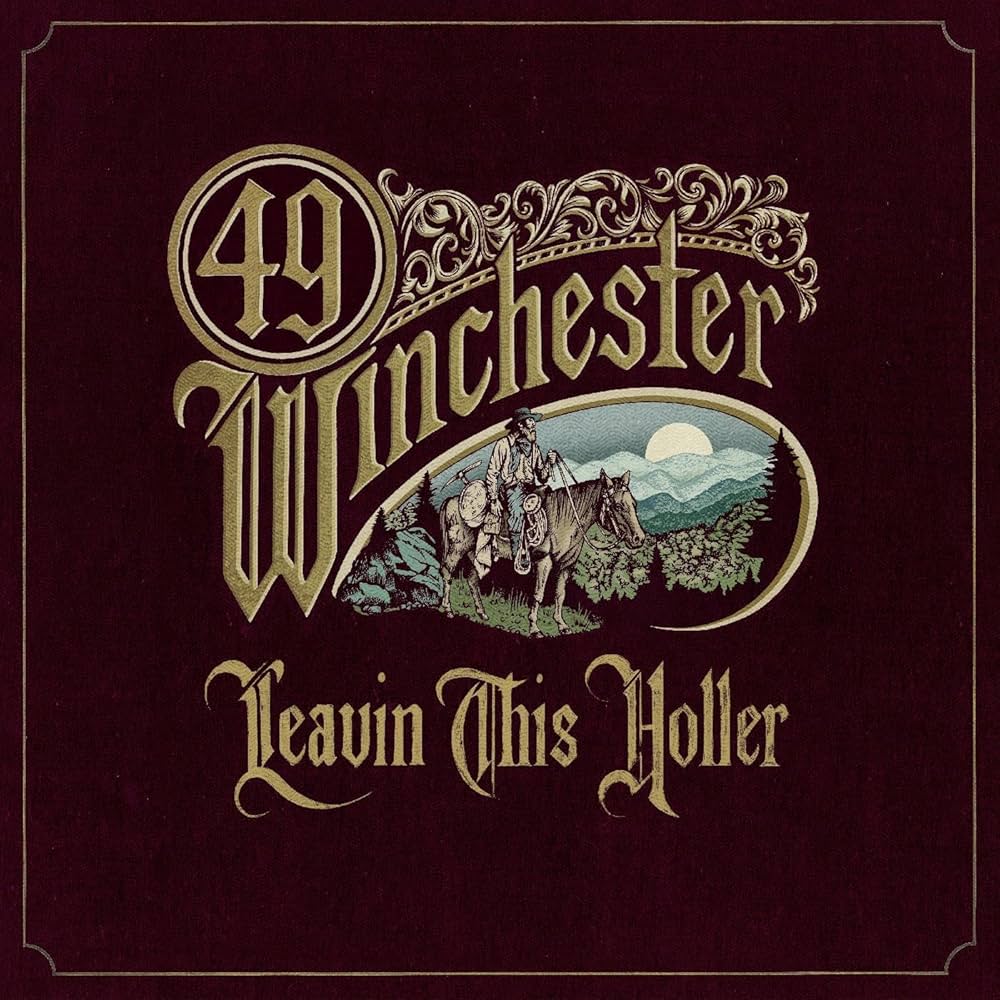
49 Winchester are a Southern band in the oldest, least marketable sense of the term. They are a group that formed because some guys in the same place played music together before they’d ever heard of tours and contracts. They come from Castlewood, Virginia, in the far southwestern corner of the state, an Appalachian region closer in spirit and history to eastern Kentucky or northeast Tennessee than to anything associated with coastal Virginia. The boys in 49 Winchester are hillbillies, and they say so themselves. Theirs is not a scene-driven story and not a migration-to-Nashville narrative. It is a local-band story, shaped by small rooms, familiar audiences, and the expectation that music should hold up under repetition and scrutiny rather than novelty. 49 Winchester is one of those bands that everyone has heard and thought, “Wow, those guys are good enough to really make it,” and did.
What are they? Is 49 Winchester a country band or are they a Southern rock band? The answer to that questions is, “Yes.” They are a Southern band whose roots are country, but whose posture is closer to Southern rock. Their songwriting is country, but not in the commercial or stylistic sense. They don’t chase after country radio production or Nashville expectations. At the same time, their functional sound is Southern rock. They have a multi-guitar attack with punctuation, and they don’t snap into three-minute singles. 49 Winchester is a Southern band that writes country songs and plays them like a rock band. They are often grouped loosely with the broader “Americana” or “independent country” ecosystem, but their music resists those labels. They do 49 Winchester, and let everybody else figure it out.
The band began as a working outfit playing bars and regional venues, learning their craft the slow way: by seeing what survived contact with real listeners. Southern musicians have a knack for playing to their audiences instead of performing at their audiences, and that background explains their defining traits before a single lyric is examined. Their songs are paced, their arrangements are tight, and their performances carry the confidence of musicians who expect to earn your attention. When they eventually entered wider circulation through recordings and touring, they did so without changing their sound, which is why their records sound like a band playing to people rather than at them.
For listeners encountering 49 Winchester for the first time, “Russell County Line” is the most direct point of entry, not because it’s flashy, but because it establishes their core concerns immediately. The song sings about home as something lived in rather than romanticized, and it treats movement and loyalty as forces that pull against each other without offering easy resolution. Equally instructive is “Second Chance,” which demonstrates how the band handles emotional material. The song is built around regret and persistence, but it avoids both melodrama and moral instruction, allowing the weight of the subject to emerge. Together, these songs show what the band values: narrative clarity, emotional accuracy, and the refusal to oversell experience. There are no lessons to be learned in these songs, but life to be lived.
At present, 49 Winchester occupy a space that many contemporary Southern bands aspire to but few sustain. They tour steadily, draw audiences that extend well beyond their home region, and continue to release records that sound like the natural extension of a working band rather than a rebranding exercise.
A useful example of their relaxed Southern sensibility is “Annabel,” a song whose effectiveness depends almost entirely on its refusal to hurry. From the opening bars, the tempo establishes a sense of time that is unpressured. The song moves the way an evening moves when nothing urgent remains to be done, yet nothing feels stalled or slack. The rhythm section holds steady without drawing attention to itself, allowing the listener to feel carried along. “Annabel” moves with a sense of motion that is cyclical, familiar, and reassuring, and the song keeps the listener engaged without demanding attention. In “Annabel,” the songs accepts relaxation and tension together within a broader, slower rhythm.
The vocal delivery of 49 Winchester reinforces this sense of relaxed time. The melodies sit comfortably in lead singer Isaac Gibson’s natural range, avoiding dramatic leaps or sustained climactic notes. Phrases unfold conversationally, shaped by breath, repetition, and and tone to accumulate meaning gradually.
That sense of relaxed control does not rest on the vocal alone. Chase Chafin, on bass, provides much of the band’s internal balance by favoring line and motion over punctuation. His playing outlines the chords with steady confidence rather than emphasize attack, giving the songs a grounded center that allows tempo to flex without losing direction. The bass is truly the band’s quiet anchor, keeping the groove conversational instead of declarative and ensuring that forward movement feels continuous rather than segmented.
On drums, Justin Louthian reinforces that elasticity through a restrained approach to keeping time. His playing emphasizes feel over precision, allowing small variations in push and pull that keep the rhythm human rather than mechanical. The backbeat is never aggressive, and fills appear sparingly, shaped to support transitions rather than announce them. This creates the impression of time being shared among the players instead of imposed from above, which is central to the band’s relaxed Southern posture.
That sense of relaxed control extends beyond the vocal into a clearly defined ensemble structure. Bus Shelton, on lead guitar, provides melodic commentary by shaping lines that extend the emotional contour of the song without competing for attention. His playing favors phrasing and tone over velocity, reinforcing the band’s preference for proportion and restraint.
Noah Patrick’s pedal steel adds harmonic color and sustain, supplying emotional shading without turning the songs into genre shorthand. The steel appears selectively and reinforces the band’s tendency toward openness rather than resolution.
Tim Hall, on piano, organ, and keys, deepens the harmonic field without crowding it. His parts are structural and textural, supporting both groove and harmony while remaining subordinate to vocal and narrative clarity.
Lead singer Isaac Gibson also plays rhythm guitar which is primarily foundational. It supports the vocal, establishes harmonic movement, and helps set the song’s pace. His playing is tied directly to phrasing and narrative, reinforcing the relaxed, conversational feel of the songs rather than driving groove or texture. So while there are two rhythm guitars in play, they are layered, not redundant: one supports the song’s telling, the other supports the song’s motion. That overlap is part of why the band sounds full without sounding busy.
The primary songwriter for 49 Winchester is Isaac Gibson. Gibson writes the majority of the band’s material, including their most widely recognized and thematically central songs. He accounts for the consistency of voice across the catalog: the conversational melodic contours, the restraint in phrasing, and the recurring focus on place, work, loyalty, and consequence. Even when songs shift in tempo or feel, they retain a stable narrative posture because they originate from the same lyrical and musical sense.
That said, the band operates as a collaborative unit in arrangement and development. While Gibson brings the songs in, it’s obvious that the final shape they take reflects group decisions about tempo, groove, harmony, and instrumental weight. The result is music that feels singular in perspective, which is why the songs retain the imprint of a working band rather than a singer supported by interchangeable players.
Taken together, these individual contributions explain why 49 Winchester has such a cohesive sound. Each member plays a clearly defined role, but none treats that role as a platform for self-assertion. The band’s authority comes from this shared understanding of knowing how to be a band. Each member knows how much to add, when to step forward, and when to let the song carry itself. That internal discipline is audible in every track and is essential to the band’s identity as a Southern ensemble built on feel, patience, and mutual trust. They give the strong impression that they would sound the same on a stage, in a bar, or on a neighbor’s front porch.
A clear example of their Southern groove can be heard in “Hillbilly Happy,” a song whose rhythmic authority comes entirely from feel. From the outset, the band establishes a shuffle feel that is steady enough to trust but loose enough to breathe. The forward motion never feels mechanical. The backbeat settles slightly behind the beat, giving the song a relaxed sway even as the tempo suggests movement. Subtle fluctuations in momentum appear as the song unfolds, small accelerations and relaxations that feel responsive rather than planned. The shuffle feel sits naturally in the pocket, producing a groove that feels comfortable.
49 Winchester almost always work inside functional major and minor tonality, even when the feel is relaxed and earthy. Their songs soften the dominant pull and avoid strong cadences. They consistently lean on pentatonic and blues-inflected melodies, but without abandoning major or minor key systems. The harmonic structure of their songs resolves exactly where functional harmony says it should, but does so gently. Across their catalog, 49 Winchester rely on an instrumentation palette that is deliberately practical rather than symbolic. Electric and acoustic guitars carry most of the weight, featuring rhythm parts that establish continuity and lead lines that comment without interrupting. Bass and drums operate as a unified foundation, prioritizing feel and forward motion over accent or display.
There is no attempt to decorate the arrangements with ornamental gestures or modern studio effects. Each instrument behaves like a tool with a specific purpose, entering when needed and exiting when its work is done. This ensemble-first approach places their sound within a Southern tradition where instruments exist to serve the song and the room rather than to announce identity.
In their music, the concept of “home” is strong and powerful, and is not treated metaphorically. “Home” is a physical and social environment that precedes the song and continues after it ends. Their lyrics return to known and familiar places, such as roads, hills, hollows, and towns small enough that memory circulates quickly. Land never appears as a symbol but as a setting, inseparable from churches, bars, kitchens, and familiar faces.
To 49 Winchester, home is where habits are formed, relationships develop and strain, and departure never fully severs connection. Even when characters leave, the land remains present as orientation rather than nostalgia. By folding geography, people, and custom into a single frame, the band presents home as something shaped by repetition and long exposure.
Taken as a whole, 49 Winchester doesn’t reinvent Southern music, but they still stand out because they practice it with coherence and discipline. Their songs rely on a flexible groove rather than rigid time, and favor melodic simplicity shaped by speech. Their instrumentation remains functional and ensemble-driven, avoiding both nostalgic ornamentation and modern gloss. The music of 49 Winchester assumes the listener is willing to stay present rather than be persuaded, and it rewards that patience with songs that feel lived in rather than constructed. They play as though Southern music is not an argument to be made, but a condition to be inhabited, and that quiet confidence defines the strength of the band.
The views expressed at AbbevilleInstitute.org are not necessarily those of the Abbeville Institute.





Wow. Thanks for turning me on to these guys.
Thanks. I like ’em.
Just listened to Annabel. I love this song! I also listened to Long Hard Life which is about a man who is having a rough time. When he find himself in jail, he asks, “Who’s gonna raise my ‘bacca; who’s gonna tend my corn?” This is a real country band! So glad to find out about them.
Cool song. The singer needs some time barefoot, so he can fix his gate. Thanks.