
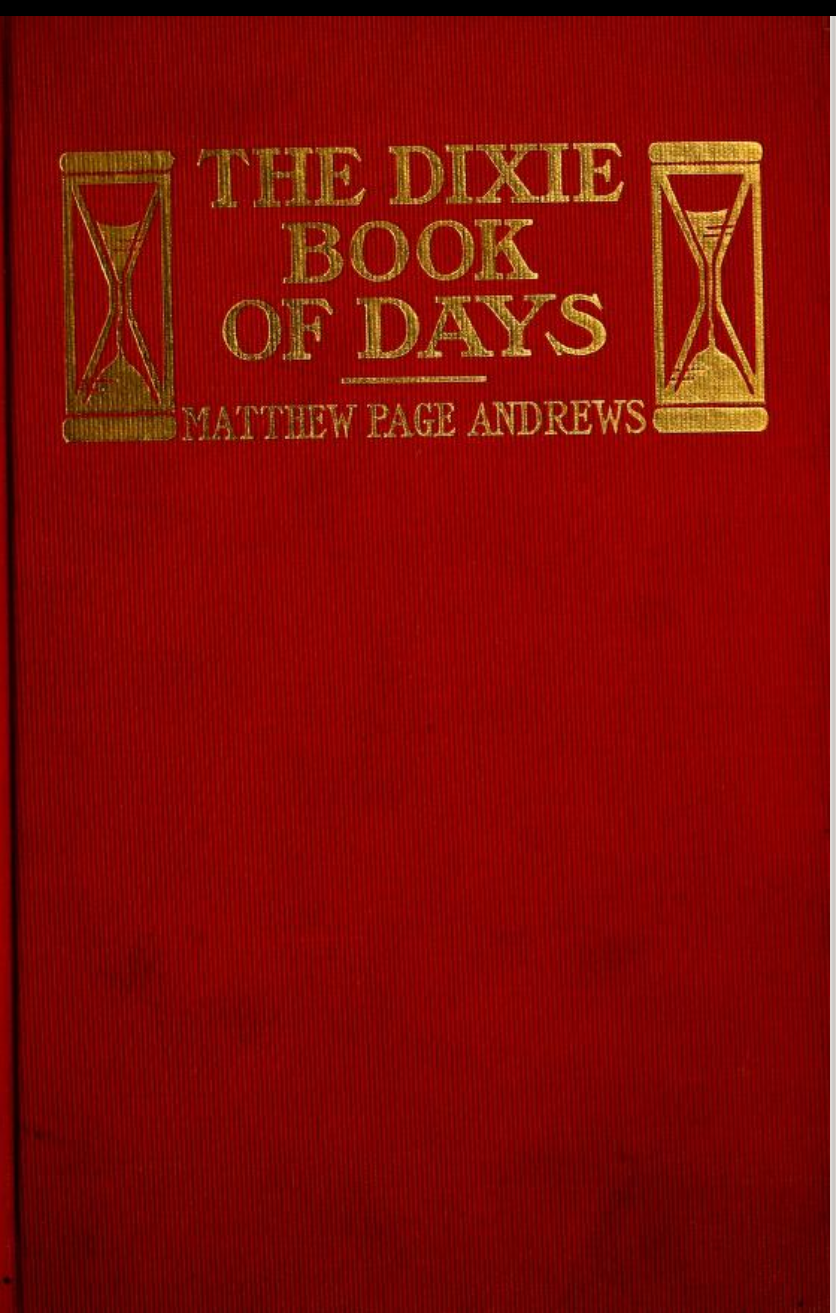
The Dixie Book of Days by Matthew Page Andrews, 1912
Like many of us today I receive the most interesting news and event notifications through group chats. In one of such group chats a friend sent a picture of a book with a succinct and articulate paragraph of one of the kindest epitaphs to receive: bravery, honesty, love of truth. The passage didn’t say who it was referring to, instead the title was January TwentySecond. Very odd. My friend didn’t go into detail; he just left the picture hanging silently – what a salesman! I took the bait. After a quick back and forth on the details, I bought the book. The passage was about LTG Thomas “Stonewall” Jackson. LTG Jackson had an even longer passage for the previous ‘day’ – his birthday. The name of the book is The Dixie Book of Days by Matthew Page Andrews, published in 1912.
How to explain what this book is? It is a time capsule showcasing the best qualities of Southern regionalism in its entirety. A political, history, or poetry lesson for every day of the year, and excellently curated by Andrews. The passages are mainly pertinent to an event in history on the ‘day’ the passage commemorates, but not always. For example, the day will be stated as the title, then a passage laid out, then the name of the described or honored event or person listed often with a side note.
The poetry selection is inspiring – and this comes from someone who seldom reads poetry. As Stark Young writes in Not In Memoriam, But In Defense, a man of culture (referring to Southern culture) possessed “a gentlemanly acquaintance with the classics, a whiff of the poets, or a respect for the polite degree of polish and cultivation, and a genuine taste for oratory…”” Of these four charges, The Dixie Book of Days will refresh a man’s acquaintance with America’s classics of history and literature, to include much about our American Iliad, and will offer a fine tasting of poetry beyond just a smell. The polish and oratory will be obvious within the pages.
I grew up within an hour’s drive of Lake Lanier, but never actually read any of Sidney Lanier’s poetry. I didn’t know about Theophilus Hunter Hill – the first published and copyrighted author in the Confederate States of America. I didn’t know the historical quotes where New England declared ‘states rights’ well before the Civil War. The Dixie Book of Days is edifying for those seeking greater study into regionalism, giving a view of the Old South through binoculars. It is ocean wide in scope but absolutely not puddle deep. My interest was piqued across multiple topics in rapid succession.
The history spans from the moment English explorers landed in Jamestown in 1607 up to Matthew Page Andrews’ day. Colonial events, Revolutionary War, War of 1812, Mexican War, Civil War, technological inventions, societal events, and so on. Literary wise there are omens to Edgar Allen Poe, folk and war song lyrics, famous speeches from the American Revolution, passages of prose from Southern authors – and all fitting nicely in the season in which these calendar dates take place. Despite being written over 100 years ago it does not come off as antiquated, it is still prescient today.
I originally started reading the book in one ‘month’ segments at a time, reading all the days of March, for example, when the actual first days of March arrived. But then I couldn’t put the book down and finished it rather quickly a week or so ago. I even read some of the naturalist poems to my kids at night, which was a hit, and is now something I need to continue. On that note – what better way to impart our history and literature to our kids than reading quick vignettes spanning dozens of topics? Each ‘day’ is different, and the duration of the passages are perfect for end-of-day reading. Plus, all ranges of emotion are engaged through the ‘days’ of the year, which speaks to Andrews’ keen eye and discernment for what to include, and who knows how much Andrews had to exclude.
Here is a sampling of a dozen ‘days’ across various topics worth sharing.
Biographies:
October Twelfth
LEE
He was a foe without hate, a friend without treachery, a soldier without cruelty, and a victim without murmuring. He was a public officer without vices, a private citizen without wrong, a neighbor without reproach, a Christian without hypocrisy, and a man without guile. He was Cæsar without his ambition, Frederick without his tyranny, Napoleon without his selfishness, and Washington without his reward. He was as obedient to authority as a true king. He was as gentle as a woman in life, pure and modest as a virgin in thought, watchful as a Roman vestal in duty, submissive to law as Socrates, and grand in battle as Achilles. Benjamin H. Hill
Robert E. Lee dies, 1870 Chief Justice Roger B. Taney dies, 1864
January Twenty-Second
Wherein, then, lay his strength, and what was the secret of his influence over all this land? I answer in one word—character. And what is meant by character? Courage? Yes; courage of his opinions, and physical courage as well; for he had a Briton’s faith in pluck. Pride of race? In a limited sense, yes. Honesty? The question is almost an insult. Love of truth? Yes, undying love of it.
George W. Bagby
(“The Old Virginia Gentleman”)
December Twenty-Third
The glory of your virtues will not terminate with your military command; it will continue to animate remote ages.
(President of Congress, to General Washington)
Washington resigns his commission as Commander-in-Chief, Annapolis, 1783
Regional history:
March Twenty-Seventh
Jamestown and St. Mary’s are both within the segment of a circle of comparatively small radius whose center is at the mouth of the Chesapeake. In this strategic region, the Jamestown experiment succeeded, after Raleigh’s head had fallen on the block; the
Revolution was fired by the eloquence of Patrick Henry, and was consummated at Yorktown; the War of 1812 was settled by the victories of North Point and McHenry; the crisis of the Civil War occurred; and seven Presidents of the United States were born.
Allen S. Will
Calvert’s Colony lands at St. Mary’s, 1634
Speeches:
May Twenty-Ninth
If we wish to be free—if we mean to preserve inviolate those inestimable privileges for which we have been so long contending—if we mean not basely to abandon the noble struggle in which we have been so long engaged, and which we have pledged ourselves never to abandon until the glorious object of our contest shall be obtained—we must fight! I repeat it, sir, we must fight! An appeal to arms and to the God of Hosts is all that is left us! Patrick Henry
Patrick Henry born, 1736
Reconstruction:
November Twenty-Second
The history of that period, of the reconstruction period of the South, has never been fully told. It is only beginning to be written.
Thomas Nelson Page
Convention in Louisiana disfranchising ex-Confederates, 1867
November Twenty-Third
But talkin’ the way I see it, a big feller and a little feller, SO-CALLED, got into a fite, and they fout and fout a long time, and everybody all round kep’ hollerin’ hands off, but kep’ helpin’ the big feller, until finally the little feller caved in and hollered enuff. He made a bully fite, I tell you, Selah. Well, what did the big feller do? Take him by the hand and help him up and brush the dirt off his clothes? Nary time! No, sur! But he kicked him arter he was down, and throwed mud on him, and drug him about and rubbed sand in his eyes, and now he’s gwine about hunting up his poor little property. Wants to confiscate is, SO-CALLED. Blame my jacket if it ain’t enuff to make your head swim.
Bill Arp
(To Artemus Ward)
Peculiar Politics:
November Twenty-Fifth
PROTEST AGAINST THE WAR OF 1812, NEW ENGLAND
The call of the Secretary of War for the militia of the States met blunt refusal from the
Governors of Massachusetts, Rhode Island, and Connecticut. The Assembly of the latter
State sustained its Executive in a formal address which denounced the war and declared Connecticut to be a free, sovereign, and independent State, and that the United States was not a national but a confederated republic. President Madison was held up as an invader of the State’s authority over her militia.
Henry A. White
Battle of Missionary Ridge, 1863
December Twenty-First
RESOLVED…. As the powers of legislation, granted in the Constitution of the United States to Congress, do not embrace a case of the admission of a foreign State or Territory, by legislation, into the Union, such an act of admission would have no binding force whatever on the people of Massachusetts.
(Resolutions of Massachusetts Legislature, 1845. Nullification?) [Andrews’ commentary]
President Tyler urges annexation of Texas, 1844
Technology:
September Seventh
OF JAMES RUMSEY, INVENTOR OF THE FIRST STEAMBOAT
I have seen the model of Mr. Rumsey’s boat, constructed to work against the stream, examined the powers upon which it acts, been the eye witness to an actual experiment in running water of some rapidity, and give it as my opinion (although I had little faith before) that he has discovered the art of working boats by mechanism and small manual assistance against rapid currents; that the discovery is of vast importance; may be of the greatest usefulness in our inland navigation, and if it succeeds (of which I have no doubt) that the value of it is greatly enhanced by the simplicity of the works; which, when seen and explained, may be executed by the most common mechanic.
Given under my hand at the Town of Bath, County of Berkeley, in the State of Virginia, this 7th day of September, 1784.
George Washington
Sidney Lanier dies, 1881
Poetry:
April First
Hidden no longer
In moss-covered ledges,
Starring the wayside,
Under the hedges,
Violet, Pimpernel,
Flashing with dew, Daisy and Asphodel Blossom anew.
Down in the bosky dells
Everywhere,
Faintly their fairy bells
Chime in the air.
Thanks to the sunshine!
Thanks to the showers! They come again, bloom again, Beautiful flowers!
Theophilus Hunter Hill
(Author of the first book published under copyright of the Confederate Government)
Battle of Five Forks, Virginia, 1865
May Thirty-First
SONG OF THE CHATTAHOOCHEE
… All down the hills of Habersham,
All through the valleys of Hall,
The rushes cried Abide, abide,
The wilful waterweeds held me thrall,
The laving laurel turned my tide,
The ferns and the fondling grass said Stay.
The dewberry dipped for to work delay,
And the little reeds sighed
Abide, abide, Here in the hills of Habersham,
Here in the valleys of Hall.
Sidney Lanier
If you made it this far, you’re now 3% finished with the book. These are only a few of the memorable passages, although any of the ‘days’ could be quoted here and stand alone as an adequate sample. Impactful, digestible, enlightening. The book is barely over 100 pages long, yet the quality condensed in this small amount of paper and ink is worth your investment in acquiring it. The reader is sure to expand in knowledge in some field, and the book will serve as an excellent repository of quotes for the writer, lover of argument, poet, and historian.
The views expressed at AbbevilleInstitute.org are not necessarily those of the Abbeville Institute.