

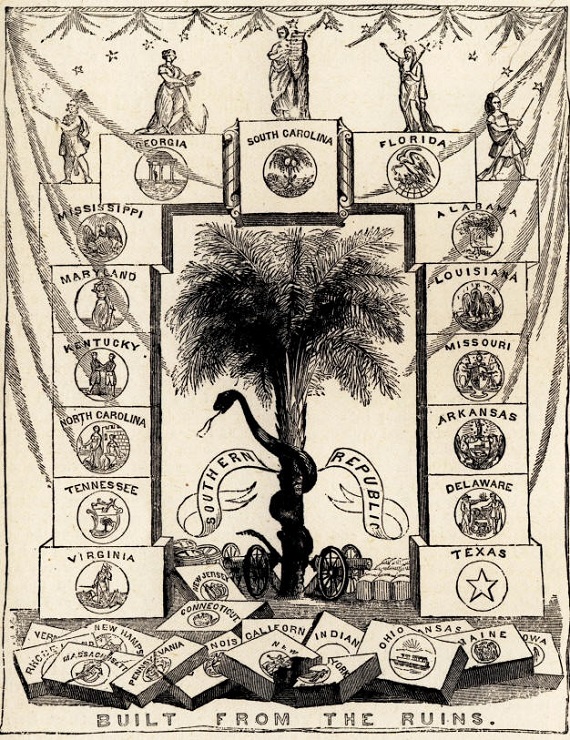
At our March 2026 conference on the Declaration of Independence, Daniel Miller, President of the Texas Nationalist Movement, explained how he asks one simple question when confronted by doubters and naysayers on secession: If your State was currently independent and with all that you know about the current government in Washington D.C., would you join the Union today?
He said the answer–from people on both sides of the political spectrum–is almost always a resounding, “No.” They are calculating the value of Union and find it wanting.
Polling data proves that secession is becoming more popular as the warfare State continues to bleed Americans dry. The “hustle economy” that has forced Americans into jobs they would never have considered just a couple of decades ago, particularly women who have sadly turned to online exploitation to earn some extra cash, is a result of inflation, high taxes, corruption, and modern corporatism. Strong one income nuclear families, the normal American condition before the 1980s, are nearly impossible in 2026. Americans feel economically, politically, and socially overwhelmed because the American unitary State has crushed the traditional American dream. The founding generation warned about this type of “consolidation” and “misconstruction,” and a substantial portion worried about the fusion of government, banking, and finance capital. “Diversity” as American States was a strength.
In fact, you could argue that every member of the founding generation was a reluctant secessionist. M. Andrew Holowchak’s recent article of Jefferson’s views of secession carried the right tone. Anyone who went to war with the British between 1775 and 1783 recognized the right to self-determination or the right of “secession.” But we forget that some, even the most ardent patriots during the War, made the decision reluctantly. John Dickinson hoped until the last that the union between Great Britain and America could be saved. George Washington served with distinction wearing the red coat and only came to conclusion that separation was necessary after “a long train of abuses and usurpations.” Conservatives dominated the First Continental Congress. As John C. Calhoun pointed out in final public speech in 1850, the founding generation moved to abandon their political connection with Great Britain only after it seemed all hope was lost. This is important as Calhoun considered himself to be a unionist to his final breath.
But no one thought secession was illegal. Not Jefferson. Not Washington. Not Gouverneur Morris who wrote the final draft of the Constitution through the Committee of Style, or Timothy Pickering who helped start the war in Massachusetts. In fact, Washington, like Edmund Randolph who famously refused to sign the Constitution at Philadelphia in September 1787, favored ratifying the Constitution because they worried about secession. If Virginia refused to ratify the document, both Washington and Randolph understood that Virginia would be an independent State free from the bonds of Union but also subject to the potential invasion of Great Britain. The Union offered protection and therefore was preferable to independence in 1788. That was the point. The Constitution and previous Articles of Confederation created a common umpire for the preservation of the States and the people thereof. But when that umpire ceased to call a fair game and instead rigged the rules for one group of States over another, Calhoun argued that the South had no choice but to choose independence. Yet, he did so with a heavy heart.
Even in 1860 and 1861, many Southerners cast a vote for independence with reservation, just as their fathers and grandfathers had done in 1776, and while cannons blasted, crowds cheered, and newly designed flags waved, their hearts still longed for the original Union. Howell Cobb suggested the Southern Union be called “The Republic of Washington,” while the Confederate Constitution of 1861 reflected Southern devotion to the original understanding of the United States Constitution.
All of these men calculated the value of Union and found it to be deficient. This does not make them traitors or un-American. The opposite would be true. Jefferson could be concerned about the potential effects of secession on Virginia or the rest of the Union and still agree that it was not only legal but possible and preferable under the proper conditions. He was not alone in that sentiment. The founding generation, like their sons and grandsons in 1861, were men of action in a time of action who carefully weighed the benefits and burdens of union and decided independence was the rightful remedy.
Those who advance secession in the twenty-first century follow the same path. When Representative Antonio Parkinson of Memphis, Tennessee recently raised the prospect that Memphis should secede from Tennessee, he was acting squarely within the American tradition of self-determination. We can debate the legal parameters of city rather than State secession, but Parkinson tapped into what William B. Travis called the “American character” at the Alamo in 1836.
Most Americans love the flag, the symbols, the Constitution, and their shared history, but as Miller has discovered, trillions of dollars of debt, endless foreign wars, replacement immigration, political corruption and executive government, centralization of power, and a stagnant economy have forged a new generation of “reluctant secessionists.” That is very Jeffersonian of them.
The views expressed at AbbevilleInstitute.org are not necessarily those of the Abbeville Institute.





The acceptance and belief in 1788 was that:
“The Constitution and previous Articles of Confederation created a common umpire for the preservation of the States and the people thereof.”
Today the acceptance and belief is that:
“The Constitution and previous Articles of Confederation created a common EMPIRE for the SUBJUGATION of the States and the people thereof.”
Fine essay, Brion. Dan Miller will be the guest on my next show, The Real Thomas Jefferson, on YouTube. You will get it on Abbeville….
Excellent points. It’s almost comical how people acknowledge the value of self-determination but reject actual efforts to assert it.