

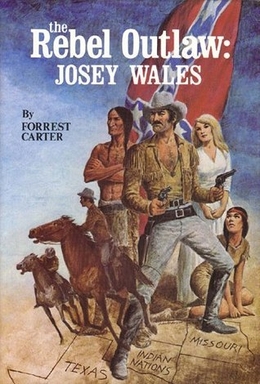
There’s much more to the story of Josey Wales than what you saw in the hit movie starring Clint Eastwood.
The novel is an underrated gold mine of adventure, Southern history, and human pathos. The Rebel Outlaw: Josey Wales by Forrest Carter was published in 1972, and later republished as Gone to Texas. The movie The Outlaw Josey Wales was released in 1976.
Josey Wales, a farmer from Tennessee who’s settled his family in the rugged Missouri border lands, gets caught up in the Civil War when Union militia kill his wife and son. Like many other Southerners who lost loved ones in such raids, Josey joins the bushwhackers, pro-Southern guerillas seeking justice and vengeance. But when the war ends, Wales declines a pardon and the chance to return home, instead choosing to make his way to Texas. He and his partner first rob a bank, a legitimate target, says Josey, since they will go after a “Carpetbagger bank, Yank Army payroll.”
The bank robbery ends with his partner getting shot, and a huge bounty on Josey’s head. Evading amateur and professional bounty hunters, US Army patrols, and hostile Comanches, Josey resorts to all the skills and tricks of the guerilla fighter. One of the pleasures of this novel is the wealth of detail about guerilla tactics, firearms, and the grim, yet captivating Texas landscape.
The narrative is further enlivened by its solid foundation in the history of the era, a hallmark of the best historical fiction. As grim and ruthless as Josey must be as he faces off and guns down his pursuers, his backstory provides convincing motivation for his actions:
When Union General Ewing issued General Order Eleven to arrest the womenfolk, to burn the homes, to depopulate the Missouri counties along the border of Kansas, the guerilla ranks swelled with more riders. … Union raiders launching the infamous “Night of Blood” in Clay County bombed a farmhouse that tore off the arm of a mother, killed her young son, and sent two more sons to the ranks of the guerillas. They were Frank and Jesse James.
Missouri was caught in the fault line between North and South, with large portions of its population on one side or the other. That, combined with the state’s vital position on the Mississippi River and as the home of the major port of St. Louis, made the contest for Missouri compelling and full-blooded for both sides.
Despite his cold efficiency in battle against his enemies, Josey risks his life for friends and those in need, including two women captured and brutalized by Comancheros. His efficient and deadly dispatching of those who would kill or capture him arise not from some abstract evil, as his enemies claim, but from what had been taken from him. Josey’s partner Lone Watie explains:
“That’s why Josey knowed he could whup them Comancheros. Josey is a great warrior. He loves deep … hates hard, ever’thing’s that killed what he loves. All great warriors are sich men.” Lone’s voice softened. “It is so … and it will always be.”
The prose that enlivens this book perfectly suits the harsh yet strangely enchanting setting, which includes not just the hilly forested land of the Piney Woods and the grassy plains, but the passions and high drama of Reconstruction. Carter’s writing is vivid, athletic, and unpretentiously elegant Even death takes on a strange beauty. When a professional bounty hunter goes for his gun against Josey, the deadly ballet of a gunfight unfolds with frightening quickness and grace:
Now the bounty hunter’s hand swept for his holster, sure and fluid. He was fast. He cleared leather as a .44 slug caught him low in the chest, and he hammered two shots into the floor of the saloon. His body curved in, like a flower closing for the night, and he slid slowly to the floor.
I will end with this note: I’ve re-read maybe a dozen novels in my time. This was the only book I re-read immediately after finishing it the first time.
The views expressed at AbbevilleInstitute.org are not necessarily those of the Abbeville Institute.





Great essay, Mike! I absolutely LOVE this book, and I think I have four copies of it. Whenever I see it in an estate sale, I buy it so that it doesn’t end up in the hands of a Yankee. If I remember the story correctly, the initial press run of Carter’s book was less than 100 copies, and Clint Eastwood’s producer, Robert Daley, got hold of one of them, and the rest is history. Eastwood used his own personal money to buy the film rights.
Thanks, Tom. I hadn’t heard how Clint learned about Carter’s work. I’m glad Daley brought it to Clint’s attention. The result was a classic.
My family is always proud to tell that our cousin, John Davis Chandler, played the role of the unfortunate bounty Hunter. You know, “a man’s gotta do something for a living!”
He was my mom’s first cousin. Thank you.
Joe Ferguson, Virginis SCV
That was a brief but unforgettable scene. I know you’re proud.
If I am not mistaken, the full name of the author of the book is Bedford Forrest Carter. Great book, and great movie. Historically accurate in details (a rareity for Hollywood.)
Carter’s grasp of history, Indian culture, and guerilla tactics is amazing.
Mike, my apologies for the quick question. I’m just short of time. What happened to your LS Rebellion Blog? I loved it. I miss it. Any plans to resurrect it?-JU (you knew me by another name, before I was raised from the dead to fight Yankees). You are sorely missed. Please post more often here.
That’s ancient history. We were not ready for the political arena.
Thank you. I still post on my writing blog, and definitely plan to contribute here more often.
“Forrest” Carter was actually Asa Carter from Alabama. Look him up, he had an interesting past.
Interesting indeed. Worked for Gov. George Wallace as a speechwriter.
I saw the movie but never read the book. Visited the James home/museum in Liberty years ago. It was an eye opener. Jesse’s picture at the beginning of the war with him being so young was riveting. Well written. I just ordered the book. Will share it with my grandsons. The oldest is about to enter 7th grade and I want to do some damage control before he gets the Yankee indoctrination formerly known as history, until it wasn’t.
The movie was great, but the book is better. I am convinced one of the major reasons literacy skills are so low is the insipid and unmanly texts forced on young people, especially boys. Your grandsons are lucky.
Wonderful article. Thank you. Favorite lines from the movie: “Wales is a man of the feud”; and “Lyin’ Blue scum bellies”. The second quote certainly is accurate as history has shown.
Those are great quotes. My favorite is when Josey’s attacking the Comancheros. One of the captive women hears a bloodcurdling sound: “The sound came from the throat of Josey Wales … the Rebel yell of exultations in battle and blood … and death.”
Yes. Great quote.