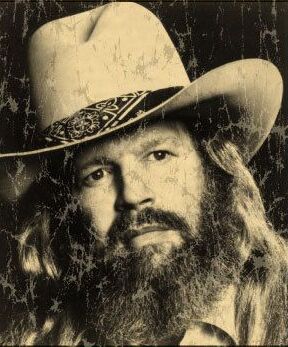
David Allan Coe died. If you’re looking for a clean, agreeable tribute, this ain’t it. Those are easy to find, and they all follow the same predictable pattern of dates, albums, controversies, and a polite nod about his influences. That kind of writing treats a musician like a museum exhibit: labeled, contained, and ultimately harmless. David Allan Coe was a lot of things, but he was never harmless. No, what you’ll find here is something different — the perspective of a fellow musician who played plenty of David Allan Coe songs in loud, smoky bars, and understood exactly what Coe was doing.
The first thing you need to know is that David Allan Coe was not from the South. He was born in Akron, Ohio, and spent the better part of two decades in jails and prisons before he ever set foot in Nashville. The second thing you need to know is that none of that is important, because David Allan Coe became the South in a way that most people born here never manage. He didn’t inherit it. He chose it. For my money, there is something deeply, profoundly Southern about a man who decides who he is and then refuses — under any pressure, from any direction, for any reason — to be anybody else. That’s the thing about the South that outsiders never quite get. We’re not asking you to be born here. We’re asking you to mean it.
David Allan Coe meant it.
He rolled into Nashville in 1967 and parked a hearse in front of the Ryman Auditorium, which is one of the all-time greatest entrance statements in the history of American music. It still makes me laugh every time I think about it. He wasn’t polished. He wasn’t packaged. He was exactly what he was, without a single one of his past’s serial numbers filed off. The Nashville establishment of that era wanted glossy, wanted pretty, wanted controllable. David Allan Coe showed up looking like a carnival and sounding like a thunderstorm, and he never once apologized for it. That defiance — that bone-deep refusal to smooth out your rough edges to fit someone else’s frame — is as Southern as red clay and sweet tea.
I want to be careful here, because this is the part where a lot of tributes go sideways. David Allan Coe was not a perfect man. He said things and did things that are often criticized, and I’m not here to offer explanations, apologies, or whitewash for of that. But the artistic lesson of David Allan Coe is entirely separate from whatever personal sins he’s credited with, and the artistic lesson is this: there is a kind of courage in absolute authenticity that the modern world is desperately short of. You can disagree with a man’s choices and still recognize that he never flinched. Not once. That’s the biggest lesson I ever learned from him.
“Longhaired Redneck” wasn’t just a song. When he sang about being told he looked like Merle Haggard and sounded like David Allan Coe (I still can’t sing that line without cracking up), he wasn’t being arrogant — he was planting a flag. He was saying, I exist. I am a real thing. You may not like me, but here I am. The South has always understood that kind of stubborn, roots-deep identity, because the South has spent a very long time being told by everyone else what it is and what it ought to be. Coe didn’t negotiate. He never had any interest in being invited to the table on somebody else’s terms.
What strikes me most, when I think about his place in Southern music, is that he wrote the songs other people became famous for. Most notably, “Take This Job and Shove It,” was made famous by Johnny Paycheck, and “Would You Lay With Me,” was made famous by Tanya Tucker. Coe did it without bitterness that their names went on the marquee instead of his. He knew his own worth. He kept moving. I’ve spent a lifetime trying to learn self-possession and self-confidence like that, and Coe had it in abundance.
I once played a bar in Columbus, Georgia, with a forgotten country band, and we realized that David Allan Coe had scratched his name into the wall backstage. Standing in that same cramped, dim space before a set, I understood something — he’d stood right there, in that same nervous pre-show quiet, and felt the same thing every musician feels before the lights come up. He just happened to be David Allan Coe. His music was never meant for concert halls or award shows. It belonged in places with bad lighting and sticky floors and a bartender who’s heard everything. I’ve played his songs in exactly those places, and I can tell you — a room full of hard-working people who’ve had a rough week will respond to David Allan Coe like he’s saying something they never had words for. Because he was. And when those people call out for a song by Coe, you don’t argue. You play it.
He called himself the Mysterious Rhinestone Cowboy. He called himself the Original Outlaw. To be honest, he called himself just about whatever he felt like calling himself on any given day, and the remarkable thing is that all of it was true simultaneously. The South is like that too — contradictory, bigger than any single story about it, and impossible to reduce to one clean sentence. Coe never tried to reduce himself, and that’s why he fit in so well as an adopted Southerner.
The song most people associate with David Allan Coe — “You Never Even Called Me By My Name” — he didn’t even write. That was Steve Goodman and John Prine (they only thought they’d written the perfect country and western song). But the way he sang it, you’d never question for a second that was his song. Any singer can perform a song. It takes something rarer to permanently attach your name to somebody else’s words — to sing it so completely that the song stops belonging to its writers and starts belonging to you. David Allan Coe did that. He had that kind of possession.
There’s another song he recorded called “The Ride” — he also didn’t write this one, either, but he made it all his in 1983 — about a hitchhiker who gets picked up on a dark highway by the ghost of Hank Williams. At the end, Hank looks at this kid and essentially says: you’re the real thing. You belong in this line. That song always struck me as more autobiographical than fictional. David Allan Coe spent his whole life auditioning for that moment — proving he belonged in the company of the greats not by being polished or proper, but by being undeniably, irreducibly himself. I think Hank would’ve pulled over.
He’s gone now, and the ones who’ll miss him most may not even know why. They’ll just feel it — that particular silence where a certain kind of unapologetic Southern noise used to be.
Ride on, David Allan Coe. You already know where you’re going.
The views expressed at AbbevilleInstitute.org are not necessarily those of the Abbeville Institute.




Both popular and country music are full of fake rebels and wannabe outlaws. Coe was the real thing.
Mike, he was definitely the mold. Willie and Waylon were outlaws in the music business. David Allan Coe was just pure OUTLAW.
Ohio Copperheads were a thorn in lincolon’s side.
In my former life, I was a police officer working a music event where Coe was playing. We were outside, working traffic and standing by his tour bus. We could hear him pretty clearly from inside the small event house (it was an actual house with a stage inside). For some reason, he got mad and walked off the stage. When he came out to his bus, there we were, five blue suits, which he probably didn’t care for. He looked at us and said, “What the f**k do you want?” I said, “Well Mr. Coe, us cops like your music too.” He said, Well, thank ya, ” and stuck out his hand. We shook hands and he got on his bus. He was a legend and I’ll never forget that night.
Keith, I love this story. Outside those trailers and buses are where you get to see the real human being inside the package.