

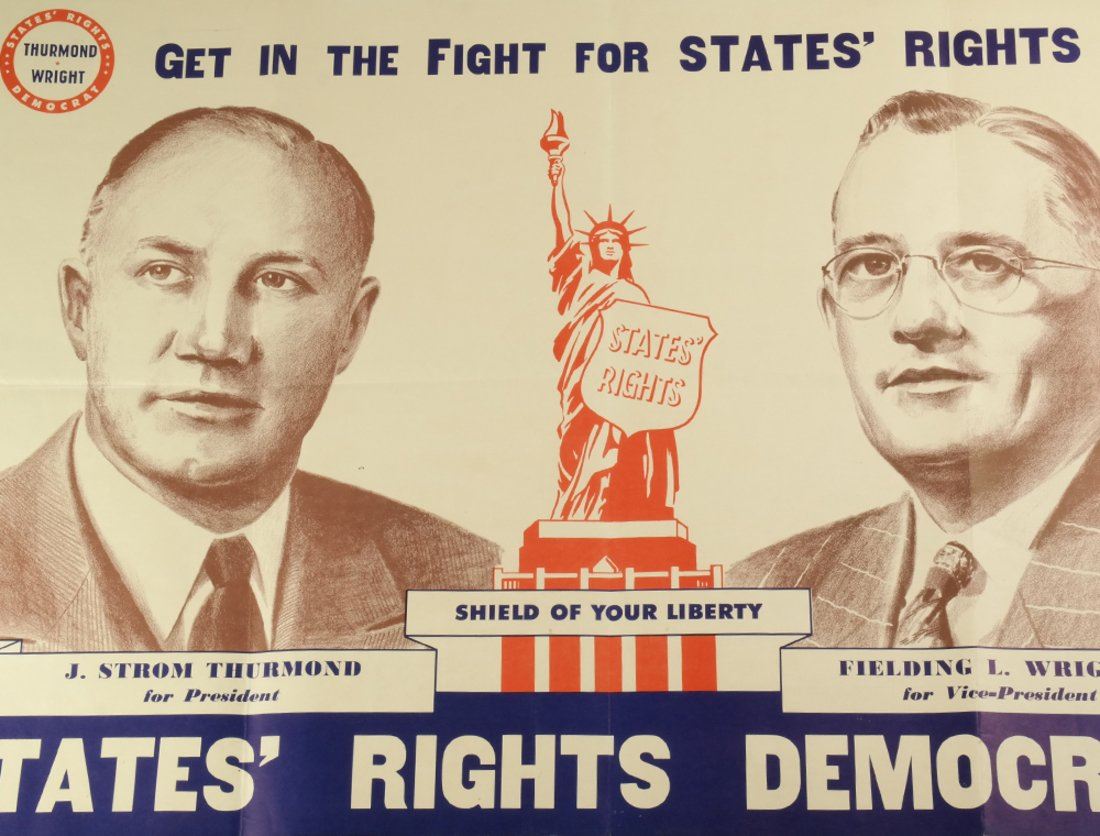
In the 1940s, the Democratic Party was fractured by a dispute that eventually split the party into factions. On the surface, as described by the New York Times in 1939, the issue concerned the specifics of the New Deal. The moderates or “conservatives” supported limited federal interventions, while the “liberals” were pushing for a much more expansive interventionist program. The conservative Democrats, like the Republicans, opposed high taxes, high spending, the growing bureaucracy, and the rising police state enforcing economic and social equality in both public and private life.
There was also a deeper feud within the Democratic Party concerning the respective constitutional roles of federal and state government. By 1948 a faction known as the States’ Rights Democrats broke away and launched a political platform championing what they called “human liberty” and opposing what they called “the totalitarian, centralized bureaucratic government and the police nation called for by the platforms adopted by the Democratic and Republican Conventions.”
Although the States’ Rights Democrats were described by NYT as “old-line Southern leaders” or “traditional Southern conservatives”, Michael Martin argues that “the States’ Righters saw themselves as a National party, looking to prevent something like secession.” Indeed, as previously discussed, John C. Calhoun promoted the doctrine of states’ rights as a way to prevent sectional conflict from spiraling into disunion.
The NYT reported in 1948 that one reason why Strom Thurmond was not keen on the States’ Rights Democrats being labelled “Dixiecrats” was that he felt it wrongly depicted the states’ rights doctrine as one that concerned the South only. It is often, wrongly, supposed that the doctrine of states’ rights is specifically Southern. But, as Professor Edward S. Corwin shows in his book The Commerce Power Versus States Rights, it is a general constitutional doctrine.
Corwin illustrates his argument with examples from Justice McLean, whose arguments “are as strongly assertive of the doctrine of exclusive State powers as are those from the Southern Justices.” Corwin’s point is that the general doctrine of states’ rights, read in light of the Tenth Amendment, concerned the balance of federal and state power in the Constitution – it was not a doctrine of relevance only to “certain peculiar institutions of some of the States”. Justice McLean explained the principle as follows:
“The States, resting upon their original basis of sovereignty, subject only to the exceptions stated, exercise their power over every thing connected with their social and internal condition … Over these subjects the Federal government has no power. They appertain to the State sovereignty as exclusively as powers exclusively delegated appertain to the general government.”
The political platform of the States’ Rights Democrats was set out in an eight-point platform. The first point depicted the Constitution of the United States as a charter of human liberty. The second highlighted the importance of protecting constitutional rights.
The third point asserted that “social and economic justice” is “guaranteed to all citizens only by a strict adherence to our Constitution and the avoidance of any invasion or destruction of the constitutional rights of the states and individuals.” In one of the most important planks of this platform, it also expressed opposition to “the totalitarian, centralized bureaucratic government and the police nation called for by the platforms adopted by the Democratic and Republican Conventions.”
As matters turned out, the next three points proved to be the most politically controversial, as they related to racial segregation. The fourth point is worth producing in full to illustrate the contention:
“We stand for the segregation of the races and the racial integrity of each race; the constitutional right to choose one’s associates; to accept private employment without governmental interference, and to earn one’s living in any lawful way. We oppose the elimination of segregation, the repeal of miscegenation statutes, the control of private employment by Federal bureaucrats called for by the misnamed civil rights program. We favor home-rule, local self-government and a minimum interference with individual rights.”
The fifth point followed by expressing opposition to “social equality by Federal fiat” and the sixth adverted to the fact that the South would be disproportionately affected by proposed civil rights laws due to the “appreciable numbers” of black people compared to, for example, states like Montana and Wyoming which even today are about 1% black.
The seventh and eighth points related to constitutional checks and balances and the opposition of States’ Rights Democrats to federal control, totalitarianism, and the growing police state, emphasizing their primary concerns. In retrospect, it is unfortunate that these concerns about liberty and constitutional limits on federal power were woefully overshadowed by confected outrage over the racial segregation platform. Michael Martin points out that the campaign to bury the States’ Rights platform under a furor of controversy about “racism” was deliberate:
“For these same reasons, Strom Thurmond was labeled a simple firebrand segregationist in order to diminish the wider political statement of the States’ Rights Democrats ticket in 1948. Thurmond was trying to wake Americans up to the reality that totalitarianism can (and would) happen in America. This is why the following planks were inserted into the States’ Rights Democrats platform:
We oppose the totalitarian, centralized bureaucratic government and the police nation called for by the platforms adopted by the Democratic and Republican Conventions…We favor home-rule, local self-government and a minimum interference with individual rights…We oppose the usurpation of legislative functions by the executive and judicial departments. We unreservedly condemn the effort to establish in the United States a police nation that would destroy the last vestige of liberty enjoyed by a citizen.”
In drawing lessons from that history, three points may be made about the constitutional protection of individual liberty under the doctrine of states’ rights.
First, we reiterate Calhoun’s argument that the balance between federal and state power is central to the constitutional protection of individual liberty. This is why Murray Rothbard described Calhoun in For a New Liberty as “one of America’s most brilliant political theorists” – Calhoun saw the importance of constitutional limits on federal power in protecting citizens from state tyranny.
Second, we observe that the States’ Rights Democrats correctly linked the segregation question to “the constitutional right to choose one’s associates; to accept private employment without governmental interference, and to earn one’s living in any lawful way.” The principle here is, once again, that of individual liberty – freedom of association and contractual freedom. Their opposition to “social equality by Federal fiat” is key. Again, this is why Rothbard supported Strom Thurmond. This surprised people who did not know that the States’ Rights platform was primarily a defense of liberty. Martin quotes Rothbard’s letter to Thurmond:
“Perhaps this sentiment was best seen in the political commentators at the time that supported Thurmond, like the Jewish libertarian Murray Rothbard, who wrote in a letter to Thurmond that ‘There are millions of Americans, who would flock to your banner. They are weary of being led by the nose by New Deal politicians of both parties – they are tired of being deprived of their votes because there is no anti-socialist and pro-liberty party to which they can turn’.”
The third lesson relates to where the platform erred – it should have gone further to reject all forms of state intervention in private life and all forms of state coercion of citizens. Individual liberty goes both ways. Citizens should neither be forced by the state to associate with others against their will – as enforced under civil rights legislation – nor prevented by the state from associating with those of their choice – as was the case under segregationist Jim Crow legislation. On the inter-racial marriage issue, the States’ Rights Democrats were right to argue that states were under no constitutional obligation to endorse such marriages, but by the same token, states should not have banned such marriages. The end result would be the same, namely that anyone wishing to undergo such a marriage would have had to do so in a liberal jurisdiction such as Washington DC or New York. That is the logic of states’ rights, namely that states do not all have to have the same laws.
It would, of course, be expected that conservative states and liberal states would differ on matters of tradition and moral principle. Most of the conflict between sections arises when liberal states attempt to impose their views on conservative states “by Federal fiat”, as the States’ Rights Democrats put it.
In conclusion, it is fair to note that in later years, as Michael Martin observed, the States’ Rights Democratic leaders including Strom Thurmond resiled from the segregationist plank of their platform.
The views expressed at AbbevilleInstitute.org are not necessarily those of the Abbeville Institute.








To trace the path of the communist movement in the US, merely follow the black vote. Blacks voted for radical republicans and then moved over to the demonic dims.
Correct.
The 14th amendment is unconstitutional and used to promote evil and destructive reforms.
Correct.
If only the party had stuck around to form a bloc in Congress.
Good point.
Thanks for this! Someone who was part of the 1930-1940s US political world and receives little notice is James W. Ford, the first black candidate on a presidential ticket (CPUSA with William Z. Foster). Ford was hailed as a leader who would help emancipate all those oppressed by the yoke of capitalist rule.” Though pro-Soviet VP Henry Wallace was removed from FDR’s ticket in 1944, it may be fair to link the CPUSA with forcing FDR, and later Truman in 1948, into accepting so-called civil rights into the Democratic platform in 1944. This certainly had much to do with the rise of the so-called Dixiecrats. Interestingly that South Carolinian Jimmy Byrnes, an important part of FDR’s administration, was passed over for VP as he was a Southerner. Truman was considered safe.