

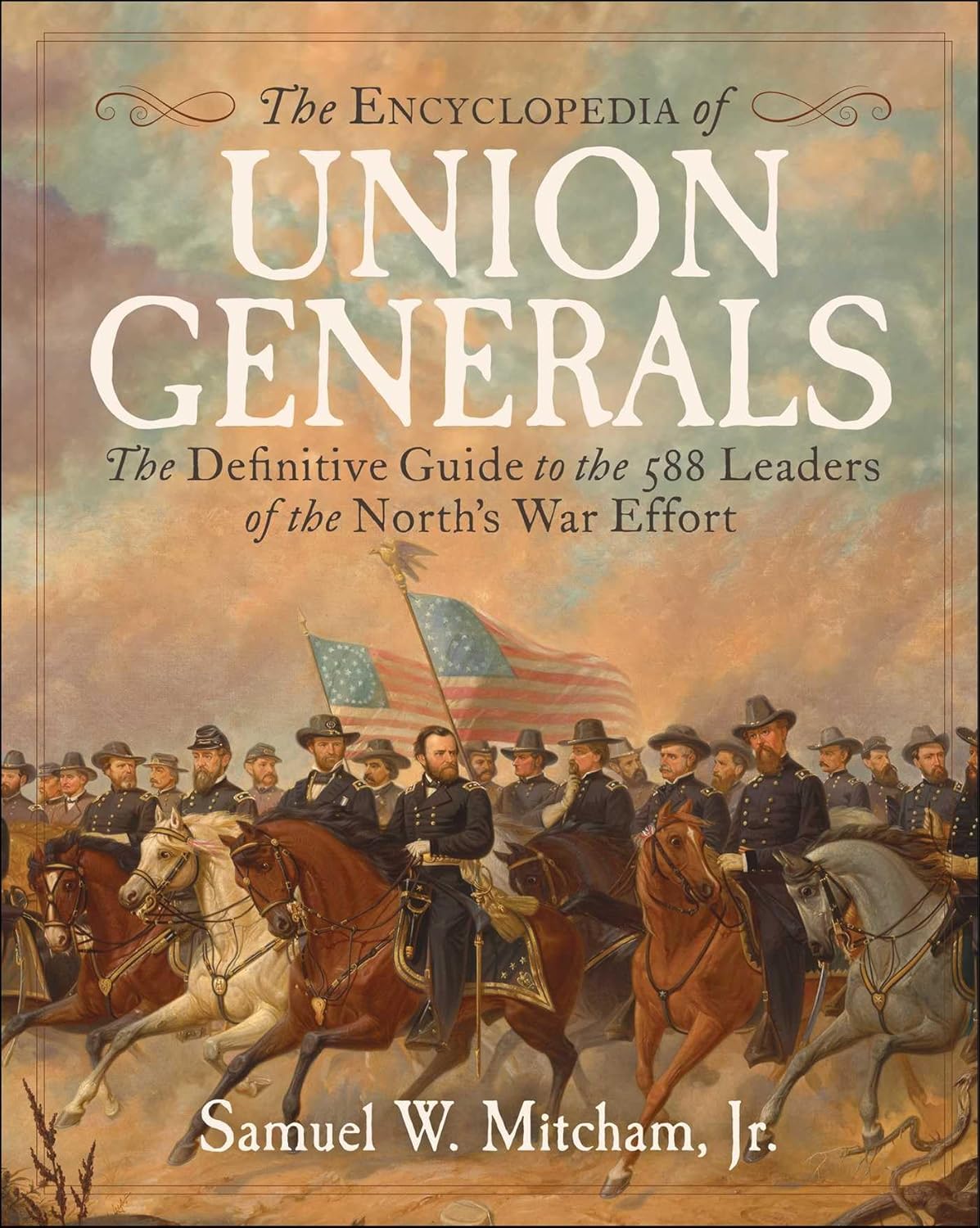
A Brief Look at Samuel Mitcham’s The Encyclopedia of Union Generals
Once upon a time, the American Civil War was widely regarded as a national epic. Not a divinely-mandated Unionist crusade against wicked slavedrivers, but something akin to the terrible Trojan War as recounted by Homer.
Under this tragic perspective, a special place might be accorded to figures such as US Senator John J. Crittenden of Kentucky, who unsuccessfully promoted an 11th hour compromise whereby secession might have been averted. Where the Crittenden Plan might have led is anybody’s guess, of course, as it failed to garner support; what is clear is that Senator Crittenden had deep, personal motivations for pursuing peace.
He would live to see his own family divided against itself. One of the senator’s sons – George – had an ill-starred career as a Confederate officer, while another – Thomas Leonidas Crittenden – wound up becoming a general for the Union. Thomas had already established his military credentials as an aide to Zachary Taylor during the Mexican War; now he would support General Grant’s forces at Shiloh as a division commander in the Army of the Ohio.
Those seeking more detail about George Crittenden can consult Samuel Mitcham’s fine Encyclopedia of Confederate Generals, while those interested in Thomas are advised to check out Lieutenant Colonel Mitcham’s more recent Encyclopedia of Union Generals. (It should be mentioned that the interested reader who finds such tomes outside his budget might put in a request for his local public library to purchase a copy.)
In this second volume, we find that the Crittenden family was hardly unique in being divided by the Mason-Dixon line. Lincoln himself had brothers-in-law in gray, after all, and often even those Union men without Confederate kinfolk had other personal connections to their opponents. Perhaps most famously, Gettysburg hero Winfield Scott Hancock was best friends with Louis Armistead, the Virginia gentleman who led Pickett’s charge against Hancock’s position.
The other great hero of Gettysburg – Medal of Honor winner Joshua Chamberlain of Little Round Top fame – likewise had had cordial prewar relations with Southerners. And while a cadet at West Point, none other than Ulysses S. Grant had been bailed out of financial disaster by his good friend Simon Bolivar Buckner – the commander of the Confederate garrison which would later captured by Grant with the fall of Fort Donelson.
More to the point, Mitcham observes, in many cases those relationships and affections which had been severed by the war were promptly restored in its aftermath. Hancock inspired gratitude from Southerners for his light touch as the ranking military authority in Reconstruction Louisiana and Texas, as he “refused to use his power to overtrn elections and jury verdicts, and restored habeas corpus and the freedom of the press.” Chamberlain saluted defeated Confederates during their surrender procession following Appommattox, for which he “was criticized by some in the North, but Chamberlain refused to apologize. He commented that he never saw the Confederate Battle Flag without thinking of the immense bravery of the men who fought under it.” Buckner and Grant renewed their friendship, and in the end Buckner served as honorary pallbearer in Grant’s funeral in New York City. (It may also be worth mentioning that surviving members of the famed “Stonewall Brigade” of General Thomas Jackson marched in the procession.)
As a constrast to the warm relations some Union flag officers had with their adversaries, it may be worth singling out one significant if small group of Union generals who had little to no affection for South: The foreigners, the “’48’ers”.
Given that even the 1789 French Revolution has largely dropped out of American consciousness, a bit of context regarding the momentous revolutionary year 1848 may be in order here. In said year, Europe was rocked and shocked by a networked series of second-wave liberal revolutions, all of which aimed at abolishing l‘ancien regime once and for all. In the aftermath of the project’s failure, a number of revolutionary leaders had crossed the Atlantic to settle in the American North. Hungarian engineer Alexander Asboth had taken part in the revolt against the Habsburgs, as had Louis Stahel and Louis Blenker, with Blenker attaining command of a Freikorps in recognition for his early victories.
Another revolutionary named August Willich had renounced his nobility, converted to Communism, and undergone a court martial for his strident convictions even before the ‘48 uprisings. During the turmoil in Central Europe, Willich had also led a Freikorps unit in the Baden-Palatinate.
European conservatives would rally their forces and crush the ‘48 movement, and so all four of the aforementioned men fled Europe to seek refuge in New York City, and were thus well-placed to take part in the Lincolnian revolution of 1861-1865. By the time the American Civil War ended, all four revolutionists had attained a general’s rank in the Union Army.
So although Mitcham’s book is a straightforward, candid reference work – or, rather, because his book is a straightforward, candid reference work – those who read between the lines cannot help but be struck by a couple outstanding points. The first point is that several of the most celebrated protagonists of the Union cause explicitly understood the war as a tragedy, a struggle of brother versus brother. In this view the Confederate was honorable if misguided, as opposed to evil; such a view stands in extraordinary contrast to the self-righteous, messianic understanding of the conflict now widely propagated by liberals and national “conservatives” alike.
The other point is perhaps even more awkward for those nationalists who like to draw superficial parallels between Tim Walz and Kamala Harris on one hand, and the ideals of the Old South on the other. Whatever the rights or wrongs of the struggle as a whole, as a matter of historical record it was the Union side of the American Civil War which was generously sprinkled with radical, left-wing progressive revolutionaries. As Mitcham mentions in an aside, Union general August Willich even enjoyed an amicable relationship with the arch-revolutionist himself – Karl Marx!
So MAGA influencers have a long, long way to go before they address the delicate issue which really lies at the heart of the globalist project: Mr. Lincoln’s legacy of Equality uber alles.
The views expressed at AbbevilleInstitute.org are not necessarily those of the Abbeville Institute.





Dear Mr. Salyer,
Thank you for your article, Contrasting Unionists. Looking at your others, it seems you might share the weight of a similar perception of American history as myself. Perhaps, for your next article, you might consider a title such as: “A Metaphysical History of the True American South & The Current Uncivil War” I, at least, would be greatly interested in your thoughts thereon.
From my recent attempts at home schooling my youngest boy, I imbibed a scant overview of the 1848 revolutions in Europe from the Roman Catholic perspective. Shortly thereafter, I was apprised of the book, Red Republicans and Lincoln’s Marxists: Marxism in the Civil War.
It seems to me, that within the context of the European revolutions of 1848, Republicanism was most often used as part of a bait and switch ploy. That is, Republicanism was presented to the populace as the end and the good achieved by overthrowing Christian Monarchies. However, once a revolution was successful, the leaders, or certain leaders, of the revolution would conspire to usurp any newly formed “Republic” in a transition to some form of totalitarianism for their, the specific leaders, benefit. To my mind, at least since The Civil War, Republicanism in the USA has been, and continues to be a bait & switch con. However, I think the stalwart Christianity of the great majority of the populace of all states, most particularly, most crucially, most Metaphysically , most intrinsically, by “The South” states. The Southern States are, undeniably, objectively, the most blessed by God, Almighty, of this fractured nation and by our courageous suffering, have thus far stayed the chastising hand of God.
Just my opinion, which you or anyone is welcome to prove wrong.
Thanks again for your insightful writing.
God bless you and yours,
TD
Locust Grove, GA
Hello Mr. Duffey,
Thanks for the kind words. I certainly agree that the mercurial quality of revolutionary movements is a subject worth thinking about. Of course I am not an expert on European republicanism by any means, but it does seem to me that most European revolutions necessarily involved a violent break with the past, as well as with Christendom.
Have just started Kennedy’s “Marx, Lincoln and the GOP.” Lincoln appointed a Marxist to his cabinet.
Mr. Salyer,
Excellent article. I have often wondered about Great Britain’s role in the migration of the “48er’s” from the various European countries in the aftermath of the failed revolutions to these united States. Many of them came up thru my home State of Texas and eventually settle on the Midwest. The 48er’s would go on to help form the Republican Party in 1856. It’s interesting that the British let Marx live in London even after the 1848 revolutions. It is more interesting that it is taught in our government education system that the
British would not recognize the Confederacy
because of the issue of institutional slavery. But what is not taught is that Great Britain was trading with the united States while it had institutional slavery enshrined in its highest law and had refused all requests to join (by way of treaty)in the prevention of the international slave trade by allowing British, Portuguese and Spanish ships to board American flagged ships suspect of engaging in the transportation of slaves to the Caribbean and South America. Another interesting observation is that the British seemed willing to feed the Confederate war efforts (like building the CSS ALABAMA) but starved the Confederate victory by failing to grant diplomatic recognition or form an alliance. If the Confederate government had agricultural products to sell that were needed by British industries and a low tariff market for British industrial products to be sold in, why would the British not recognize the Confederacy? An added benefit would have been a friendly, free trade country like the Confederacy on the southern border of a weakened united States. So the question is, why? Why would Great Britain let Marx stay in London? Why would Great Britain help the 1848 communist insurgents immigrate into the United States? Why would Great Britain refuse to recognize the Confederacy because of the issue of slavery but continued to maintain relations with country with institutional slavery? I see the shadow hand of international banking (with its home in the City of London) and the desires for a world patterned after the “Hazard Circular” so famously described by Congressman Charles Lindbergh Sr. in his book, Banking and Currency and the Money Trust. What are your thoughts on this matter?
Deo Vindice
I picked up Mitcham’s Confederate encyclopedia after it was reviewed on this blog. I’ll be looking to pick up this book soon. I’ve read a few of his other books and enjoyed them.
The 48ers are the missing puzzle piece to the war. There wasn’t really a good reason for the war to be so awful if it was only between Americans. The same people that did this to us, did it to Europe twice within a century.