

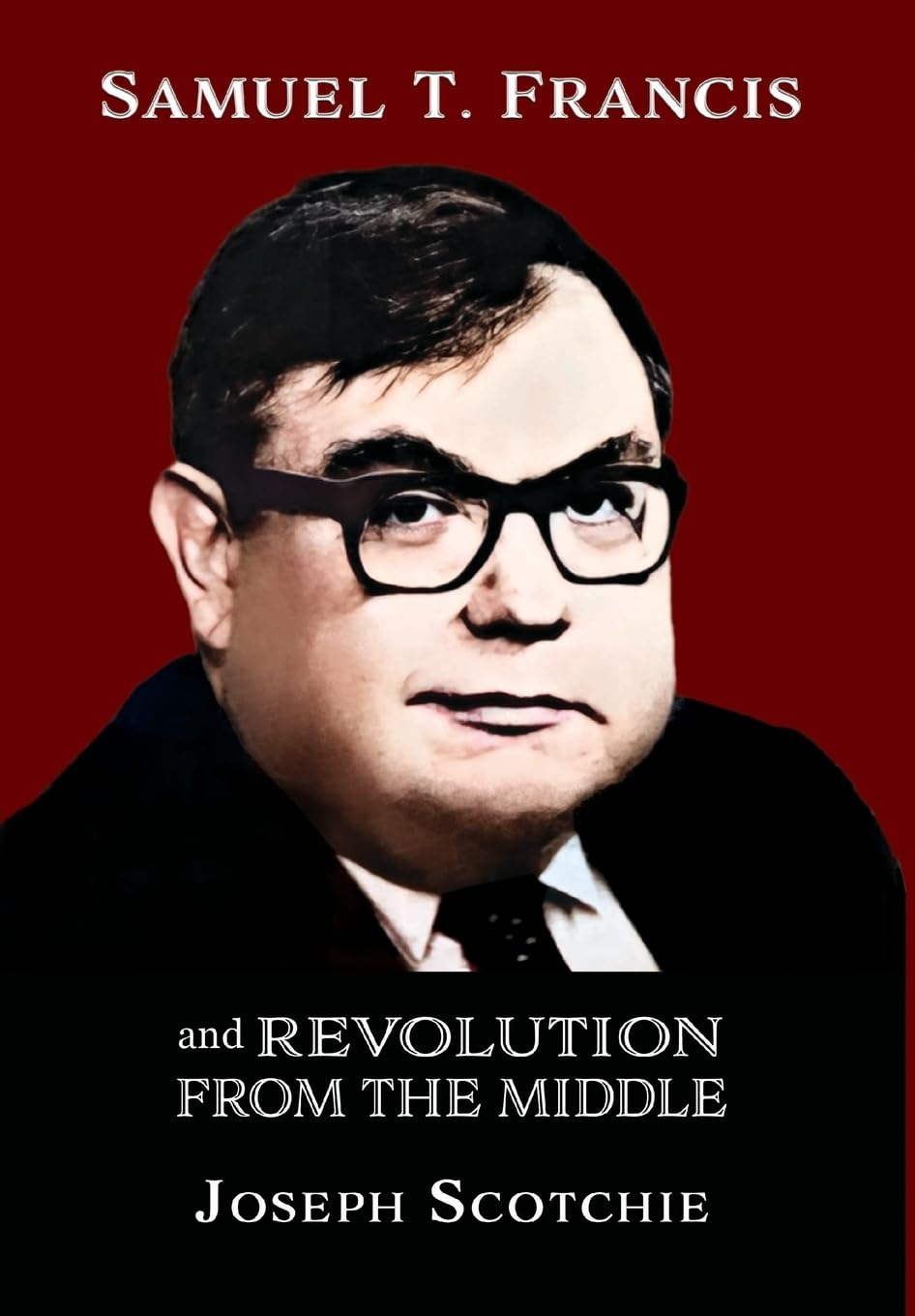
A review of Joseph Scotchie, Samuel T. Francis and the Revolution from the Middle (Shotwell, 2025) by Jack Trotter
In the Old Testament, the prophet Samuel is called three times by God to “listen to the voice of the people.” In these latter days, his namesake, Samuel Francis (1947-2005), is often described as a “prophet,” even by some of those who reviled him prior to his death, for over the course of several decades Francis unceasingly warned—in his syndicated column, in his books, and in innumerable speeches—against the threat posed to traditional American liberties and moral foundations by the tyranny of the managerial state. In the first book-length biography of Francis, Joseph Scotchie’s Samuel T. Francis and Revolution from the Middle (Shotwell, 2025), Francis’s life and his seminal political thought are presented fairly and with a good deal of sympathy—and most importantly, wihout the usual (sometimes vicious) accusations of racism that one is accustomed to encounter in almost every mainstream discussion of his politics.
Scotchie attempts, for the most part successfully, what may be called an “intellectual biography.” The focus here is largely upon Francis’s political ideas, his political friends and allies, the cultural and political contexts in which his ideas developed, and his eventual exile from the sacrosanct realm of authorial respectability. The details of his personal life are given short shrift, though it must be noted that his life was all but consumed by his intellectual and political endeavors. That said, it is also true that he had a gift for friendship and those who knew him best always testify to the warmth of his personality and his fine sense of humor, as well as his enduring love of music, literature and popular culture.
The book is arranged in fourteen chapters that develop more or less in a chronological fashion, from Francis’s early years and education; to his endeavors after graduate school as a “dutiful foot soldier” in the Conservative movement, especially for the Heritage Foundation in the late 1970s; to his years as a staffer and speechwriter for North Carolina junior senator, John P. East; to his emergence as a syndicated columnist and a celebrated opinion writer for Chronicles Magazine and the Washington Times; to his involvement as an advisor to the Buchanan presidential campaigns; and finally to his later years as a tireless and increasingly radical freelancer and near pariah on both the left and the right (or, at least, the “respectable” Republican right). The arc of Scotchie’s narrative, it might be added, has an almost tragic movement—from heady success to isolation and ostracism, followed by an early death after a heart attack struck Francis down at the age of 57 when he was still at the height of his creative powers.
As a graduate student at the University of North Carolina at Chapel Hill, Francis earned a Ph.D. in Modern History, and it was there that he established a lifelong friendship with historian Clyde Wilson, who became an authority on John C. Calhoun and, concurrently, a key figure in the “paleoconservative” movement that originated under the leadership of Thomas Fleming and Paul Gottfried, both editors and writers with Chronicles: A Magazine of American Culture. Eventually, Wilson would introduce Francis to Fleming, who was by then the magazine’s Editor-in-Chief, and Francis would become, by way of his popular monthy column (“Principalities and Powers”), a galvanizing force for the hard right wing of the conservative movement. Along with Wilson, Fleming, Chilton Williamson, Joseph Sobran, M.E. Bradford and a handful of others, Francis began to formulate an alternative to the traditionalist “virtue” conservatism of men like Russell Kirk, whose work (like The Conservative Mind and The Roots of American Order) were widely read and influential across the spectrum of conservative thought.
While the Chronicles circle never made a complete break with the kind of conservativism promulgated by Kirk and his associates, they were, or became, less interested in the politics of virtue than in the struggle for power. This is not to suggest that they were opportunists interested in power alone; on the contrary, their politics had its own moral foundation, one rooted especially in the moral traditions and commitments of middle- and working-class Americans. But beginning in the 1980s they were faced with a new breed of antagonists, the emergent “neo-conservatives”—many of them former Trotskyites—who were rapidly displacing the older decentralized, anti-federalist right with a thinly disguised “managerial” conservatism—in short, a faux conservatism that paid lip service to the moral concerns of middle Americans but was primarily about promoting an agenda in which America would play the role of global hegemon, spreading “democratic” values to every corner of the earth.
But even before the neo-conservatives began to displace the old conservative order, Francis, ironically enough, had begun to redefine the politics of the hard right by assimilating the ideas of another former Trotskyite, James Burnham, who, after his break with the Workers Party in 1940, published a book that some consider his most important: The Managerial Revolution. This and subsequent works by Burnham (who eventually became one of the founders of The National Review in 1955) profoundly influenced Francis’s political thought.
In a nutshell, Burnham’s argument was that the insurgent managerial class had its roots in the late 19th century emergence of what has since been termed “technocracy”—a bureaucratic order that, in the West, thrived within the vast enlargement of capitalist economics and the expansion of national governments. The shift from a capitalist economy tied to production to one dominated by the imperative of consumption was also a key factor. As corporations became international conglomerates, vastly more complex than the business entities of the 18th and 19th centuries, they became increasingly dependent upon technocratic elites—middle-level managers who, in time, became indispensible. If, legally speaking, the new managerial class did not “own” the means of production, they nonetheless—in the years after the first World War—assumed control over production as well as the dissemination of consumer goods and services to a degree unknown in the era of laissez-faire when capitalist entrepreneurs were at once owners and directors. At the same time, managerial elites trained in the same Ivy League schools, began to infiltrate federal bureaucracies.
Francis’s most extensive examination of Burnham’s political philosophy appeared in Power and History: The Political Thought of James Burnham (1984). There and in a number of stand-alone essays published in The World and I and Chronicles, he argues that the consolidation of power by managerial elites was transforming not only the corporate world but the political realm, as well. What this new elite sought was ultimately the “liquidation of the middle-class and its bourgeois cultural order.” In the decades following the New Deal, America witnessed not merely “the rolling up of comparatively small owner-operated business enterprises and farming units by colossal corporate organizations,” but additionally, “the replacement of local, legislative and constitutionalist government by centralized, executive bureaucratic regimes.”
Indeed, the erosion of the American middle-classes was of particular concern to Francis, since the continued existence of the nation’s republican values resided with them. Thus he penned for The New Right Papers in 1982 a seminal essay called “Message From MARS”—a powerful defense of the Middle American Radicals whose way of life was under attack, not only by the forces of inflation, rising interest rates and unemployment but also by a managerial New Class that “mocked the pieties … of the Mom and Pop family unit.” This theme became a staple of Francis’s work for the next two decades, as he intransigently called for “the localization, privatization and decentralization of the managerial apparatus of power”—in short, “a dismantling of the corporate, educational, labor and media bureaucracies.”
Most prophetically, perhaps, Francis called upon the forces of the New Right (as it was called in those years) to “favor a populist-based presidency able to cut through the present oligarchical establishment and to promote new intermediary institutions centered on Middle America.” Such populist messaging came to the forefront, especially in the 1990s, as he became involved in Patrick Buchanan’s presidential campaigns, and though Buchanan failed to reach the White House, much of the intellectual groundwork for the victories of Donald Trump in 2016 and 2024 was laid by Francis and a handful of other supporters of Buchanan, whose disgust with the Republican establishment was rooted in the realization that the GOP was itself merely the “conservative” wing of the managerial status quo.
One of the weaknesses of Scotchie’s book is that it does not give sufficient attention to Burnham’s The Machiavellians: Defenders of Freedom (1940), a work that was, if anything, more important for Francis’s political thought than The Mangerial Revolution. The former work focuses not just upon the thought of the great Florentine but on that of a handful of 19th century Italian political thinkers, including Gaetano Mosca, Vilfredo Pareto, Roberto Michels, and Georges Sorel. For Burnham, the doctrine of the latter-day Machiavelians was threefold: First, political reality is, always and everywhere, fundamentally a struggle for power. Second, as corolllary to this, political arrangements in any given society are always defined by elite minorities—that is, a small ruling class that controls and dominates the masses, though its modes of coersion aren’t necessarily violent or brutal. Third, rule by elites is the best hope of an existence under the rule of law, which is what the term “freedom” signifies in this context.
Francis, like Burnham, understood that the rule of law in the American context rested on the Constitution and its balance of powers. Both men, in agreement with the Machiavellians, were deeply suspicious of mass democracy, which rests on the illusion of rule by majorities. Francis recognized that even a wisely arranged constitutional republic can remain viable only if the cultural institutions and religious traditions that gave it birth still flourish, and by the late 1980s he was convinced that those traditions and institutions were deeply threatened by a new leftist hegemony.
The term “hegemony,” a key referent in Francis’s political lexicon, was borrowed from Antonio Gramsci’s Prison Notebooks (1929-1935). Gramsci, an anti-Stalinist Marxist, developed his widely influential theory of cultural hegemony in an effort to demomstrate that the best hope of a Marxist takeover of the state (in his case Italy) was not through a violent overthrowal of the capitalist ruling class by an organized proletariat, but through a gradual establishment of cultural hegemony—a non-violent infiltration of all the institutions (political, judicial, religious, educational et al.) that had for several centuries enabled oligarchical elites to rule, not by violent coersion but by consent. In short, hegemony in this sense was as much a psycholocial and sociological principle as it was political, for it described how the masses internalized the value system and the mythology of the haute bourgeoisie.
In “Winning the Culture War” (Chronicles 1993), one of his most important essays, Francis argues that in the latter half of the 20th century, and especially beginning in the 1960s, the American left had established a new cultural hegemony, what was then called a “counter-culture,” along Gramscian lines, by infiltrating our institutions at every level. “We must understand,” he asserts,
that the dominant authorities in the United States—in the federal government and often in state and local government as well, in the two major political parties, the major foundations, the media, the schools, the universities, big business, and most of the system of organized culture, including the arts and entertainment—not only do nothing to conserve what most of us regard as our traditional way of life but actually seek its destruction or are indifferent to its survival.
In no uncertain terms he lambasts so-called “conservatives” for failing to see that in order to conserve the institutions and way of life that were now profoundly threatened by leftist cultural revolution, it was no longer suffficient to do so by the usual means; to prevent leftist elites from taking complete contrrol of the country, it would be necessary to fight fire with fire, to engage in a counter-revolutionary struggle—a restoration of the old order:
When I call for the overthrow of the dominant authorities that threaten our culture … I am not advocating illegal or undemocratic processes, but the war for the culture is nonetheless a radical or even a revolutionary conflict because it involves an almost total redistribution of power in American society—the displacement of the incumbent governing and cultural elites, the dismantlement of their apparatus of domination, the delegitimation of their political formulas and ideologies, and the radical decentralization of power and shift in control of cultural norms from the hands of the present elite to those of the Americans who remain loyal to their traditional cultural and national identity.
It was such a “radical decentralization of power,” Francis argued repeatedly, that must be the central aim of the MARS. More clearly than most, he recognized that the hegemony of the left was aided and abetted at every turn by managerial elites in government and in the corporate realm, and he understood, to his cost, that the so-called neo-conservatives were effectively in league with the leftist counterculure, especially in their promotion of “democracy-building” abroad, their acceptance of a multicultural status quo, and their refusal to resist the inundation of middle America by wave after wave of illegal immigrants.
It might also be noted here that the leftist hegemons that had seized control of the apparatus of power in Washington were not promoters of the “rule of law.” Unlike the historical elites discussed by Burnham, they promoted instead what Francis called “anarcho-tyranny” by failing to enforce basic, lawful protection of citizens against criminality, leading to a condition resembling anarchy. But that “semblance of anarchy,” he argues in a 1996 Chronicles piece,
is coupled with many of the characteristics of tyranny, under which innocent and law-abiding citizens are punished by the state or suffer gross violations of their rights and liberty at the hands of the state. The result is what seems to be the first society in history in which elements of both anarchy and tyranny pertain at the same time and seem to be closely connected with each other and to constitute, more or less, opposite sides of the same coin.
Yet perhaps the most flagrant instance of anarcho-tyranny in those years was the failure or refusal to enforce immigration law.
In point of fact, Francis’s concerns about immigration were not confined to the illegal variety. In his last decade he became increasingly involved with groups and publications that were, rightly or wrongly, labeled “white supremacist”—with groups like the Council of Conservative Citizens and with magazines like Jared Taylor’s American Renaissance, and he shared with these groups a concern that unrestricted immigration from the third-world was a growing threat to the diminishing white majority in America. Scotchie does an admirable job of tracking this shift in Francis’s thought—what he terms a “shift to racialism.” In numerous columns, speeches and essays, he probed the historical origins of a growing “anti-white” agenda, one that was deeply rooted in the idealogy of “multiculturalism,” a deceptively benign term that concealed a ruthless move on the part of left-leaning political elites to aggrandize their own power while promoting the interests of minorities at the expense of the white, middle-American population whose ancestors had founded and built the country. Affirmative action for blacks and for women was a part of this scenario, but the overthrowal of the National Origins Quota and the enactment of the 1965 Immigration and Nationality Act, prioritizing family reunification, was of far greater import. More ominous was the refusal of mainstream conservatives in the GOP (Reagan and the Bushes, for example) to put up any resistance to such developments, or even to admit that the threat was genuine.
Scotchie states that the most important of Francis’s “racialist” essays was “The Roots of the White Man” (American Renaissance 1996) a sweeping, lengthy examination of the traits and achievements of Indo-Europeans, i.e. Aryans. Francis’s claims here follow closely those made V. Gordon Childe in his 1926 study The Aryans. Among the traits Fraancis highlights are the following: The Aryans were the first to understand that humans inhabit a “cosmic order” that is “independent of what we believe or want to believe, and out of this perception there eventually arose the world-view that we call scientific; they were also profoundly “innovative, aggressive, creative, mobile, aspiring and daring,” and possessed by a passion for exploration, discovery and colonization—what Francis called a “Faustian dynamism,” following Oswald Spengler; moreover, the Aryans were a people devoted to self-rule, incapable of tolerating tyranny or slavery of any kind; and they were distnguished, uniquely, by a character of individuality—that is, a variety and fecundity of expression (think here of the brilliant and individualized mythologies of the Greeks and the Norsemen, or of the profusion of styles in Western art).
All of these traits and accomplishments, argues Francis, were racial. Toward the end of the essay he concedes that such attributes “may seem” to reflect “cultural ideas rather than racial characteristics,” but insists that the truth lies at a deeper, genetic level: common Aryan traits “derive from genes carried by [common] ancestors.” He cites no support for this assertion but merely mentions in passing Jared Taylor’s claim for the growing evidence that “personality traits are under genetic control.”
It is unfortunate that Scotchie does not probe more deeply into this issue (aside from lamenting the fact that the term “Aryan” is unwisely used). Thoughtful readers, familiar with the brilliance of Francis’s earlier work, may wonder whether in his final years he slipped into a kind of intellectual ghetto, embracing too uncritically a questionable white nationalist identitarian ideology. Of course, virtually all of the traits he discusses in the essay are to a greater or lesser extent true—if understood as cultural characteristics that evolved over several millenia. To insist, as he does, that racial traits are a kind of “fate” amounts to a genetic determinism that, in the last analysis, diminishes the very Indo-European qualities that he celebrates.
It is unfortunate that today, more than 20 years after his death, the broad scope of Francis’s work as a political thinker of the Right is largely forgotten or ignored. If, for example, someone unfamiliar with his thought were to seek illumination in the Wikipedia entry that bears his name, the overwhelming impression for such a reader would be that Francis was little more than an advocate of “white supremacy.” Powerful players on both the left and the right have conspired to ensure that his best and most penetrating analyses are suppressed or dismissed. Therefore, Joseph Scotchie’s insightful and honest study of Francis is all the more welcome, and one may hope that it will be widely read and understood as the biography of a brave and unique mind.
The views expressed at AbbevilleInstitute.org are not necessarily those of the Abbeville Institute.







Sam Francis was definitely one of my favorite columnists, and by coincidence so also was Pat Buchanan.
“In the Old Testament, the prophet Samuel is called three times by God to “listen to the voice of the people.” In these latter days, his namesake, Samuel Francis…is often described as a “prophet,”…Francis unceasingly warned…against the threat posed to traditional American liberties and moral foundations by the tyranny of the managerial state.”
“Listen to the voice of the people” didn’t sound familiar. I looked it up and it was nowhere. The word “listen” occurs only once in the Bible, in Isaiah 49:1. But, I looked at Bible gateway and saw “listen to (all that) the people” (1 Sam. 8:7) is in the NIV. Well, no, it’s not exactly the NIV rendering either.
But, I see the point attempted to be made. Francis did “protest” the choice many were making, as Samuel protested Israel’s choice of Saul for king.
Fascinating that Francis borrowed from Gramsci! I don’t think we have time for a traditionalist “long march through the institutions”, and the Marxist gatekeepers probably wouldn’t allow it anyway. Thank God we have some people in leadership who see the issues and want to win.
Sam Francis, along with many other paleoconservative thinkers, are my philosophical and political heros. The only qualm I have with this review is excluding Russell Kirk from their ranks. I understand why he was excluded (Virtue, The Permanent Things, etc.) However, more often than not, I feel his views would align more with Paul Gottfried and others, over Buckley and the Neocons. What puts Kirk into the paleocon category for me is his friendship with M.E. Bradford, and Kirk supporting Patrick Buchanan in his 1992 presidential run.