

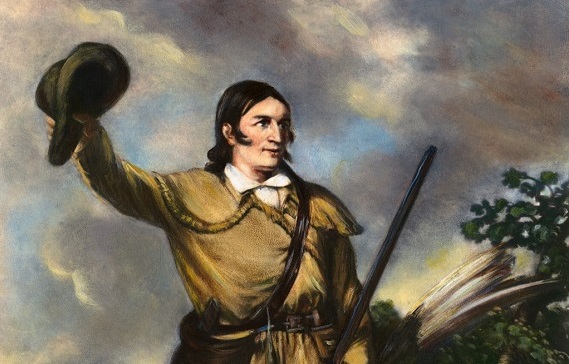
After the fall of the Alamo in San Antonio on March 6, 1836, a disconsolate but resolved General Sam Houston ordered the torching and evacuation of Gonzales, so as to deny resources to the advancing Mexican forces. He then ordered a strategic withdrawal of his own army, as well as that of Colonel James W. Fannin at Goliad. But this withdrawal did not avert another disastrous development for the Texians.
Fannin and his 400-man army were surrounded and captured a short distance outside Goliad on March 20. Despite appeals for clemency from the Mexican field commander, General José de Urrea, the vindictive Santa Anna ordered the immediate execution of all the Texian prisoners. The Texians were charmed by their duplicitous captors with false hopes of release, but on the morning of Palm Sunday they were subjected to an ambush execution. Only 28 of the 400 prisoners escaped by feigning death, concealing themselves, or fleeing during the chaos. The bodies of the dead Texians were heaped and burned. Colonel Fannin was among the last to be killed. His dying requests—that he be shot in the heart rather than the face, that he receive a Christian burial, and that his watch be returned to his family—were ignored; he was shot in the face, his body was put to the flames, and his watch was reportedly kept by one of the Mexican officers as a trophy.
The calamitous days of March 1836–and the prospect of what Santa Anna’s forces may yet do to the unyielding Texians—compelled thousands of civilians to undertake a desperate flight through East Texas, which came to be known as the Runaway Scrape. The exodus occurred during one of the region’s wettest springs on record. Rivers and creeks spilled over their banks, roads turned to sloughs, wagons bogged down, and exhausted civilians suffered from exposure, disease, and hunger. Among the knots of beleaguered Texians were several members of the temporary government of the Republic of Texas. President David G. Burnet carried in his possession the engrossed copy of the Texas Declaration of Independence.
Sam Houston had thus far avoided direct confrontation with the Mexican forces. His evasive strategy, though frustrating to his troops and the fleeing civilians, did have a purpose: to prevent encirclement of the Texian army and to compel the Mexican army to overextend its columns. When Texian intelligence determined that the brazen Santa Anna had further divided his army and left his advance column isolated and vulnerable near the San Jacinto River and Buffalo Bayou, Houston held a council of war with his senior officers and determined to launch an immediate offensive. The Texians attacked swiftly, and their victory was total. In only 18 minutes, they utterly routed the Mexican forces. The battle cry of the Texians as they rose to final victory at San Jacinto on April 21, 1836, was: “Remember the Alamo! Remember Goliad!”
Santa Anna, who had habitually and vainly embraced being cast as the “Napoleon of the West,” hardly acquitted himself as a great commander in the wake of his army’s rout. He exploited the chaos of the battle and fled with a small escort, from which he shortly became separated. After his horse became mired in marshy ground, he was compelled to hide in tall grass near the battlefield overnight. The following morning, a search party discovered him—dirty, disheveled, and clad in plain civilian clothes to disguise himself. As he was being taken back to the Texian camp, some of the Mexican prisoners recognized him and began shouting, “El Presidente!”—betraying his identity.
Santa Anna was immediately presented to Sam Houston. Realizing the hopelessness of his situation, the humiliated Mexican president agreed to recognize Texas independence and to convince the Mexican Congress to do the same. The Congress ultimately refused to recognize independence and claimed Santa Anna had no authority to ratify it. Nevertheless, Mexico made no serious attempt to reconquer Texas. San Jacinto hence proved a decisive diplomatic and moral victory and signaled the achievement of Texas independence. Mexican forces withdrew south of the Rio Grande, leaving the Texian Army in control of the territory between the Sabine River and the Rio Grande.
—
The events of 1835-36 cause President Coolidge’s narrow question, “What was the Alamo built for,” to recede into the background, and a broader inquiry to take its place: “What did the Alamo become?” The same should be asked of Gonzales, Washington-on-the-Brazos, Goliad, San Jacinto, and the other places that are forever joined to the grand achievement of Texas independence. There are noble monuments adorning these places and signaling to the world the courage and sacrifice that purchased her liberty. One of the most poignant is the Alamo cenotaph.
During the 1936 Texas Centennial celebration, San Antonio sculptor Pompeo Coppini was commissioned to create a monument honoring the defenders. The end of his labor, known as The Spirit of Sacrifice, was erected in Alamo Plaza and dedicated on November 11, 1940. A stately and moving sculpture of pink Texas granite and gray Georgia marble, its imposing shaft rises 60 feet above the plaza. On the face of the shaft the namesake spirit soars skyward against a mantle of flame, representing the power of the Alamo defenders’ sacrifice. The opposite face is ornamented by a female figure bearing the shields of Texas and the United States of America. The ledges on the remaining two faces depict William Barret Travis, David Crockett, James Bowie, James Bonham and other defenders who determined never to surrender nor retreat, that their sacrifice might serve the cause of Texas independence.
In 2020, a leftist malcontent defaced The Spirit of Sacrifice—spray painting on the base the incoherent triad, “Down with white supremacy,” “Down with profit over people,” and “Down with the ALAMO.” The cenotaph remains intact, and thankfully has thus far been protected against the more despicable acts of destruction that have been wrought on other Southern monuments in recent years. Other progressives have adopted alternative approaches to conveying their anxiety over monuments commemorating the Texas Revolution—namely, retaining the physical monuments while attempting to reframe them as dubious tributes to a history miserably polluted by slavery, settler colonialism, and white supremacy. Still others have embraced the significance of these monuments, but have insisted their meaning be diffused to some of the left’s favored causes. For instance, a recent story in the Dallas Morning News lamented social studies revisions by the Texas State Board of Education that “make no mention of positive legacies of Islam, including Moorish influence on the architecture of Spanish Colonial buildings such as the Alamo.”1
Though differing in outward form, all of these projects are thoroughly malignant, because their refrain is this: forget. Forget your forebearers. Forget your roots. Forget your homeland. Forget yourself. Forget.
Many voices of our age have adopted a hermeneutic of suspicion, and treat past generations with scorn and hostility, except where said generations conform to principles bearable to modern progressives. Such presentism undermines mature historical discernment. It fails to tolerate, even in the most rudimentary fashion, those who went before us, while treating our own generation as perfectly enlightened and just. But our descendants will find that we were susceptible to the weaknesses of our own age. God forbid they come to view us with the same Manichean contempt so many present-day social justice warriors exhibit toward past generations.
A magnanimous people understands there is wisdom in beholding the faces of its ancestors with gratitude and humility. For their part, Southerners have a distinguished record of honoring their kindred who have upheld what is true and valuable: inherited wisdom, ordered liberty, localism, self-government, family, community, and moral courage, among other virtues. But we do not honor our forebears because they championed abstract principles in isolation, but because they lived them out. In the words of Stark Young, we engage in “the defense of what we have drawn not from theory but from an actual civilization, and believe it necessary to remember. For us there are certain things, now endangered, that leave a kind of death to follow after them, and so must not be lost.”2
Our Southern ancestors upheld tradition, localism, and self-government to maintain the integrity of their families and communities. Their moral courage was employed in defense of their hearths. This was true for the Southerners serving in the vanguard of the Texas independence movement. Modern-day Southerners are connected to them by a fraternal chain. Decency enjoins us to graciously commemorate their sacrifices. In seeking to do so, we may take our signal from the luminous Tejano soldier-statesman Juan Seguín—who himself fought for Texas independence and served that cause selflessly.
In 1837, while serving as military commander of San Antonio, Seguín oversaw the burial of the Alamo defenders’ burned remains, on which occasion he delivered the following eulogy:
“COMPANIONS IN ARMS!!! These hallowed relics which we have now the melancholy task of bearing onward to consign to their kindred earth, are all that remains of those heroic men who so nobly fell, valiantly defending yon towers of the Alamo! If they, my brave associates, preferred rather to die a thousand times, than basely to bow down under the vile yoke of tyranny, what a brilliant, what an illustrious example have they bequeathed to us! How worthy to illumine with unchanging splendor the ever glowing pages of history! Even now the genius of liberty is looking down from her lofty seat, smiling with approbation upon our proceedings, and calling to us in the names of our departed brethren, Travis, Bowie, Crockett, and their iron-hearted band—bids us in imitating their mighty deeds, to secure, like them, a high place upon the scroll of immortality. Since then, soldiers and fellow-citizens, undying fame is the glorious reward of those who fell in this noble contest, cheerfully will I encounter the most formidable dangers which fortune can crowd in the path of glory, in the noble attempt to achieve my country’s independence, or regardless of whatever indignity the brutal ferocity of my enemies, may offer to my lifeless body, joyfully perish on the field of battle, shouting the warcry of these heroes; God and liberty, victory or death!!”3
The high deeds of our ancestors warrant this reverence. And so, let us continue to defend what is true and valuable in the Southern tradition—by refusing to forget what they did. Filial duty calls us to no less.
Works Cited
- Allen, Silas. “Texas education officials pushed to delay new social studies standards. Here are the issues.” Dallas Morning News, 8 April 2026, https://www.dallasnews.com/news/education/article/texas-sboe-social-studies-teks-22195765.php or https://www.msn.com/en-us/news/us/texas-education-officials-pushed-to-delay-new-social-studies-standards-here-are-the-issues/ar-AA20s32I. Accessed 10 April 2026.
- Young, Stark. “Not in Memoriam, But in Defense.” I’ll Take My Stand: The South and the Agrarian Tradition, by Twelve Southerners, Harper & Brothers Publishers, 1930, p. 329.
- Telegraph and Texas Register (Columbia, Texas), vol. 2, no. 12, ed. 1, 28 March 1837, p. 2, available online at https://texashistory.unt.edu/explore/titles/t00413/browse/?q=&t=fulltext&fq=str_year:1837&fq=str_month:03_mar&fq=str_day:28.
The views expressed at AbbevilleInstitute.org are not necessarily those of the Abbeville Institute.





Dollarism stuffs this out.
They say everything is bigger in Texas. Dollars are big around here.