

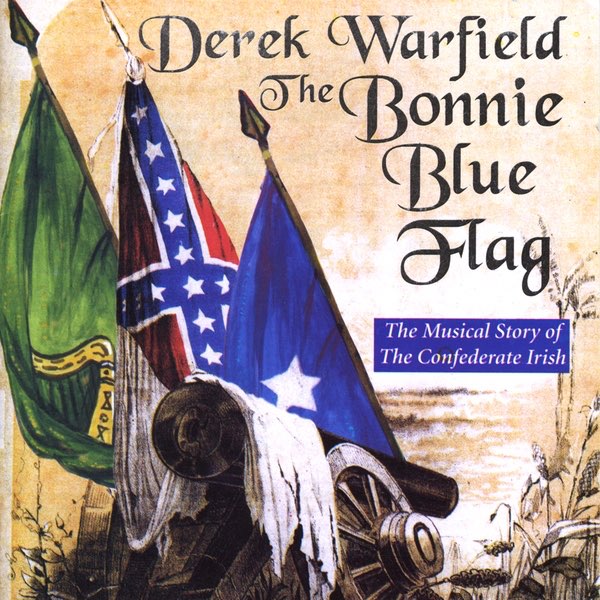
It’s not unusual for music to preserve historical memory, but it is surprising sometimes where that memory ends up surfacing. One such instance appears in the work of Irish balladeer Derek Warfield, whose songs normally focus on Dublin and Belfast, but in this particular instance, he turns his attention to Dixie. This might seem like a head-scratcher of an unlikely pairing, as Irish rebel ballads traditionally recount Ireland’s numerous and plentiful struggles of uprisings, exiles, and long political conflicts. Yet the history of Irish migration and the musical traditions carried across the Atlantic are a natural connection to the South, and the South and Ireland share an extraordinary habit of remembering their past through song. I previously posted an essay called “Songs of Lament” that connected the Scottish Jacobites with Dixie. However, it’s now time to include the Irish.
It’s not a novelty when Irish balladry celebrates Southern history, as it’s more of a meeting of two cultures that have always used music as a way to carry memory across generations. This is remarkably obvious in a set of Civil War ballads performed by Derek Warfield and circulated online in a YouTube playlist under the heading “The Musical Story of the Confederate Irish,” recounting the history of Irish immigrants who lived and fought in the Confederate South.
Derek Warfield himself stands squarely within one of the most influential musical traditions of modern Ireland. The Irish folk group The Wolfe Tones formed in Dublin in 1963 and quickly became known for Irish historical and rebel ballads. The band’s name, The Wolfe Tones, comes from Theobald Wolfe Tone, one of the central leaders of the Irish Rebellion of 1798. Warfield joined the group in 1964 and became its most recognizable performer and musical arranger. The Wolfe Tones built an international audience through songs about Irish political struggles, exile, emigration, and the cultural memory of Ireland itself. Their repertoire functioned more as a form of musical storytelling about the Irish past than just basic, ordinary crowd-pleasing entertainment.
Warfield’s later career continued that same impulse. When he eventually departed the band in 2001 (he wanted to continue in a historical repertoire, and the rest of the band wanted to stick to the established fan favorites) and began performing as Derek Warfield & The Young Wolfe Tones. His work still revolved around the intersection of music and history, and his songs repeatedly returned to the experiences of Irish migrants scattered throughout the Atlantic world. Warfield’s artistic interest has never been limited to Ireland alone, and he has long explored the historical journeys of Irish people wherever those journeys carried them.
Once that broader perspective is understood, an Irish musician taking a close look at the South makes a lot of sense. During the nineteenth century, Irish immigration reshaped communities across the United States, including parts of the Deep South. The largest Irish populations formed in northern cities such as New York and Boston, but Southern port cities also received significant numbers of immigrants, particularly during and after the Great Famine of the 1840s. Cities such as New Orleans, Charleston, Savannah, and Richmond developed visible Irish communities whose members worked as laborers, tradesmen, dock workers, and merchants, while the Scots-Irish from Ulster settled mostly in the uplands of Appalachia.
These immigrants did not remain isolated from the societies in which they settled. Throughout the South, they became integrated into the economic and social life of Dixie. They were wary of government interference and were proud of their new homes. Also, just like other residents of the South, they experienced all the political upheavals of the time, including the coming of the American Civil War. When war finally erupted in 1861, Irish immigrants found themselves divided along the same geographic lines as their neighbors. Irish-born soldiers fought for both the Union and the Confederacy, reflecting the realities of where Irish communities had established themselves.
The Confederate side of that story includes several historically documented figures whose lives illustrate the complexity of immigrant loyalties during the war. One of the most prominent was Patrick Cleburne, an Irish-born officer who emigrated from County Cork to the United States in 1849 and eventually settled in Arkansas. During the Civil War, Cleburne rose to the rank of major general in the Confederate Army and commanded a division in the Army of Tennessee. His reputation for tactical brilliance and personal courage earned him the nickname “the Stonewall of the West.” Cleburne was killed at the Battle of Franklin in 1864, where his death became one of the most widely mourned losses among Confederate officers.
Another Irish immigrant whose wartime career entered Confederate legend was Richard W. Dowling, born in County Galway and later a resident of Texas. Dowling commanded Confederate forces at the Second Battle of Sabine Pass in 1863, where a small garrison successfully repelled a Union naval assault. The soldiers under his command included several Irish immigrants who had settled along the Gulf Coast, and their victory became one of the most celebrated defensive actions of the Confederate war effort.
Warfield’s musical treatment of these historical subjects becomes clearer when listening to the individual songs themselves. In the original Warfield ballad “General Patrick Cleburne,” he resists the temptation to present the Irish-born Confederate officer through detailed military chronology, and instead focuses through the narrative style typical of traditional Irish historical song. The lyrics emphasize Cleburne’s origins, his rise through the Confederate ranks, and the respect he commanded among soldiers in the Army of Tennessee, condensing an entire military career into a portrait suitable for ballad storytelling. The same approach appears in another original song, “Sabine Pass,” which recounts the dramatic defense of the Texas coast under the command of Richard W. Dowling. Rather than dwelling on the tactical details of the battle, the song focuses on the improbable nature of the Confederate victory and the determination of the small garrison that repelled the Union naval attack in 1863. “The Bonnie Blue Flag” shifts the focus from individual biography to the broader musical culture of the Confederacy itself. One of the most recognizable songs associated with the Confederate cause during the war, it situates Warfield’s ballads about Irish immigrants within the larger tradition of wartime music that circulated among Confederate soldiers and civilians alike. Heard together, the three songs illustrate Warfield’s method: historical events are distilled into narrative episodes that can be carried forward through melody and memory, much as earlier Irish ballads preserved the stories of uprisings, exiles, and fallen leaders.
These figures demonstrate that Irish immigrants in the South were not at all temporary residents passing through unfamiliar territory. Many had established permanent lives there, and when war arrived, they responded as members of the communities in which they lived. At the same time, their experiences were not identical to those of Irish immigrants in northern cities. The Union famously fielded an “Irish Brigade,” a large ethnic formation composed largely of Irish-born soldiers. No equivalent Confederate brigade existed. In the South, Irish immigrants were generally fewer in number and more dispersed, so they usually served within local regiments drawn from the towns and counties where they lived.
For an Irish balladeer like Warfield, however, the significance of these stories lies not only in military history but in cultural memory. Irish music has a long history through narrative ballads recounting battles, uprisings, exile, and martyrdom. These songs are rarely composed as academic documents. Instead, they condense historical events into human stories that can be sung and remembered. The ballad form allows communities to carry their past forward even when political circumstances change or when written records fade into the background of everyday life. In that respect, the Irish ballad tradition shares a surprising resemblance with musical practices in the South. Southern musical culture has long included narrative songs recounting historical events, tragedies, and community memories. Many of those songs ultimately descend from the same British and Irish ballad traditions that migrants carried across the Atlantic.
Ballads are not historical monographs. They compress complicated events into memorable narratives that can be sung, repeated, and adapted. Yet precisely because of that simplicity, they often preserve historical memory with unusual durability. A melody remembered across generations can carry names, places, and events long after the surrounding political landscape has changed.
Seen against that broader historical backdrop, the musical connection between Ireland and the South is a natural cultural relationship instead of a novelty. The same narrative ballad tradition that preserved Irish history also survived in the Appalachian Mountains and later contributed to the formation of Southern musical styles. When an Irish balladeer sings about the South, he is working within a musical language that already belongs to both places. Warfield’s work exploring Irish immigrants in the Confederacy can be understood as part of that larger transatlantic tradition. His songs follow the familiar Irish practice of commemorating historical figures and events through narrative ballads. The subject matter happens to involve Irish migrants living in the South, but the artistic method remains recognizably Irish. The result is a body of music that sits at the intersection of two cultural histories.
Warfield’s music does more than recount a curious episode of diaspora history. It illustrates the durability of a musical habit shared by two societies shaped by upheaval. In both Ireland and the South, historical memory has often traveled more through songs in ordinary places, such as parlors, taverns, front porches, and community gatherings, than through official documents. Ballads compress history into stories that can be carried by the human voice long after the political circumstances that produced them have faded into the past. When an Irish balladeer sings about Dixie, he is not exploring foreign territory. He is working within a tradition that both cultures recognize instinctively, and that is the use of music to remember what history alone cannot fully preserve. Across oceans and generations, the melody continues.
The views expressed at AbbevilleInstitute.org are not necessarily those of the Abbeville Institute.







My compositions are Southern Celtic. I mean this makes perfect sense. Two generations removed from the Earth in Virginia, but luck has me married to a lady descended from James O’Neill of Chicago, who saved Celtic music here by writing it down
Great piece. I’m a fanatic for Irish music. I’ve been playing it for forty years, since meeting some Irish lads from Cork working construction at a military base in NYC where I was stationed who introduced me to the “sessions” at the Irish bars in the Bronx. Mandolin, tenor banjo, tin whistle and soon uilleann pipes. It is the finest music known to man and I’ll stand on Mozart’s coffee table and shout that at the top of my lungs.
I’ve long believed the Irish were a larger presence in the South than the Scots (who I think benefited from the “Braveheart effect” — Sir Walter Scott was the most popular writer, so everyone wanted to be a Scott. Gen Billy Mahone, the railroad engineer, named stops on the lines he built after towns in Scott’s books). Company I in my great great grandfather’s regiment (8th Alabama) was known as the “Emerald Guards,” all Irish from Mobile. In my own woodpile there’s a bunch of Scots-Irish from Antrim but there’s also Gaelic Irish from Donegal.
it’s also interesting to note the loathing that the New Englanders had for the Catholic Irish. I was reading memoirs of a Vermont soldier in the 4th Vermont, who stated he wished all the NY Paddies would be deported back to Ireland. That helps explain why the Irish clustered in units like the 69th NY (not to mention the NYPD and the NYFD) – self protection. they didn’t have that problem in the South, so were more dispersed.
James O’Neill (mentioned above) is truly a great great man. Departed Cork as a sailor in 1865, and after many journeys ended up in Chicago, where he became chief of police. And yeah, compiled O’Neill’s Music of Ireland, collecting a tunes from members of Chicago’s finest. Also wrote a book on the fun and excitement of collecting old Irish tunes — ones written for the pipe and harp, adapted for guitar, penny whistle, etc. O’Neill is one of the great men of our time, IMHO.
“The Union famously fielded an “Irish Brigade,” a large ethnic formation composed largely of Irish-born soldiers. No equivalent Confederate brigade existed.”–not even the 10th Tennessee?