

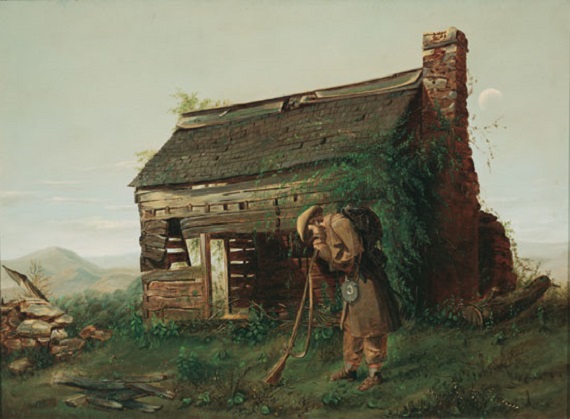
Originally published at From the Desk of Jon Harris
Upon the Soviet Union’s dismissal of 146 historians from Czech universities, Milan Hübl, among those dismissed, is said to have observed, “The first step in liquidating a people is to erase its memory.” Hübl went on to predict that after a “new history” takes the place of the old “the nation will begin to forget what it is and what it was.”[1] Such sentiment echoed a similar southern fear during and after the American Civil War. Confederate General Patrick Cleburne declared that, “Surrender means that the history of this heroic struggle will be written by the enemy; that our youth will be trained by northern school teachers; will learn from northern school books their version of the War; will be impressed by all the influences of history and education to regard our gallant dead as traitors, and our maimed veterans as fit subjects for derision.”[2] To Cleburne, along with many other southern patriots, such an outcome was unacceptable. When the cannons fell silent in 1865, the pen became the only weapon the South had left, and many wielded it masterfully.
Vindications of the southern cause came from all quarters. Scholar Basil L. Gildersleeve released The Creed of the Old South in 1865. The next year saw two vindications released. Albert Taylor Bledsoe, a lawyer, finished writing Is Davis a Traitor? and Edward A. Pollard, a journalist, published The Lost Cause, from which the name for the entire genre of literature came to be called. Robert Lewis Dabney, a theologian and Stonewall Jackson’s chief of staff, published A Defense of Virginia and Through Her of the South in 1867. Alexander H. Stephens released the two volume A Constitutional View of the Late War Between the States also in 1867 and 1870. Jefferson Davis finished Rise and Fall of the Confederate Government in 1881, and congressman and lieutenant-colonel Jabez L.M. Curry published The Southern States of the American Union in 1894. In addition to books, there were organizations such as the Southern Historical Society out of New Orleans and magazines such as the Southern Review out of Baltimore.
Recently, the cannon of “Lost Cause” literature has greatly expanded in the eyes of some historians, making defining it difficult. Before the war ended two basic opposing historiographical paradigms already existed each claiming an accurate depiction of the conflict. The vast majority of critical attention is devoted to the southern “Lost Cause” while hardly any study is given to the Northern “Slave Power” narrative.
University of South Carolina historian Clyde Wilson in his 2006 book Defending Dixie: Essays in Southern Culture and History outlines a basic history on how these two divergent positions have interacted. Throughout Reconstruction Southerners were “officially the demons of American history” in the minds of “Yankees” for their crime of trying to “‘destroy the greatest nation on earth’ because of . . . lust for slavery.”[3] Wilson makes a separation between “Yankees” and those whom he regards as “decent Northerners” like Joshua Chamberlain who “saluted the defeated.”[4] The critical period to understanding the modern historiographical situation came in the 1890s. “A truce was called to which most Northerners and Southerners subscribed in good faith.”[5] Wilson goes on to recount a 1907 speech given by Charles Francis Adams, Jr., “on the centennial of R.E. Lee’s birth called ‘Lee, the American.’”[6] southern participation in the Spanish-American War, joint Union and Confederate reunions, and D.W. Griffith’s charitable portrayal of both the South and Lincoln in The Birth of a Nation all symbolized the truce.
The terms of the Truce went something like this. Northerners agreed to stop demonizing Southerners and to recognize that we had been brave and sincere and honourable in the War, although misguided in trying to break up the Union. Northerners agreed also that Reconstruction was a great wrong that would not have happened if Lincoln had lived. And they willingly accepted Confederate heroes like Lee and Jackson as American heroes.[7]
This truce held strong in general, popular, and civic culture up until the middle of the 20th century at which time it started to fade and was completely broken by the time Wilson gave his observations in 2003. The relatively new term “Myth of the Lost Cause” is cited by Wilson as one evidence of the broken agreement.
In the 1987 Ghosts of the Confederacy: Defeat, the Lost Cause and the Emergence of the New South 1865 to 1913 Gaines M. Foster, a historian at Louisiana State University, makes a similar observation.
. . . the election of Cleveland helped convince southerners that they had a political future within the union . . . but northern respect was needed to heal the wounds of defeat. . . In the late seventies and early eighties, a tentative rapprochement with northern soldiers and an acknowledgment in national publications of southern heroism indicated that a few northerners were willing to proffer such respect. . . Soldiers . . . served as key agents in reconciliation because they had developed respect for one another in war.[8]
By the early 20th century the “Lost Cause” position was fading as the conciliatory motif gained steam. To put it another way, the “Lost Cause” had been absorbed into a greater American narrative. As the South rebuilt its academic infrastructure professional historians augmented the way history was remembered. By the 1930s the term “Civil War” was outperforming the more acceptable “Lost Cause” terminology of “War Between the States.” Foster writes that, “. . . after 1913 little institutional structure survived to sustain the memory of the war. Fewer and fewer towns put up monuments. . . In the late 1920s schoolboys in three Alabama cities cited Lincoln more often than Lee as a historical or public character after whom they wished to model themselves . . .”[9] The truce was not only a success in binding the wounds of the nation, but also in watering down the “Lost Cause.”
After Reconstruction, the “Lost Cause” narrative, as it came to be called, was seen in both popular culture and academia as a valid contribution to understanding the war. This perception started to change in the 1960s. Most modern scholarship has not looked favorably on the original “Lost Cause” sources, nor any of the subsequent works in the same tradition. Historian Edward Bonekemper, in his 2015 book The Myth of the Lost Cause, refers to “disappointed Southerners, aided by many other ‘conveniently forgetful’ and ‘purposely misleading’ comrades” spending “three decades after the Civil War creating the Myth of the Lost Cause.”[10] Bonekemper asserts that:
At the heart of the myth is the contention that the Civil War had nothing to do with slavery. It had everything to do with it. Other facets of the Myth include the idealization of slavery, the adoration of Robert E. Lee and denigration of Ulysses S. Grant, the insistence that the South had no chance of winning the war, blaming James Longstreet (not Lee) for losing the Battle of Gettysburg, and condemning the North for waging “total war.”[11]
Modern academic consensus is that a minimization or rejection of slavery as an issue motivating the conflict spawned the “Lost Cause.” William C. Davis believes that the creators of the “Lost Cause myth sought to distance themselves from slavery.”[12] Charles B. Dew who teaches at Williams college and authored the 2002 best seller Apostles of Disunion, has as the subtitle Southern Secession Commissioners and the Causes of the Civil War. Dew accuses Jefferson Davis and Alexander Stephens of concealing their true intentions by conspiring to avoid discussing the issue of slavery as a cause after the war, instead opting to write “from the ashes of Confederate defeat . . . a passionate insistence that states’ rights, and states’ rights alone, lay at the root of the recent conflict.”[13] Dew’s assertion is a good example of how the categorical distinctions in which “Lost Cause” authors thought are conflated today.
In The Rise and Fall Jefferson Davis cited, concerning the reason for war, the “denial of the right of a State peaceably to withdraw.”[14] Included in this discussion was the presence and reinforcement of military fortifications in the seceded states as well as Lincoln’s call for troops. Davis leaves slavery for his discussion of secession. Contrastingly, Dew implicitly assumes the war as the inevitable result of secession. This connection neither Davis, nor the other “Lost Cause” authors, ever assumed. Davis further distinguished between the question of slavery serving as an “occasion” for secession and the question of slavery serving as a “cause” for secession.[15] Dew, like many other contemporaries, simply assumes slavery was the cause. One further distinction Davis adduced was between slavery as a political question and slavery as a moral question. Davis denied that any “moral nor sentimental considerations were really involved in either the earlier or later controversies which so long agitated and finally ruptured the Union.”[16] Edward Pollard made the same distinctions concerning secession when he wrote:
The slavery question is not to be taken as an independent controversy in American politics. It was not a moral dispute. It was the mere incident of a sectional animosity, the causes of which lay far beyond the domain of morals. Slavery furnished a convenient line of battle between the disputants; it was the most prominent ground of distinction between the two sections; it was, therefore, naturally seized upon as a subject of controversy, became the dominant theatre of hostilities, and was at last so conspicuous and violent, that occasion was mistaken for cause, and what was merely an incident came to be regarded as the main subject of controversy.[17]
Choosing by default to view slavery as a moral question, Dew rhetorically asks if “secession and racism [are] . . . intimately connected?”[18] a view he shares with many modern faculty members.
In academic circles the term “Lost Cause” evolved into somewhat of a pejorative during the third quarter of the 20th century often being inextricably linked with the word “myth.” Bonekemper describes “The Myth” as “a collection of fictions, lies, and component myths that purport to explain why much of the South seceded from the Union and why the Confederacy lost the Civil War.”[19] Bonekemper goes on to assert that after Appomattox the “Myth came to dominate the historiography of the Civil War for most of the next 150 years.”[20] Presumably, it was not until around 1973 with the publication of The Myth of the Lost Cause, 1865-1900 by Yale University historian Rollin G. Osterweis that historians finally became aware of the alleged fantasy their profession had previously taken for granted.
To be clear, the employment of the term “myth” represents more of an academic condescension than it does an exhaustive affirmation of the idea that it contains no truth value whatsoever. Osterweis himself said that “It represented the postbellum adjustment of the old chivalric concepts and the old idea of southern cultural nationalism to the traumatic experiences of devastation, defeat, poverty, and humiliation.”[21] The “Lost Cause,” Osterweis explains, despite its “shadowy basis in empirical fact” was a romantic legend advanced in literature for the purpose of granting the South an identity to take pride in while simultaneously reshaping “political and social realities.”[22] In the 2000 book The Myth of the Lost Cause and Civil War History, University of Virginia historian Gary Gallagher asserts that a myth is not to be confused with a “falsehood.” “Myths,” Gallagher claims, “arise when people draw on images and symbols to construct a usable truth, which in turn permits them to deal with traumatic events such as the Confederacy’s defeat.”[23] Thus, many modern professional historians see the “Lost Cause” as a symbolic truth rather than an objective truth. While opposing its influence in the culture at large, there is an especially aggressive attempt to fence it away from the ivory towers of academia. It may have served a purpose for 150 years, often at the expense of national unity and minority rights, but it is now time to retire the legend and, like other myths, cease retelling it until it too is gone with the wind.
Patrick Cleburne’s concern in 1864, however, was not over whether or not southern children would be deprived of a symbolic legend by which to cope with the inevitable depressing circumstances of defeat. Nor was Cleburne worried about blacks gaining civil rights, his own personal feelings being in favor of emancipation. Cleburne’s fear was that the historical record would be compromised by a northern “version” of events having the lasting effect of dishonoring the Confederate dead. Fortunately for Cleburne, he was not alone in his sentiment.
While the war was still being waged in 1862, Albert Taylor Bledsoe, a West Point graduate, former Episcopal minister, lawyer, and previous chair of the mathematics and astronomy department at Ole Miss wrote Fall of the American Union. In it he argued that “Slavery . . . was not the root of southern independence. The differences between the North and South were ‘as deep as the foundations of society itself, and as universal as the interests of humanity.’”[24] Northern vilification of the South eventually caused the conflict. It is worth noting that while most modern academic treatments of the “Lost Cause” claim that it was not until after the war that southerners distanced their cause from the perpetuation of slavery, Fall of the American Union, “a portion of which appeared in the Army and Navy Messenger in 1863,” is one example that such opinion had already been introduced in southern intellectual thought.[25]
At the encouragement of Jefferson Davis, Bledsoe ran the blockade to England in 1863 and began writing perhaps the most important historical piece of “Lost Cause” literature: Is Davis a Traitor? Or Was Secession a Constitutional Right Previous to the War of 1861?. After returning to the United States in 1865, Robert E. Lee reportedly remarked, “Doctor, you must take care of yourself; you have a great work to do; we shall look upon you for our vindication.”[26] Jefferson Davis was imprisoned at Fort Monroe and if he went to trial the information in Bledsoe’s book would serve as a defense of the entire former Confederacy. It was an “attack on . . . nationalism in the antebellum period” advocated by “Daniel Webster, Joseph Story, and John Motley, and their political master Abraham Lincoln.”[27] The work was published in Baltimore the following year. Bledsoe would go on in 1867 to establish the Southern Review in Baltimore, a magazine primarily consumed with justifying the southern cause.
Other than a few passing comments from the likes of David Blight and Charles Reagan Wilson, there is not a lot of information on the significance of Albert Taylor Bledsoe from the historical establishment. Historian Brion McClanahan and talk show host Mike Church published a critical edition of Is Davis a Traitor? in 2013, with the premise that it “is not simply a defense of the ‘Lost Cause,’ it is a fine commentary on the Constitution. . .”[28]
Recently, professional historical consensus has drastically changed in a defining way on the extent to which the Southern view, or “Lost Cause,” has influenced American culture. Alan T. Nolan, Gallagher’s co-author in The Myth of the Lost Cause and Civil War History, defines the “truce” between the North and South forged in the1880s as an expression of the “Lost Cause” itself. After stating that “The political legacy of the Lost Cause . . . facilitated the reunification of the North and South,”[29] Nolan goes on to say that, “The virulent racism that the North shared with the South, in spite of northern antislavery views, was a premise of the Lost Cause and the principal engine of the North’s acceptance of it. The reunion was exclusively a white man’s phenomenon and the price of the reunion was the sacrifice of the African Americans.”[30]
It is at this point that an important assumption is made on the part of the current academic establishment. “The Lost Cause” becomes intrinsically tied to white supremacy, which oddly enough is a feature that already existed in the North. If this premise is accepted, the only significant factor “Lost Cause” mythology could have possibly offered, in addition to what both sides already shared in common, were the stories of southern heroes and culture before and during the war.
This is precisely how the list of “Lost Cause” proponents invariably widens to include fiction writers like “Thomas Nelson Page, James Dixon, and Joel Chandler Harris to Walt Disney and Margaret Mitchell”[31] who painted the antebellum South, including slave conditions, in a positive light. William C. Davis in his 1996 book The Cause Lost: Myths and Realities of the Confederacy called Gone With The Wind “distorted,” and a “mostly fictitious ‘moonlight and magnolias’ portrait of the Old South and the Confederacy.”[32] “Mortals like Stonewall Jackson,” Davis says, “have been metamorphosed into demigods.”[33]
Davis takes it upon himself to present a more realistic rendition of some of the Confederacy’s heroes, devoting an entire chapter to demythologizing Jackson. Two of the major realities in Davis’s mind that admirers of Stonewall Jackson fail to recognize are the fact that he was allegedly a hypochondriac, and that he did not care for lemons in the way legend has remembered him. Perhaps it should be more impressive to admirers that a hypochondriac would love his country enough to risk the unsanitary life of a soldier, but Davis does not mention this.
Alan T. Nolan considers Nathan Bedford Forrest to be “a strange hero,” describing him as looking “on as his troops helped massacre black Union soldiers at Fort Pillow after they had surrendered” and then becoming a “prominent Ku Klux Klan leader.”[34] Nolan leaves out the question of conflicting testimony in the incident.[35] No mention is made of the performance of Forrest’s slaves as Confederate cavalrymen, his granting their freedom, their commitment to him after the war, and his reputation as a charitable employer to former slaves after emancipation. The Forrest responsible for disbanding the first Klan while disavowing any subsequent entities claiming to be part of the organization is unnoticed. Nolan offers no trace of the Nathan Bedford Forrest who kissed Lou Louis, a black woman, after giving a speech in support of an early civil right’s group in Memphis in 1875.[36]
More significantly, the character of Robert E. Lee has been the subject of much scrutiny since the publication of The Marble Man in 1977 by South Carolina State historian Thomas L. Connelly. Connelly took it upon himself to psychologically analyze Lee and, to an extent, those he credits with giving him legendary status, such as Lee’s famous biographer Douglas Southall Freeman whose four volumes in 1934-1935 entitled R. E. Lee: A Biography won him a Pulitzer Prize. Connelly claims that “inner loneliness” and the “repression of a vibrant spirit, was basic to his nature.”[37] In opposition to the vast majority of secondary sources on the general, Connelly asserts that “Lee could also show a savage temper,” which caused Connelly to invoke Sigmund Freud’s “‘death instinct’ which related aggressive behavior to inner guilt.”[38]
In a more recent 2007 work by historian Elizabeth Brown Pryor entitled, Reading the Man: A Portrait of Robert E. Lee Through His Private Letters, an even less genteel picture is painted of the legendary general. Pryor introduces a Lee who “had broken up every [slave] family”[39] on his estate, regularly beat his slaves, captured free blacks in Pennsylvania in order to enslave them in Virginia, and possibly “turned a blind eye”[40] to attempted lynchings administered by members of the student body when he was the president of Washington and Lee College. Many of Pryor’s conclusions are based upon historical inference or questionable sources, such as the Wesley Norris letter.[41] Pryor even goes so far as to make reference to “a hypothetical case of foot fetishism,”[42] a theory she found in journalist Roy Blount, Jr.’s 2003 publication Robert E. Lee in an appendix entitled Speculation.
Like Connelly, Blount imposes psychological assumptions onto the historical record. Because of Robert’s father, Harry Lee’s, relational shortcomings, Robert “fit the description of children who repress the childhood pain of having to serve as ‘mothers . . . of their own mothers.’”[43] “Lee always loved . . . foot massage,” and “in Lee’s culture feet were highly eroticized.”[44] Lee’s frequent mention of “socks” in letters to his wife, along with the ease he exhibited around women, render “Lee’s sexuality . . . less gender-specific than that of his role model, George Washington. . .”[45] Lee’s complimentary remarks toward other women, which were no issue or secret to his wife, Blount refers to as “crushes.” The author also asserts that “many men” also “seem to have had a kind of platonic crush on him.”[46] According to this bizarre interpretation, Lee’s self-restraint in the face of his desires were the result of “his mother’s preachments and his father’s bad example”[47]
Without a doubt, Robert E. Lee has weathered more criticism in the last ten years than any other Confederate hero. Washington Post opinion writer Eric Lamar calls him a “traitor.”[48] Adam Serwer, who used Pryor’s Reading the Man as his main source, wrote in an Atlantic piece that “Lee was devoted to defending the principle of white supremacy.”[49] Biographies produced by historians are generally careful to include the story of Lee’s allegiance to Virginia and reluctance to fight the Union as well as his generally sympathetic attitude toward slaves and emancipation (with the possible exception of Pryor). Nevertheless, recent historical retellings have been used by opponents of Lee’s image to tarnish the general.
Though new academic approaches, such as psychoanalysis, have birthed new perspectives, many of Lee’s detractors are actually repeating accusations as old as the man himself. While it would be possible to eulogize the general using exclusively Northern sources contemporary with him, it would also be possible to vilify him. Though not a biography, historian John Reeves 2018 book The Lost Indictment of Robert E. Lee: The Forgotten Case against an American Icon goes farther than any historian has in attempting to make the treason charge stick to Lee. Reeves uses original source material such as “The New York Times and Chicago Tribute [which] led the way among the nation’s newspapers in making the case that Lee be tried and punished for treason.”[50] It should come as no surprise that Lee’s image is faltering in popular culture.
Alan T. Nolan makes the case that “the Lost Cause . . . is a caricature of the truth. . .” when the war was actually a rebellion against the Constitution in which rich planters seceded in order protect the inhumane system of slavery, occupying land that was not theirs and attacking Fort Sumter, thus starting the war. Lincoln defended the United States with skill and success.[51] Nolan’s goal is to “start again” by putting away “distortions, falsehoods, and romantic sentimentality of the Myth of the Lost Cause.”[52] Nolan’s view has progressively come into vogue within the past forty years in most academic institutions. There exists the “Myth of the Lost Cause,” and there exists the unbiased truth.
Of course, this interpretation would require the presupposition that northerners, having victoriously defeated the South in a costly war, were blinded enough by their own racism to the point of being duped by their recent enemy into conceding the moral high ground, all at a time when they were economically, politically, and socially more influential than the South. There is, of course, another way to interpret the collapse of the reconciliatory “truce” which remained the status quo until recently.
In Free Soil, Free Labor, Free Men: The Ideology of the Republican Party before the Civil War, Columbia University historian Eric Foner observes that before the Civil War both North and South viewed their “own society as fundamentally well-ordered, and the other as both a negation of its most cherished values and a threat to its existence.”[53] Foner goes on to state:
At the center of the Republican ideology was the notion of ‘free labor.’ This concept involved not merely an attitude toward work, but a justification of ante-bellum northern society, and it led northern Republicans to an extensive critique of southern society, which appeared both different from and inferior to their own. Republicans also believed in the existence of a conspiratorial ‘Slave Power’ which had seized control of the federal government and was attempting to perfect the Constitution for its own purposes.[54]
In this narrative, southern political objectives were always connected with the motivations of the “Slave Power.”
What Alan T. Nolan calls the “Lost Cause,” Yale University historian David Blight refers to as “the forces of reconciliation,” which defeated “the emancipationist vision, embodied in African Americans’ complex remembrance of their own freedom, in the politics of radical Reconstruction, and in conceptions of the war as the reinvention of the republic and the liberation of blacks to citizenship and Constitutional equality.”[55] The “persistance” of the “neoabolitionist tradition,” according to Blight, “made the revival of the emancipationist memory of the war and the transformation of American society possible in the last third of the twentieth century.”[56]
Instead of a recent inexplicable triumph of objective historical “truth” over the “Myth of the Lost Cause,” the “Slave Power” narrative has actually defeated the conciliatory “truce” on the basis of “reinvention” and “equality.” No new discovery leading to such a seismic upheaval in Civil War interpretation has come to light. Instead, a cultural paradigm shift took place which favored an old interpretation of old facts.
Mainstream historical academic rejection of both the conciliatory and “Lost Cause” paradigms in favor of the “Slave Power” narrative has not made the southern interpretation cease to exist. Areas ignored, or inadequately explained by the “Slave Power” narrative are analyzed in modern retellings of the “Lost Cause.” Marshall DeRosa, a Constitutional Law professor at Florida Atlantic University, has penned two favorable studies on the Confederate Constitution and one favorable book on Robert E. Lee. Loyola University economist Thomas Dilorenzo has authored three books critical of Abraham Lincoln. The Kennedy Brothers continue to produce popular-level books on the Confederacy, slavery, reconstruction, and the “War of Northern Aggression,” including an edited reprint of William Rawle’s A View of the Constitution. Karen Stokes, an archivist at the South Carolina Historical Society, has published numerous works from southern fiction to compilations of primary historical accounts on Sherman’s atrocities and war experiences.
Many authors, often with pen names or formal training in fields other than history, have self-published or published with companies such as Shotwell, whose goal, among other things, is to keep the “Lost Cause” alive. Formal historians such as Boyd Cathey, Clyde Wilson, and Brion McClanahan, have gone around academic establishments in recent years finding favorable reception in outlets like the Abbeville Institute and Confederate Veteran.
As long as questions such as, “Why did the Confederate Constitution outlaw the slave trade?” “Why were there free blacks who fought for the Confederacy?” or “Why did the vast majority of non-slaveholding southerners fight?” are asked, there will always be a demand for “Lost Cause” explanations. The existence of the Slave Narratives, U.S. census records, and foreign observations suggesting favorable slave conditions in the South, will always prompt research that must come to terms with the “Lost Cause.” Lincoln, and other northern politician’s attitudes toward civil rights in the North, as well as their stated purposes for invading the South, will always raise questions and the answers may not conform with the “Slave Power” narrative.
In some ways, Patrick Cleburne’s concern that southern children would learn the northern “version of the War” to the point of regarding Confederate soldiers as “fit subjects for derision” has taken place in urban areas of the South. However, in small towns and rural areas the Confederate ghost, the moonlight and magnolias, and indeed, the “Myth of the Lost Cause” still continues to endure. Or perhaps it is not a myth at all. Maybe Jefferson Davis was right when he was said to have remarked after the war, “Truth crushed to the earth is truth still and like a seed will rise again.”
Bibliography
Bledsoe, Albert Taylor, McClanahan Brion, and Mike Church. Is Davis a Traitor?: Or Was Secession a Constitutional Right Previous to the War of 1861? Founding Father Films Publishing, 2014.
Blight, D.W. Race and Reunion: The Civil War In American Memory. Belknap, 2002.
Blount, Roy. Robert E. Lee. New York: Viking, 2003.
Bonekemper, E.H. The Myth of the Lost Cause: Why the South Fought the Civil War and Why the North Won. Regnery History, 2015.
Davis, Jefferson. The Rise and Fall of the Confederate Government. Kindle Edition, 2012.
Davis, William C. The Cause Lost: Myths and Realities of the Confederacy. Lawrence, Kansas: Univ. Press of Kansas, 1996.
Dew, C.B. Apostles of Disunion: Southern Secession Commissioners and the Causes of the Civil War. University of Virginia Press, 2017.
Foner, E. Free Soil, Free Labor, Free Men: The Ideology of the Republican Party before the Civil War. Oxford University Press, 1995.
Foster, Gaines M. Ghosts of the Confederacy: Defeat, the Lost Cause and the Emergence of the New South 1865 to 1913. New York: Oxford University Press, 1988.
Gallagher, Gary W., and Alan T. Nolan, The Myth of the Lost Cause and Civil War History. Bloomington: Indiana University Press, 2000.
Hurst, J. Nathan Bedford Forrest: A Biography. Vintage Civil War Library. Knopf Doubleday Publishing Group, 2011.
King, S.S., and D.P. Cushman. Political Communication: Engineering Visions of Order in the Socialist World. SUNY Series in Human Communication Processes. State University of New York Press, 1992.
Lamar, Eric. “Why Praise Robert E. Lee?” The Washington Post, August 23, 2017. https://www.washingtonpost.com/blogs/all-opinions-are-local/wp/2017/08/23/whats-politically-correct-about-praising-robert-e-lee/
Mtcham, S.W. Bust Hell Wide Open: The Life of Nathan Bedford Forrest. Regnery History, 2016.
Osterweis, R.G. The Myth of the Lost Cause, 1865-1900. Archon Books, 1973.
Pollard, E.A. The Lost Cause: A New Southern History of the War of the Confederates. New York: E. B. Treat, 1867.
Pryor, E.B. Reading the Man: A Portrait of Robert E. Lee Through His Private Letters. Viking, 2007.
Reeves, J. The Lost Indictment of Robert E. Lee: The Forgotten Case against an American Icon. Rowman & Littlefield Publishers, 2018.
Serwer, Adam. “The Myth of the Kindly General Lee.” The Atlantic, June 4, 2017. https://www.theatlantic.com/politics/archive/2017/06/the-myth-of-the-kindly-general-lee/
Wilson, Clyde N. Defending Dixie: Essays in Southern History and Culture. Foundation for American Education, 2006.
***************************************************
[1] S.S. King and D.P. Cushman, Political Communication: Engineering Visions of Order in the Socialist World. SUNY Series in Human Communication Processes, (State University of New York Press, 1992), 7.
[2] E.H. Bonekemper, The Myth of the Lost Cause: Why the South Fought the Civil War and Why the North Won, (Regnery History, 2015), 1.
[3] Clyde Wilson, Defending Dixie: Essays in Southern History and Culture, (Foundation for American Education, 2006), 127.
[4] Ibid.
[5] Ibid.
[6] Ibid., 128.
[7] Ibid.
[8] Gains Foster, Ghosts of the Confederacy: Defeat, the Lost Cause and the Emergence of the New South 1865 to 1913, (New York: Oxford University Press, 1988), 66.
[9] Ibid., 197.
[10] Bonekemper, The Myth of the Lost Cause, 2.
[11] Ibid., xi.
[12] William C. Davis, The Cause Lost: Myths and Realities of the Confederacy, (Lawrence, Kansas: Univ. Press of Kansas, 1996), 180.
[13] C.B. Dew, Apostles of Disunion: Southern Secession Commissioners and the Causes of the Civil War, (University of Virginia Press, 2017), 15.
[14] Jefferson Davis, The Rise and Fall of the Confederate Government, (Kindle Edition, 2012), 143.
[15] Ibid., 46.
[16] Ibid., 14.
[17] E.A. Pollard, The Lost Cause: A New Southern History of the War of the Confederates, (New York: E. B. Treat, 1867), 47.
[18] Dew, C.B. Apostles of Disunion, 2.
[19] Bonekemper, The Myth of the Lost Cause, 2.
[20] Ibid.
[21] R.G. Osterweis, The Myth of the Lost Cause, 1865-1900, (Archon Books, 1973), ix.
[22] Ibid., x.
[23] Gary W. Gallagher and Alan T. Nolan, The Myth of the Lost Cause and Civil War History, (Bloomington: Indiana University Press, 2000), 8.
[24] Albert Taylor Bledsoe,. Is Davis a Traitor?: Or Was Secession a Constitutional Right Previous to the War of 1861?, Ed. McClanahan Brion and Mike Church (Founding Father Films Publishing, 2014), xiv.
[25] Ibid., Davis. The Cause Lost, (Lawrence, Kansas. 180), x.
[26] Bledsoe, Is Davis a Traitor?, xxi.
[27] Ibid., xvi.
[28] Ibid.
[29] Gallagher and Nolan. The Myth of the Lost Cause and Civil War History, 28.
[30] Ibid.
[31] Ibid., 16.
[32] Davis. The Cause Lost, 194.
[33] Ibid., x.
[34] Gallagher and Nolan. The Myth of the Lost Cause and Civil War History. 26.
[35] J. Hurst, Nathan Bedford Forrest: A Biography. Vintage Civil War Library, Knopf (Doubleday Publishing Group, 2011), 176.
[36] Mitcham, S.W. Bust Hell Wide Open: The Life of Nathan Bedford Forrest, (Regnery History, 2016), 310-312.
[37] Connelly, Thomas Lawrence. The Marble Man: Robert E. Lee and His Image in American Society. (Baton Rouge: Louisiana State University Press, 1978), 176.
[38] Ibid., 204.
[39] E.B Pryor, Reading the Man: A Portrait of Robert E. Lee Through His Private Letters, (Viking, 2007. 264), 264.
[40] Ibid., 455.
[41] Ibid., 260-261.
[42] Ibid., 29.
[43] Blount, Roy. Robert E. Lee. (New York: Viking). 2003.168.
[44] Ibid., 170-171.
[45] Ibid., 172.
[46] Ibid.
[47] Ibid., 183.
[48] Lamar, Eric. “Why Praise Robert E. Lee?” The Washington Post, August 23, 2017. https://www.washingtonpost.com/blogs/all-opinions-are-local/wp/2017/08/23/whats-politically-correct-about-praising-robert-e-lee/?utm_term=.5f3e8aad7382.
[49] Serwer, Adam. “The Myth of the Kindly General Lee.” The Atlantic, June 4, 2017. https://www.theatlantic.com/politics/archive/2017/06/the-myth-of-the-kindly-general-lee/529038/.
[50] Reeves, J, The Lost Indictment of Robert E. Lee: The Forgotten Case against an American Icon. (Rowman & Littlefield Publishers, 2018), 49.
[51] Gallagher and Nolan, The Myth of the Lost Cause and Civil War History, 29.
[52] Ibid.
[53] E. Foner, Free Soil, Free Labor, Free Men: The Ideology of the Republican Party before the Civil War. (Oxford University Press, 1995), 9.
[54] Ibid.
[55] Blight, D.W. Race and Reunion: The Civil War In American Memory, (Belknap, 2002), 2.
[56] Ibid., 2-3.
The views expressed at AbbevilleInstitute.org are not necessarily those of the Abbeville Institute.





This is very good and very useful.
There is a lot to digest, much to mull.
And like a seed will rise again..yes it shall
ONLY when the facts are uncovered:
1. 1783: The Treaty of Paris establishes the states as 13 free sovereign and independent states; and treats with them as such. Each is supremely ruled by its respective state government.
2. 1787-1788: Some states exercise this sovereignty unilaterally, to withdraw from their union and form a new one under a Constitution, that only requires nine of the 13… and ultimately goes into effect between only 11 of them, with each state doing so by its respective state voters acting as sovereign principals– and thereby establishing them as such over government agents; under the principle of popular sovereignty by consensual government.
3. 1789-1790: the last of the original 13 states ratify the Constitution, with the voters of Rhode Island doing so directly, thus proving their individual status as sovereign principals of their respective state as a sovereign nation (and thus the voters of all state being the same).
4. 1790-1860: 30 new states are added to this Constitutional union, and are recognized as equally sovereign under the Constitutional “Equal Footing” doctrine. Total number of states increases to 34.
5. 1832-1833: The (international) federal government begins denying point #1. above; instead claiming that: 1) the original 13 states always only formed one single de jure free, sovereign and independent state (i.e. a national union) from 1776 onward– and that therefore 2) all states were subordinate to it including the newer states. This includes precedent of Jackson’s “Force Bill,” which authorizes federal military force against individual states under claim of “national” authority.
6. 1860-1861: As in point #2. above: once again the respective voters of 11 states exercise their sovereignty; to unilaterally withdraw from their international union with the other states, and choose to form a new international union under a different Constitution instead.
7. 1861-1865: in response; the president and Congress cite the claims from point #4. above to declare the repeated-withdrawal as “rebellion” against the (falsely) alleged federal state that was (supposedly) formed in 1776; and the non-withdrawing states concur. The federal government usurps national authority is established over all states by Total War in a self-coup, through re-written history; while under international law, de jure principal sovereignty remains respective to each state, via its respective citizen-voters.
8. 1869: The Supreme Court concurs with the other federal branches in the case of Texas v. White.
9. 1869-present: De jure sovereignty remains suppressed under the federal usurpation and re-written history; however the 1783 Treaty of Paris remains in force under Article 1, while also being the legal mechanism for enabling voter-principal sovereignty from Constitutional ratification and Equal Footing doctrine.
At this point “the Lost Cause” is practically a pejorative along the lines of “racist” or “anti-Semite” that just dismisses efforts to say truthful things about Lincoln’s War or “Reconstruction.” It isn’t a useful term except as a cudgel against people trying to have an intelligent conversation. Particular Southern general’s reputations are less important to me than the truth about the causes of the tragedy that was Lincoln’s War.
Part of the post “Reconstruction” reconciliation was a recognition of what an utter disaster “Negro Rule” that the North inflicted on the South was. Northerners learned how grotesquely corrupt Carpetbaggers using the illiterate Black electorate were in continuing the destruction of the South after the war…from reading James Sheppard Pike’s The Prostrate State: South Carolina Under Negro Government (1877) et al. The people of the North shared the natural ethnic chauvinism of all people of the 1870s and then had it exacerbated by seeing how stupid it was to have immediately given the vote to illiterate former slaves (explicitly for the Republican Party retaining power over the conquered South). (None of the other countries in the 19th century freeing slaves immediately gave them the vote.)
But a single fact will destroy a most interesting falsehood; and the 1783 Treaty of Paris, Article 1, wholly invalidates the US government’s legal argument for national union: i.e. the claim that the states were never 13 sovereignties without a political superior.\
‘Upon the Soviet Union’s dismissal of 146 historians from Czech universities, Milan Hübl, among those dismissed, is said to have observed, “The first step in liquidating a people is to erase its memory.”’
One can start with the historical facts of the American Revolution– specifically that it established the following Timeline:
1. 1783: The Treaty of Paris establishes the states as 13 free sovereign and independent states; and treats with them as such. Each is supremely ruled by its respective state government.
2. 1787-1788: Some states exercise this sovereignty unilaterally, to withdraw from their union and form a new one under a Constitution, that only requires nine of the 13… and ultimately goes into effect between only 11 of them, with each state doing so by its respective state voters acting as sovereign principals– and thereby establishing them as such over government agents; under the principle of popular sovereignty by consensual government.
3. 1789-1790: the last of the original 13 states ratify the Constitution, with the voters of Rhode Island doing so directly, thus proving their individual status as sovereign principals of their respective state as a sovereign nation (and thus the voters of all state being the same).
4. 1790-1860: 30 new states are added to this Constitutional union, and are recognized as equally sovereign under the Constitutional “Equal Footing” doctrine. Total number of states increases to 34.
5. 1832-1833: The (international) federal government begins denying point #1. above; instead claiming that: 1) the original 13 states always only formed one single de jure free, sovereign and independent state (i.e. a national union) from 1776 onward– and that therefore 2) all states were subordinate to it including the newer states. This includes precedent of Jackson’s “Force Bill,” which authorizes federal military force against individual states under claim of “national” authority.
6. 1860-1861: As in point #2. above: once again the respective voters of 11 states exercise their sovereignty; to unilaterally withdraw from their international union with the other states, and choose to form a new international union under a different Constitution instead.
7. 1861-1865: in response; the president and Congress cite the claims from point #4. above to declare the repeated-withdrawal as “rebellion” against the (falsely) alleged federal state that was (supposedly) formed in 1776; and the non-withdrawing states concur. The federal government usurps national authority is established over all states by Total War in a self-coup, through re-written history; while under international law, de jure principal sovereignty remains respective to each state, via its respective citizen-voters.
8. 1869: The Supreme Court concurs with the other federal branches in the case of Texas v. White.
9. 1869-present: De jure sovereignty remains suppressed under the federal usurpation and re-written history; however the 1783 Treaty of Paris remains in force under Article 1, while also being the legal mechanism for enabling voter-principal sovereignty from Constitutional ratification and Equal Footing doctrine.
: