Walk through the biography or history section of any bookstore and you will likely see many works on Franklin Delano Roosevelt, a man with a severe handicap who overcame the odds to serve as the nation’s chief executive for more than a dozen years, a president who saved American democracy, as well as capitalism, the leader who, during a major economic catastrophe, reached out a helping hand to his fellow man, particularly those in the lower classes, even though he was from the upper ranks of society.
At least that’s how academia portrays the story. The true Franklin from Hyde Park declared national emergencies, expanded government far beyond its constitutional limits, imposed an imperial presidency, and pushed the country further down the road of “progressivism,” producing a “New Deal” that did nothing to end the depression, only worsening it. He, like his cousin Theodore before him, believed the federal government could do virtually anything it desired by not relying on a “horse and buggy” interpretation of the Constitution. As long as the Constitution didn’t specifically prohibit it, the Roosevelts believed, presidents could do it, a legacy that is still very much with us today.
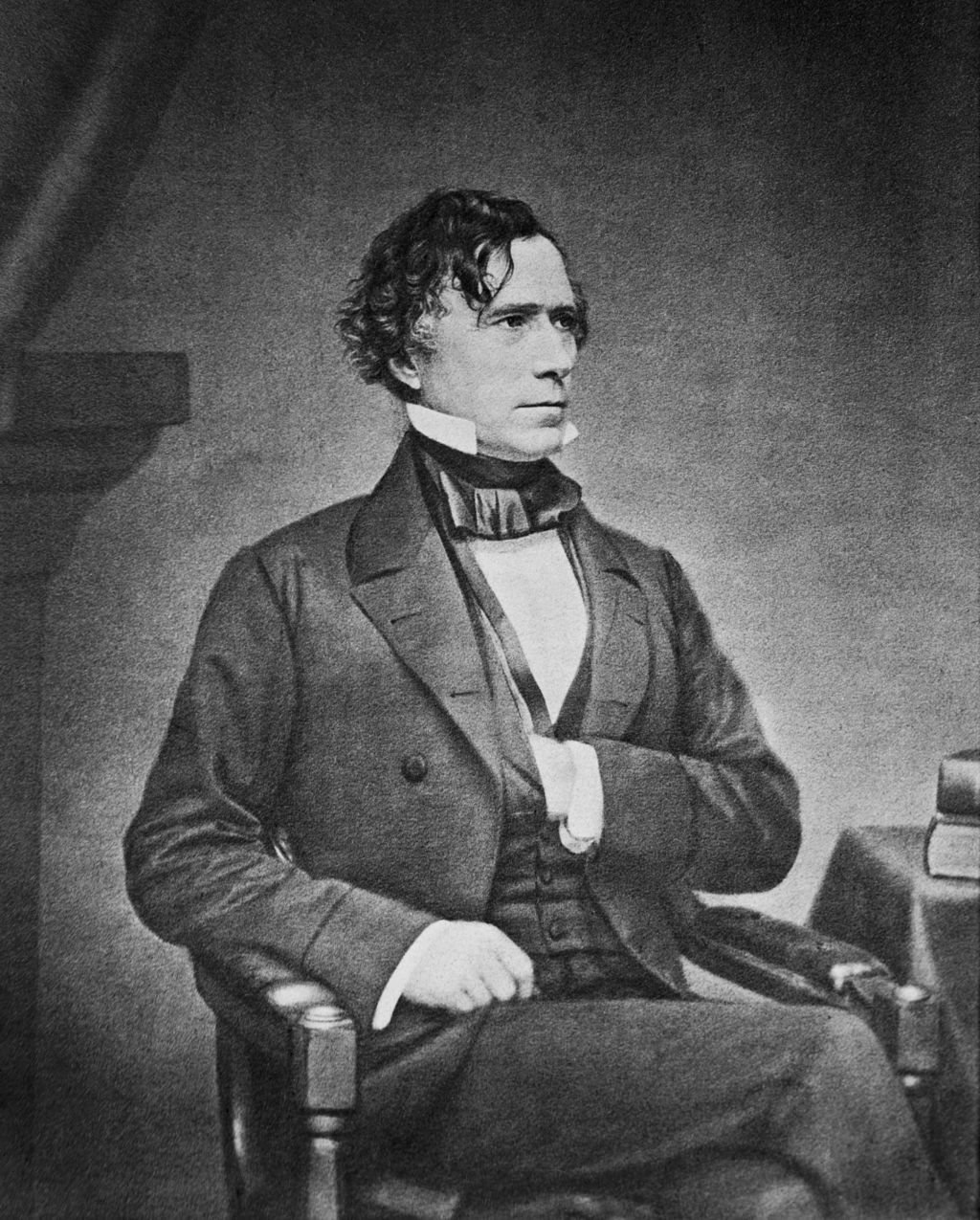
But a forgotten President named Franklin had a much different take on the Union and the role of the federal government in American society. Franklin Pierce served as President from 1853 to 1857, the only chief executive from the state of New Hampshire. Most scholars, though, have been less than enthusiastic about Pierce, most often rating him a failed President. Visiting the same bookstore, you are unlikely to ever find a book on Pierce.
The most recent CSPAN poll ranked him 42 out of 45, while a Wall Street Journal survey had him listed 38 out of 43. Even those scholars who are more conservative don’t see Pierce in a positive light. Robert Spencer recently declared him the worst President, calling him “Disastrous for America.” Ivan Eland, in Recarving Rushmore, ranked him higher, at 24 out of 43, but still placed him in the “Poor” category. Larry Schweikart gave him a constitutional grade of “C” in his Politically Incorrect Guide to the Presidents. In Bill O’Reilly’s latest book, Confronting the Presidents, Pierce is portrayed as little more than a failed drunkard. But there was far more to Franklin Pierce than meets the academic eye.
Born November 23, 1804, young Franklin Pierce grew up in a household inundated with politics. His father, Benjamin Pierce, a veteran of the revolution, served as a sheriff, a state representative, and two terms as governor of New Hampshire as a Jeffersonian Republican. In fact, Franklin would later serve in the state legislature while his father was in the governor’s mansion, eventually rising to Speaker. He would also serve in the United States House of Representatives and the U.S. Senate.
Pierce was more than a mere lawyer and politician but an American veteran, serving as a brigadier general during the Mexican War, in which he sustained several injuries, including an incident when his horse fell on him, badly injuring his knee, yet he continued to try to command his men. After fainting from the severe pain in his leg, and a terrible, ongoing bout of diarrhea he’d battled while in Mexico, a number of soldiers accused him of cowardice, which was far from the truth. Ulysses S. Grant, also a Mexican War veteran, later wrote of Pierce in his memoirs.
“By an unfortunate fall of his horse on the afternoon of the 19th he was painfully injured. The next day, when his brigade, with the other troops engaged on the same field, was ordered against the flank and rear of the enemy guarding the different points of the road from San Augustin Tlalpam to the city, General Pierce attempted to accompany them. He was not sufficiently recovered to do so, and fainted. This circumstance gave rise to exceedingly unfair and unjust criticisms of him when he became a candidate for the Presidency. Whatever General Pierce’s qualifications may have been for the Presidency, he was a gentleman and a man of courage. I was not a supporter of him politically, but I knew him more intimately than I did any other of the volunteer generals.”[i]
Stumping for his fellow Democrat in 1852, James Buchanan angrily answered the cowardice charge. “Frank Pierce a coward! That man a coward, who, when his country was involved in a foreign war, abandoned a lucrative and honorable profession and all the sweets and comforts of domestic life in his own happy family, to become a private volunteer soldier in the ranks! How preposterous!”[ii]
Like FDR’s battle with polio, Pierce had his own personal tragedies to overcome. His private life was very sad, as he lost all three of his children at early ages. One died after three days, another at four years, and the youngest son, Benjamin, called “Benny,” was killed in a disastrous train derailment at age eleven. Both parents saw the mangled body of their last remaining child, lying on the ground nearly decapitated. The loss of Benny came just six weeks before Pierce’s inauguration as President. In his inaugural address, he told his fellow countrymen, “You have summoned me in my weakness.” Depression followed him into the White House, as Jane Pierce remained confined to her bedroom throughout most of those four years in Washington.
Pierce lost Jane to tuberculosis in December 1863. Six months later, he took a trip to the New Hampshire mountains with his close friend, the writer Nathaniel Hawthorne, who he had known since they were classmates at Bowdoin College. In fact, Hawthorne had written a campaign biography for his friend’s presidential run in 1852. Staying in adjoining rooms, Pierce discovered one morning that his friend had died in his sleep. Death seemed to surround the man.
These calamities, coupled with his experiences in war, caused him to drink heavily, though not while he was President. But that didn’t stop his political enemies to often joke that Pierce was the “hero of many a well-fought bottle.” Yet he overcame his personal anguish to serve as the nation’s 14th President, at a time when America was a house dividing.
Pierce’s party, the Democrats, were coming off a presidential loss in 1848 to the Whigs, who ran General Zachary Taylor, who died in office in 1850. The Whigs declined to re-nominate President Millard Fillmore, after he finished out the term, and instead nominated the other commanding general during the Mexican War, Winfield Scott. Pierce, a dark horse like James K. Polk before him, received the Democratic nomination on the 49th ballot.
The party campaign slogan was: “We Polked you in 1844; we shall Pierce you in 1852!” And that they did, as Pierce easily defeated General Scott with an electoral vote majority of 254 to 42, becoming chief executive at the age of 48, the youngest President up to that time. Pierce’s friend, Nathaniel Hawthorne, wrote him a note that was meant to be light-hearted. “Frank, I pity you – Indeed I do, from the bottom of my heart!”[iii]
Critical scholars, though, have pounced on Hawthorne’s note to cast stones at Pierce. “In reality,” wrote Nathan Miller, “Hawthorne should have extended his sympathies to the people of the United States because the nation’s fourteenth president was one of our worst chief executives,” who was “well beyond his depth in the sectional quagmire of the 1850s, a pleasant mediocrity at a time that demanded political giants in the White House.”[iv] But why would Hawthorne be so critical when he had penned a lengthy biography for use by Pierce’s presidential campaign?
In a personal letter in October 1852, during the final days of the campaign, Hawthorne wrote to a friend of his thoughts on Pierce:
“I have come seriously to the conclusion that he has in him many of the chief elements of a great ruler. His talents are administrative; he has a subtle faculty of making affairs roll onward according to his will, and of influencing their course without showing any trace of his action. There are scores of men in the country that seem brighter than he is; but Frank has the directing mind, and will move them about like pawns on a chess-board, and turn all their abilities to better purpose than they themselves could do. Such is my idea of him after many an hour of reflection on his character while making the best of his biography. He is deep, deep, deep. But what luck withal! Nothing can ruin him.”[v]
Academics, though, would cite Hawthorne’s sentiments and, in a bout of mocking, contend that the great author should hone his skills of political analysis. Yet the truth about the presidency of Franklin Pierce is not what has been portrayed by the pointy-headed intellectuals of professional academia and leftwing media. His record, according to Professor Marshall DeRosa, is one of “strict adherence to the American rule of law, States’ rights, and decentralization” and he had an “unwillingness to exceed the constitutional limits placed on the executive branch.”[vi] By contrast, Abraham Lincoln, and many Presidents after him, cared little for such limits.
Pierce was a rock-solid Democrat, unwavering in his support for traditional party values that dated back to Thomas Jefferson. “General Pierce is a sound radical Democrat of the old Jeffersonian school, and possesses highly respectable abilities. I think he is firm and energetic, without which no man is fit to be President,” wrote James Buchanan.[vii]
As a party activist, Pierce had many loyal friends and chose wisely in his selection of a cabinet. In fact, Pierce is the only President to maintain his entire cabinet for a full four-year term, a source of pride to him. Among his most trusted advisors was his good friend and Secretary of War, Jefferson Davis of Mississippi. In addition, his four-year administration had no scandals.
One Democratic principle that Pierce held in high regard was a strict adherence to the Constitution. He, as a good Jeffersonian, was a great foe of centralization. “The dangers of a concentration of all power in the general government of a confederacy so vast as ours are too obvious to be disregarded,” he stated in his Inaugural Address on March 4, 1853, a speech he memorized and delivered without notes. “You have a right, therefore, to expect your agents in every department to regard strictly the limits imposed upon them by the Constitution of the United States.”
This was not simply high-minded rhetoric. In 1854 Pierce vetoed a bill that would have provided government funds for the mentally insane. “I can not find any authority in the Constitution for…public charity,” he told Congress. “To do so would, in my judgment, be contrary to the letter and spirit of the Constitution and subversive of the whole theory upon which the Union of these States is founded.”[viii]
Along with his high regard for the limitations of the Constitution, Pierce had a profound understanding of the true nature of the Union. He held the Jeffersonian view that it was a union of sovereign states that had voluntarily joined a confederation called the United States of America. By doing so, the states had not given up their sovereign and independent character.
In December 1854, Congress passed a bill that funded internal improvements within the individual states that was full of wasteful spending. In his veto message President Pierce reminded Congress that the “federal government is the creature of the individual States, and of the people of the States severally; that the sovereign power was in them alone; that all the powers of the federal government are derivative ones, the enumeration and limitations of which are contained in the instrument which organized it, and by express terms. The powers not delegated to the United States by the Constitution, nor prohibited by it to the States, are reserved to the States respectively or to the people.”[ix]
This Jeffersonian viewpoint, however, was not articulated by nationalists like Alexander Hamilton, Joseph Story, Daniel Webster, and Abraham Lincoln, who accepted the notion that the federal government created the states and could therefore rule them as mere provinces. It was this non-traditional view that allowed Lincoln to deny that secession was a legitimate right reserved to the states, thereby crushing Southern secession and the principle of state sovereignty. But Pierce believed in American liberty and self-determination, the same rights that allowed colonists to secede from the British Empire.
Pierce’s strict adherence to the Constitution was unbending and he believed that it was the key to keeping the Union together. “It is evident that a confederation so vast and so varied, both in numbers and in territorial extent, in habits and in interests, could only be kept in national cohesion by the strictest fidelity to the principles of the Constitution as understood by those who have adhered to the most restricted construction of the powers granted by the people and the States.” In fact, as one of his biographers wrote of him, Pierce was “bewildered at the general flouting of the law and the Constitution, as he described it, by the people of his own New England.” And that, he understood, was detrimental to the future of the American Union.[x]
Despite New England recalcitrance, by the middle of Pierce’s presidency, the United States was one of the most prosperous nations in the world. Agriculture production generated $1.3 billion annually; while manufacturing netted just over $1 billion. The national debt on July 1, 1854 stood at just $47.2 million. The federal budget was $58 million, with a $15.7 million surplus sitting in the treasury. Everything seemed to be headed in the right direction – national prosperity, expansion, progress, and domestic tranquility, all were on the right track. The three years following the Compromise of 1850, wrote Avery Craven, “had not brought any great upheaval. On the contrary, some things on the surface seemed to indicate a gradual return to political normalcy.”[xi]
In addition to economic prosperity, during Pierce’s presidency, the United States negotiated the Gadsden Purchase with Mexico to round out the present continental boundaries of the country, signed the first treaty with Japan that opened up that country to the West, and opened the first World’s Fair. Yet this is a man academia is determined to deem a failure.
So why is Pierce labeled a failure? Michael Holt, of the University of Virginia, lists a few reasons. He notes his agreement with many scholars that Pierce made “personal mistakes in judgment,” had a “lack of farsighted statesmanship,” and was “a fundamentally weak man who craved the approval of his peers and who deferred to stronger personalities in his cabinet and party.” Holt also believes that Pierce “had an obsession with preserving the unity of the Democratic Party,” yet ended up wrecking it. “A passionately committed Democratic Party loyalist, Pierce during his presidency managed to divide his party into fiercely warring factional camps. More important, he helped propel the nation down the road to the Civil War.” Essentially, Holt contends, Pierce caused his party to lose badly in the 1854 midterm elections, thereby putting it on a path of a minority status.[xii]
But are these the real reasons why Franklin Pierce has never ranked high in any presidential survey? I think there are more.
First, he was considered a “doughface,” a Northerner with Southern political positions. Counting Jefferson Davis as among his closest friends, and naming him to a prominent cabinet position, demonstrates Pierce’s mindset. A few years after his presidency, in the climatic election of 1860, he voted for the Southern Democratic candidate, John C. Breckinridge, rather than Illinois Democrat Stephen Douglas.
Second, he approved the Kansas-Nebraska Act that repealed the old Missouri Compromise line and opened up the vast Kansas and Nebraska territories to the possibility of slavery with the imposition of popular sovereignty. This is the reason scholars say that Pierce destroyed the party and opened the door to civil war.
The act, though, was introduced in Congress, not by a Southerner, but by Senator Stephen Douglas of Illinois. One reason for the bill was growing interest in a transcontinental railroad that would connect the east to the Pacific Coast. There were proposals for various routes but Douglas had real estate in northwestern Illinois, and he wanted the rail line to have a terminus in Chicago, which would route it through his property on its way west. This would benefit him personally. Another reason was Douglas’ extreme advocacy of popular sovereignty, which he believed would settle the territorial question once and for all, and, as an aspiring candidate for President, he wanted to promote his political prospects, as well as pad his pockets.
To ensure that he received enough Southern support, he had to do something about the Missouri Compromise line, as the Kansas and Nebraska territory was north of 36-30, and according to the Missouri Compromise, slavery was prohibited there, as it was part of the old Louisiana Purchase.
The bill, therefore, divided the territory into two parts – Kansas to the south and Nebraska to the north, both to decide the status of slavery on the basis of popular sovereignty. In order for that to occur, the act repealed the Missouri Compromise line. The assumption was by some (though not part of the act itself) that Kansas, directly west of Missouri, could likely become a slave state but Nebraska would likely be free.
The Pierce Administration backed the Kansas-Nebraska Act, but it ran into strong opposition in Congress. Northerners overwhelmingly opposed it, as did most of the Whig Party. The Democrats split over the issue, with about half supporting it, yet it mustered just enough votes to pass Congress and Pierce signed it into law, which caused a real firestorm, including a civil war in Kansas over slavery, pushed largely by New England and its Emigrant Aid Company that flooded the territory with armed free-soilers, with some weapons provided by none other than Henry Ward Beecher, one of the leading ministers in the country. The breach-loading Sharps rifles were dubbed “Beecher’s Bibles,” as a way to hide the true nature of the shipments. Yet no such organizations existed in the South, which doesn’t stop academia from fully blaming Pierce.
According to Marshall DeRosa, in his book Redeeming American Democracy, Pierce supported the Kansas-Nebraska Act at the behest of Westerners, not Southerners, for in his mind “popular sovereignty was in effect practical abolition.” Pierce did not believe that those who resided in the Kansas and Nebraska territories would ever vote to legalize slavery, so it was unlikely to ever spread. The violence, though, lasted for years.[xiii]
Another knock against Pierce is that he upheld the legality of the South’s institution of slavery, but so had every American President before him, including Washington, Jefferson, Madison, Jackson, and Northerners Van Buren and Fillmore. Four years after Pierce left office, Lincoln would make the strongest pledge to uphold slavery where it already existed. Yet the institution of slavery was a state issue, as most everyone understood, and the federal government had no right to interfere with it, save a constitutional amendment.
Pierce also vigorously enforced the Fugitive Slave Law, returning runaway slaves to their masters. Yet this was in keeping with his duties of office, to see that “all laws be faithfully executed.” The Fugitive Slave Law was passed as part of the Compromise of 1850, supported by the likes of Daniel Webster, and President Pierce had to uphold it as he did every other law of the Union. He was a passionate believer in the rule of law. Yet Lincoln also pledged to uphold the Fugitive Slave Law upon his election as President in 1860.
But perhaps the main reason for Pierce’s denigration is that he, like former President John Tyler, was a supporter of the Southern Confederacy and opposed Lincoln’s “War for the Union,” which Pierce believed to be one of “subjugation,” where “the hand of military usurpation strikes down the liberties of the people and its foot tramples a desecrated Constitution.”[xiv]
Of Lincoln’s decision to reinforce and resupply Sumter, Pierce wrote, “I cannot conceive of a more idle, foolish, ill-advised, if not criminal thing,” a decision he considered to be “the first act of war.” A few days, when Lincoln called for 75,000 volunteers to put down the Southern “rebellion,” Pierce wrote to the governor of Virginia that “this war . . . which seems to me to contemplate subjugation I give no countenance—no support to any possible extent in any possible way. . . . Come what may the foul schemes of Northern Abolitionism, which we have resisted for so many years, are not to be consummated by arms on bloody fields, through any aid of mine.”[xv]
To criticize Lincoln risked vilification, and one’s freedom, whether a former President or not. And many Northerners were beginning to find themselves in the clink for opposing the Lincoln regime. Despite the threat, and the denunciations of his character, Pierce didn’t back down one bit. Throughout the conflict, he continued to give public speeches decrying the war and Lincoln. “I do not believe oppression by arms is a suitable or possible remedy for existing evils,” he said. “I never justify, sustain, or in any way or to any extent uphold this cruel, heartless, aimless unnecessary war.”[xvi]
“Our opinion is that Franklin Pierce is a prowling traitor spy,” opined one Northern newspaper on September 10, 1861, as the former President was traveling around the North.[xvii] But Pierce was no spy; he was right. Lincoln did wage a war to subjugate the South, crushing the liberties of the people by trampling on the Constitution. For those like Pierce, who believed in the sanctity of the Constitution and upholding the rule of law, the war was a disaster and he would not support it.
“What are to be the ultimate fruits of having first wronged and then conquered and humiliated a spirited and gallant people, whose fathers were the loved friends and co-laborers with our fathers in the Revolution, and who have nobly stood with us, as companions and fellow-soldiers, in every war with foreign foes since that period, remains to be seen,” Pierce wrote in a published letter in the New Hampshire Patriot after the capture of Fort Donelson.[xviii]
Things only got worse for him. After the fall of Vicksburg, in July 1863, Union soldiers raided the home of Jefferson Davis and found a letter Pierce had written to Davis in January 1860. “I have never believed that actual disruption of the Union can occur without blood; and if through the madness of Northern Abolitionists that dire calamity must come, the fighting will not be along Mason and Dixon’s line merely. It will be within our own borders, in our own streets,” he had written to then-Senator Davis.[xix]
Pierce’s public utterances, and letters such as his private correspondence with Davis, only fueled those who believed him to be disloyal to the Union. For his efforts, Pierce was nearly arrested and jailed, as thousands of others had been, accused of treason by Secretary of State William H. Seward. It was alleged that he had joined the Knights of the Golden Circle and had taken a trip on their behalf to promote the organization. It was all a lie. But Seward believed it and began arresting those involved, while contemplating an arrest of Pierce. But the Secretary first sent a letter to the former President asking for an explanation.
Pierce, though, was angry at the mere suggestion of something as serious as treason and he fought back against the allegation in a letter to Seward, who would eventually apologize for the accusation. The House and Senate looked into the matter and determined it was a hoax. The perpetrator, a Dr. Guy S. Hopkins, was arrested, netted in his own web of lies when Seward moved to snuff out the treasonous behavior. The issue was dropped and it was Seward who was embarrassed at having fell for the charade.
Although his name was cleared, Pierce never did live down the widely-held belief, in those dark days of accusations and questions of loyalty, that he was a traitor to the very country he had served on the field of battle and led as President.
On October 8, 1869, Franklin Pierce died from complications of cirrhosis, his liver shutting down after years of alcohol consumption. He was 64 years old. A man who should be a model for conservatives is, instead, denounced as inept by historians. His reputation has endured more than 150 years of shame and dishonor, forever tarnished because he believed in the American tradition of the rule of law and strictly adhering to the plain meaning of the Constitution, and forever denounced because he didn’t believe in waging a war to stop the political self-determination of 11 sovereign states, a brutal sectional conflict that would eventually take the lives of a million Americans.
Sadly, though, America has chosen to side with Franklin Roosevelt and not Franklin Pierce; with progressivism and not constitutionalism; with an ever-expanding federal government and not one with limited powers. And we are still paying the price today.
*************************************************
[i] Ulysses S. Grant, Personal Memoirs of U.S. Grant, 2 Volumes (New York: Charles L. Webster & Company, 1894), Volume 1, 89.
[ii] Chris DeRose, The Presidents’ War: Six American Presidents and the Civil War That Divided Them (Guilford, CT: Lyons Press, 2014), 58-9
[iii] Nathan Miller, Star-Spangled Men: America’s Ten Worst Presidents (New York: Touchstone Books, 1998), 151
[iv] Ibid.
[v] Nathaniel Hawthorne to Horatio Bridge, October 18, 1852, in Horatio Bridge, Personal Recollections of Nathaniel Hawthorne (1893).
[vi] Marshall L. Derosa, “President Franklin Pierce and the War for Southern Independence,” in Northern Opposition to Mr. Lincoln’s War, edited by D. Jonathan White (Abbeville Institute Press, 2014), 10-38.
[vii] James Buchanan to John Binns, July 26, 1852, in George Ticknor Curtis, Life of James Buchanan, Vol. 2 (New York: Harper & Brothers, 1883), 41-42.
[viii] Franklin Pierce, Veto Message, May 3, 1854: https://www.presidency.ucsb.edu/documents/veto-message-445
[ix] Franklin Pierce, Veto Message, December 30, 1854: https://www.presidency.ucsb.edu/documents/veto-message-447
[x] Roy F. Nichols, “Franklin Pierce,” Dictionary of American Biography, edited by Dumas Malone (1934), 580.
[xi] Avery Craven, The Coming of the Civil War (Chicago: University of Chicago Press, 1942), 324.
[xii] Michael Holt, Franklin Pierce (New York: Times Books, 2010), 2-3.
[xiii] Marshall L. DeRosa, Redeeming American Democracy: Lessons from the Confederate Constitution (Gretna, LA: Pelican Publishing Company, 2007), 100.
[xiv] H. A. Scott Trask, “Franklin Pierce and the Fight for the Old Union,” Chronicles, October 1, 1997.
[xv] Ibid.
[xvi] Franklin Pierce to Jane Pierce, March 3, 1863.
[xvii] Detroit Tribune, as quoted in the Chicago Tribune, September 10, 1861.
[xviii] https://www.shapell.org/manuscript/political-cartoon-and-advert-call-former-president-franklin-pierce-a-traitor-and-copperhead/
[xix] Ibid.
The views expressed at AbbevilleInstitute.org are not necessarily those of the Abbeville Institute.



Thanks for this history.
“America has chosen to side with Franklin Roosevelt…with progressivism…” “Progressivism” is a discordant word to describe the tendency to the big, abusive government that has characterized most of the past. Socialism and fascism regress to feudalism over time.
I loved this essay on Franklin Pierce. It was very enlightening. As has been said, there has never been a constitution in history that has ever protected freedom. What we learn from history is that we learn nothing from history.
The unlearned lesson is that governments are inherently corrupt. Because power corrupts.
If some government is a necessary evil, certainly a really well-designed Constitution (that attempts to tie the self-love of the magistrates to virtuous behavior) can help. But as you imply, it is at best something to appeal to as a standard of right. Perhaps more important is to educate each generation about the innate corrupting nature of government as routinely as we teach toddlers not to touch a hot stove.
“…we learn nothing from history.” Actually, it is worse than that. The US learned all the wrong lessons from WWII. WWII is now the Founding Myth of the US Empire that replaced what our Founding Fathers tried to establish.
This sort of study is where you can learn some history. That is opposed to silly fatuous “historical-mouthers” like Bill O Reilly or Brian Kilmeade et al.