

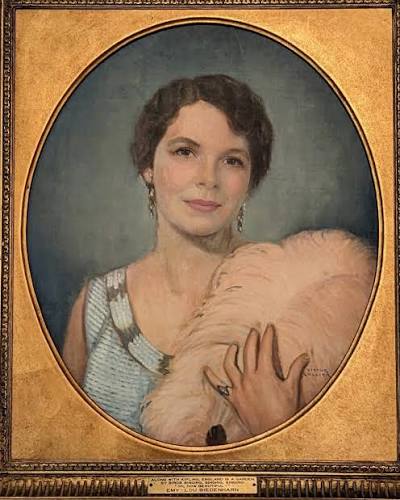
In the world today, there are well-known singing competitions on major television stations that help launch singers to national and international fame.
For the sweet Southern gal Emy-Lou Biendenharn, born in 1902 in Vicksburg, Mississippi, those were not options. She had a more difficult path to travel. Yet walk it she did, and with the typical strength and grace of a lady of Dixieland.
Ancestry
Emy-Lou’s family was no stranger to hardship. Her grandfather Herman Henry Biedenharn emigrated alone from Germany to New Orleans, Louisiana, in 1852, and in order to have some cash on-hand, he sold some of his clothes during his journey upon the sea for $2.50. His grandmother, Louisa Lundberg, left Denmark in 1854 with her family for the United States. Their ship sank on the way over, and only she and her father survived the ordeal, losing her mother and four siblings shortly after their arrival in New York due to the effects of exposure to the elements (and all their property to the depths of the ocean).
Herman and Louisa by God’s Providence would meet in Monroe, Louisiana, in 1862 and get married that same year. Though they were recent arrivals to the South, they quickly formed a deep and lasting bond with her. Herman voluntarily joined the Confederate Army in the latter part of 1862 and served in Vicksburg until its fall. He would remain in Vicksburg after the War, opening two businesses, a shoe shop and confectionary store.
Their first son, Joseph Biedenharn, being an enterprising fellow like his father, quit school when he was 14 to work in the family’s confectionary store. This fascination with sugary things would lead to a remarkable event later in his life: He became the first person to bottle Coca-Cola in 1894.
Emy-Lou: Beginnings
Ol’ Joe would marry Annie Schlottman and together they would have four children: three boys and one girl, Emma Louise (later shortened to Emy-Lou). As part of her education, Emy-Lou’s mother made her learn to play the piano, which she hated. ‘There were tears, but there was music,’ she would write of her childhood lessons.
This is rocky soil for the seeds of a musical career. Nevertheless, Emy-Lou would later go on to develop a love of singing, attending prestigious schools in Cincinnati, Indiana, and Boston from 1921-5. Later would come lessons in Kansas City, Missouri, and London, England.
Debut
After years of intensive training in the aforesaid places together with successful public performances in the States, Emy-Lou’s first international performance of note came in London in 1931 at Wigmore Hall. Performing a mix of classical and contemporary songs, from Schubert to John Alden Carpenter, she received high praise from the music critics in England:
‘The June 26, 1931 Daily Telegraph stated, “There can be no question that Mme. Biedenharn is an artist of high distinction” while the Juen 27 The Times declared Emy-Lou “possessed a contralto voice of unusual richness and beauty.” The June 26 Sunday Times also said Emy-Lou had a “rich, malleable contralto” which caused the songs she sang to be “brought . . . fresh to the ear and the consciousness.”’
In the wake of these positive reviews, Emy-Lou began planning for a series of performances in other European countries. In a touching tribute to her grandmother Louisa, Emy-Lou chose Copenhagen, Denmark, as the city for her first performance in continental Europe. Others would follow in Germany and the Netherlands. The reviews again were overwhelmingly positive. One from the Hague included these lines:
‘We have rarely heard such a glorious contralto voice, shining with the power of youth and gripping us with the sensitive charm of its noble material. There was a wonderful equalizing of the voice in the whole of its wide range; a natural musicianship, warmth of feeling and an interpretation devoid of all cheapness. Great things are to be expected from this singer, and we will watch her development keenly.’
From 1931 to 1939 Emy-Lou would travel throughout Europe, delighting audiences with that ‘glorious contralto voice’. In 1936 she would begin singing in operas, her first performance being in Verdi’s Rigoletto in London.
A Southern Girl at Heart
Despite this fame and attention, despite acquaintances and friends within the highest echelons of European and United States societies – even with members of royal families – Emy-Lou remained a level-headed, down-to-earth Southern woman. Throughout her years of touring as a professional singer, she always made time to go home to Monroe to spend time with her family and friends, especially during the Christmas season. While at home, she would give liberally of her time and talents, singing at concerts held at churches and school auditoriums for various benevolent causes.
Like her grandparents, she proudly identified herself as a Southerner and praised her land and people. In an interview with the Musical Courier she pronounced,
‘“My home is very dear to me,” she said, “and as soon as I set foot on American soil my first thought is to turn southward. Of course, I always loved it there, but I think one must go away—to school, to travel, to live for a few years—before the fine, distinctive flavor of life in our American South is fully appreciated. There is an atmosphere of graciousness, of responsiveness and tradition that is not found elsewhere, however many compensating advantages other countries and localities may offer.”’
As a Southerner, she had a deep love of nature. It is illustrated well in this touching description Emy-Lou penned of the sycamore tree that stood in front of the Biedenharn’s Monroe house:
‘Mr. Joe’s tree, we called it. For as long as I can remember, Father would take my hand and we would stand very still under the big sycamore . . . and listen—just listen. It was almost as when David sang in his Psalms, “Be still and know that I am God.” For it seemed a sacred moment as we stood so still and silently listened to nature. There is always a stir of breeze, and of sound, in a sycamore tree. . . . Looking skyward, Father and I would silently love the slick white branches of the Sycamore against the deep blue summer sky.’
And no Southern story is complete without acts of reverence for ancestors. Emy-Lou and some of her family would seek out their relatives in their ancestral homelands of Germany and Denmark during Emy-Lou’s years of professional singing in Europe. The reunions are beautiful, with one of the German relatives showing the same blue eyes of Emy-Lou’s father, the descriptions of the house where Herman Biedenharn was born, along with the Christmas celebration in the little German village of Neuenkirchen. And in Denmark, they received old photographs of Joe’s grandparents during a warm visit with cousins and also got to see the old Lutheran Church where the Lundberg family attended and where Joe’s grandparents were married.
Such are Southerners – never far removed from their past.
The End of a Singing Career
Emy-Lou would receive a hard blow in 1936 with the sudden death of her mother. She continued on with her singing afterwards, but with the onset of World War II, she was forced to return home in 1939. This was the beginning of a transition in her life. Her attention to singing waned, and her main focus became her family, especially caring for her widowed father, then 72, and the running of his household in Monroe: The family’s beloved black servant Mammy had become too old to help around the house and had moved back to Vicksburg.
In addition to these duties, Emy-Lou also took great care to build up the community around her. Amongst her major efforts were establishing an organization to promote the arts, undertaking a years-long project to plant on her own family’s property a garden whose beauty would rival that of those she had seen in her time in Europe, and the founding of a Bible museum to share with the world her love for the Holy Scriptures.
These kinds of projects are the expression of the true spirit of the Southern squirearchy, noblesse oblige, by which those who had been blessed with an abundance of wealth and influence used those things for the good of their neighbors – the sign of true aristocracy rather than squalid oligarchy. It has been a mainstay of the Biedenharn family in the past and continues on with them to this day, several generations after their arrival on Southern soil.
Emy-Lou’s father would repose in 1952, and she herself would be gathered to her forebears in 1984, after a lifetime of bearing good fruit. But her legacy lives on at the Biedenharn Museum and Gardens in Monroe, where the Biedenharn family home may be toured, the Bible museum and the beautiful ELSong (i.e., Emy-Lou’s Song) gardens viewed, and the Coke museum visited.
Notes
Material for this essay is taken mainly from the book by George Thomas Walker, Emy-Lou Biendenharn: Her Life and Legacy, Walsworth Publishing Co., Marceline, MO, 1999.
For those interested, an old VHS documentary about Emy-Lou is available on YouTube.
The views expressed at AbbevilleInstitute.org are not necessarily those of the Abbeville Institute.




Thank you for this wonderful story.