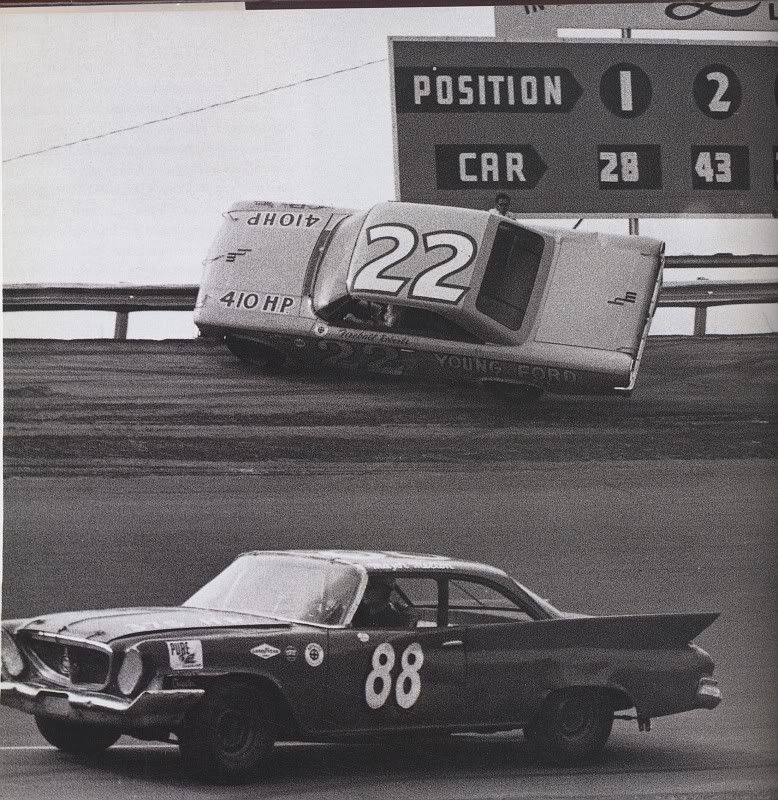
There is no sport more shaped entirely by its origin in the South than NASCAR. A sport built on southern tradition, southern rebellion, and the spirit of the southern common man. That “spirit” was driven by moonshiners, who were transporting moonshine during the prohibition era. These Appalachian moonshiners were not just driven by rebellion, but by survival. Moonshine was the only way these poor, isolated southern farmers were able to make ends meet. They would soup up the Ford V-8 engine in order to outrun police and deliver their mountain dew wherever they needed to.
These cars began to run so fast, that they would start to race each other in the 1930’s. As the 1940’s came about, a stock car racer named Bill France, would recruit stock car racers and eventually found what would become the National Association for Stock Car Auto Racing or NASCAR. The founding of NASCAR took place in Daytona Beach, Florida where the early pioneers of the sport would form the organization and rules for this new motorsport. Bill France’s goal was to go away from the moonshiner image, focus on corporate sponsors, and become the leading figure for stock car racing.
The charm of NASCAR, became the individual drivers. The majority of which were southern. Drivers that included Dale Earnhardt from North Carolina, Darrell Waltrip from Kentucky and Tennessee, and Richard Petty from North Carolina. These southern personalities would charm their audiences the likes of which was not seen in Indianapolis’ open wheel racing.
The other staple of NASCAR, were the racetracks, which in the early days, were primarily based in the south. Like Daytona Superspeedway in Florida, Charlotte Motor Speedway in North Carolina, Darlington in South Carolina, Martinsville in Virginia, Bristol Motor Speedway in Tennessee, and Talladega Super Speedway in Alabama.
Stock car racing became the premier racing in the southeast since the racing in Indiana was focused more on Indy Car racing, which is open wheel. When stock car racing was in its infancy, open wheel racing was the most popular racing in America. What differentiated stock car racing from open wheel, was the fact that these were cars that the public could see race on Sunday, and buy on Monday. Stock car racing represented the common man, a vehicle that was accessible to the public.
The tide turned for the sport of NASCAR at the 1979 Daytona 500, often deemed the most important race in NASCAR history. It was the first ever nationally televised race on CBS. During this time, a major snowstorm hit the Midwest and Northeast of the US and it increased the viewership for a race that featured a Richard Petty victory and a major fight after a wreck between Cale Yarborough and Donnie Allison. This race introduced to the rest of America, the racing of the south, the Appalachian style feuds, and stock car racing all in one.
NASCAR would overtake Indy Car as the most popular motorsport in America, and never look back. The sport would eventually outgrow its southern only audience to become so popular, that it would become the second most watched sport in America in the 2000’s after the NFL. It would even attract drivers not from the south like Jeff Gordon, Jimmie Johnson, and Tony Stewart due to its greater prospects for success and money over open wheel racing.
For a sport that was primarily southern based, was not based in major hubs like Los Angeles, New York, or Chicago, this was impressive. Today, NASCAR is not as popular as it once was, but continues to be the most watched motorsport in America with the Daytona 500 still attracting over 7 million viewers each year. The spirit of the South still lives on, even if the spirit is not being delivered up and down state lines in a car trunk full of moonshine.
The views expressed at AbbevilleInstitute.org are not necessarily those of the Abbeville Institute.




“There is no sport more shaped entirely by its origin in the South than NASCAR. A sport built on southern tradition, southern rebellion, and the spirit of the southern common man. ”
And today both Carpetbaggers and Scalawags will ballyhoo NASCAR as a great AMERICAN tradition as if the damn Pilgrims invented the 4-barrel carburetor along with the wheel!
Nice article for sure. Somewhere, NASCAR lost its way and forgot its roots and recipe that made it successful. Abandonment of historic tracks, pushed into markets that had absolutely no interest in the sport etc. etc. etc. The list is long for sure. One just needed to look at the stands this past weekend at the Brickyard 400. Minimal attendance for this once great event was obvious. NASCAR needs to step back and look at what made it successful and what demographic had the most interest in the sport. As with everything else nowadays, being “politically correct” is more important than being successful.
The NASCAR series is nothing resembling the sport as it was originally.
The cars on the track bear no resemblance to the models found on dealers’ lots. Other than an enclosed cab, they more closely resemble Indy or F1.
As an example, Toyota does not sell a Camry with a V8, which is the NASCAR engine.
The only thing that can be found on a NASCAR racer that will be found in the showroom is the badging. The cars themselves don’t even look similar. Nothing OEM on the cars.
Even the drivers don’t need talent if they can bring sponsorship.
No more CSA battle flags, since everything must be sanitized for the media and minorities, with exceptions for BLM or Democrat approved liveries and causes.
Very well done article!! As many of the comments illustrate, NASCAR ain’t NASCAR no more! The Abbeville Institute is so mightily attempting to keep Our Beloved South from doing the same thing to ourselves!
When NASCAR went woke and told us that flying our flags or wearing a t-shirt with a battle flag on it (you know, as sold at the Southern 500 for many years) is racist and doesn’t belong at the race track – that was the day I quit watching.
Even prior to their newly found hatred of the Confederate flag and those who fought under it, NASCAR was making poor decisions with tracks and car designs. It was so easy to predict the decline, and lets face it…it’s a shadow of what it once was. It will NEVER be what it was.
NASCAR is a southern sport at its roots, but now its southern only in the past tense. Now, it’s only southern when it’s a convenient marketing tool, and that’s a watered down brand of “southern”. They might have one broadcaster with a faint accent to throw some “southern” into it, but that’s all that is allowed.
They chased Yankee money and turned their backs on the fanbase that built them. They abandoned local tracks and venues with long histories and tradition in exchange for meaningless, boring road courses in the American west, Mexico or even Japan.
I remember when Dale Earnhardt (bar none, my favorite driver of all time, may he rest in peace) crashed in that Japan road race and was questioned if he was going to fix the car and go back out…his looked at the reporter like they were crazy and his answer said it all: “What the hell for?!”
Exactly.
Greed and not appreciating their customer, the hallmark of this new NASCAR. Actually though, NASCAR did know their customer, they just didn’t give a S$*t if they screwed us over with their global decisions and newly discovered, politically expedient southern hatred in exchange for a wider, more “diverse” audience. In the new global environment, we were a source of embarrassment for them.
Personally, and maybe somewhat selfishly, I hope NASCAR fails miserably and a new Southern Racing League or something like it fills the void one day. I would rather watch a Friday night, small town dirt track race than anything NASCAR puts out now. Back to the basics.
Those other fan bases they’ve chosen to chase and apparently love more than the true DNA of their sport will not keep them alive in the long term.
They turned their backs on us, and they are Yankee-grade arrogantly damned proud that they did it. They are willing to die on that hill. So be it.
I reclaimed my time on Sunday a long time ago.
As said by Powers Booth in Tombstone: “Well, bye.”
When they let a car on the track with BLM colors was the last straw for me.
If you are really interested in the origin’s of Stock Car Racing, visit the Georgia Racing Hall of Fame in Dawsonville, GA. If you want to see real Moonshine cars, go to the Moonshine Days Festival at Dawsonville in October.