

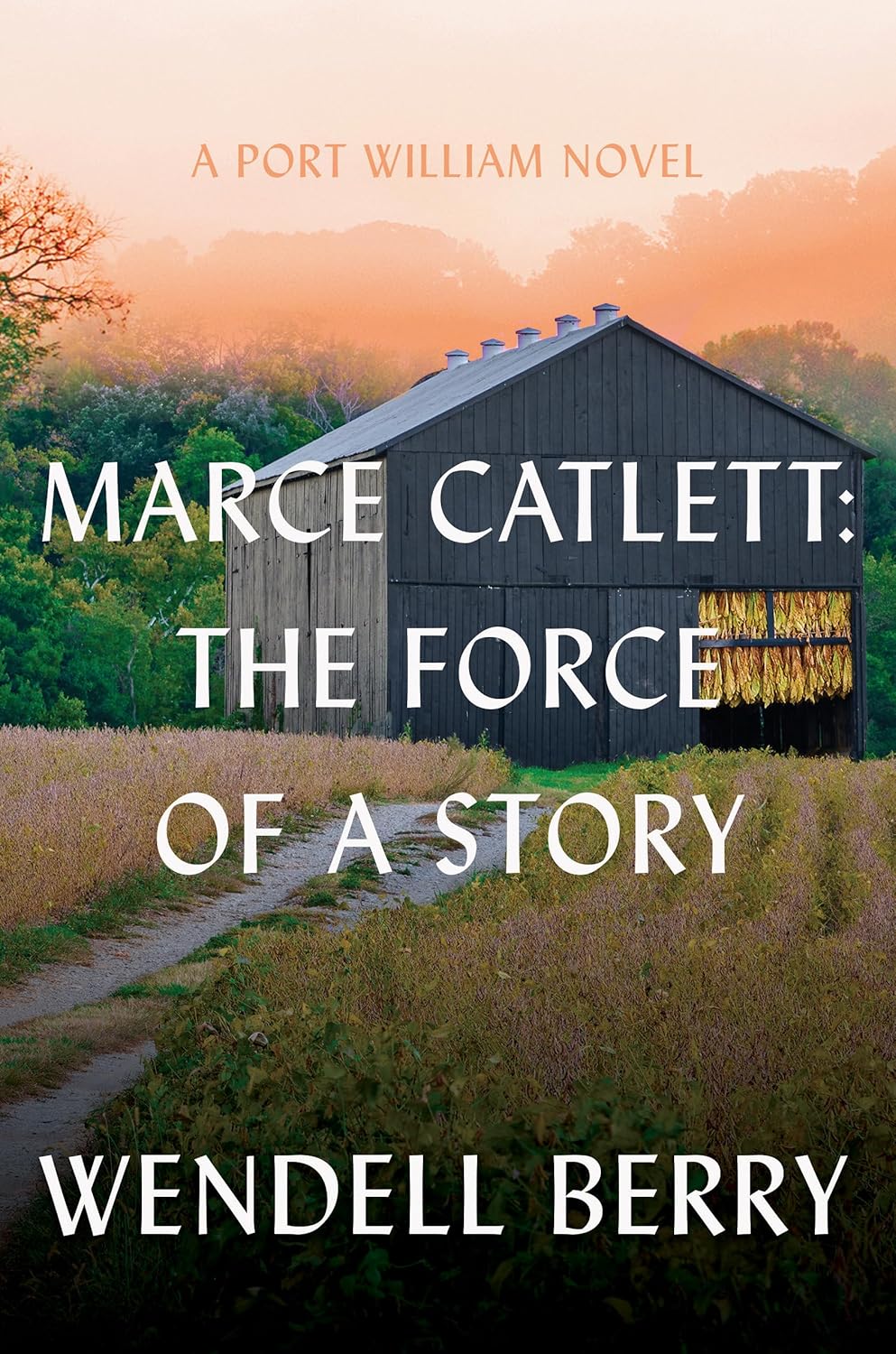
A Review of Wendell Berry’s Marce Catlett: The Force of a Story by Randall Ivey
I have never worked on a farm. My paternal grandparents did. They were cotton farmers and dabbled some in tobacco, although their chief means of subsistence was work in the textile plants that used to occupy the South Carolina upcountry like kudzu. I have gotten my hands dirty only in the work of words and ideas—perhaps a coward’s way out of truly hard labor. However, I know what it feels like watching a tradition and a way of life diminish almost to the point of being completely moribund. My people were textile people, the participants in what was once a thriving industry in South Carolina and her sister Southern states, a guarantor of employment for generations and a foundation for a community that was close-knit despite age or ethnic differences. Textile workers often lived in areas of town called “mill hills.” They knew each other and looked after each other in times good and bad. They shopped at the same company store. They got along, as people who need each other tend to do.
That industry has died, for all intents and purposes, and taken with it a way of life, a bond between people nearly as strong as blood. At least it has in my native Union County, South Carolina, in the community of Jonesville, where the Cedar Hill plant, the mill from which my father retired twenty-five years ago, has recently closed its doors, leaving Union with one mill standing oh-so precipitously.
The reasons for its demise are many, with no room here for repeating.
So, I read Wendell Berry’s latest novel with more than a bit of empathy, although I am not sure what Mr. Berry, America’s greatest living writer, thinks about the textile industry, whether he counts (or counted) it as a good or an ill.
Marce Catlett: The Force of a Story is a paen, a dithyramb, and finally an elegy to the way of life its author knows best, that of the hard-scrabble Kentucky tobacco farmer who worked his land without aid of “machines and chemicals” but with the strength and resources God gave him –the land itself, his family, his neighbors. As with the textile workers, the hard work of farming brought these people together, made them close, made them family almost. At least it did in the area about which Berry writes and has written for more than sixty years, the apocryphal Port William County in northeast Kentucky, except people there would not refer to themselves as neighbors; in Port William, they belong to a “membership,” the Port William membership.
This latest work, Berry’s ninth novel, hinges on an old tale from the Catlett family that has occupied the minds and mouths of the Port William membership for nearly one hundred years—the story of family patriarch Marce Catlett’s failed attempt to sell his tobacco crop at auction in 1906, a failure that does not defeat him but spurs him on to continue working, to do that job he essentially was born to do, farm his native land and make a living off it. This refusal to concede inspires his son Wheeler Catlett to become an attorney and advocate for the tobacco industry and his grandson Andy Catlett (surely a stand-in for the author) to become a writer, teacher, and farmer himself, one who leaves a cosmopolitan lifestyle to return home and resume the family tradition. These changes, these ups and downs, these triumphs and failures are recalled through the eyes of the latter Catlett, now a very old man himself who holds out some hope for the generations to follow him.
That is about it as far as plot goes. The novel eventually morphs into a handbook on the proper growing and care of tobacco and a diatribe against industrialized farming and big corporations that rape the land of its resources and its sense of community and tradition. But one does not resent the book for such a turn. The process of tobacco-growing is described in such loving detail, with such unsentimental tenderness, that one is not only interested to read of it but is moved by it. Growing tobacco for Catlett and family was not just an example of very hard work but also a time when family members and neighbors could laugh, sing, tell tales, and catch up with each other. It was a transmission of a way of life. In light of that, one shies away from declaring Marce Catlett a failure as a work of fiction. Indeed, one could argue that few novels, especially works of this brevity, have gotten deeper into the bones and blood of a people and its place than has Marce Catlett: The Force of a Story.
Wendell Berry is now ninety-one, ninety-two come this August. Some have speculated that Marce Catlett: The Force of a Story may be his last novel. Let us pray the Good Lord gives him many more years and much energy to continue to show us the life worth living.
The views expressed at AbbevilleInstitute.org are not necessarily those of the Abbeville Institute.



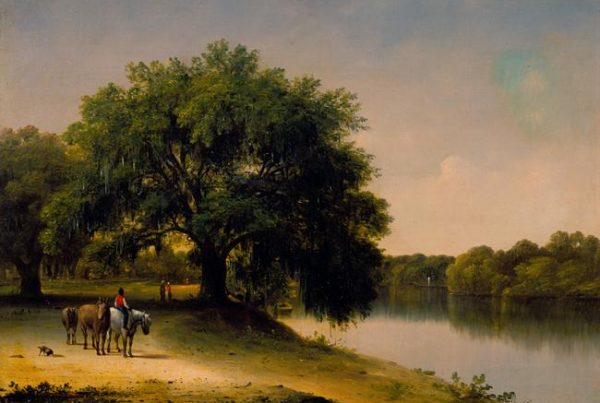




Say what you will about tobacco farming, it was certainly a lifestyle that kept folks close to the land and to each other. Neighbors would help others lay in a barn, stringing loose leaves to poles that were hung to cure in low heat. Wendell Berry knows that a community coming together is the real harvest.
So few understand this concept today.