

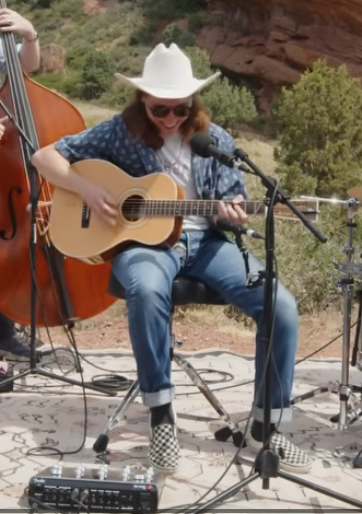
What would you call it if you created a band with Buck Owens, Don Rich, Duane Allman, Gram Parsons, Clarence White of The Byrds, and Jerry Garcia of The Grateful Dead? Daniel Donato of Nashville calls it Cosmic Country, and it might be the most intriguing thing you’ve heard in a long time.
Daniel Donato is one of the more compelling figures to emerge from Nashville in recent years, and it’s definitely not because he fits neatly and comfortably within an established lineage and reliable marketability. Daniel Donato demonstrates, with unusual clarity, what happens when a musician absorbs a tradition deeply enough to move beyond it without severing the ties that anchor him to it. You could say that he took the Nashville mold and just ran with the line. He’s not a novelty or a trend. Daniel Donato’s work draws attention as a case study in how Southern musical practice continues to evolve through dynamic performance rather than a rule book.
Born in 1995, Donato’s formative years were not spent in any of the magnificent educational music institutions available in Nashville, but literally on the street. As a teenager, he played for tips on Lower Broadway, long before he had a band, a label, or any formal platform. He was one of those dime-a-dozen buskers you see all over downtown Nashville, and chances are you probably did if you were there after 2010. Street performance is a heck of a lot more than mere exposure; it is a rigorous, unfiltered feedback loop. It demands repetition, adaptability, and the ability to command attention from pedestrians who have no reason to stop and listen. In such an environment, musicianship is not an academic abstract technique, but an electricity fused with timing, pacing, and instinct. Daniel Donato’s playing bears the imprint of that formation. He is disciplined, but never inert; responsive, but never unfocused. He learned, in the most practical sense, how to hold on to a crowd.
His early musical identity was firmly rooted in traditional country guitar, particularly the Telecaster-driven lineage associated with Buck Owens and Don Rich of the iconic Bakersfield sound. This is a style defined by clarity and economy: clean articulation, precise right-hand control, and phrasing that prioritizes function. There are no extra notes in this style. It is, in many respects, the most conservative country vocabulary, one that rewards restraint and punishes indulgence. If you had encountered Donato busking on the street in this phase would have recognized a remarkable young traditionalist with unreal technical command and stylistic fidelity.
What distinguishes him, however, is his willingness to depart from that language without abandoning its underlying context. His current musical approach, described under the self-applied label “Cosmic Country,” blends several streams that don’t typically coexist within the same performance framework. Traditional country forms and picking techniques remain present, but they are extended through improvisational structures more commonly associated with jam-band traditions, enriched by psychedelic tonal color, and loosened by a rhythmic sensibility that draws on Southern rock. The result is not a fusion in the compositional sense, but an expansion in the performative sense. Songs become starting points rather than fixed objects; they stretch, contract, and occasionally dissolve completely under the improvisational nature of real-time onstage interaction. There are many videos available online of Daniel Donato’s Cosmic Country performing live versions of the same song in different cities. None of the versions are the same.
It is here that a comparison to Gram Parsons, often invoked in discussions of genre hybridity, becomes both tempting and misleading. Parsons’ project—what he termed “Cosmic American Music”—was fundamentally all about songwriting. He sought to integrate country, soul, gospel, and rock within the structure of the song itself, producing recordings that recontextualized country music for new audiences while retaining a strong emphasis on lyrical and emotional coherence. His work is interior and exclusively concerned with the expressive capacity of the song as a finished form.
Donato operates differently. His emphasis is not on reconfiguring the song as an object, but on reconfiguring the act of performance. Where Parsons expanded the harmonic and stylistic palette within fixed structures, Donato expands the temporal and improvisational possibilities of those structures in real time live on the stage, which is not a trivial distinction. Parsons’ legacy is preserved in recordings that articulate a broadened conception of country songwriting. Donato’s reputation, by contrast, is built primarily on stage in front of live audiences. His performances are elastic, responsive to the crowd, and improvisationally unsettled, and that is the central experience of Cosmic Country.
A more accurate lineage for Donato emerges when one considers figures whose work similarly bridges technical discipline and improvisational openness. The influence of Jerry Garcia is evident not in stylistic imitation, but in approach. Garcia’s playing with the Grateful Dead established a model in which songs function as frameworks for collective exploration, with improvisation serving as a primary mode of musical thought rather than a decorative extension. Donato’s live performances exhibit a comparable elasticity, in which thematic material is continually revisited, reshaped, and extended.
At the same time, his technical foundation aligns with the innovations of Clarence White, a brilliant country and bluegrass guitarist whose work with The Byrds demonstrated how country flatpicking vocabulary could be adapted to new contexts without losing its defining characteristics. White’s ability to maintain clarity and precision while expanding the expressive range of the instrument finds a clear parallel in Donato’s playing, particularly in his right-hand control and articulation.
The Southern dimension of Donato’s work is further illuminated through comparison with Duane Allman, whose approach to guitar emphasized fluidity, tonal richness, and an openness to extended form. While Allman’s idiom differs in its blues and slide-guitar orientation, the underlying principle—a willingness to allow music to unfold beyond conventional boundaries while maintaining a strong sense of direction—resonates strongly with Donato’s live aesthetic. In a different style but similar way, Donato makes the guitar talk.
Beneath these more expansive influences, however, the foundational presence of Buck Owens and Don Rich remains unmistakable. Their Bakersfield insistence on clarity, timing, and functional phrasing anchors Donato’s playing even at its most exploratory. This grounding is essential. Without it, the improvisational elements of his work would risk diffusion; with it, they retain coherence and purpose.
In considering Donato’s place within Southern music, it is also necessary to address the question of identity beyond sound. He is not, by any meaningful measure, a political artist. His work does not center on overt ideological statements, nor does it rely on topical commentary for its significance. This absence reflects a mode of Southern artistic practice in which authenticity is demonstrated through performance, continuity, and participation rather than declaration. His credibility derives from what he does on stage and how he does it, not from the positions he articulates off it.
For listeners approaching Donato’s catalog for the first time, several recordings provide useful entry points. A live performance in Huntsville, Alabama of “Justice” offers a concise example of his ability to integrate traditional country phrasing with a more expansive tonal palette. This video demonstrates his command of traditional forms, and reveals the full scope of his improvisational approach. It is in these live contexts that his musical identity is most clearly articulated.
The most representative and encompassing live performance video on Daniel Donato and Cosmic Country is “Sunshine in the Rain,” recorded at the Ryman Auditorium in Nashville in 2025. The performance demonstrates, in real time, the principles that define Donato’s approach. What begins as a structurally recognizable song gradually opens into a fluid, extended exploration, with the band responding dynamically rather than executing a fixed arrangement. The result is not a departure from country music, but a demonstration of what it can sustain when treated as a living practice rather than a closed form.
Ultimately, what makes Daniel Donato a distinctly Southern artist is not simply his geographic origin, his use of country-derived vocabulary, or his affinity for that Buck Owens Fender Telecaster, but his adherence to a mode of musical authority rooted in practice. His work aligns with a broader Southern tendency to treat music as a living, breathing activity to be carried forward through performance, not preserved in a museum. He doesn’t seek to revive country music, nor to escape it. Instead, he fully extends it, allowing it to absorb influences that might otherwise remain external. In doing so, he demonstrates that tradition, when properly understood, is not a constraint but a resource—one that can sustain innovation without requiring rupture. Donato’s significance lies in continuity under altered conditions. He represents a form of musical evolution that doesn’t boast or brag, but reveals itself in the way the music moves, night after night, in the presence of those willing to listen.
The views expressed at AbbevilleInstitute.org are not necessarily those of the Abbeville Institute.





Excellent points. I liked your line about Southern music “as a living, breathing activity to be carried forward through performance, not preserved in a museum.” And that’s what real tradition is, an evolving dynamic linking the past with the present.
Mike, I’m convinced that’s what separates Southern music from everybody else’s. While they’re all concerned with writing it down and archiving it, we’re only concerned with playing and singing it. So many people gripe about “music going downhill.” No, the music business is going downhill, but MUSIC is doing perfectly fine.
Big music has certainly sold out real Southern music. Most of what passes for “country” music is just hip-hop with a fiddle.
“And that’s what real tradition is, an evolving dynamic linking the past with the present.”
Exactly. And not severing the past from the present.
Paul, that’s how we keep winning. Our past and our present are superior.
Tom, I still want you on my show to do TJ and the music of his day. I think that I did send to you a chapter on music.
Yes, you did Mark, and forgive me for not replying. I look forward to being a guest on your show when I have a couple less irons in the fire.