
Dedication: to the memory of my cousin, Tony – U.S.M.C. Sergeant Dale Anthony Marion (Dec. 10, 1938-May 15, 2026), who was like a second father to me after the loss of my Dad, Dr. Jerry B. Marion (Dec. 10, 1929-Aug. 3, 1981).
On June 3rd, 1944—Confederate Memorial Day and the birthday of Jefferson Davis—a former Confederate enlisted man, Julius Franklin Howell, addressed the United States House of Representatives in Washington. The representatives noted that “General Howell will probably be the last veteran of the War between the States, on either side, to visit this Capitol.” They resolved that “out of respect for the [United] Confederate Veterans and the Daughters of the Confederacy,” General Howell was invited to address the members of the House. Members of the Daughters of the Confederacy also were invited to accompany him.[1]
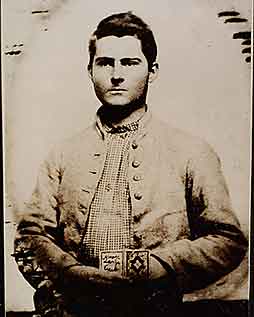
Howell, then 98 years of age, was born on January 17, 1846, in Nansemond County, Virginia. The youngest of sixteen children, Julius was studying at the Reynoldson Collegiate Institute in Gates, North Carolina, when his schooling was interrupted by the war in 1861. A number of his classmates volunteered for the Confederacy, but Howell’s father forbade his youngest son from entering military service until reaching the age of sixteen and a half years. In late 1862, Julius enlisted in the Confederate Army, later serving in Company K, 24th Virginia Cavalry, under Gen. James Longstreet. The young Howell served primarily as a courier. Engaged in numerous skirmishes rather than major battles, he suffered a leg wound. A few days before General Lee’s surrender at Appomattox, Howell was captured at Sailor’s Creek and sent to the Union prison camp at Point Lookout, Maryland. After spending two months there as a prisoner-of-war, the nineteen year-old veteran was released and on the same day took the oath of allegiance to the United States of America.
In 1944 the former (and then acting) commander-in-chief of the United Confederate Veterans, who received the title of “General” in that role, Howell was introduced by Mr. Rankin of Mississippi. The congressman declared: “. . . if we needed any evidence at all that we are a united country, we had it here today” in the unanimous invitation extended to General Howell to address the House. Enduring the trials of the war, Howell “has put in the last 79 years rebuilding the peace, sustaining American enterprises and promoting American institutions.”
Indeed, he had. Returning home as an American citizen once again, within a few years Howell had studied an additional year at the Reynoldson Institute in North Carolina, began teaching there, and eventually acquired the school. By the early 1870s, he had married, sold the institute, and moved to Arkansas where he pursued his career as an educator, eventually devoting himself to the study of pedagogics when that discipline was new to the South. In later years, he earned advanced degrees at Harvard and the University of Pennsylvania, and taught at Illinois State Normal University before moving to Bristol and serving as president of the Virginia Institute (later, Virginia Intermont College). He and his first wife, Ida Hinton Howell, were married 63 years before her death in 1933. They had seven children, five of whom survived General Howell’s death in 1948 at the age of 102. Howell’s second wife, Maude Sharp Howell—whom he married at age 90, died around 1973.
Howell began his address to the House:
My friends, you have no idea how deeply I regard the honor you have paid me. . . . You will be surprised when I tell you that I served 3 years . . . under Gen. Robert E. Lee, but having been of small rank . . . I never had the pleasure of seeing Mr. Davis, although I was stationed for several months toward the close of the war within 2 or 3 miles of Richmond, helping to guard . . . that city against possible invasion by the Federal cavalry. . . . Since then I have read a great deal about him, and because of his sufferings, I have grieved for him.
We often hear it said: how is it that our southern people did not show more honor to the memory of Mr. Davis until several years after he had passed away? I do not know why they did not do it. Our southern people did not begin to honor him until some time after the Federal side began to honor their soldiers. . . . It was not until then that they began to honor the boys in gray, but for 50 years and more now they have been. . . .
In representing our great United States, you have a great responsibility resting upon you. I read about you as much as I can. I take my little daily paper, and I see what you are trying to do. . . . I am proud of you.
. . .
My first wife and I lived together for 63 years. We raised a considerable family. One of my boys was in the Spanish-American War, a colonel in the United States Army. . . . Some of my boys today are fighting to help preserve our liberty. . . . One of them is in Italy. Another is in New Guinea. New Guinea is away over yonder somewhere, I hardly know where it is, but it is somewhere in the Pacific Ocean.
Reflecting on the aspirations of honorable, praying men during the war who, eight decades earlier, had petitioned their God to bless the course that each side believed to be right, Howell seemed to have accepted—perhaps early on—the providence of God, as from the prophet Amos: “If a calamity occurs in a city has not the LORD done it?”[2] Howell continued,
At that time, my friends, nobody could foresee the First World War, and especially such a war as we have on our hands now.
God bless them. We stand as one great united Nation, no longer in blue and gray, except in sentiment. We love to look back at the glories that both sides achieved. I met the granddaughter of Gen. Ulysses Grant today. I went up and shook her hand. I told her that the boys in gray remembered the comparative leniency of her grandfather at Appomattox. Although I was not there, I read a great deal about it. I had friends there.
Mr. Speaker, I thank you so much for this privilege and for this honor. . . . My descendants will say with pride that the House of Representatives of the United States invited one of their ancestors to appear before them and make a little talk. . . . God bless you and guide you in your deliberations. Keep in mind that God in heaven rules the world. Poor humanity is a small thing indeed when compared to the great spiritual power that rules the world.
I thank you.
[Prolonged applause, the Members rising.]
Howell’s story was almost lost to history, however. After the death of the second Mrs. Howell, my close cousin, Tony Marion of Blountville, Tennessee, waited for an opportune moment to drop by the Howell home on Moore Street in nearby Bristol. When I was a young teenager, Tony took me on several memorable Civil War relic hunts with a metal detector. A sergeant in the U.S. Marine Corps Reserve, rural mail carrier, and an avid collector of all things connected with the war, Tony had been looking for a Thunderbird with Carolina plates that belonged to Mrs. Howell’s nephew. Mrs. Howell had left everything to him. Some time earlier Tony had met her and asked if she was interested in selling any of her husband’s books. She was not. But her nephew was of a different mind altogether. When asked if he was willing to part with any of the general’s belongings, his response was, “Hell, yes, everything’s for sale.” Books were a dollar apiece. Over several visits to the home, Tony collected—in addition to several hundred books—the documents and photographs that told the life story of Julius F. Howell. A half-century later, a number of General Howell’s papers and photos were included in a short pictorial history compiled and self-published by Brett Compton. Most appropriately, Compton dedicated the book “to Tony Marion—a true gentleman and an avid collector of Southern history,” whose “remarkable foresight by preserving these historical artifacts” almost certainly saved them from loss.[3]
In an era in which neo-Marxist ideology spews an oppressor vs. oppressed worldview upon the West generally and the United States particularly, the story of Gen. Julius Franklin Howell stands as a reminder of the reconciliation and mutual respect between northerners and southerners—that once was.
************************************************
[1] Congressional Record, Jun. 3, 1944.
[2] Amos 3:6b.
[3] Brett Compton, comp., Julius Franklin Howell, 1846-1948, A Pictorial History (privately published, 2026).
The views expressed at AbbevilleInstitute.org are not necessarily those of the Abbeville Institute.