

Reflections on the Alamo and Texas Independence, Part I
In March of 1930, the former President of the United States, Calvin Coolidge, and his wife Grace had occasion to travel through the State of Texas during a leisurely train trip. During an excursion to San Antonio, they were treated to a private tour of the Alamo. It was here that Mr. Coolidge overcame his customary reserve and inquired, “What was the Alamo built for?” This was a rather gauche question, in that it was the only one he asked; and communicated to some of his attendants that he had no particular interest in the significance the Alamo subsequently attained in 1836, when it became one of the most celebrated emblems of Texas independence. Coolidge aggravated the slight by asking the question on March 6–the anniversary of the fall of the Alamo and the deaths of its defenders. Later, at a hotel breakfast held in his honor, the former president rebuffed attempts at polite conversation.
Silent Cal earned the just reproach of various parties for this conduct. Perhaps the most eloquent analysis of his misstep came from the pen of one of the Southern Agrarian writers. In an essay entitled “Not in Memoriam, But in Defense,” Stark Young suggested that Coolidge was a discourteous boor—an arresting consideration, as Coolidge hailed from a long line of distinguished New Englanders and should have known the importance of respecting one’s forebears.1
Nevertheless, some Southerners did come to the defense of the former president. The publishers of the Nolan County (Texas) News dismissed “wisecracks” from Coolidge’s critics and suggested that faultfinders were likely unable to explain the original significance of the Alamo themselves.2 For Stark Young, these kinds of dismissals were too casual, embodying the South’s cultural retreat and ominous readiness to accept the ambivalence of outsiders toward what is true and valuable in the Southern traditions. Young recognized that such outside disregard, if not corrected, would eventually give way to hostility. And indeed, respecting Texas, the South, and the Southern tradition, this has been the case. Long gone are the days of Calvin Coolidge clumsily probing the significance of a Texas shrine. Latter-day vandals now openly proclaim their disdain for such icons.
Mr. Coolidge’s question was a narrow one. But an exposition of the Alamo and its significance must be broad and comprehensive, toward the end of imparting why it deserves to be honored today.
The Alamo mission was originally established by Spanish Franciscan missionaries in 1718 to evangelize local tribes living in what was then the Viceroyalty of New Spain. The famous chapel and compound were constructed when the mission moved to its current location on the east bank of the San Antonio River in 1724. After serving the noble purpose of advancing the Christian Gospel for several decades, the mission entered a period of decline and fell into disrepair. The mission was secularized in 1793, and the structure was partially rehabilitated as a military garrison.
Following a hard-fought war, Mexico gained its independence from Spain in 1821. Three years later, it adopted the Federal Constitution of the United Mexican States, which resulted in the establishment of the First Mexican Republic. The Mexican Constitution promoted federalism, republicanism, and local self-governance and placed strict limits on the powers of the national executive.
The Mexican government continued a policy first introduced by Spain and opened its northern frontier province (modern-day Texas; containing San Antonio and the Alamo) to Anglo-American settlement. The purpose of this policy was variegated. Texas was territorially vast, yet sparsely populated. Mexico hoped that, by introducing settlers, they might promote the expansion of agriculture and ranching and check the ever-present threat of Comanche and Apache raids.
The first Anglo-American land grantees—Stephen F. Austin’s “Old Three Hundred”—began settling Texas in 1821. These sturdy settlers hailed mainly from the Trans-Appalachian South: Louisiana, Arkansas, Alabama, Tennessee, and Missouri. The vast majority of pioneers who joined them in subsequent years also hailed from the South—as many as 20,000 by the early 1830s. At first these settlers found the Mexican Republic amiable to the expectations of federalism, republicanism, and self-government they brought from their Southern homeland. Sadly, they soon found themselves objects of the government’s displeasure.
The shrewd and opportunistic politician Antonio López de Santa Anna was elected president of Mexico in 1833 under the Federal Constitution of 1824, ostensibly as a supporter of federalism. However, the next year he revealed his centralist and authoritarian designs when, with the help of allies, he dissolved Congress, annulled liberal reforms, and assumed dictatorial powers. He then convened an assembly congenial to his political goals. This assembly produced the Siete Leyes (Seven Laws), which abolished the federal republic and established a unitary state. The previously existing states were reorganized into departments, which were directly controlled by the central government in Mexico City.
Governors of departments were no longer elected by the people; rather they were appointed by the president. State legislatures and local militias were dissolved or restricted. All significant legislative, fiscal, judicial, and military authority was transferred to the national government. These changes, of course, directly violated the liberty-loving federalist principles of the 1824 Constitution—principles which Anglos hailing from the American South had cherished so highly.
Federalists in the state of Zacatecas refused to submit to the centralist coup. In response, Santa Anna personally led an army of 4,000 veteran troops to crush the resistance. On May 11, 1835, on the heights of Guadalupe, just outside the capital city (also called Zacatecas), the “Napoleon of the West” decisively defeated the federalist dissidents. His vengeance against them was swift and brutal. He allowed his soldiers to pillage the city for two full days, during which they looted homes, churches, and government buildings, and seized vast quantities of silver, gold, and other property. Much of this wealth was put in the service of Santa Anna’s future military campaigns. Centralist forces also perpetrated many acts of wanton violence against civilians, killing hundreds.
Even as his forces brutally repressed the federalists of Zacatecas, Santa Anna turned a more disquieted gaze northward—toward Texas and her legions of independent-minded, freedom-loving settlers. In September, Colonel Domingo de Ugartechea, the Mexican military commander in Texas, ordered the confiscation of the six-pounder cannon possessed by the colonists at Gonzales. The colonists received this cannon on loan in 1831 to defend against Comanche raids. But now they found themselves compelled to use it against malevolent government forces.
On the morning of October 2, the Texians hoisted a makeshift flag featuring a cannon, a lone star, and the defiant slogan, “Come and Take It”, then briefly engaged the Mexican force. Though a minor skirmish, the lasting significance of the Battle of Gonzales was conveyed in its sobriquet, “The Lexington of Texas.” It represented the inauguration of the Texas Revolution.
Initially, many Texians fought to restore the 1824 Constitution, with its federalist and republican principles. However, upon enduring Santa Anna’s severity firsthand, they concluded that Texas must pursue permanent separation from Mexico. On March 1, 1836, Texian delegates convened at Washington-on-the-Brazos, where they drew up a statement of grievances against Mexico to be “submitted to an impartial world.”
The delegates detailed how, in a short time, the distant Mexican government had devolved into a military despotism, trampled the welfare of its own people, and turned into an instrument of oppression. Some of the gravest charges against the Mexican government were its domination of the national church “to promote the temporal interests of its human functionaries rather than the glory of the true and living God;” the attempted confiscation of arms “essential for our defence, the rightful property of freemen, and formidable only to tyrannical Governments;” and its tolerance and promotion of “arbitrary acts of oppression and tyranny” by military commandants.
Much like their ancestors who stood against Great Britain, Southerners in the vanguard of the Texas independence movement declared their intent to cast off an imperious regime that threatened their liberty, families, and hearths. Receiving no redress, the Texians were forced to the “melancholy conclusion” that self-preservation required permanent political severance:
“We, therefore, the delegates with plenary powers of the people of Texas, in solemn convention assembled, appealing to a candid world for the necessities of our condition, do hereby resolve and declare, that our political connection with the Mexican nation has forever ended, and that the people of Texas do now constitute a free, Sovereign, and independent republic, and are fully invested with all the rights and attributes which properly belong to independent nations; and, conscious of the rectitude of our intentions, we fearlessly and confidently commit the issue to the decision of the Supreme arbiter of the destinies of nations.”3
The Texians recognized that such a declaration would hardly settle matters with the mother country. Indeed, even as the delegates gathered at Washington-on-the-Brazos, Santa Anna’s Army of Operations—numbering as many as 8,000 soldiers in multiple columns—had crossed the Rio Grande River and begun bearing down upon the scattered and vastly outnumbered Texians. Santa Anna himself accompanied a 1,500-man column (later 2,000) that entered San Antonio (170 miles southwest Washington-on-the-Brazos) on February 23 and besieged the Alamo. The tiny Alamo garrison was the only organized Texian force standing between the Mexican army and the eastward roads into the Anglo settlements. It comprised just 150 effective fighters under the command of Lieutenant Colonel William Barret Travis and Colonel James Bowie (Bowie was soon laid low by illness and confined to bed for most of the siege). Upon commencement of the siege, the vengeful Santa Anna resolved to blot the Alamo defenders from the face of the earth, and so ordered the hoisting of a blood-red banner from the San Fernando Church tower, signifying “no quarter” for the Texians.
Recognizing the strategic import of hindering the Mexican advance eastward, but accepting that this delaying action would be purchased with their lives, nearly all the men in the Alamo elected to stay. Their resolve is encapsulated in a letter Travis sent by courier on the second day of the siege.
Addressed “To the People of Texas & All Americans in the World,” it read in part:
“Fellow Citizens & compatriots –
I am besieged, by a thousand or more of the Mexicans under Santa Anna – I have sustained a continual Bombardment & cannonade for 24 hours & have not lost a man – The enemy has demanded a surrender at discretion, otherwise, the garrison are to be put to the sword, if the fort is taken – I have answered the demand with a cannon shot, & our flag still waves proudly from the walls – I shall never surrender or retreat. Then, I call on you in the name of Liberty, of patriotism & everything dear to the American character, to come to our aid, with all dispatch – The enemy is receiving reinforcements daily & will no doubt increase to three or four thousand in four or five days. If this call is neglected, I am determined to sustain myself as long as possible & die like a soldier who never forgets what is due to his own honor & that of his country – Victory or Death.
William Barret Travis
Lt. Col. comdt”4
The following day, Travis dispatched the brave Tejano Captain Juan Seguín, who successfully passed through the Mexican lines at the head of a small company of soldiers and reached Gonzales, where he rallied 32 reinforcements who came to the aid of the garrison on March 1. Seguín himself attempted to return to the Alamo, but arrived after the fortress had fallen.
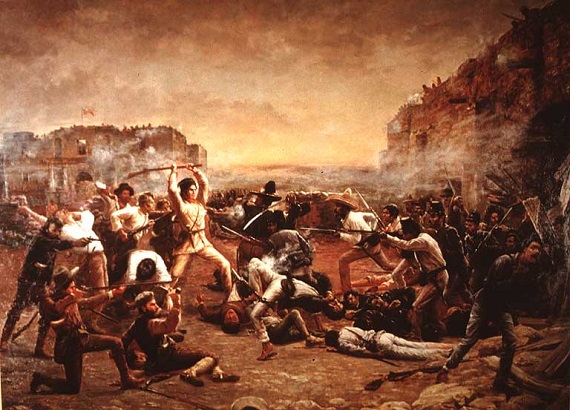
The courageous Texians withstood intensifying artillery bombardments and infantry assaults during the 13-day siege. At last, in the pre-dawn darkness of March 6, 1836, Santa Anna ordered a coordinated general assault on the Alamo. The Mexican soldiers marched into the fight to the notes of El Degüello, the bugle call signaling “no quarter.”
The Alamo garrison opened a devastating defensive fire with cannons and small arms and sent the first and second Mexican assaults away with heavy losses. A third assault, bolstered by reserves, breached the north wall. Fierce hand-to-hand fighting broke out on the walls and inside the fortress. As Mexican troops poured into the main plaza, they turned the Alamo’s cannons against the defenders. The desperate conflagration filled the compound, until Texian resistance began to flag under the sheer burden of overwhelming Mexican force. The final organized resistance fell back to the chapel and the rooms of the Long Barracks, where some defenders bravely fought to the end with knives, pistols, and clubbed rifles.
Nearly all of the approximately 190 Alamo defenders were killed during the overwhelming Mexican assault. One combatant who did escape with his life was Joe, the slave of Travis. He fought alongside the Texians on the wall until Travis was mortally wounded, then withdrew to a concealed position, from which he continued firing at the enemy troops. Joe was slightly wounded when he announced himself at the end of the fighting, but was presumed by Mexican soldiers to be a noncombatant and was spared. He was interrogated and released to spread the dismaying news of the Alamo’s fall. Also entrusted with this news was civilian survivor Susanna Dickinson, wife of the Alamo’s artillery commander, Almaron Dickinson. Susanna, her infant daughter Angelina, and Joe made their way east to Gonzales, where a small and ragged Texian force was gathering. Once there, the survivors informed the Texian Commander-in-Chief, General Sam Houston, of the Alamo’s fall, and the grim fate of the defenders’ bodies.
Susanna Dickinson later testified, “As we passed through the enclosed ground in front of the church, I saw heaps of dead and dying…. In the evening the Mexicans brought wood from the neighboring forest and burned the bodies of all the Texans, but their own dead they buried in the city cemetery across the San Pedro.”5 The Telegraph and Texas Register of March 24 extolled the Alamo defenders and lamented the inhumanity that deprived them of Christian burial.
General Houston ordered the torching and evacuation of Gonzales, so as to deny resources to the advancing enemy. He then ordered a strategic withdrawal of his own army, as well as that of Colonel James W. Fannin at Goliad. These reversals contributed to a growing Texian despondency. The fall of the Alamo would be compounded by further adversities in the following weeks, so that many Texians despaired of the final success of their cause. (Continued in Part II)
The views expressed at AbbevilleInstitute.org are not necessarily those of the Abbeville Institute.
************************************
Works Cited
- Young, Stark. “Not in Memoriam, But in Defense.” I’ll Take My Stand: The South and the Agrarian Tradition, by Twelve Southerners, Harper & Brothers Publishers, 1930, pp. 328–59.
- “How Texas Forts Got Their Names.” The Nolan County News (Sweetwater, Texas), vol. 6, no. 22, ed. 1, 19 June 1930, p. 11, available online at https://texashistory.unt.edu/explore/titles/t00606/browse/?q=&t=fulltext&fq=str_year:1930&fq=str_month:06_jun&fq=str_day:19.
- Texas Declaration of Independence, March 2, 1836, available online at https://www.tsl.texas.gov/exhibits/texas175/declaration.
- Travis, William Barret, “To the People of Texas & All Americans in the World,” February 24, 1836, available online at https://www.tsl.texas.gov/treasures/republic/alamo/travis-about.html.
- Morphis, JM. History of Texas, From Its Discovery and Settlement With a Description of Its Principal Cities and Counties, and the Agricultural, Mineral, and Material Resources of the State. New York, United States Publishing Company, 1874, pp. 176-77.





The commies at the splc just had a hundred of brick fall on them…should have been a thousand. War to the Bowie knife…
REMEMBER THE ALAMO!
Thank you for this very interesting article, Dr. Foltermann. I had the privilege of visiting the Alamo during a trip to San Antonio about 25 years ago. We visitors entered this Texas shrine with a quiet reverence, similar to that of stepping into a magnificent cathedral.
I had seen the 1960 movie, The Alamo, starring John Wayne, as a child and, I believe, had also seen the Disney remake by the time of my visit.
As I recall, the movie sets made the mission appear larger than it actually was.
I walked the grounds and read the names of the men who sacrificed themselves in a fight they must have known they had no chance of surviving. It prompted me to ask myself whether I would have the same courage and
conviction these men possessed.
I left the Alamo with a renewed respect for the men who gave their lives defending that old mission and, in turn, bought time for Sam Houston to muster an army that would destroy Santa Anna’s Army at San Jacinto.