Never has history been so perverted, never did misrepresentations so effectively deceive. Lewis L. Bogart, United Empire Loyalists (UEL) descendant, Adolphustown, Upper Canada, 1884
The American Revolution in the southern colonies was a ferocious civil war, particularly in the back county. The 250-year anniversary of the 1776 Declaration of Independence falls on the present year, 2026. Contemporaries estimated that the British American colonial population was a third patriot, a third neutral, and a third loyalist, though later estimates put the loyalist proportion as one-fifth. Nevertheless, the southern colonies were thought to harbor a higher proportion of loyalists.
American children have been taught a self-serving story: the British oppressed the colonists in America who, therefore, rebelled to achieve liberty. Put politically, it was Tory versus Whig. The Tories, loyal to King George III, were considered treasonous by the new Whig government. Loyalists were “Enemies to the State.” Considered “disaffected” or “deluded” people, they were described by Whigs as “savage” and “notorious” and “villainous.” A loyalist was also called a nonjuror or recusant for refusing to take the oath of allegiance to the revolutionary government.
The British, of course, used the term, “loyalists,’ for colonists for the King, and “rebels,” for those against. To an American Loyalist, the Revolution was “unnatural” and “incomprehensible.” To many Loyalists, the new Revolutionary government meant only abuse of power, indeed arbitrary power, enforced by a Revolutionary militia that would act as Judge, Jury, and Executioner, which often proved to be the case. A balanced perspective has been slowly achieved over 250 years. Every Tory cruelty was indeed matched by a Whig cruelty, and neither side achieved moral superiority.
The Backcountry
Surry County, NC, and Montgomery County, VA, adjacent on the state line, being Blue Ridge country, and to the west, the New River Valley—northwestern NC, together with southwestern VA—would be considered back county in 1776. From both counties, of course, new counties later formed.
To illustrate the civil war in the back country, the case of Loyalist Colonel James Roberts is presented. James Roberts and his brother, John, had land surveys on Snow Creek in western Halifax County (now Franklin County), VA in 1753 —James 329 and John 335 acres). Then in 1775, both brothers purchased land in the Hollows (now Mr. Airy), just south of the VA border, along the Ararat River in Surry County, NC — James 500 and John 290 acres. By 1775, several sons and a daughter of James Roberts had migrated west across the Blue Ridge into the New River Valley, along Elk Creek in Montgomery County (now Grayson County), VA, 50 miles north.
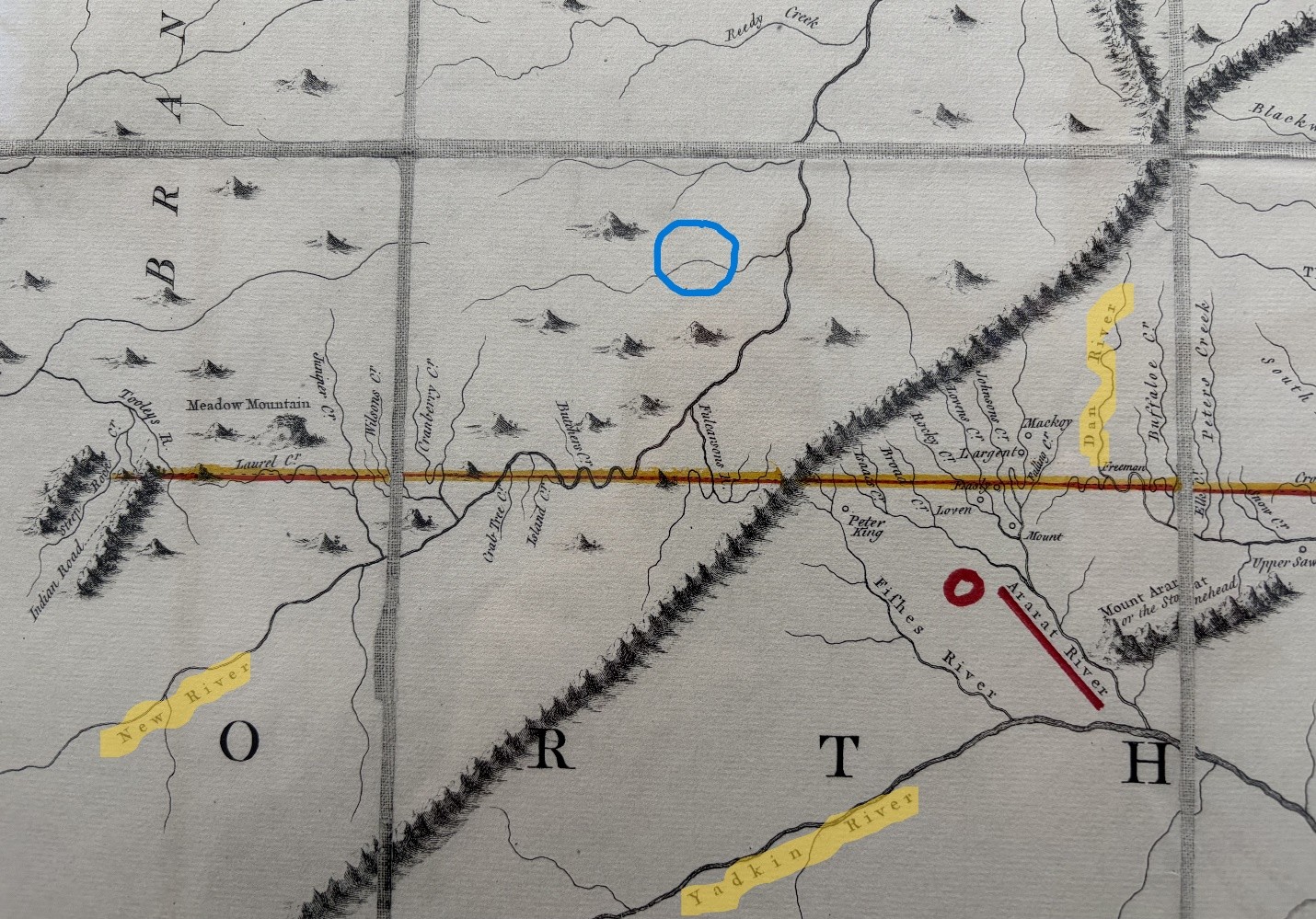
Figure 1. The VA/NC western border on the Jefferson-Fry Map of 1749. The RED circle is where Loyalist Colonel Roberts lived on the Ararat River in 1775 (Surry County, NC) and the BLUE circle is where his 4 sons lived on Elk Creek in the New River Valley (Montgomery County, VA)
1775: The First Year of the War
The people of the headwaters of the Dan and Ararat Rivers, along the VA/NC border, were mostly Tory. In his History of Surry County, or Annals of Northwest North Carolina, J.G. Hollingsworth, writes, “Among the men who have cast their lot with the Royalists were the Bryans, Wrights, Robertsons, and Robertses.” In the adjacent Mongomery County, VA, where 4 sons of James Roberts lived, 40% of the population and militia did not support the patriot cause. In October 1780, Colonel Preston of Montgomery County, VA, wrote to General Gates that “Montgomery County contained more Tories that any other County in Virginia.”
In March 1775, a month before the Battle of Lexington and Concord, a letter was sent to the Royal Governor from Samuel Bryan with 195 signatures from Surry and Rowan Counties, NC, expressing their loyalty to the Crown. In the same month, the first battle in NC battle occurred at Moore’s Creek Bridge in which loyalist Scottish Highlanders were defeated by a rebel Whig militia. It was American versus American, Tory versus Whig, and a set-back for Loyalists in the southern colonies, until British forces came south in late 1778.
The first Provincial Congress or Convention of NC took place August 25-26, 1775, in New Bern. A Committee of Safety was formed in each county. Benjamin Cleveland, who detested Loyalists, was appointed Chairman of the Committee of Safety of Surry County, NC, and later colonel of the militia of adjacent Wilkes County, NC. Called a scourge of New River Tories, he proved to be a belligerent, abusive Revolutionary, and a particular nemesis of Loyalist Colonel Roberts.
Property Confiscation
On July 5, 1776, a day after the Declaration of Independence was signed, the following letter was sent by the Council of Safety (including Benjamin Cleveland) to Colonel Martin Armstrong who commanded the Surry County Militia.
With respect to the property of James Roberts & other Tories of Surry County now armed against the good of the people of this province. The Council of Safety are of Opinion that the Committee of the County may take into possession such part of their estates as may be movable and make out an inventory of their Estates strictly personal and return same to next Congress observing in the meantime that their families are supplied with the necessities of Life and if possible take their persons and sent them with proper witnesses before this Council…
This property confiscation by the county militia was set into law in several Confiscation Acts of NC. On October 18, 1779, the following act was passed at the North Carolina Convention:
An act to carry into effect an Act passed at New Bern in November 1777, intitled “An act for confiscating the property of all such person as are inimical to this State or to the United States… all the lands, tenements, hereditaments and person property with the State of…..James Roberts, late of Surry, George Miller, late of Dobbs county, James Cotton, Walter Cunningham, Samuel Williams, late of Anson, Samuel Bryan, William Spergen, Mathias Sappinfield, late of Rowan…..
Of the 62 Tories listed in this Act, James Roberts is the only Loyalist from Surry County. Samuel Bryan from Rowan County, who wrote the letter (signed by 195 loyalists) to the Royal Governor in March 1775, is also listed in the Act.
War Activities
During the war, beginning in 1775, Loyalist Colonel James Roberts was active primarily west of the Blue Ridge, from 1775 to late 1780, it appears. He is mentioned in numerous Revolutionary pension applications (> 18), in the Draper Manuscripts (10 times), and in the NC State Records. In his book on King’s Mountain and Its Heroes (1881), Lyman Draper states:
When the Cherokees were inveigled by the British into hostilities, Captain Cleveland in the summer of 1776, served a tour of duty in scouting on the Western frontier of the State; and shortly after getting intelligence that a Tory Colonel Roberts had embodied a number of Loyalists on the Northwest side of the Blue Ridge, on the borders of North Carolina and Virginia, he went in quest of them, but hearing of this pursuit, they disbanded and dispersed.”
In their 2025 book, War without Mercy, Liberty or Death in the American Revolution Lender and Martin point out that 93% of revolutionary engagements (1775-1783) were “primarily the business of local militias, irregular forces, tribal groups, or even families defending their individual homesteads.” They also conclude that “the war was a very local conflict.” The following passages from several pension applications mention Roberts, suggesting guerrilla warfare in the back country:
In the spring of 1776 he volunteered as a minute man in Capt. James Shepherd’s company of NC militia, was elected Lieutenant, and attached to Colonel Martin Armstrong’s [Surry County, NC] regiment. During this year he was mostly engaged in keeping in subjugation Cols. Bryan and Roberts, whose loyalty induced them to raise two regiments of Tories, with whom he had several engagements on the Yadkin and Catawba Rivers…[Jonathan Clark]
…orders were received by Captain Cleveland from Col. Armstrong to take his company and go in pursuit of Col. Roberts (a Tory Colonel) who had embodied a number of Tories on the North-west side of the Blue Ridge. They immediately set out in pursuit of Col. Roberts and continued to pursue him and his company without being able to overtake them until they advanced considerably into the State of Virginia, when they learned that Roberts had disbanded his men and that they had dispersed.” [Col. Richard Allen, Sr., on the 1777 New River Expedition]
He was then living at the house of Captain John Cox on the New River in Montgomery County, Virginia, now Grayson County, about the year 1779 or ’80 engaged in making a crop of corn, when Colonel Roberts at the head of a company of Tories came and took him prisoner, William Craig, and Beverly Watkins. The Tories took him to the British army commanded by Lord Rowdan. [Benjamin Phipps]
“…a certain Capt. Roberts, of the tory party, came into the neighborhood with a company of six Hessians, and this declarant with Major Love pursued them into Carolina near the head of the New River, determined to overtake them, but Captain Baker of North Carolina had heard of them, got in before the declarant and his party, overtook, killed and wounded the whole party except Roberts, their Captain, who made his escape. [James Cox]
…again entered service as a volunteer militia soldier under Capt. William F. Lewis. They marched from Surry into Rowan and Iredell Counties to oppose a Tory leader called Captain Roberts who at that time was intimidating the surrounding country.” [David Cockerman]
This expedition was intended to guard against the depredations of the Tories, on the south line of Wilkes County [NC] under a certain James Roberts. They found the Tories had dispersed, when they reconnoitred the County to that quarter, and then returned to Grayson County, VA. [Jesse Bolling]
…in the summer of 1778 he was drafted and called into service for three months under the command of Benjamin Cleveland and Captain Richard Allen, was marched up the Yadkin River out at its head into Burke County to was called Criders Fort in pursuit of a company of Tories under the command of a Tory Colonel by the name of Roberts. On arriving at the fort we were informed that the Tories had retreated toward the Catawba River, we pursued them on, when we reached the river we continued our march down the river, and we had not gone many miles before we were fired upon by the Tories from the cliffs, the captain of our light horse, Captain Larkin Cleveland, was shot through the thigh…in the month of October 1779…we marched from Wilkes County [NC] across the Blue Ridge to Cove Creek crossing Stone Mountain to the Watauga River in pursuit of the above named Colonel Roberts, a Tory, and his company…[Amos Church, Sr.]
…sometime in August 1779. I again volunteered under one Capt. Underwood for an expedition against the Tories that had collected at Ramsour’s Mill [present Lincoln County, NC] where we whipped the Tories under one Capt. James Roberts…[Hal Hudson]
…in the spring of the year 1780…the Tories under the command of Roberts assembled at a place in the country called Raimhower’s [Ramsour’s] Mills…we marched to said Mills…the Tories made but little resistance to forces of the Whigs but broke up and scattered…they continued their pursuit and took seventeen prisoners…[Joseph Rogers James]
…commanded by Colonel Arthur Campbell on an expedition [June 1780] against the Tories who were commanded by Colonel James Roberts…[Joseph Lusk]
…under the command of Colonel Benjamin Cleveland and Captain Alexander Gordon against the Tories in Virginia which Captain James Roberts was then assembling on New River—during this term nine Tory prisoners were taken and to __Nichols and __Riddle, out of the nine were hung on our return…[John Spelce]
…was employed during a three month tour [1780] in routing the Tories. They marched into Rowan County [NC] scouting after Captain Fanning [probably David Fanning] who at the head of a band of Tories was doing much injury, then marched into Surry into the Hollows of the Yadkin [River] endeavoring to take a Captain Roberts who also headed Tories there—who came in and surrendered himself and his men…[John Lloyd]
The Charlotte Action and Capture
Pension applications transcribed from verbal statements made decades after the war can be inaccurate. Exactly when Loyalist Colonel Roberts was finally captured in unclear. In his account of the “Charlotte Action,” on September 25, 1780, the day Cornwallis crossed from SC into NC, patriot Colonel William R. Davie noted that British and Tory prisoners were taken. Captain Hart served in the NC State Cavalry Troops under Colonel Davie in September 1780 and is mentioned in the following letter on September 29 (or between September 25-29, 1780), from General John Butler to Colonel Jethro Sumner,
“Captain Hart last evening brought into camp 15 prisoners, one of them Col. Roberts or Robenson, from the hollows of the mountain (a very villain) with several of the more active of the tory gang, and 5 British dragoons.”
How Roberts died is also unclear. He may have been handed to county militia and hung, extra-judiciously, as many loyalists were, but it has been stated that he died of disease. In 1785, two years after the Treaty of Paris, administration of his estate in Surry County, North Carolina, began, but was delayed because 3 slaves “supposed to belong to the estate” had still not been recovered in 1787. Finally, in 1795, a legal petition by the new owner of the 500-acre Roberts property, concerning the deed, closed the matter.
The 4 Sons and 1 Daughter in Montgomery County
During the war, Colonel Roberts sought refuge, it appears, among his loyalist sons on Elk Creek in the New River Valley in southwestern Virginia. In a letter to Edmund Pendleton on June 15,1776, William Preston, colonel of militia of Fincastle County, VA, had written, “Roberts with Tories on Elk Creek.” Tory activities in Montgomery County, VA, also included a plot against the lead mines in 1779 and an insurrection of a militia company, known as the Tory Insurrection of Montgomery County, both of which were put down by the Revolutionary militias. In A History of the Middle New River Settlements, David E. Johnston states that
“The upper New River Valley, in what is now in part Bland, Wythe, Grayson and Carrol Counties in Virginia as well as some of the counties on the North Carolina side, were among the hiding places of the Tories, and they made frequent uprisings and had to be repressed.”
Court records of Montgomery County, VA, abound with instances of Tories summoned for Tory activities. Such was the case for 4 sons of Colonel Roberts, whose court appearances are mentioned. On November 8, 1780, a month after the Battle of Kings Mountain, one son James Roberts, Junior, appears in the court of Montgomery County:
On hearing the Petition of James Roberts, Jesse Meeks and William Riddle it is the opinion of the Court that the sd. Petioners be received as members of the Community as long as they behave as good citizens, but the Court does no believe itself properly authorized to grant pardon for Offences against Individuals , therefore if any of the Petitioners while they were in open rebellion against the State or concerned in Insurrections were guilty of Murder, Robbery , or of Feloniously taking away the property of any person, such must be amenable to the laws of the State of which they become inhabitants….
Two other sons, William and Cornelius Roberts are also mentioned later in the same Court Sessions, together with other former Tories:
Ordered that Wm. Roberts, Neal Roberts [Cornelius], Moses Johnson, Richard Green, Richard Wright, Clem Lee, and George Herd be restored their property again, it being lately taken from them by the Militia of Montgomery and Washington Counties, as nothing appears against them with Regard of their being enemies of the State.
A fourth son, John, appears in a record of the Court in Montgomery County on March 5, 1782, 5 months after the surrender of Cornwallis at Yorktown:
Ordered that John Roberts who has been inimical to the American Cause be received as a Citizen of his State and under the protection of the law on his taking the oath of Allegiance and giving security of his good behavior for twelve months and one day, whereupon the said John Roberts acknowledges himself indebted to the Commonwealth in the sum of Twenty pounds in species and Doswell Rogers and John Rice in the sum of ten pounds each to be levied of their respective lands and Chattles and to the Commonwealth rendered, Yet upon the condition that the sd. John Roberts shall be of the good behavior for twelve months and one day from this time.
A son-in-law of loyalist James Roberts, married to Harriet Roberts, was William Riddle, another open loyalist. Riddle was eventually captured and hung by Benjamin Cleveland, as noted by the above pension application of John Spelce. Lyman Draper in his book on King’s Mountain goes into greater detail on the capture and hanging of Riddle.
Brother Against Brother
To take this essay to another level of conflict, allow me to introduce John Roberts, the brother of loyalist Colonel James Roberts. Both brothers were neighbors on Snow Creek in Halifax County, VA, and then again on the Ararat River in Surry County, NC. John’s branch of the family, however, had no loyalists, to my knowledge, and 2 older sons enlisted in the Patriot (or Whig or Rebel) cause.
The oldest son, also called James Roberts, enlisted 3 times (3rd NC Regiment), participating in the battles at Shallowford , Kings Mountain, and Guilford Courthouse. A younger brother, John, though only 14, also served 3 months (Mecklenburg County Regiment), collecting corn to be ground for the Militia’s use before Guilford Courthouse.
Conclusion
Thus, for the Roberts family in the Hollows, the Revolution led to tragedy for a patriarch, as well as a brother-versus-brother conflict. It is interesting, to me at least, that the older brother, Colonel James Roberts (and his sons for a time), remained loyal to King George III, and the sons of a younger brother, John, joined the Rebels. The loyalist Roberts suffered loss of life and property for his 4 years of resistance to the Revolutionary regime.
The children of Colonel Roberts, however, appeared to suffer no major consequences of the Revolution, and eventually moved West or South. One son, Cornelius, had 12 children, 117 grandchildren, and 660 known great grandchildren, few of whom would know that the patriarch was an open Loyalist. It seems that a page in Roberts family life was turned in the year 1783, and no family record was left, oral or written, of loyalist sentiment, more evidence that the story has served the Revolutionaries.
The views expressed at AbbevilleInstitute.org are not necessarily those of the Abbeville Institute.




Great topic, thank you!
“Contemporaries estimated that the British American colonial population was a third patriot, a third neutral, and a third loyalist…” Could you provide some documentation of that? That is oft repeated, but I know of no basis for it other than a misinterpretation of something John Adams wrote.
Modern historians trying to get a handle on it seem to say 40-45% Patriot and 15-20% Tory. And that makes sense in that Patriots never had any trouble in any state taking over the governing apparatus.
Surry Co. Toryism may have stemmed from the fact that the 1776 Revolution in NC was led by the same eastern NC aristocrats who abused them badly in the War of Regulation in 1771. Even though in both instances, the Regulators and the Patriots were rebelling against corrupt big government. And the Scots beaten at Moore’s Creek surely had no love for the King, but rather a deep memory of their suffering from going against the King back in Scotland and the oath he forced them into.
“American children have been taught a self-serving story: the British oppressed the colonists in America who, therefore, rebelled to achieve liberty. ” Do you mean to imply that is untrue? Do you know something that indicates that the author of the Declaration of Independence wrong in some way?
Hope Dr. Roberts doesn’t mind.
“…know something that indicates that…the Declaration of Independence wrong in some way?”
Yes.
First, what happened has happened, and I try to be thankful to the Lord for this country I was born and raised in, but after much reading, I think a very, very strong case can be made for the arguments of the Loyalists against the Revolution. After that, as far as the war between the States, I think “The South Was Right,” (Kennedy twins), and I have great appreciation for the writings of Clyde Wilson, Rod O’Barr, Brion McClanahan, Shelby Foote, Ms. Njoya, other’s.
Returning to the Revolution:
“Patriot preachers tapped into the theories of John Locke; Loyalist ministers delved into law, reason, and history. The decisive factor for the clergy, however, was arguably their respective views of Romans 13, I Peter 2, and other passages of Scripture. Were the instructions there to be taken literally or not? Lawrence Leder summarizes it very well:”
Leder: “If government was God’s ordinance to man, little more need be said. Disagreement with government became rebellion against authority and, in turn, opposition to God–an unthinkable situation…”
Back to book text: “…they could not embrace notions of social contract, popular sovereignty, and resistance to authority. They consciously chose to defend God’s ordinance and to reject a rebellion against authority that amounted to rebellion against God.”
Excerpts from: “God Against the Revolution,” by Gregg Fraser
Matt, the question I presented was this: Roberts implies that colonists did not have serious grievances with their British overlords; their claims were “self-serving.” I submit that Jefferson’s detailing of the specific grievances (abuses by a big, corrupt govt essentially) are pretty good proof that Robert’s implication is silly. No one disputes the facts laid out by Jefferson.
You haven’t provided information directly relevant to that question. If some of the Tories found justification for their stances in Biblical scripture, that has little to do with the facts of Patriot grievances.
Leder’s statement is the typical gambit by which religion girded the tyranny of monarchies through the barbaric Dark and Medieval ages. What sentient person could look at history and suppose that government (by its nature inherently corrupt) was “God’s ordinance to man”?
J. Sobran, the question I addressed was this:
“Do you know something that indicates that…the Declaration of Independence wrong in some way?”
I deliberately left out Jefferson’s name because the question at hand is not about him. He authored the Declaration, but Jefferson was expressing all of the Revolutionaries thoughts on the matter; that matter being the declaration to break from the Crown. That’s the point.
So, your words:
“You haven’t provided information directly relevant to that question.”
are not correct. What in the document was wrong? The revolutionaries “declaration” was wrong.
You stated: “No one disputes the facts laid out by Jefferson.” (The revolutionaries. Its not about Jefferson.) No one, though? The Loyalists did.
Besides, the point argued between the patriots and the loyalists was not so much the so-called “facts” in the document. It regarded whether or not the colonies had a right, a God given right, to declare their independence from the Crown. The Loyalists case was stronger.
As far as Leder’s “gambit,” the patriots didn’t have any? We know better.
And as you read what Fraser stated, the Loyalists did not just pound the Book on everyone’s heads; the Loyalists “delved into law, reason, and history,” also (and made excellent arguments). However, what the Bible says about the matter is not to be passed over lightly. It does not matter if a newly governing body are not collectively bible believer’s. Nero may not have believed in the God of Abraham, Isaac and Jacob, but it doesn’t matter. He and and his administration are still going to give account to God for how they governed, and those governed are going to account, too.
Respectfully, Matt, I think you are arguing something different from what I attempted to say. My argument is that Jefferson expounded many [though not all] valid grievances the Patriots had against the King and Britain. Here are a smattering from the Declaration:
” [The King] has obstructed the Administration of Justice, by refusing his Assent to Laws for establishing Judiciary Powers.
He has made Judges dependent on his Will alone, for the Tenure of their Offices, and the Amount and Payment of their Salaries.
He has erected a Multitude of new Offices, and sent hither Swarms of Officers to harrass our People, and eat out their Substance.
He has kept among us, in Times of Peace, Standing Armies, without the consent of our Legislatures.
He has affected to render the Military independent of and superior to the Civil Power.
He has combined with others to subject us to a Jurisdiction foreign to our Constitution, and unacknowledged by our Laws; giving his Assent to their Acts of pretended Legislation:
For quartering large Bodies of Armed Troops among us:
For protecting them, by a mock Trial, from Punishment for any Murders which they should commit on the Inhabitants of these States:
For cutting off our Trade with all Parts of the World:
For imposing Taxes on us without our Consent:
For depriving us, in many Cases, of the Benefits of Trial by Jury:
For transporting us beyond Seas to be tried for pretended Offences…”
The British govt was abusive of the Colonists in all manner of other ways too. For instance, a colonist could not transport woolen products over any body of water [not even a creek] and so was not allowed to be a manufacturer or dealer in wool products. Britains mercantilist laws were not so far removed from the economic fascism afflicting the US and others today. These multitude of grievance are facts, and I don’t believe Tories said they weren’t facts.
You are arguing instead: “It regarded whether or not the colonies had a right, a God given right, to declare their independence from the Crown.” I grant you Tories might find that a soothing thought. But for Patriots, to the extent the Enlightenment had penetrated their culture, it was unpersuasive if not ridiculous.
To argue that innately corrupt governments (which in varying degrees routinely devolve–even starting with decent constitution– into organized crime over time) have the imprimatur of God and that only God may punish them…is to reflect badly on either God or the one proposing such an illogical principle.
The Anglican/Catholic/Protestant churches, Islam, and Communism have all been used to justify and strengthen dictators/tyrants/kings for centuries. Tories were victims of the propaganda they grew up in, just like a present-day citizen of Communist China or Saudi Arabia.
J. Sobran, I couldn’t reply to your last message under that message, so I am doing so here.
You quoted Dr. Roberts stating this:
“American children have been taught a self-serving story: the British oppressed the colonists in America who, therefore, rebelled to achieve liberty. ”
Then you asked:
“Do you mean to imply that is untrue?”
Again, hoping that Dr. Roberts doesn’t mind, I will say I agree with you, some, that there was “oppression” of the Colonists.
Then you asked:
“Do you know something that indicates that the author of the Declaration of Independence wrong in some way?”
No, he “probably” wasn’t. For the sake of argument, I’ll, emphatically, say, No, he wasn’t wrong.
However, on that same paper where they listed those “grievances” the patriots said and did something wrong: they declared their independence from the Crown. They should have left that out.
I don’t know if you are a saved Bible believer, but if you are, I respectfully suggest you visit this topic/doctrine in the Bible. In the O.T. economy, the Lord punished His people for not submitting to the wicked Nebuchadnezzar.
Returning again to Leder and what he said: the issue is not him. He may indeed have used what he said as a “gambit;” that’s not the issue, either. The issue is the words he said, and whether.or not those words are true.
Leder: “If government was God’s ordinance to man (it was and is), little more need be said (indeed).
You: “To argue that innately corrupt governments (which in varying degrees routinely devolve [Yes, agree]–even starting with decent constitution– into organized crime over time [Yes, agree}) have the imprimatur of God…”
You know better, or ought to know better, than to put it that way. God instituted human government, not “innately corrupt governments; though, yes, these ” governments” almost immediately became corrupt. However, when God instituted human government, it was when Noah and his son’s came out of the ark, those men, Noah particularly, knew the Creator and His instructions. The inevitable corruption might have been lessened if God and His words had been very carefully passed on from one person to another, from one family to another, from one town to another. Something like that didn’t come close to happening, nevertheless the ordinance was still there and in place.
“…and that only God may punish them…”
My impression of that view, just above, is that men know as much, or better than God. I see that as arrogance.
Jude 8-9: Jude 1:8-9 “Likewise also these…despise dominion speak evil of dignities.”
Even the powerful angel Michael said only so much:
“Yet Michael the archangel, when contending with the devil he disputed about the body of Moses, durst not bring against him a railing accusation…”
Peter lived under some pretty wicked rulers such as Herod and Caligula, nevertheless the Lord through Peter said:
1 Peter 2:17-18 “…Honour the king…be subject…also to the froward.”
“(Samuel) Seabury provides an effective Loyalist summary of the American response to Great Britain’s overtures of conciliation:”
Seabury: “The unhappy contention we have entered into with our parent state, would inevitably be attended with many disagreeable circumstances, with many and great inconveniences to us, even were it conducted on our part, with propriety and moderation. What then must be the case, when all proper and moderate measures are rejected? When not even the appearance of decency is regarded? When nothing seems to be consulted, but how to perplex, irritate, and affront, the British Ministry, Parliament, Nation AND KING.” (Emphasis mine.) From Fraser book, “God Against the Revolution.”
Thanks for your careful reply, Matt. I can’t believe a loving God would subject his sheep to some government that makes claims to “divine right”, regardless of how horrible that government was. The government of Great Britain was established by Brobdingnagian quantities of extreme violence by men without a scintilla Christian behavior to suggest God had a damned thing to do with it. From William the Conqueror to George III, they were corrupt in the way power makes men corrupt, total strangers to the Golden Rule.
Are you familiar with the theory that Christianity was the invention of the Roman Flavian dynasty in an effort to render the extremely troublesome Jews more docile? Quite a few things fit well.
Hey J. Sobran.
“I can’t believe a loving God would subject his sheep to some government that makes claims to “divine right”, regardless of how horrible that government was.”
You’re not alone in thinking that, far from it. But, you recall the rulers the apostles had to be subject to: Herod, Tiberius, Caligula, Nero. You know what the Saviour said: “Render unto Caesar the things which are Caesar’s…”
Do we think God didn’t love this particular sheep when the following happened?:
Acts 12:1-3 “…Herod the king stretched forth his hands to vex certain of the church.”
“And he killed James the brother of John with the sword.”
“And because he saw it pleased the Jews, he proceeded further to take Peter also…”
Of course, we know better. The Lord loved James whom Herod viciously killed.
Among many, many other’s, the podcaster Michael Savage has asked a few times in the past several years, “Where is God?” when something awful had happened.
I strongly suggest Sir Robert Anderson’s book: “The Silence of God,” besides the Fraser book.
I don’t say George III was put there by the Creator, but the government he ruled from was Gods ordinance. And the Lord didn’t say He’d only have “holy” Bible believer’s in place, though that would be desirable (maybe).
Romans 13:1-2 “Let every soul be subject unto the higher powers. For there is no power but of God: the powers that be are ordained of God.”
“Whosoever therefore resisteth the power, resisteth the ordinance of God…”
And by the way, I think those words apply to everyone, including the so-called “atheist.”
“Are you familiar with the theory that Christianity was the invention of the Roman Flavian dynasty in an effort to render the extremely troublesome Jews more docile?”
I don’t think I am? But, that’s interesting. I think “Christianity” was begun by the Lord with the apostle Paul (Boy, you want to talk about something else which stirs the heat up!).
With the change the Lord initiated there in the book of Acts, the Jews had become anything but “docile.” And they weren’t docile before that, as we just saw from their reaction when Heard killed James.
So much that can be discussed.
J. Sobran, I had wanted to say something else.
You: “I can’t believe a loving God would…”
I think we have it backwards. I think men should say rather: “I can’t believe a loving God would have anything to do with ME and the entire human race.”
That, I think, should be our thinking, our perspective.
Psalm 8:4 “What is man, that thou art mindful of him? and the son of man, that thou visitest him?”
If I remember correctly, Daniel Boone’s wife was a Bryan. I wonder if her family were the loyalist Bryans mentioned here.