

If I were a Yankee, I could likely make an outrageous claim and expect it to be believed on the strength of its articulation alone. Yankees, of course, possess the advantage of literacy, and literacy, in modern cultural shorthand, is synonymous with intelligence. As a Southerner, I don’t enjoy that rhetorical luxury. Everything I say must be prefaced, situated, and defended against the lingering suspicion that it came from a porch swing instead of a peer-reviewed journal. That asymmetry implies a deeper cultural reflex in which written authority is granted automatic legitimacy while lived authority is required to prove itself. Since Yankees enjoy framing the South as illiterate, then they also make the deductive jump that illiteracy equals stupidity.
My family once vacationed together in the French Quarter of New Orleans. Most of us left the hotel and walked all over the Vieux Carré until our feet blistered. We heard the music and the voices. We rode the trolley. We ate the food. We smelled the smells and felt the grime. We wilted under the humidity. We marveled at the architecture. We took it all in with a typical New Orleans sensory overload. However, my Yankee sister-in-law did not accompany us. She stayed behind and read a book on New Orleans. Instead of living it, she chose to read about it. Do you want to guess which one of our family still insists that she knows more about New Orleans than any of the rest of us?
With that in mind, consider a question that appears harmless at first: What happens to a song when you write it down? Most modern listeners respond instinctively that it is preserved. Writing feels like protection. Notation suggests rescue. Documentation appears to erect a barrier against disappearance. The logic is so intuitive that it rarely receives scrutiny. To write something down is to care about it. To fail to write it down is to risk losing it. That equation—documentation equals preservation—sits quietly at the center of modern archival culture.
We inhabit an age that archives compulsively. Music, correspondence, grocery receipts, fleeting digital utterances—everything is stored somewhere, ideally in multiple redundant locations. The impulse feels responsible and forward-thinking, as though civilization is finally behaving sensibly. Yet embedded within that impulse is a profound distrust of memory. The archive exists because we assume memory is fragile, unreliable, and prone to distortion. Writing becomes the corrective force that stabilizes what human recollection cannot be trusted to maintain.
That assumption has shaped how modern society imagines oral culture. We often picture primitive, pre-literate communities passing songs from person to person in a kind of extended children’s game, with each repetition introducing further corruption. The metaphor of the “telephone game” lingers in the background of such discussions, reinforcing the belief that oral transmission inevitably degrades content. Thank goodness we figured out how to write stuff down, because otherwise, we would have forgotten everything. From that perspective, writing appears as salvation: the moment at which instability is arrested and fidelity is secured.
Historical reality is less convenient. Oral cultures were not casual about memory; they were exacting. Songs, genealogies, and liturgical texts were corrected in real time by participants who regarded accuracy as a communal responsibility. When someone faltered, others supplied what was missing. When a phrase drifted too far, it was pulled back into alignment. Memory in such contexts did not belong to the individual; it belonged to the whole group. The act of remembering was inseparable from the act of belonging, and continuity was maintained through repeated, disciplined participation, not through storage.
Modern people tend to imagine memory as a container into which information is deposited and sealed. Once transferred to an external device—a book, a hard drive, a cloud server—the burden feels lifted. The archive assumes responsibility. By contrast, in oral cultures, memory functioned as performance. A song existed only when it was sung. If it was not enacted, it didn’t sit quietly awaiting rediscovery; it vanished. That condition strikes modern observers as precarious, even reckless. Yet the very precarity created motivation. Someone had to show up. Someone had to remember. Someone had to teach.
Writing alters that relationship in subtle but consequential ways. Once a song is fixed on the page, the pressure to internalize it diminishes. But more dangerously, different variations of that song are considered to be incorrect deviations. The written version becomes the measure against which the song is judged. What is gained in security may be offset by what is surrendered in responsibility. The archive protects form, but it also redistributes authority, relocating it from the people to the text.
This tension between memory and notation is not merely cultural intuition; it has been examined directly within music education research. Children do not learn music by decoding symbols; they listen, they imitate, and they assign meaning to sound. They sing, they play, and they have fun. Only AFTER they internalize the song do they develop music literacy as a tool. When music notation is introduced before their memory of the song is secure, students reproduce symbols accurately without comprehending what they produce. The result is external precision without internal understanding. They know the music, but they do not know the song. In other words, they know New Orleans better than the rest of us.
Most musicians recognize this phenomenon. People who read music frequently struggle when they can’t see the page, while musicians described as “unable to read” often demonstrate extraordinary comprehension and perfect recall. They anticipate harmonic motion, internalize form, and retain large repertoires through repeated participation. Their fluency emerges from necessity rather than consultation of the page. Memory was not an optional supplement to literacy; it was the foundation of their musical thinking.
The point is not to romanticize illiteracy or to condemn documentation. Literacy remains one of humanity’s most powerful tools. The question is more precise and more unsettling: What about the music changes when preservation is equated with inscription? What responsibilities are quietly relinquished when continuity is assumed to reside in storage rather than in practice? If every song stored on the internet vanished tomorrow—every streaming catalog, every cloud backup, every lyric site, every tutorial video—how many of the songs you love could you actually sing without assistance? Not hum in fragments, not approximate a chorus with scattered syllables, but sing with a stable melody and a coherent text from beginning to end.
This musical reorientation first occurred in the South during the early twentieth-century collection of Anglo-Scottish ballads from Appalachia. For centuries, those narrative songs circulated in flexible forms. Singers adjusted verses, altered sequence, modified diction, and occasionally reshaped endings to suit the audience and the circumstance. Variations were functional and necessary, not corruptions; it allowed the ballad to remain responsive to context. When British musical archivist Cecil Sharp assembled his monumental collection, English Folk Songs from the Southern Appalachians, he preserved an extraordinary body of material that might otherwise have disappeared. Yet the act of codification introduced a subtle but decisive shift. By identifying and numbering canonical versions, the collection process implicitly established a hierarchy. Variants increasingly appeared as deviations from textual authority rather than as legitimate expressions of communal practice. The songs endured in print and in academic study, but the conditions that had sustained their elasticity weakened.
The early blues tradition offers another Southern analogue. In its formative decades, blues performance was fluid. Verses migrated freely between songs. Melodic phrases were bent according to expressive need. Harmonic frameworks shifted in response to local habit and individual inclination. The music lived primarily in performance settings—in juke joints, on porches, in informal gatherings—where memory and improvisation operated as structural necessities rather than stylistic embellishments. As blues entered the domains of sheet music publication, copyright law, and later academic description, its flexibility was bound by new constraints. Formal patterns were codified, canonical recordings acquired normative status, and “authentic” structures were identified. Improvisation didn’t completely vanish, but it required defense. What had once been the mechanism of continuity became a mark of personal style. The effect is that older, authentic recordings of primitive blues are thought of increasingly as being in incorrect form. The singer was wrong, while the page was right.
Southern jazz musicians experienced a related transformation with the widespread circulation of published fake books. Prior to such compilations, learning a tune typically required listening, memorizing, and being corrected in live performance contexts. Knowing a song meant carrying its melody, harmonic structure, and formal outline internally. Older jazz musicians carried an incredibly large repertoire of music inside their heads, and might begin a jam session by saying something like, “Let’s play an ‘Ain’t Misbehavin’ verse with a ‘Lady Be Good’ bridge.” Before fake books, every musician in the room knew exactly what to do. Afterwards, musicians had to flip pages back and forth to rely on the book instead of their own cognition of the music. With the availability of comprehensive charts, memory became less urgent. Authority gravitated toward the printed page. Disagreements that might once have been resolved through collective musical negotiation could now be settled by consulting the page. Jazz didn’t stop changing and growing, but the relationship between musician and repertoire shifted from internalization to access. Knowing a tune evolved into knowing where to find it.
The question is not whether literacy saves repertoire; it clearly does. The question is what else it does. Writing redistributes responsibility. It redefines deviation. It alters the location of authority. Once a version can be cited, it can be enforced. Once a chart can be consulted, it can outrank memory.
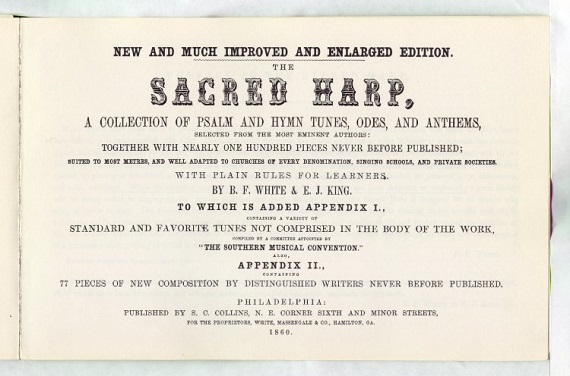
And yet, the exception that proves the rule is Sacred Harp. The survival of Sacred Harp singing presents a revealing counterexample. Shape-note tunebooks contain extensive instructional material on how to read music. They diagram intervals, explain rhythmic notation, and provide guidance for participants. On the surface, such apparatus might appear poised to produce the same ossification observed elsewhere. Yet Sacred Harp culture developed a distinct boundary between instruction and authority. The book facilitates entry, but it does not finish the song. Tempo, dynamics, and expressive emphasis are determined communally within the singing. If there’s a dispute between the room and the page, the room always wins.
That cultural rule is decisive. Because authority remains embedded in the assembled participants, notation functions as scaffolding rather than statute. Variation is not automatically construed as error. Regional flavor and habits persist, and are even encouraged. Correction occurs, but it occurs through collective practice rather than textual enforcement. The tunebook preserves a way of gathering rather than a fixed performance. Sacred Harp didn’t survive because it was written down, but because those who used the book refused to surrender to it.
This distinction aligns with broader regional patterns of authority in the South. In parts of New England, literacy historically operated not only as a practical tool but as a moral indicator. The written word anchored legitimacy, and textual reference often settled disputes. In the South, by contrast, authority frequently remained embodied. Elders carried memory through lived experience. Preachers spoke without manuscripts. Songs were learned by standing next to someone louder and more confident. Writing was used, but it was rarely permitted to displace presence entirely. The page assisted, but it did not rule.
When I was in college, I had a music education professor who was deeply ashamed of the South. I could never figure out what he was doing in Alabama if he hated the South so much, but whatever. The point is that he spent a great deal of energy illustrating how the North had so much better literacy than the South – both linguistically and musically – and Southerners should never stop being ashamed of that. The North is better because it wrote everything down. The South is backwards because it resisted that.
He was right about one thing—Southern musical traditions reflect this posture. Yet, in doing so, they tend to bend rather than fracture. They absorb influence without surrendering identity. Their resilience emerges from sustained communal responsibility, and not from superior documentation. When music remains embedded in shared practice, it retains the flexibility necessary for renewal. This is the Southern way. When music is primarily secured through the printed page, continuity narrows into mechanical repetition. This is the Northern way.
Modern readers may feel quite a bit of discomfort at this argument. It implies that certain losses were not inevitable consequences of technological limitation but products of cultural choice. Efficiency was chosen over obligation. Storage was chosen over stewardship. Access was chosen over participation. The archive offers convenience, and convenience is persuasive. Yet convenience can quietly erode the habits that once sustained continuity. We recognize melodies when they begin, but we do not necessarily carry them. The distinction between exposure and internalization becomes visible only when access is removed. The ease with which music can be retrieved has reduced the urgency with which it must be remembered.
Remembering is hard work. It requires repetition, attention, and often correction by others. Earlier generations memorized extensively because retrieval was uncertain and communal knowledge mattered. Writing reduces that burden, and its benefits are undeniable. Yet when memory becomes optional, it also becomes fragile. A song that costs little to keep costs little to lose.
I am certainly not calling for a rejection of literacy or a retreat from technology. But I do invite a reconsideration of what it fully means to preserve something. Storage and continuity are not the same thing. Documentation doesn’t automatically sustain a song. It may be preserved as an object that endures materially while ceasing to function socially. On the other hand, a song carried imperfectly by people may shift in detail, but remain alive in purpose and practice.
Human beings made music for millennia without the security of inscription. Songs endured because they were enacted repeatedly within communities that regarded remembrance as responsibility rather than convenience. The most significant transformation of modern musical culture may not have been the invention of notation or recording but the gradual assumption that preservation absolves participation. If a song lives only when someone sings it, then preservation cannot be reduced to inscription. The question that remains is not whether writing saves music; it does. The question is whether we have mistaken the saving of material for the sustaining of the song.
The Southern situation described earlier complicates this dynamic. In the South, authority has historically remained embedded in presence rather than solely in text, and Southern traditions retain a participatory core even in the presence of documentation. Sacred Harp singings don’t continue because the tunebook exists, but because people gather regularly and accept the love of singing together. Blues and country repertoires don’t regenerate simply because recordings are available, but because performers reinterpret and inhabit them in new contexts. In the South, the archive doesn’t replace the performance.
Literacy and memory are not adversaries. The difficulty only arises when their relationship is inverted—when inscription is assumed to suffice without enactment. Writing can extend memory across time; it cannot substitute for the act of remembering. Recording can capture a performance; it cannot generate the communal conditions that made the performance meaningful. Documentation preserves traces. Continuity requires repetition. We sing; therefore, we are.
The long history of human music suggests that preservation depends more on community performance than inscription. Songs that were necessary for worship, for labor, and for identity were remembered because forgetting them carried consequence. Preservation emerged from use rather than precaution. Continuity was sustained by practice.
A song lives only in the moment it is sounded. It endures only if that moment recurs. Writing can safeguard the possibility of recurrence. It cannot guarantee the act itself. The final responsibility for that act remains where it has always been: with those willing to carry the song into the room and risk singing it together.







I have a cousin who, though partially deaf, learned to play music by ear. Astoundingly talented guy. And he got criticized and put down until he learned to read music.
I majored in music even though I couldn’t read music when I started college. I quickly realized that although I was behind my fellow students in written literacy, my ears were way better than theirs. Your cousin likely experienced the same thing.
That reminds me of the regular criticism of Elvis: “Well… well… he didn’t write his songs.” Elvis’s ears were way better than theirs, too.
Yes, that is something frequently overlooked about Elvis. He was a legend in the studio for getting the sound just right.
James Burton being your bandleader helps, too.
Absolutely brilliant, thank you. And a Yankee reading this won’t understand a thing. Yankees are mechanical, raised to do things the “right way” (whatever that is). Follow the blueprint, not the inner soul.
Raised in Ohio like this with unawakened N. Georgia Mountains DNA, I moved to Texas after my Masters Degree and I found myself. I learned the guitar and made my own rendition of “O Come, O Come Emmanuel.” I didn’t need the music because the song came out of my soul. A song not internalized cannot be sung as your words so aptly reveal.
This principle applies to the bastardization of the Constitution by the Yankees. Manipulate the document to align with the obsessions of the ego rather than the spirit of the Framers of Liberty before Union (thank you Mr. Henry). The Framers were correct that for the Constitution to work requires a people who are spiritually grounded.
Well , well said, Mr. Daniel.
A few years ago I could remember the phone numbers of 20 or 25 friends, family and business associates. Then along came cell phones with contacts. Now I can only remember my wife’s number.