

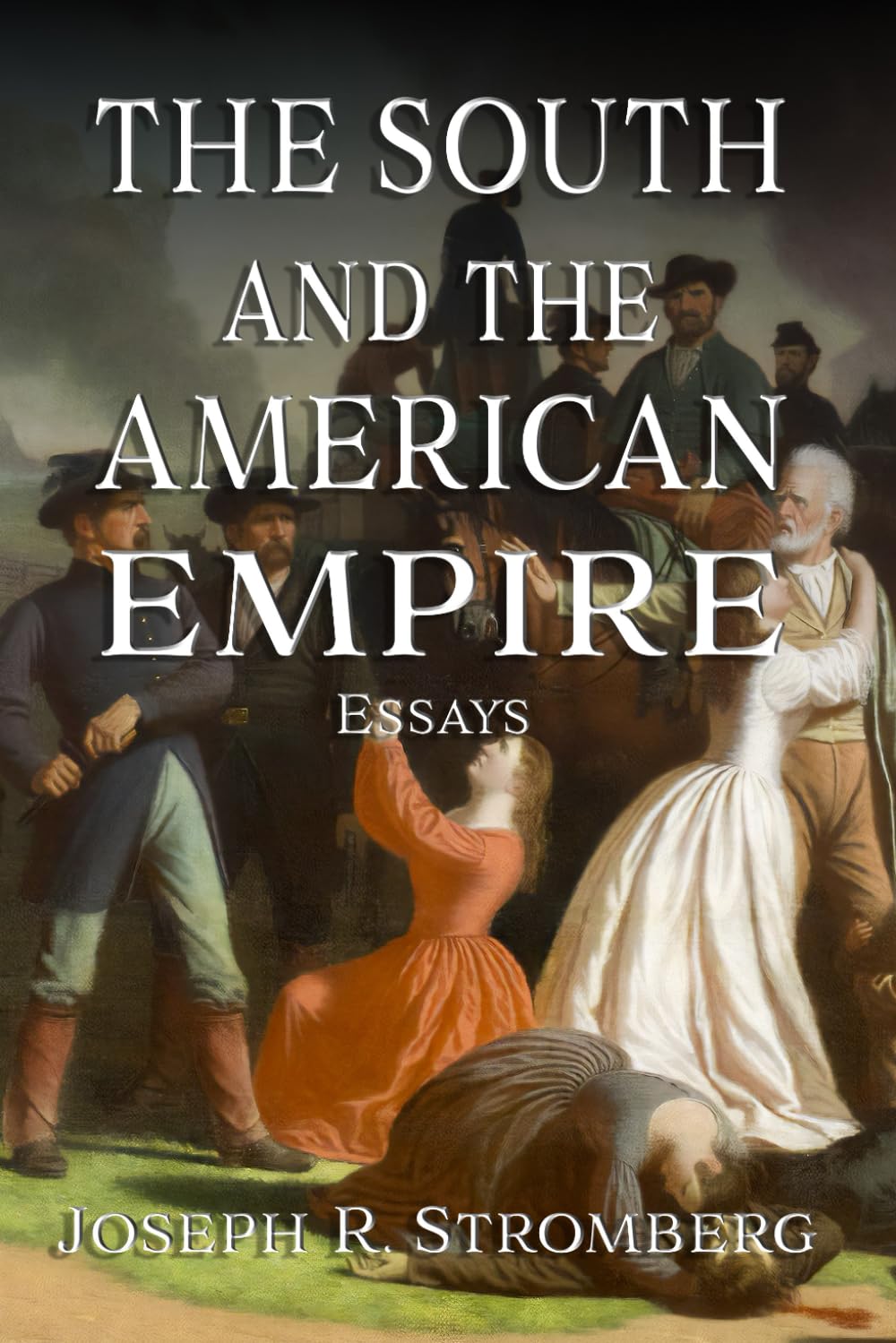
A Review of Joseph R. Stromberg, The South and the American Empire: Essays (Shotwell Publishing, 2026)
Those familiar with the work of Joseph Stromberg know the mastery Stromberg has over the secondary literature in a diversity of academic fields. In the preface, Clyde Wilson states, “Joseph Stromberg is the consummate scholar for all seasons. . . . [H]is many essays show his immense seamless scholarship in history, economics, culture, and philosophy. I know of no historian who can match this performance.” Academic specialization and the unfortunate tendency of academics to “know more and more about less and less” make Stromberg something of a unicorn among contemporary intellectuals. The eclectic nature of his collection of essays proves this. Nevertheless, Stromberg’s essays are held together by a common theme, the nineteenth-century intellectual and ideological underpinnings of the emerging American empire and the resistance, mostly Southern, to its emergence and continued existence.
The collection is organized into four parts. The first three essays are reflections on Southern political thought and culture as these relate to secession, republicanism, federalism, and the place and views of the plain folk of the South on these matters. In chapters four through six, Stromberg considers the strains of thought, mostly Hegelian and secular Puritan, which poisoned the Northern mind and were the ideological bedrock for the justification of the brutal repression of Southern independence. Chapters seven through nine present prominent Southern critics of imperial war and empire, with seven and nine specifically focusing on the two most prominent Southern historians of their respective generations: Ludwell Johnson of William and Mary and Clyde Wilson of the University of South Carolina. The last two chapters might be subtitled “hope” and “despair,” as in these essays Stromberg contemplates possible ways out of the current imperial swamp, and its maze of quicksand, mud, and ditches.
Stromberg’s essays on Southern political thought and culture were written over a period of twenty-three years. In “The War for Southern Independence,” Stromberg, a younger and self-described “Radical Libertarian,” boldly states that Northern war aims were “profoundly conservative.” The federal regime fought to “preserve the federal government, retain markets, and preserve slavery if possible.” One detects a bit of the enfant terrible as such statements were sure to rile some members of the history guild. They were, however, generally true. In 1860, the Republican party captured the presidency and the House of Representatives, secession resulted in the Republicans also taking control of the Senate. Republican control of the Supreme Court was a matter of time. Preserving the new order of things in Foggy Bottom was certainly a priority for the Republicans. Stromberg’s analysis has the “court” firmly in the hands of Northern politicians, both Republican and nationalist Democrats, placing the champions of Southern independence in the role of a libertarian “country party.” As Stromberg relates in chapter two, Southerners, indeed all Americans, played fast and loose with ideological positioning. Southerners of the founding generation certainly read Bolingbroke, Trenchard and Gordon, and Locke as well, but they were not concerned with harmonizing any disparate or contradictory ideas these worthies expressed. Southerners, again all Americans, possessed a powerful pragmatic streak. As Forrest McDonald pointed out in Requiem, Americans typically tended to use whatever was lying around in the tool shed of ideas if it articulated their views and experiences. Stromberg’s examination of the plain folk of the South in chapter three underlines this essential pragmatic, anticourt bias of many Southerners. Outsiders were held in suspicion, as were far away governments. The plain folk feared enslavement by outsiders, and their common horse sense also instructed them to embrace partisan guerrilla warfare during the Late Unpleasantness. The failure to do so, at scale, contributed to their subjugation by the dreaded outsiders.
Next, Stromberg turns his attention to the Yankee intellectual heritage in the nineteenth century. Chapters five and six are vintage Stromberg. These chapters closely examine the influence of pietism, Hegelian, and Romantic ideas (especially of the national destiny variety) upon the North’s intelligentsia and political class. Hegelian and Romantic strains of thought were also married to a secularized Puritanism; the state replaced God and war became the favored instrument of the self-righteous in their pursuit of heaven upon earth. I would also add that the advocates of Manifest Destiny seem to fall into this same category. My summary above does not do justice to Stromberg’s sensitivity to the different strains and points of emphasis in the thought and action of the historical actors he examines or how deftly he handles the complexities of intellectual history. Chapter four is the true masterpiece of this section. Here Stromberg analyzes the primary source literature the Civil War thought of Orestes Brownson, one of the more influential intellectuals in the North. After secession, the Brownson that emerges in Stromberg’s account is at some distance from the committed Northern Democrat and supporter of John C. Calhoun. Though a convert to the Catholic faith, Brownson proved the axion that you can take the man out of Puritanism (and Transcendentalism), but you can’t take the Puritan (secular variant) out of the man. Like many Northern intellectuals, Brownson rooted his political theory of the Union in Hegelianism, romantic notions of national destiny, and a bloodthirsty vindictiveness towards his adversaries. Brownson was taken aback by the opposition to his views by fellow Catholics, North and South, somehow blind that his tenor and views had far more in common with Oliver Cromwell and his roundheads than with the Gospels. As Stromberg points out, Brownson did tone down his intemperate rhetoric in his post war writings, as in The American Republic (1865), but the strains of the Battle Hymn of the Republic are still there. Though not explored, Stromberg’s analysis of Brownson’s thought suggests the powerful role culture plays upon the reception and articulation of an ideology.
In chapters seven, eight, and nine, Stromberg turns his attention to a consideration of modern and contemporary Southern intellectuals. A too long neglected subject is Stromberg’s account of Southern antiwar thought in the nineteenth early twentieth centuries. Most accounts treat the Spanish-American War and World War One as watershed moments in the reconciliation of North and South, as both regions joined in the great construction of the American empire. Stromberg’s examination of the Southern dissent on empire and war is a much-needed corrective to that view. Chapters seven and nine are an examination of the important work of historians Ludwell Johnson and Clyde Wilson. Johnson was influenced deeply by such Civil War revisionists as Avery Craven who emphasized the role of political blundering in the 1850s in bringing on the war, as well as Charles Beard and his disciples who lay the emphasis upon economic factors. Johnson combined these schools of thought into a neat synthesis he styled “the plundering generation.” The war came through a mix of political incompetence on the part of politicians, North and South, and the avarice of Northern financial and economic interests. Wilson, an admirer of Johnson’s work, placed his stress elsewhere. An interesting mix of reverence for republican virtue and the legitimate and just concerns of the “plain folk” are two prominent themes that run through his work. Wilson articulated an important observation in his work as an historian and commentator on contemporary issues: social context and culture matter deeply because their foundation is the universal truths that find their expression in particular places and times.
Stromberg attempts in his last two essays a foray into the fields of hope and despair. Chapter ten is an ambitious attempt tell the story of “two laissez faires” in American history that were antagonistic systems of political economy and social organization. Though Stromberg details this conflict with sensitivity and attention to all its complexities, it is essentially the old fight between the Jeffersonians and those I shall call the Hamiltonian Lincolnites. In its essence the conflict boiled down to whether large consolidated and centralized government would be allowed to enter into marriage with large capital and finance. The war takes many forms over the decades of the American republic, but sad to say the Hamiltonians own the upper hand. Stromberg sees hope in an intellectual synthesis between the ideas of the Southern Agrarians, the (old) New Social History, a sprinkling of Marxists, libertarians, and old Progressives to analyze anew the historical situation of America and the South. Other than Stromberg, I am not sure who is capable of undertaking the task, and given Stromberg’s final chapter, I am not sure the task would prove fruitful.
Stromberg’s last essay is ironically titled “Dark Night of the American Soul.” One might be tempted to figuratively ask if Americans have a soul, as self-reflection is not a typical American trait. As Stromberg points out, what passes for American ideas are notions from Greater New England to which the American public gives ready and unthinking assent, chief among these perhaps is “American Exceptionalism,” a ticket to escaping all the trials and tribulations the rest of humanity endures because of the Fall. Stromberg’s criticism of contemporary American culture bites: Americans are good natured Philistines who believe that “history [is] a series of bad things that happen to other people.” In other words, innocent rubes who bought into a bunch of Hegelian, secular Puritan, and Yankee tripe about how special and unique they are. Yes, biting, but again mostly true. Stromberg concludes that the American inability to reflect, to face the complexities of the past, and not just the approved list of evils to be condemned produced by the Left, undercuts our ability to think our way out of the current situation. This forbodes a dire future.
I have only accounted for a small number of the important questions and issues Stromberg explores. Anyone unfamiliar with the intellectual currents of the nineteenth century will receive an invaluable introduction in Stromberg’s account and a good deal of rich food for thought.
The views expressed at AbbevilleInstitute.org are not necessarily those of the Abbeville Institute.







One Comment