
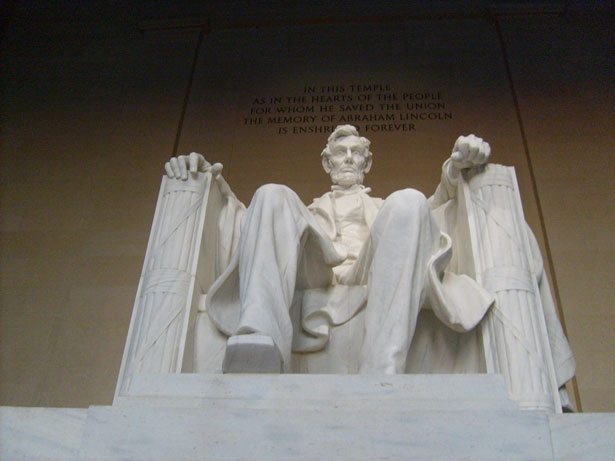
This is how most Americans see America’s 16th President. But, in reality, so much of what most of us “know” about Abraham Lincoln is not only untrue, but a mockery of the truth. Why does this matter? It matters because much of what is wrong with America today—and especially our out-of-control central government—can be traced back to Lincoln’s time and to Lincoln himself. For under the 16th President, the United States not only suffered a catastrophic war, but an equally or even greater catastrophic afterward which resulted in the creation of an entirely different nation than that created by the Founders.
Educating people about Lincoln and the War of Secession runs into difficulties because of our politically correct revisionist “history” which reduces a matter of great complexity to the issue of slavery.
- Everything is determined through the lens of chattel slavery of blacks in the South.
- Nothing matters but chattel slavery of blacks in the South.
- All was motivated by chattel slavery of blacks in the South.
- Any judgments regarding the actions of both sides cannot and must not be determined by any criteria other than that of chattel slavery of blacks in the South.
Of course, the problem here is that this is historical and intellectual nonsense.
Furthermore, Lincoln’s refusal to accept secession had nothing to do with the Constitution or chattel slavery of blacks—though he dearly wanted Americans to believe such was the case—but with a concept not of union but of government that led to all that followed. Therefore, arguing the constitutionality of secession is pointless since that was not the basis upon which Lincoln acted. And if this is, in fact, the case, what is it that Lincoln believed that set him upon the path of total war and all that came afterward? We begin to understand his thinking in an statement made in his First Inaugural Address:
“I hold, that in contemplation of universal law, and of the Constitution, the Union of these States is perpetual. Perpetuity is implied, if not expressed, in the fundamental law of all national governments. It is safe to assert that no government proper, ever had a provision in its organic law for its own termination.”
Lincoln’s understanding of the nature of the federal government and its relationship both to and with the States is expressed in a November 20th 1863 letter in which he reiterates the doctrine he and many of like mind believed regarding the undefined and absolute primacy of the central government to that of the States.
“The point that was made against the theory of the general government being only an agency whose principals are the States … is one of the best arguments for the national supremacy.”
In other words, the “national government” in its relationship to the states is supreme without limits or restrictions! This is hardly a “constitutional construction” of the arrangements, but once understood makes all else that comes after comprehensible.
And there were other men who understood this new role of what had formerly been a circumscribed federal government acting with the consent of the sovereign states and – even more important! – their citizens. They knew that with the rise of the Enlightenment, a new religion had entered into the culture and politics of the West and became very important as that period went on. This was the religion of Humanism, a “faith” (for it was certainly not held by virtue of any “science”) that rejected traditional Christianity and embraced the worship of Man as the ultimate power in the Universe. However, this was not Man as the individual or even Mankind, but Man as the State! This was the creed of the French Revolution whose adherents threw down not just the monarchy and the aristocracy, but the Catholic Church! And this worship of “government” that Lincoln revealed in many of his utterances was the driving force behind what some have called our own American–French Revolution!
But there were others who understood this new god and recognized its existence as well as its place in the War of Secession. Generals Thomas Jackson and William Tecumseh Sherman were among them. Speaking of waging the war against the Union under the black flag, Jackson—a devout Christian—intoned:
“I myself see in this war, if the North triumph, a dissolution of the bonds of all society. It is not alone the destruction of our property…, but … the prelude to anarchy, infidelity, and the ultimate loss of free responsible government on this continent. With these convictions, I always thought we ought to meet the Federal invaders … and raise at once the black flag … “No quarter to the violators of our homes and firesides!” It would … have proved true humanity and mercy. The Bible is full of such wars, and it is the only policy that would bring the North to its senses.”
On the other side of this issue, another true believer William Sherman declared what should be the fate of those who opposed this new God of Government:
“To the petulant and persistent secessionists, why death is mercy, and the quicker he or she is disposed of the better. Satan and the rebellious saints of Heaven were allowed a continuous existence in hell merely to swell their punishment. To such as would rebel against a Government so mild and just as ours was in peace, a punishment equal would not be unjustified.”
Here are two men who understood the War’s underlying religious nature. The so-called Civil War was a religious war – a jihad if you will – and all that followed is made comprehensible only by acknowledging the underlying situation extant at the time.
However, for those who believe that Abraham Lincoln acted or intended to act according to the United States Constitution, let us look at his actions and see if those beliefs are valid.
On June 17th, 1858, Lincoln gave a speech at the State Capitol in Illinois. It is one of the most well-known speeches of a man famous in no small measure because of his oratory. What Lincoln said became renowned as a warning regarding the state of the nation at that time. Quoting a Book in which he did not believe, the candidate stated:
“A house divided against itself cannot stand. I believe this government cannot endure permanently half slave and half free…It will become all one thing or all the other.”
Everyone—then as now—believed that Lincoln was warning against the “slaveocracy” of the South taking control of the government and spreading slavery into the North, an idea that terrified Northerners—bringing the African into what were then virtually all-white states and territories was their greatest fear. But the South had become, by virtue of slavery itself, politically impotent and no more able to seize power than it was able to free itself of Northern hegemony.
As well, the nation had existed since its inception with slavery, both white and black. Indeed, the first slaves sent to both the West Indies and the American colonies, were Irish! And though the institution was mostly (but not completely) abolished in the North, its retention in the South caused very little disharmony among the vast majority of Americans. Indeed, the economic wealth of the South, rising from the use of slave labor, was responsible for the growing wealth of the North through tariffs. Certainly, there were abolitionists but they were not a powerful influence. As long as the money flowed northward, abolitionists were ignored in the North though they were feared in the South for their attempt to foment servile insurrection.
Now, it was true that by Lincoln’s time the government could not long endure the way that matters stood. But the problem was not slavery, but two diametric and irreconcilable concepts of nationhood, a problem that had become ever more divisive since the establishment of the union. And it was this “division” that Lincoln wanted most desperately to “cure” albeit with his viewpoint triumphant. Nothing, could be allowed to weaken or destroy the federal government and that included secession. Whatever had to be done to prevent or cure such an action must be done, the Constitution notwithstanding! And as for the Constitution, the President before Lincoln, James Buchanan – a Southerner who rejected secession – asked his Attorney General, Judge Jeremiah Black to find him a constitutional means to prevent the Southern States from seceding or to legally force them back into the union had they already done so. Black worked assiduously but was forced to inform Buchanan that no such constitutional power was available to either himself as President or any other branch of the Federal Government. The most pertinent words from Black’s opinion are found in section 6 wherein he states:
“There was undoubtedly a strong and universal conviction among the men who framed and ratified the Constitution, that military force would not only be useless, but pernicious, as a means of holding the States together.”
Therefore, as the secession of Southern states in 1860 and 1861 was neither unconstitutional nor in any other way illegitimate; and as the Confederate States of America did not invade the United States of America, the right of the government to use the military to supposedly defend itself against an invasion by a foreign power did not justify Lincoln’s call for 75,000 troops to force the seceded states back into the Union.
However, on the other hand, the Southern States rightly believed that the federal government had rejected the constraints placed upon it by the Constitution and expanded its powers far beyond its “enumerated limits.” The majority of the people of the Southern States, having left the British Empire because of the tyranny of the King, concluded after a long series of political crises during the first half of the 19th Century, that the Federal Government by 1861 had become King in all but name and, as such they were determined to exercise their right to remove themselves from its control via secession, a recognized recourse under the Constitution.
Lincoln and his Party – and many in the North who needed Southern money to support their own economies – understood that they had to do more than just defeat secession. They had to conquer and subjugate the people of the South and establish a new constitutional order in place of the old—an order in which the Federal Government moved from a position of limited, enumerated Constitutional powers to one in which that government was perpetual, indivisible, dominant and exalted as “sacred. Thus, the aim of the war—and we shall see that Lincoln begins his presidency promising “civil war” upon any State attempting secession—was that Lincoln, acting as Chief Executive and Commander in Chief, would create a supreme National Government with the potential to exert almost unlimited authority. But such a design required a massive re-structuring of the national will, a change which meant that the South—unwilling to accept such a concept—could not just be defeated in war! As a force within the nation, it had to actually be destroyed, its culture demonized, its economy desolated and its political will broken so thoroughly that there would never again be any challenge to Federal domination over the States.
Adam Badeau, a member of Grant’s staff and present at Appomattox, wrote later:
“It was not victory that either side was playing for, but for existence! If the rebels won, they destroyed a nation; if the government succeeded, it annihilated a rebellion.”
Badeau was more than half wrong. First, the nation would have survived Southern secession just as it would have survived the secession of the New England States contemplated years earlier. Neither did the South wish to “destroy” the United States, but merely to leave. Badeau then uses an interesting word to describe the agent of victory. Most of us would refer to the Union or the country or the nation, but Badeau says “…if the government succeeded…” You will see this concept throughout our study of Lincoln and the Constitution; that is, the identification of that which is being advanced and protected. Not the country or the nation or even the Union but the government. And according to Badeau, it didn’t just “overcome” a rebellion, it annihilated it.” Annihilate is an interesting word. It’s first definition in the dictionary is to destroy something so completely that it ceases to exist. This is not just defeat in war as Europe had waged since the Enlightenment, this was the type of war that was waged by the Vikings or the Mongols—war in which whole regions were depopulated for generations. But we will speak more of this on the topic of Total War.
The word “treason” was much used before, during and after the war but few people even now know the constitutional definition of treason as found in Article III, Section 3:
“Treason against the United States, shall consist ONLY in levying War against them, or in adhering to their Enemies, giving them Aid and Comfort.”
As the definition of treason is “making war upon them,” “them” being the States, let us hearken back to Lincoln’s First Inaugural Address. In it, he refers to those Southern States that had already seceded from the Union or were considering doing so:
“In your hands, my dissatisfied fellow-countrymen, and not in mine, is the momentous issue of civil war. . . You have no oath registered in heaven to destroy the Government, while I shall have the most solemn one to preserve, protect, and defend it”
Notice two things: Lincoln speaks of taking an oath to defend the government. But actually, the oath found in Article II, Section 1 of the Constitution states as follows:
“…I do solemnly swear that I will faithfully execute the office of President of the United States, and will to the best of my ability, preserve, protect, and defend the Constitution of the United States.”
Nowhere does the word “government” appear in that oath! Lincoln swore to uphold the Constitution, not the “government! And as we shall learn later, he entered his office already prepared to sacrifice the Constitution for his idea of protecting the government.
Then, Lincoln states unequivocally that any attempt at secession will result in civil war. Now, civil war is a war between two factions vying for control of a nation. But the States of the South wished only to leave the old union and create a new one more favorable to the needs of its people. For by 1860, the Southern States were in permanent economic and political subjugation and being reduced yearly into greater and greater poverty despite producing more economically than most of the rest of the Union combined. This situation was identified by Missouri Senator Thomas H. Benton in 1828 three decades before the Cotton States acted to escape political and financial servitude. Benton, speaking on the floor of the Senate stated:
“Before the (American) revolution [the South] was the seat of wealth … Wealth has fled from the South, and settled in regions north of the Potomac: and this in the face of the fact, that the South, … has exported produce, since the Revolution, to the value of eight hundred millions of dollars; and the North has exported comparatively nothing. … Under Federal legislation, the exports of the South have been the basis of the Federal revenue …Virginia, the two Carolinas, and Georgia, may be said to defray three-fourths of the annual expense of supporting the Federal Government; and of this great sum, annually furnished by them, nothing or next to nothing is returned to them, in the shape of Government expenditures. That expenditure flows…northwardly, in one uniform, uninterrupted, and perennial stream. This is the reason why wealth disappears from the South and rises up in the North. Federal legislation does all this!”
But whatever the reasons for secession—and they were many—Lincoln saw them as an attempt to, in his words, “destroy the government” and the destruction of the government—not the destruction of the nation or even the Union, becomes the mantra throughout the war—and even after. And it is to prevent the destruction of the government that all of Lincoln’s actions address. He promises—and initiates—war for that purpose. Lincoln’s motives do not change or mitigate his actions—that is, to wage war in the name of the “government” upon the states of the South. And since the federal government is not a state but a creature of the Constitution which itself is a creation of the States and voted into existence by the States—upon some of whom Lincoln was now waging war—a more clear definition of treason cannot be found. And not only was Lincoln and his government guilty of treason, but so was every person, and every state in the Union that bore arms giving aid and comfort to his treason.
Lincoln refused those restraints which the Constitution placed around and upon his “government” because to his mind the federal—now national—government was the repository of all power and answerable to no one, certainly not the States. And this mindset was never seriously contested by members of the other two branches of government. Thus strengthened, Lincoln went forth to initiate, sustain and triumph in the most bloody and brutal war ever fought by the United States and in so doing, his constitutional crimes were many and grievous:
As President-elect, he planned and carried out a “false flag” action against the government of South Carolina and the newly constitutionally created Confederate States of America in direct violation of both the Constitution and the accord reached between outgoing President Buchanan and that State not to attempt to rearm and send troops and supplies to the federal fort in Charleston. We know this from his correspondence with various people involved in the matter. His own Cabinet violently disagreed with the President’s intentions referable to Sumter, stating that his actions would be correctly seen as a declaration of war by the Confederacy.
As President, he declared war on those States that had seceded from the Union. But the Constitution gives the power to declare war only to the Congress! Article I, Section 8 states that Congress is able: “To declare War…; To raise and support Armies. . .; To provide and maintain a Navy; … according to the discipline prescribed by Congress…”
He suspended habeas corpus, another power relegated to Congress alone in Article I; Section 9 on the duties of the Legislative Branch. Habeas corpus can be suspended, but only by Congress. Needless to say, Congress was not consulted on the matter.
He used the military to control the election of 1864, sending soldiers to vote where they did not reside and using them at the polls to intimidate voters, something that was facilitated by the use of colored ballots indicating the voter’s intentions before his vote was cast. Gen. Butler telegraphed Lincoln from New York City declaring that not one Democrat had voted there.
He established martial law in States within the Union and areas that were not in a war zone. He suspended civil rights to what he termed “military necessity” as was stated in a letter of August 9th, 1864: “Nothing justifies the suspending of the civil by the military authority, but military necessity, and of the existence of that necessity the military commander … is to decide.” In other words, if you think it necessary to suspend the God-given constitutionally guaranteed liberties of Americans, be my guest.
He authorized the trial of civilians by military tribunals in areas that were not war zones; this practice was continued even after the war. Consider the trial of his assassins which was military in nature, though none being tried were in fact in the military or charged with acting as members of the military.
He gave his blessing to the waging of war contrary to those rules of war in place at that time in the “civilized world,” a strategy which intentionally targeted civilians and non-combatants and involved the destruction of the enemy’s way of life, his culture, his history and his identity; that is, what today we would call “cultural genocide.”
He created the State of West Virginia, from territory legally part of the State of Virginia contrary to the constitutional requirement of the approval of the State, from which territory is taken to make any new State.
And these are only a few of the actions taken by Lincoln that were contrary to both the spirit and the letter of the Constitution and which rendered that document null and void not only in those states of the South … but in those which remained. Indeed, between what Lincoln did during the war and what his government did after his death, the Constitution has never recovered.
Above is a political cartoon carried in a Northern newspaper [and you thought that today’s political cartoonists were savage!]. The cartoonist has managed to place in his work, a very clear, accurate and comprehensive image of Lincoln’s administration and I present it to you as a sort of illustrational short-hand.
The most important point made in the cartoon is expressed in the words emanating from the mouth of the Lincoln figure: “Necessity is my only law!” This was Lincoln’s only creed. He saw himself as the Savior of the government and did not bother to consider whether or not the efforts he made to save the nation might indeed be fatal to it. In this, I am reminded of another old saying, “The operation was a success—but the patient died.”
Beneath Lincoln’s feet we see being trampled both habeas corpus and “freedom of the press.” Now let us remember that habeas corpus goes back to the Magna Carta. It ended the right of kings to arrest and imprison their enemies without consequence for it required that any person so detained—within a reasonable period of time—had to be charged with a crime and permitted recourse to law. So egregious was Lincoln’s trespass against this fundamental right of Western Civilization, that a book written in 1869 by John Marshall was entitled The American Bastille, a reference to the notorious French prison which became a by-word for government tyranny. In this book are the accounts of only a very few of the tens of thousands so imprisoned and we find that these men and women were subjected to not just arrest and imprisonment but suffering, exposure, starvation, torture, humiliation and the theft of their property and sometimes their lives. It would seem that the method of warfare used against the South was not limited to that region but was also practiced against American citizens in the North who disapproved of Lincoln’s actions.
The second right trampled underfoot is Freedom of the Press which is part of First Amendment of the Bill of Rights. Very briefly, the Amendment states:
“Congress shall make no law respecting an establishment of religion, or prohibiting the free exercise thereof; or abridging the freedom of speech, or of the press; or the right of the people peaceably to assemble, and to petition the Government for a redress of grievances.”
Under Lincoln, the entire First Amendment was rendered null and void. Of course, the Amendment speaks to laws created by Congress. But whether by Executive Order or by law, it is forbidden for the Government in, by and/or through any of its branches, to restrict religious observance, freedom of speech, freedom of the press or the right of peaceful assembly and petition. Yet all of the above were effectively suspended by Lincoln.
Lincoln’s treatment of Maryland was particularly egregious and included sending General Benjamin Butler to Baltimore where that worthy trained United States Army cannons on the City while Lincoln had various state leaders arrested and imprisoned to prevent the call for a vote on secession. When such a vote was eventually taken, it was overwhelmingly defeated as there were no pro-secessionists able or willing to vote “Yea!” under the circumstances.
As was usual with Lincoln, any publication that dared to challenge his war or criticize his actions was shut down and its editor arrested and imprisoned without charge. The grandson of the author of the Star Spangled Banner, Francis Key Howard, editor of The Exchange Newspaper of Baltimore, was arrested on the morning of September 13th, 1861 and taken to Fort McHenry. He later wrote:
“When I looked out in the morning, I could not help being struck by an odd and not pleasant coincidence. On that day forty-seven years before my grandfather, Mr. F. S. Key, then prisoner on a British ship, had witnessed the bombardment of Fort McHenry. When on the following morning the hostile fleet drew off, defeated, he wrote the song so long popular throughout the country, the Star Spangled Banner. As I stood upon the very scene of that conflict, I could not but contrast my position with his, forty-seven years before.”
Howard was correct. The tyranny against which Americans had fought in 1776 had not been defeated, but merely changed in person and place from a tyrant 4,000 miles away to a tyrant in their own backyards.
And what about Lincoln and his Administration’s effect on religion? Well, there are countless stories of clerics who were ordered–not asked—to pray for the President and not just for his health or his immortal soul, but for the furtherance of his war. This was demanded by the military of religious leaders both in the North and in the South and when it was not forthcoming—especially in occupied areas in the South—the pastor was arrested and the church closed. Worse, during the war, the churches in the South were a particular target for destruction as a means of inflicting cultural death upon the section. This crusade—fully as awful as any waged by the Ottoman Turk or the Nazis and Communists of the last century—must stand as proof that Lincoln violated even this seemingly militarily neutral section of the First Amendment. Indeed, freedom of any kind was in short supply during the War of Secession. There was a pervasive malignant atmosphere of suspicion and betrayal that silenced even the most benign dissent by the most honorable of dissenters.
We must now return to our artist and see what else he provides. Oddly, the only reference in the cartoon to the slave—despite what we are told is his importance—is the game Lincoln plays with him. A cherry labeled the Emancipation Proclamation is dangled over the tiny figure’s head and he reaches for what he believes is the fruit of liberty; the stick on which it dangles carries the words, “MY WILL IS LAW” which was certainly true. But does the Emancipation actually represent liberty? It freed no slaves. Those given their “freedom” were not in any territory over which Lincoln had control while those living in the Union were exempt.
Finally, two illustrators demonstrate the nature of the men with whom Lincoln surrounded himself. Indeed, the slave is more a man than Secretary of State, William Seward who appears in these two images, first as a mere extension of the Goblin King’s tail and secondly as a mere hand. Yet, despite being nothing more than an appendage of his master or a single body part, Seward performs unconstitutional atrocities from the other end, so to speak. From Seward’s mouth comes a paraphrase of his infamous comment to Lord Lyons, British envoy to the United States for much of the War:
“My Lord, I can touch a bell on my right hand, and order the arrest of a citizen of Ohio. I can touch a bell again, and order the imprisonment of a citizen of New York; and no power on earth, except that of the President, can release them. Can the Queen of England, do so much?”
In the image from the original cartoon, Seward’s “bell” is connected to telegraph lines showing the speed with which tyranny spreads in Lincoln’s new America. The clapper of the bell is a mask symbolic of the deceit hiding the true nature of Lincoln’s government while Lincoln’s government is itself a mask for Lincoln.
A great deal of Lincoln’s fame is based upon his gift for language. 20th century literary giant H. L. Mencken, pointed out that Lincoln went from being a back-bench political hack to a statesman when he cultivated his powers as a wordsmith. But it must be remembered that Lincoln’s words were crafted for his audience. Though he did have deeply held beliefs, there was no way to know if what he was saying of the moment included any such; indeed, his motives were always in question. For instance, Lincoln’s utterances are liberally sprinkled with references to the Divine, to Scripture and to Christianity. Yet, he held that religion in contempt. He often spoke of “universal law” despite the fact that no such law existed to which he could actually refer and even if it had, there would have been no understanding of its primacy referable to the Constitution.
Many of the sublime phrases with which the name of Lincoln has become synonymous are outright lies. For instance, his Gettysburg Address—perhaps the most perfect speech ever given in the English language—is filled with contradictions. It was not the federal army fighting for government of, for and by the people, but the armies of the Confederacy which fought for limited government, the consent of the governed and states’ rights. And it is hard to equate “…with malice towards none and charity for all…” with Lincoln’s plan to subjugate the South which began with a war of extermination and was followed by military occupation together with Radical Republican thugs, corrupt carpet-baggers and the Union League—Washington’s very own Ku Klux Klan—designed to make of that section an eternal stronghold for his party. Such plans indicate a considerable amount of malice and damned little charity for the people of the South white and black.
Here are some quotes from Lincoln referring to the Constitution. While many of these sound orthodox, his sentiments—like his much-vaunted General Order 100—are filled with caveats and admissions that, in the end, he would do whatever was necessary rather than constitutional.
“Don’t interfere with anything in the Constitution. That must be maintained, for it is the only safeguard of our liberties.”
Lincoln’s only concern was that the Constitution would interfere with him and hence, he was determined to ignore it from the outset.
“We the people are the rightful masters of both Congress and the courts, not to overthrow the Constitution but to overthrow the men who pervert the Constitution.”
Here Lincoln speaks of himself in terms of the royal “we,” but he alone is “master” which he proved by virtually nullifying the other branches of government. And while Lincoln assures his listeners that he only intends to “overthrow the men who pervert the Constitution,” he neglects to point out that he is chief among them.
“Must a government, of necessity, be too strong for the liberties of its own people, or too weak to maintain its own existence?”
In a rhetorical question, Lincoln sets up a false dichotomy, validating his treason by presenting it as the only means by which the country can be saved.
“The dogmas of the quiet past, are inadequate to the stormy present. The occasion is piled high with difficulty, and we must rise with the occasion. As our case is new, so we must think anew, and act anew. We must disenthrall ourselves, and then we shall save our country.”
Lincoln sees the Constitution as “inadequate” for the “stormy present”—a present he made stormy—and validates his chosen course by speaking about “disenthralling ourselves”—that is, throwing off the yoke of constitutional limitations. This particular statement in his December 1st, 1862 Annual Message to Congress is Lincoln’s version of Orwell’s “new think.”
“Can this government stand, if it indulges constitutional constructions by which men in open rebellion against it, are to be accounted, man for man, the equals of those who maintain their loyalty to it?”
Again, Lincoln excuses an unconstitutional act—the creation of West Virginia and its admission into the Union—by calling into question the patriotism of those who oppose it. He points out that those who support the government—again, not the Constitution—are “loyal” while those who disagree are “rebels” and “insurrectionists” intent upon destroying it. But the Constitution says nothing about motives or the government. An act is constitutional or it is not; it stands and falls by no other criteria.
“…I must save this government if possible. What I cannot do, of course, I will not do; but it may as well be understood, one for all, that I shall never surrender this game leaving any available card unplayed.”
Lincoln writes to Reverdy Johnson, on July 26th, 1862 assuring him that he will not to do what the Constitution forbids him doing—but then he turns around and assures Johnson that he intends to do whatever he has to do to “save this government.” Part B clearly revokes Part A.
Lincoln’s intention to destroy the Constitution is confirmed in his letter to Albert G. Hodges on April 4th, 1864:
“Was it possible to lose the nation, and yet preserve the constitution? By general law life and limb must be protected; yet often a limb must be amputated to save a life; but a life is never wisely given to save a limb.”
Lincoln implicitly believes that the nation cannot be saved through adherence to the Constitution and therefore it is better to “save the nation” by abandoning it. He embraces the Hobbesian philosophy that the ends justify the means. Of course, in the loss of the Constitution, the nation also is lost—at least as it was conceived by the Founders.
In his letter to Edward Everett, Lincoln also wrote what apparently was supposed to be a sort of constitutional homily on right behavior, behavior from which he exempted himself:
“Continue to execute all the express provisions of our national Constitution and the Union will endure forever – it being impossible to destroy it, except by some action not provided for in the instrument itself.”
There is a modicum of truth in this for Lincoln’s actions were not provided for in the instrument itself and did in fact destroy the Union created in 1776—replacing it with an Empire ruled by a supreme central authority.
In a letter of July 12th, 1863, Lincoln addressed concerns about the many arrests and imprisonments of those who disagreed openly with his actions. To a New York Convention he wrote:
“The resolutions quote from the constitution, the definition of treason; and also the limiting safe-guards and guarantees therein provided for the citizen, on trial for treason, and on his being held to answer for capital or otherwise infamous crimes…But these provisions of the constitution have no application to the case we have in hand, because the arrests complained of were not made for treason—that is not for the treason defined in the constitution…nor yet were they made to hold persons to answer for any capital, or otherwise infamous crimes; nor were the proceedings following, in any constitutional or legal sense, ‘criminal prosecutions’. The arrests were made on totally different grounds, and the proceeding following, according with the grounds of the arrests.”
This is a rather spectacular example of Lincoln’s ability to parse words. He assures the Convention that nobody was being arrested for real treason as defined by the Constitution, but the arrests and all that followed had been made “on totally different grounds”—grounds which Lincoln refuses to identify. This has the same moral, ethical and legal value of a modern President’s response to another difficult question: “It all depends upon what the meaning of ‘is’ is.” And we can be sure, that both statements were made for the same purpose; to obscure, protect, excuse and justify criminal activities by a President and his government.
Going back to his First Inaugural we look again at Lincoln’s attempt to establish the concept of perpetuity.
“I hold, that in contemplation of universal law, and of the Constitution, the Union of these States is perpetual. Perpetuity is implied, if not expressed, in the fundamental law of all national governments.
If Lincoln had not been a lawyer and unfamiliar with the Constitution, perhaps some excuse could be made for this statement, but as he was both, the only conclusion we must reach is that his ambition was greater than his honesty. For four centuries prior to the Constitution, English common law held that there was no such thing as a contract in perpetuity. True, the Articles of Confederation spoke of a “perpetual union,” but the Constitution deliberately did not—and neither was it implied. Therefore, any contract—which is what the Constitution was—cannot be considered perpetual, simply by adding the word “perpetual”—as in the Articles—or the phrase “implying same,” as did Lincoln. I can call a bull a butterfly, but that doesn’t make it one.
In conclusion, Abraham Lincoln came into office with an agenda involving a total restructuring of the government of the United States. Obviously, such an agenda required a total disregard of the Constitution. From the time of his election, he was in contact with, among others, General of the Armies, Winfield Scott concerning any response available to the government referable to the secession of the Southern states. He was asking—and receiving—advice on his options under various circumstances once he assumed the office of President and, as we have seen by his sentiments expressed in his first inaugural address, those actions included a plan to initiate war against any state that attempted to leave the Union—a clear act of treason. This was not a man who suddenly found himself in an untenable position and had to scramble as best he could to deal with circumstances that even a Solomon would find challenging.
As previously noted, Lincoln was a lawyer. He knew the Constitution, what it said, what it meant and what it stood for and he understood that which, as President, he was—and was not—permitted to do. However, it is also apparent that what he wanted, and in fact, would do as President required him to violate that document and render it ineffective as the Law of the Land! But, for Abraham Lincoln, that didn’t matter. For him, might made right, the ends justified the means and he was willing—nay eager—to do anything and everything necessary to triumph. In the end, he was successful, but his success led to the creation of a new nation and a altered government based upon his own understanding of and desire for, both.
A lot of tributes have been paid to Lincoln over the years, but the most accurate one comes from the pen of a Northern historian by the name of Dr. Jay Hoar. Though Dr. Hoar does not mention Lincoln by name, his conclusions are directly referable to the man:
“The worst fears of those Boys in Gray are now a fact of American life—a Federal government completely out of control.”