

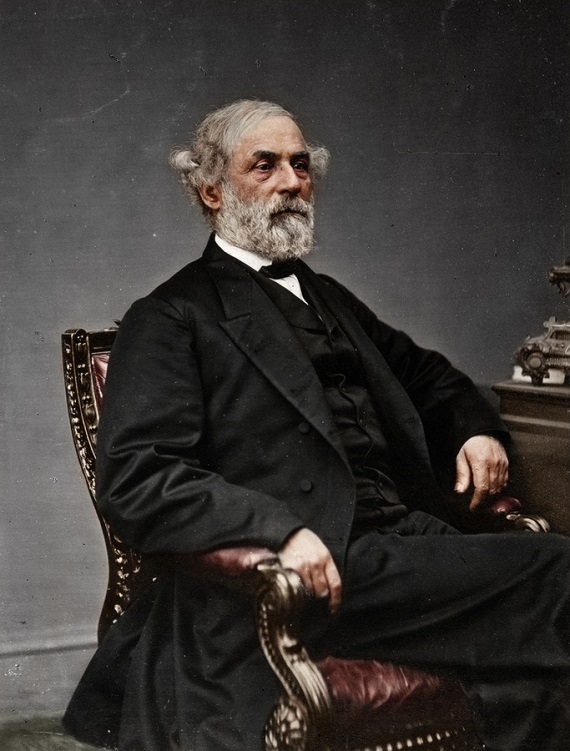
Robert E. Lee did not play an instrument. That single fact, set beside the musical lives of Thomas Jefferson, Patrick Henry, and Jefferson Davis, requires a moment of careful consideration, because it does not mean what it first appears to mean. Jefferson submitted himself to decades of violin practice, treating musical discipline as inseparable from intellectual formation, and understanding that an educated man was expected to participate directly in the arts rather than observe them from a distance. So did Henry, playing fiddle as an extension of his unique personality. Davis, like Lee, never played, but music moved through his life at every critical juncture, from the voice of his dying first wife singing their courtship song through a Louisiana sickroom wall, to Varina’s starvation parties holding civilization together by the thread of fiddle and piano, to Winnie playing the Knabe at Beauvoir in the quiet evenings of his old age. In both cases, music was woven into the fabric of who they were. Lee’s position in that same Southern tradition was shaped by a different kind of relationship with music: not the performer’s relationship, and not the man whose life music moved through as grief and consolation, but the father’s and husband’s relationship. Lee was the man who shaped the conditions under which music could flourish in his house, who paid close attention to it in his children, and who understood, without ever needing to state it plainly, that an evening with music in it was an evening worth having.
To understand the musical world Lee inhabited, it is necessary to go back a generation, because the house he married into was already saturated with music long before he arrived in it. Arlington House was built by George Washington Parke Custis, Lee’s father-in-law, between 1802 and 1818. Custis had been raised at Mount Vernon as the step-grandson of George Washington, and he carried that inheritance into every corner of his household. Music at Mount Vernon had been a serious matter. Martha Washington’s grandchildren were trained on keyboard instruments, violin, flute, and guitar, and Custis himself later recorded the memory of his sister Nelly being made to practice at the harpsichord under their grandmother’s strict supervision for long hours, playing and crying in equal measure. That kind of disciplined musical culture was an expectation. When Custis built Arlington and filled it with Washington relics and Washington memory, the musical habits of the household he had grown up in came with him. The house Robert E. Lee married into in 1831 was already, by inheritance and cultural reflex, a musical one.
Lee’s wife, Mary Anna Custis Lee, was the only child of that household and received its full formation. When Lee came to Arlington as a young Army officer and then as a husband, he entered a domestic world in which music was a continuous presence. Lee himself was not musical and did not add any music to the house, but what he contributed was something different: a father’s attentiveness, a husband’s steady encouragement, and an understanding of music’s place in the formation of character that expressed itself most clearly in the way he raised his children.
That expression is documented most clearly in his letters. The Lees had seven children, three sons and four daughters, and the daughters in particular received musical training as a matter of course. Lee’s correspondence with them reveals a father who tracked their progress with genuine interest and pushed them with genuine expectation. Writing to his daughter Mildred during the years of his Army postings away from home, he told her plainly that he was “very glad to hear of your interest and progress in music” and hoped her “proficiency will keep pace with your labor.” The phrasing is characteristic of Lee: warm enough to encourage, precise enough to set a standard. Proficiency was expected to follow from labor. He used that word specifically — not talent, not gift. In a letter to his youngest daughter Mildred, advising her about a new piano teacher, he was even more direct: “you will like neither the teacher or the subject unless you practice diligently and learn to play, well.” He then added the sentence that reveals the full shape of his thinking: “We are always fond of what we do well.” That is not a casual remark. It expresses his belief of how affection and discipline are related, applied specifically to music. Lee was a man who believed that loving an art requires earning the right to love it.
He also wrote Mildred from her boarding school years with a further expression of what he wanted her music to become: he wanted her to learn to play “well enough to take pleasure in your own performance… and to impart true pleasure to those who hear you.” The purpose was double — the pleasure of the player and the pleasure of the room. That is the front porch understanding of music, applied by a general and college president to his daughter’s piano lessons. Music was not for display, but was for the people gathered together.
The same letters that document his investment in his daughters’ musical education also reveal, in passing, the texture of musical life in the Lee household during the Arlington years. Mrs. Lee reported to acquaintances that young Mildred had “become quite a little woman” and “sings a great many songs.” The daughters took lessons, practiced at the piano, and were expected to advance. Music moved through the house as part of daily domestic rhythm. They were not being trained to give recitals and perform for audiences. They were being trained to carry music with them as a habit of living, which is the older and more serious purpose the parlor piano served in Southern households of that generation.
The war took everything. Arlington was seized by the Union Army in 1861, turned first into a military camp and then, with a decisiveness that can only have been intended as a message, into a cemetery. The Lees never went back. The musical instruments, the parlor, the domestic world that had organized itself around those evenings — all of it was gone. Lee spent the war years in the field, and his daughters spent them in motion, staying with relatives across Virginia and North Carolina, displaced and increasingly bereaved. His daughter Anne, known to the family as Gentle Annie, died of typhoid fever in North Carolina in 1862 at twenty-three years old. A staff officer found Lee in his tent, weeping over the letter that brought the news. Music in those years was only a memory of a world that no longer existed in any physical form.
When the war ended, Lee accepted the presidency of Washington College in Lexington, Virginia, and it was there, in the last five years of his life, that the musical life of the household reassembled itself in its final and most fully documented form. The college president’s house became a center of social life for the students and young faculty of Washington College and the Virginia Military Institute, and Lee’s surviving daughters — Mary, Agnes, and Mildred — were at the center of it. Callers came in squads, and the evenings were full. The organizing feature of those evenings, the activity around which the social life of the household gathered, was the piano.
The scene contemporaries recorded from Lexington is among the most vivid domestic portraits in Lee’s biography, and my absolute personal favorite. Evenings just before ten, Lee entered his outer parlor, where his daughters and their guests were chatting or singing at the piano. His next weapon was to move about the room and begin closing the window shutters, as his arrival was the signal for the gentlemen to make their good-nights. If one failed to take the hint, Lee sat down beside him and stared at him. Lee’s presence in the parlor was not that of a performer or an audience member but of a presiding figure, the quiet gravitational center of the household, who entered the room where music was being made as its natural authority. He was there because the evening was his, and the music was part of the evening.
He was fond of his youngest, Mildred, with an openness that surprised those accustomed to his public gravity. “Where is my little Miss Mildred?” he would call when he came home at the end of the day. “She is my light-bearer, the house is never dark when she is in it.” That she was the most musical of the daughters — the one whose singing had been noted since childhood, the one who practiced at the piano in those Lexington evenings — is probably not coincidental. Lee could not produce music himself. Mildred could, and did, and her father named what she gave the household in the plainest possible terms.
The Lexington years also produced one of the more unexpected encounters in Lee’s domestic biography. In September 1869, a Swiss painter named Frank Buchser arrived in Lexington. He had been sent by the Swiss government to produce a large painting of the American Civil War for display in the Swiss Parliament — a commission he never completed — but during his years in the United States he had painted portraits of Andrew Johnson and William Tecumseh Sherman, and he wanted to paint Lee as well. Lee, to the surprise of observers, took an immediate liking to the free-spirited and flamboyant Buchser, which may have been a case of opposites attracting. Lee refused to pose in his Confederate uniform, insisting he was no longer a soldier, but agreed to pose with the uniform on a table behind him. Mary, Agnes, and Mildred were thoroughly charmed by their visitor, and a significant part of Buchser’s appeal was musical: he played piano and guitar and sang in six languages. The evenings during Buchser’s stay were, by all indications, uncommonly lively.
The last musical scene in Lee’s life is the most specific and the most haunting. In the autumn of 1870, his health declining, Lee sat in the parlor while Mildred played Mendelssohn’s “Funeral March” on the piano. He smiled at her and said, “Life, that is a doleful piece,” then kissed her and went out into the rain, wearing a cape. That night Mildred and Agnes rubbed his hands and tried to get him to take medicines. He declined. Within two weeks he was dead. The last music he heard in his own house was his youngest daughter playing a funeral march, and he met it with a smile and an affectionate word before walking out the door. It is the kind of moment that biography rarely manages to preserve: specific, unguarded, and final.
Lee died in October 1870, five years after the war ended. The household that had gathered around him in Lexington — the daughters, the callers, the evenings of singing at the piano, the shutters being closed as the signal that the evening was done — dissolved in the years that followed. Agnes died in 1873. Mrs. Lee died within the month. Mildred, who had been his light-bearer, lived on in increasing loneliness, writing years later that “most women when they lose such a Father replace it by husband and children. I have had nothing.” None of the daughters ever married. Mildred found she could not bear to ride a horse after her father died, and did not even want to visit Traveller in his stall. The music that had filled those Lexington evenings had been organized, in some essential way, around the man who entered the room just before ten and whose presence gave the whole occasion its meaning.
What this amounts to, finally, is a portrait of Southern musical culture operating through a man who was not himself a musician. The tradition didn’t require him to play, but it required him to understand that music was part of what a household was, and that daughters were to be trained in it with the same seriousness applied to any other discipline, Lee understood that evenings with music in them were evenings worth having, and that the man who presided over such evenings was responsible for the conditions that made them possible. Lee met those requirements not as a theory but as a practice — across the years at Arlington, through the long separations of his Army postings, in the Lexington parlor where the piano and the voices of his daughters filled the house until just before ten, and in that last rainy evening when he paused long enough to name the piece, kiss his daughter, and step outside.
The views expressed at AbbevilleInstitute.org are not necessarily those of the Abbeville Institute.








What a man.
I’ve always gotten chills thinking about him.