

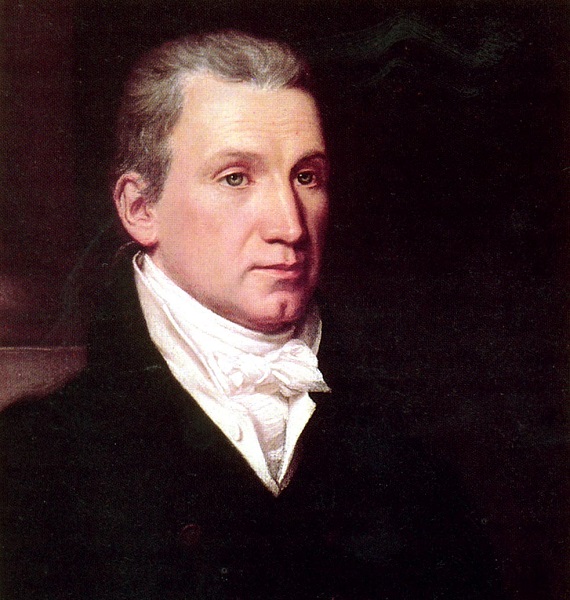
In his lengthy Seventh Annual Address to the US Congress—6354 words—President James Monroe offers an assessment of the state of the United States during the latter stages of his second term in office. The address—written by John Quincy Adams who often shows that he has his father’s DNA by wordiness, infelicity of grammar, and lack of clarity of expression in the document—begins with articulation of the need of a national policy, wise and transparent, vis-à-vis the American citizenry. He is speaking not just to Congressmen, but to Congressmen qua representatives of their constituents.
The people being with us exclusively the sovereign, it is indispensable that full information be laid before them on all important subjects, to enable them to exercise that high power with complete effect. If kept in the dark, they must be incompetent to it. We are all liable to error, and those who are engaged in the management of public affairs are more subject to excitement and to be led astray by their particular interests and passions than the great body of our constituents, who, living at home in the pursuit of their ordinary avocations, are calm but deeply interested spectators of events and of the conduct of those who are parties to them.
Thus, Monroe, in keeping with his Jeffersonian roots, opens with acknowledgement that in the US, it is the people, not the politicians, who are sovereign. Politicians, much more excitable than their disinterested constituents, are easily dissuaded from their task of representing the interest of the citizenry. Hence, it is essential that the US’s citizens be apprized of the most current and singular events concerning the Federal government.
Monroe then turns to fiscal affairs, and states that the country is fiscally sound, with a surplus of some nine million dollars by January 1824. Given a state of lasting peace, the US will be in position to pay off almost all its war debt by 1835. He then turns to the state of the US’s readiness to defend itself in the event of war, improvements in the US’ infrastructure, with a focus on uniting the Chesapeake Bay with the Ohio River by a canal.
Monroe soon turns to foreign policy.
A precise knowledge of our relations with foreign powers as respects our negotiations and transactions with each is thought to be particularly necessary [sic]. Equally necessary [sic] is it that we should [ask?] for a just estimate of our resources, revenue, and progress in every kind of improvement connected with the national prosperity and public defense. It is by rendering justice to other nations that we may expect it from them. It is by our ability to resent injuries and redress wrongs that we may avoid them.
Monroe is concerned about the interest of European nations in the Americas’ lands. He has sent ministers to England, France, Spain, and Russia to inquire about possible activities in the Americas. He has also sent ambassadors to the nascent states Colombia and Buenos Aeres and is about to send ambassadors to Chile and Mexico.
Toward the end of his address, Monroe limns his vision of the US’s relationship with European powers—what would later become known as the “Monroe Doctrine.”
The citizens of the United States cherish sentiments the most friendly in favor of the liberty and happiness of their fellow men on that side of the Atlantic. In the wars of the European powers in matters relating to themselves we have never taken any part, nor does it comport with our policy so to do. There is readiness for Americans’ use of arms only when “our rights are invaded or seriously menaced.”
The US’s relations with “the movements in this hemisphere” are a more immediate concern. The political system of the allied powers is essentially different in this respect from that of the Americas.
The states of America comprise freedom-loving peoples. Thus, Americans consider “any attempt on their [the nations of Europe] part to extend their system to any portion of this hemisphere as dangerous to our peace and safety.” The US has never interfered in the affairs of Europe and intends never to do so. It has also “declared [its] neutrality at the time of their recognition” of the new governments formed by Spain in the Americas. Yet certain “allied powers” deem it meet to interfere in the “internal affairs of Spain.”
Our policy in regard to Europe, which was adopted at an early stage of the wars which have so long agitated that quarter of the globe, nevertheless remains the same, which is, not to interfere in the internal concerns of any of its powers; to consider the government de facto as the legitimate government for us; to cultivate friendly relations with it, and to preserve those relations by a frank, firm, and manly policy, meeting in all instances the just claims of every power, submitting to injuries from none.
But in regard to those continents [North and South America] circumstances are eminently and conspicuously different. It is impossible that the allied powers should extend their political system to any portion of either continent without endangering our peace and happiness; nor can anyone believe that our southern brethren, if left to themselves, would adopt it of their own accord. It is equally impossible, therefore, that we should behold such interposition in any form with indifference. If we look to the comparative strength and resources of Spain and those new Governments, and their distance from each other, it must be obvious that she can never subdue them. It is still the true policy of the United States to leave the parties to themselves, in the hope that other powers will pursue the same course.
The relationship of the new governments with Spain is similar to that the Colonies had with England. There is a great ocean between Spain and the new governments and Spain has not the resources to “subdue them.” Yet Spain’s inefficacy is not an invitation for other European powers to fill the void and subdue the new governments. The US will not be indifferent to any such “interposition.”
Monroe’s belief is that if European nations stay out of the affairs of the Americas, then the new governments of South America will through a sort of natural inertia morph into the sort of republics that Jefferson ever envisaged. To illustrate, he shows how the US has prospered and expanded since 1776 through its policy of focus on its, not others’, affairs—roughly, political isolationism. The US population after the war was no more than three million. It is at the time of Monroe’s address some 10 million, and that increase was natural, not due to immigration. There is too the accumulation of a vast amount of territory.
Since then new territory has been acquired of vast extent, comprising within it many rivers, particularly the Mississippi, the navigation of which to the ocean was of the highest importance to the original States. Over this territory our population has expanded in every direction, and new States have been established almost equal in number to those which formed the first bond of our Union. This expansion of our population and accession of new States to our Union have [sic] had the happiest effect on all its highest interests.
Behind populational and territorial increases, there has been adoption of a Constitution, which has had the “happy effect in elevating the character and in protecting the rights of the nation as well as individuals.”
Not much was made of the address after it was given. Yet it came over the decades to be known at the Monroe Doctrine: Let the countries of Europe confine themselves to European matters and let American states develop their own interests, pursuant to their inclination to embrace freedom.
Prior to his address, Monroe wrote to Thomas Jefferson to discuss the US’s foreign policy
Jefferson replied on October 24, 1823. The matter, he said, was one to be handled with great gravitas.
The question presented by the letters you have sent me is the most momentous which has ever been offered to my contemplation since that of independence [sic] that made us a nation; this sets our compass, and points the course which we are to steer thro’ the ocean of time opening on our view. and never could we embark on it under circumstances more auspicious.
Jefferson’s intimation is that Monroe needs to address the issue of possible European encroachment in the Americas in a firm and unequivocal manner.
Monroe’s political mentor then goes on to articulate two axioms of any republican policy of the US.
our first and fundamental maxim should be, never to entangle ourselves in the broils of Europe; our 2d never to suffer Europe to intermeddle in Cis-Atlantic affairs.
These two Jeffersonian principles form the bedrock of “Monroe’s Doctrine” of his seventh annual address.
Why was Jefferson espousing such political isolationism?
Jefferson answers:
America, North & South, has a set of interests distinct from those of Europe, and peculiarly her own. she should therefore have a system of her own, separate and apart from that of Europe. while the last is laboring to become the domicil [sic] of despotism, our endeavor should surely be to make our hemisphere that of freedom.
Why does Jefferson believe that the newly forming states of the Americas, if left alone, will be freedom-loving?
Jefferson never says. Yet unlike Adams and Hamilton, he tended to think that humans were naturally freedom-loving—a thesis fully developed in my book “The disease of liberty”: Jefferson on History and Liberty.
There needed to be certain albatrosses put into place—e.g., readiness for war by constant threats of war or autocratic despotism—to keep people from enjoying the benefits of their natural disposition. The United States was on the right path, Jefferson thought. That is evident by his last known letter to Governor Roger Weightman (24 June 1826), where Jefferson declines an invitation by the governor to participate in celebration the fiftieth anniversary of the birth of the US>
Our fellow citizens, after half a century of experience and prosperity, continue to approve the choice we made. May it be to the world, what I believe it will be, (to some parts sooner, to others later, but finally to all,) the signal of arousing men to burst the chains under which monkish ignorance and superstition had persuaded them to bind themselves, and to assume the blessings and security of self-government. That form which we have substituted, restores the free right to the unbounded exercise of reason and freedom of opinion. All eyes are opened, or opening, to the rights of man. The general spread of the light of science has already laid open to every view the palpable truth, that the mass of mankind has not been born with saddles on their backs, nor a favored few booted and spurred, ready to ride them legitimately, by the grace of God. These are grounds of hope for others.
In short, Jefferson in his reply to Monroe, and in numerous other writings, is clear that liberty through republican principles of governing will flourish naturally in the Americas if they are kept free of the taint of European belligerency—hence the need of isolationism.
Enjoy the video below….
The views expressed at AbbevilleInstitute.org are not necessarily those of the Abbeville Institute.






I have always thought (I am a student of history and NOT a historian) that the deal on the MD was that the united States (yes, a small “u “) in conjunction with the British (and its navy, of course) would stay out of European affairs and European states would reciprocate. It seems like we blew that deal off a long time ago. But then a lot of truth was turned inside out at Appomattox. It just seems that ilk such as Fox News, et al never got the message.
Hmmm, so the “Monroe Doctrine” was actually the John Quincy Adams doctrine. Monroe just read it.
Quincy was a terrible writer. Read the document and notice its unclarity.