I am not a Southerner. Born and raised in northern Illinois, I enjoy crisp autumn weather, pristine blankets of snow, and I hate to sweat. I’m impatient, and small talk annoys me. Yet there are things about Southern culture that appeal to me. Southern Gothic literature, Edgar Allan Poe, the sway of Spanish moss and willows, and the way time seems to stand still in certain places. In the North, everything feels ephemeral. In the South, history permeates.
Prior to 2019, I experienced the South only in fits and starts, on vacations to Civil War battlefields, the Smoky Mountains, Florida’s sandy beaches, Beale Street, and the French Quarter. Contrary to certain negative stereotypes, I’ve always found Southerners tolerant of eccentricity and color—à la Midnight in the Garden of Good and Evil—with a celebration of public art and music, and a casual way of seeing the world distinctly different from where I grew up.
I didn’t know many Southerners. The only one I’d ever met in Chicago, my dad’s friend Sam, seemed ancient, at least in my adolescent mind. He had attended the prestigious St. Christopher’s School in Richmond, Virginia, and then Auburn University. He was one of a fading breed of old Southern gentlemen, with a voice I’d listen to even if he were reading the phone book. He was old enough to have seen the bones of Robert E. Lee’s horse, Traveller, mounted at Washington and Lee University.
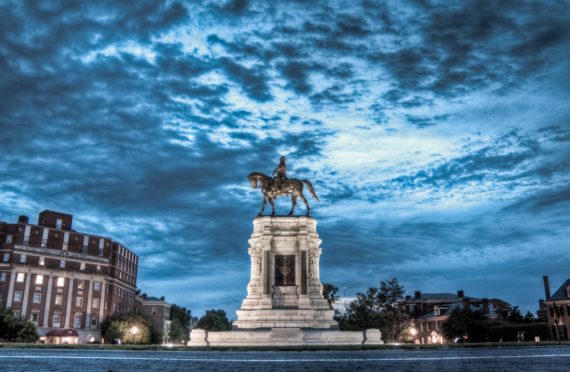
When my Army enlistment ended, I moved to northern Virginia for the same economic reasons as many others, excited to live in a part of the country I had previously only visited. I’ve been a Civil War buff since childhood, and in the mid-1990s my family and I toured northern Virginia’s battlefields down to Richmond. I remember that trip clearly because it occurred around the same time as the unveiling of tennis star Arthur Ashe’s statue on Monument Avenue. A lot has changed in the 23 years since.
One of the first things I did after moving to Virginia was take a Civil War tour of Alexandria. At the time, the Appomattox statue still stood at the corner of Prince and Washington Streets. Though occupied by the Union Army for nearly the entire war, Alexandria had been a major slave-trading hub and voted overwhelmingly for secession. Before the occupation, James W. Jackson, proprietor of the Marshall House, flew a large Confederate flag from its roof (the Stars and Bars, not the battle flag introduced later).
When the 11th New York “Fire Zouaves” marched into town, their colonel, Elmer E. Ellsworth, went straight to the Marshall House to remove it. Ellsworth, an Illinois native and friend of President Abraham Lincoln, was shot dead by Jackson while descending the stairs, flag in hand. Jackson was killed moments later. A modern hotel eventually rose on the Marshall House site, with a street-level plaque commemorating the event.
After purchasing the hotel, Marriott removed the plaque in 2017. Our tour guide said it was because the plaque recounted events “from the Southern point of view.” I’ll never forget that: “From the Southern point of view.” Weren’t we in the South?
Then, in the summer of 2020, came George Floyd’s death and the protests and riots that followed. Suddenly, anything with even a tangential connection to the Confederacy had to be renamed or removed from public spaces. Whatever the tragic circumstances of Floyd’s death, it occurred in Minneapolis, Minnesota, over a thousand miles from Virginia, and had nothing to do with the South, Virginia, or the Civil War.
It is no coincidence that much of this historical iconoclasm unfolded in northern Virginia. Portions of Lee Highway in Arlington and Fairfax counties were renamed. A marker on Fairfax Boulevard, commemorating the spot where Peyton Anderson became one of the first Virginians wounded in the war, was quietly removed. Jefferson Davis Highway became Richmond Highway. J.E.B. Stuart High School became Justice High. Dozens more streets and schools were renamed in Alexandria, Arlington, Fairfax, and Manassas.
On my way to a night class at George Mason University, I used to drive past the old Fairfax County Courthouse. On its lawn once stood an inconspicuous monument marking one of—if not the—first battles of the Civil War, where Capt. John Q. Marr of Virginia’s Provisional Army was killed. Surely that was something worth remembering? But in 2020, the marker, after 116 years of offending absolutely no one, was removed.
They say it is not about erasing history. Yet the Slave Auction Block at the corner of William and Charles Streets in Fredericksburg, a tangible, public reminder of slavery’s existence, had to go as well, though its removal was planned before 2020. The goal, as articulated by a member of the city council, was to rid the city’s main thoroughfare of this “relic of time gone by.” It was moved to a local museum’s basement, and an interpretive sign bearing its image was erected in its place.
Monuments, historical markers, and the commemorative naming of public spaces are all ways of carrying memory into the future. A historical street or school name is the expression of a particular people and culture and its connection with the past. Renaming changes that relationship and changes what receives public recognition.
Over the past forty years, thanks largely to the expansion of federal agencies, the population of northern Virginia has exploded. You would be hard pressed to meet anyone with a Southern accent living north of Fredericksburg along the I-95 corridor. A recent issue of Virginia History & Culture highlighted the state’s newcomers, calling them “new” Virginians.
Let me be clear: when I talk about Southerners, I mean people like my dad’s friend Sam, both white and black, whose families had lived in Virginia for generations—people with a distinct way of speaking and cooking, and with a perspective on the world shaped over centuries. Their ancestors fought in a rebellion against the federal government in the 1860s and later lived in a segregated society. All of which is very foreign to my own experience.
Today, however, over half of Virginia’s residents were born elsewhere, including 1.16 million born abroad. About two-thirds of the state’s immigrant population lives in Northern Virginia. Foreign-born residents make up at least 25 percent of the population in Loudoun, Fairfax, Prince William, and Arlington counties and the city of Alexandria. In Fairfax County, that figure exceeds 30 percent, with immigrants coming mainly from Asia, Central America, and the Middle East.
How many of these new Virginians know anything about the history, traditions, and culture of their adopted home? Or want to know?
My kids are more likely to develop a British accent watching Peppa Pig than they are a Southern drawl from their peers at school.
In the 2024–25 school year, nearly half (47.59 percent) of Fairfax County public school students were of Asian or Hispanic descent. FCPS reports that its students speak as many as 194 languages at home. When local news channels highlighted students petitioning to rename their schools, those featured were not black Americans whose ancestors had been enslaved, but, by and large, first-generation Americans with no connection to Virginia’s historical legacy of slavery or segregation.
The reason calls to remove or rename parts of Northern Virginia’s Civil War commemorative landscape have gained traction over the past two decades is undeniable. Those who object today are a small, powerless minority. Truthfully, if not for my interest in the Civil War and American history, I wouldn’t care if something was renamed or removed. I pay taxes and vote here, but I have no ancestors who fought in the war, no relatives buried in local cemeteries, no traditional ties to this land and its history at all.
Over the past several years, “New” Virginians like me have done everything they can to erase their adopted home’s uncomfortable past, relegating the markers and monuments of a distinct people to dusty museum shelves, where the relics of all vanished civilizations go. I write this not as a Southerner lamenting the loss of that heritage, but as someone saddened to have witnessed firsthand the erasure of a centuries-old American culture.
The views expressed at AbbevilleInstitute.org are not necessarily those of the Abbeville Institute.




“Their ancestors fought in a rebellion against the federal government in the 1860s and later lived in a segregated society.
I say the following with respect and in a friendly tone, the South did not “rebel”, it exercised its right under the Constitution. That is fact, not revisionist, neo-Confederate, lost cause or anything else. Read the Declaration of Independence – the whole thing, not just the part about life, liberty, and ‘I get to do whatever I want’ – which is about all most people know and are taught. Pay attention to the part that speaks of having “the right and the duty”. Given the words of the DOI, only the oppressive tyrant views secession as rebellion.
Also, the North was segregated just as much as the South. I saw it firsthand when my family moved north in the early 1960’s. How do Yanks think Harlem got started, and those were not Johnny Rebs yelling the ‘N’ word at Jackie Robinson when he broke into the majors, the famous post WWII housing developments of Levittown, NY & PA openly stated that Blacks were not allowed, many businesses had “Whites Only” signs posted in their store windows, Black people didn’t riot ALL across the North in the 1960’s because white Yanks treated them as equals and the North was fully integrated and welcoming, I heard the ‘N’ used much more up North than I ever did down South, among numerous other racial and ethnic epithets. This is how these myths are perpetuated, in remarks like the author made in this piece. Northerners were and always have been just as discriminatory and bigoted as any Southerners ever were. Here is a book to read:
“The Strange Careers of the Jim Crow North: Segregation and Struggle outside of the South”
Whether it was a rebellion or not is a matter of perspective. Even if you think the South took up arms to win its independence, that’s still technically a rebellion. Your second point is well taken. I’m definitely not saying the North was some kind of racially harmonious utopia, but there were distinct legal and cultural differences between how that was handled in North and South. That’s part of the history that makes the two sections different.
Respectfully, the proper perspective is what the DOI says, hence the South was exercising its right and duty to throw off government that they did not like or want and institute a new government that they did want.
The DOI shows the true intent of the framers as united is in tiny font while STATES OF AMERICA puts “united” in perspective. The framers could have just called their group the “allied” STATES OF AMERICA…or the “cooperative” STATES OF AMERICA. If I could go back and change one single word, it would be to strike “united” from the DOI.
And one more thing. Northerners NEVER mention how the North had segregation too and they were just as bigoted. That is the issue. When segregation is only mentioned in relation to the South it creates the impression that the South was the only place it existed. I’ve witnessed this since the early 60’s when we moved north. Also, it was Reconstruction that brought about Jim Crow in the South. Back in the 60’s Northerners were blind to their segregated society and racist attitudes toward Black people, they still are because Jim Crow etc. is never mentioned except in relation to the South. Ironically, Jim Crow laws were created in the North in Connecticut in the 1830’s and they came up with the name. Finally, see Brett Mofatt’s comment below.
It’s ok. You can say it. S-E-C-E-S-S-I-O-N. This ain’t Northern Virginia.
Whether you call it rebellion or not, the South simply withdrew their consent to be govverned by what they considered an abusive faction within the country. War was not necessary, and was actually treason by the Constitutional definition, but Lincoln had to have war to protect the lust for money of his backers, who were only interested in money and corruption. The South was invaded by a barbaric and brutal people, mostly not the average Northern citizen but those tied to big business or socialists just escaped from Europe’s tumultuous failed revolutions. Lincoln had said in Congress that people had the right to secede, but when it was going to hit their pockets books and mercantile system, that opinion went by the wayside.
Those “New Virginians” are NOT Virginians but a cancer on the public mind and our inherited ways. The culture of the South is under attack, and it is the same love of money and big government which has brought “those people” here to rape and pillage our heritage. The only consolation is that their crude empire is sinking, the way all earthly empires do.
Jim Crow was brought South by Yankee carpetbaggers. The military dictatorship which we suffered under looked at the mostly good relations between blacks and whites in the South before, during and immediately after the war as an obstacle to their staying in power, so they used terrorism to drive a wedge between the races. Definitely an evil people bent on destroying anything that threatened their lust for power.
Segregation created the largest black middle class ever to exist. The black family and community THRIVED under segregation just as the black family and community had THRIVED under slavery. It wasn’t until the communists infiltrated the black movement in the early 1960s that the black family came under assault. To think White Southern Males didn’t understand what carving out a portion of the Southern economy for blacks would do FOR the black family and community is to be deliberately obtuse. For hundreds of years, the black nuclear family was the God-blessed version “forced” upon negroes…when their commie buddies took over, they got PAPA WAS A ROLLING STONE.
Booker T. Washington understood this concept. But Booker wasn’t a communist…and he didn’t cheat his way through college, his marriage or life in general. When blacks were absorbed into the communist party, a glimpse into the future for all the races was provided to those willing to see.
Finally, the South was fighting for the original Republic of Sovereign States. Southerners were the patriots…the damn yankees the traitors. It was the damn yankees who changed THEIR OATH OF ALLEGIANCE. Research the Ironclad Oath…that’s where the fedgov capable of inflicting the IRS, the Federal Reserve (there goes that damn name again) and the Covid scam spring forth.
“…rebellion against the federal government in the 1860s…”
I don’t think it was a rebellion. The southern states just wished to leave the Union and be left alone, which I think was their Constitutional right.
Now, what the Colonists did in the 18th century, that to me was a rebellion.
If you ever go back to IL any, visit Shorewood Bible Church in Rolling Meadows (or check out their website). It’s not “another” Christian church. The pastor/Bible teacher there was born and raised in Alabama.
I too was born and raised in the north, but now have been living in Hampton Roads for over 40 years. Lots of changes here, too.
Interesting, thanks. I know for a fact that these demographic changes have affected other parts of Virginia, including Richmond, of course, but I wanted to stick to my personal experience. Plus, I think the change is most drastic / obvious in NOVA. There are major political implications as well, but I wasn’t quite sure how to shoehorn that into my article, so I left it out. But it is a big part of the story.
If you didn’t know, or weren’t sure, the slave memorial is built and up at Ft. Monroe. There’s one statue erected, I’m not sure if another will be going up. Some seem to think so. Of course, the Jefferson Davis memorial was removed. In Newport News (or Hampton) a school named after Davis was renamed. Magruder Blvd in Hampton is now Neil Armstrong Pkwy. There was a nice statue of a Confederate veteran in Tappahannock. That’s gone.
I came North, two generations ago, two, removed from the Earth – the Southwest Mountains of Virginia.
Here, the South grows within me
Excellent perspective, Mr. Kleen. I appreciate it very much.
In the case in question, the use of the term “rebellion” is not correctly a matter of mere “perspective”. Rather, it must be a matter of LAW.
Because 3 states – Virginia, New York and Rhode Island – reserved the Right to secede as a caveat to ratifying the Constitution and joining the Union; and were accepted into the Union with that caveat; and because the concept of “equal footing” means that all states belong to the in Union under “equal footing”, the right to secede which is accepted for 3 states, becomes a right belonging to all states!
This means that the Confederate States withdrew from the United States lawfully under the Constitution of the latter.
A lawful exercise of a lawful right, can not be “rebellion” (in the legal sense of the word), therefore, just because someone/anyone (mis)perceives it so.
The persistent application of the word “rebellion” to the Confederate States’ secession and bid for independence, is quite literally “victors’ propaganda”.