

Originally published at Mises.org
In their book Who Killed the Constitution, Thomas E. Woods and Kevin C.R. Gutzman argue that the demise of constitutionalism—the principle of limited government—is by no means a recent development. It can be traced back several decades, “close to a century.” It is not the work of just one political party or another, but an assault from multiple sources:
The crisis we face today is the culmination of decades of offenses against the Constitution by Democrats and Republicans, justices, presidents, and congresses alike, all of whom have essentially rejected the idea that the Constitution possesses a fixed meaning limiting the power of the U.S. government.
That idea was not a minor aspect of the Constitution; it was the very purpose of the Constitution.
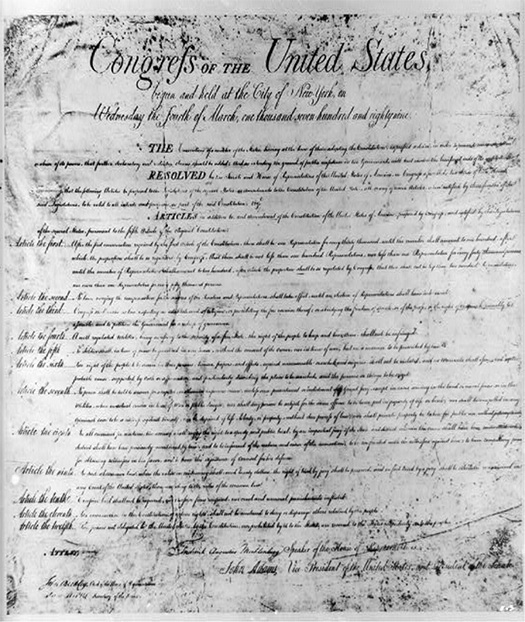
The principle of constitutional government is rendered meaningless if the Constitution is treated as a document whose meaning is endlessly malleable or, even worse, impossible to ascertain. At different times, different parties have deemed it expedient to construe the constitution in whichever way will rubber stamp their political policies. This lack of consensus on the interpretation of constitutional principles is strikingly clear in relation to the Tenth Amendment, which provides that,
The powers not delegated to the United States by the Constitution, nor prohibited by it to the States, are reserved to the States respectively, or to the people.
You might reasonably think the meaning of that provision is self-evident. It seems obviously to reflect the principle that states are sovereign and independent. There would be no point for the thirteen American colonies to have declared independence from Britain only to swear fealty to a new, albeit homegrown, imperial overlord. Gary Galles observes,
Everyone knows about the Federalists who pushed the Constitution. But far less known are the Antifederalists who warned with good reason against the creation of a new centralized government, and just after so much blood had been spilled getting rid of one.
Writing in 1863, Chief Justice Taney observed that the Tenth amendment protects the sovereignty of states—a point that was clearly understood at the time. As Woods and Gutzman put it, the states “remained the final authorities in the areas the Constitution did not delegate to the federal government.” That accords with the ordinary and common-sense interpretation of the words of the Tenth amendment.
But to the New York Times, the purpose of the Tenth Amendment is not at all clear—a columnist observed in 1983 that “the meaning of those phrases is not self-evident. Indeed, the Tenth Amendment was long thought to mean little.” Those who sought to erase the notion of state sovereignty treated this amendment as a mere footnote stating that in some cases there may be a distinction between state and federal powers. Chief Justice Harlan Fiske Stone is cited with approval for his comment that the Tenth Amendment “states but a truism that all is retained which has not been surrendered.”
Murray Rothbard highlighted the problem with this interpretation. It is used as a justification to consolidate and centralize power in the federal government. Courts have interpreted the Tenth Amendment not as a means of limiting federal power, by recognizing such power as vested in the states, but instead as implicitly delegating power to the federal government “through judges’ elastic interpretation of the Constitution”—the precise opposite of what was intended. Rothbard explains,
This loophole for vague “delegated” power allowed the national courts to use such open-ended claims as general welfare, commerce, national supremacy, and necessary and proper to argue for almost any delegation of power that is not specifically prohibited to the federal government—in short, to return the Constitution basically to what it was before the Tenth Amendment was passed. The Tenth Amendment has been intensely reduced, by conventional judiciary construction, to a meaningless tautology.
Interpreted in that way, the Constitution no longer fulfils its intended purpose. Instead of serving as a limit on centralized government power, it functions as an instrument for further consolidation and growth of federal power.
What then is to be done? If people cannot even agree on what the Constitution says, should it be abandoned altogether?
In his essay “Let’s Give Up on the (Unwritten) Constitution,” Brion McClanahan argues that it would be dangerous to simply give up on the Constitution and write it off as a dead letter. He argues that, instead, “What the American political system needs is a good dose of federalism and decentralization and a return to the Constitution as ratified through the Tenth Amendment.” He further argues, in “The Jeffersonian Tradition,” that limited government as envisaged by the Constitution is only possible when the locus of power resides primarily at state level:
The State is the most responsive level of government, the most democratic, the purest form of a republic, and the political entity most able to ensure republican principles, which Jefferson listed as “simplicity, economy, religious and civil freedom.” All the Founders would agree.
The views expressed at AbbevilleInstitute.org are not necessarily those of the Abbeville Institute.






TENTHAMENDMENTCENTER.COM 🇺🇸❤️👍
Republican Federal Judge John C. Coughenour (a Reagan appointee) recently said that the judges are the ones, alone, responsible for determining constitution law. He said that if people didn’t realize that, they just didn’t realize what they (judges) are supposed to do.
His posing (on some podcast) when he said it was of a man who was shocked that people didn’t worship him.
I did not curse him because he could not have heard me. I did not vomit because the carpet was not mine.
The Constitution as originally intended has been dead ever since the hypocritical traitor Dishonest Abe Lincoln took the Oath of Office for the first time. We’ve been living through its death throes ever since.
Excellent work, Dr. Wanjiru Njoya.
I’d only wished that the 10th Amendment read exactly as Article II of the Articles of Confederation: Each state retains its sovereignty, freedom and independence, and every Power, Jurisdiction and right, which is not by this confederation expressly delegated to the United States, in Congress assembled. I don’t know, it probably wouldn’t matter. The Courts, the Executive, and both political parties of Congress would still ignore it.
“Anti-federalist” Brutus wrote that because the Supreme Court was totally unaccountable and had the last word, the Supreme Court could “… mold the government, into almost any shape they please.” Jefferson’s Kentucky Resolutions effort to establish that the states were equally qualified to judge the constitutionality of laws under the Constitution they were parties to…shouldn’t have been dropped after the revolution of 1801 was won.
Constitutions are a very weak counter to the inherent corrupting dynamic of government, but they are better than nothing at all.
Dr. Njoya’s works are as intelligent as they are insightful. They are must reads when I visit the Mises web site. In reference to this article, the word “expressly” was voted down, I believe, by the Federalist in Congress while debating what would become the 10th amendment. This makes me suspicious and points to a longer game being played by the nationalist who could not get the national government they want in Philadelphia. By excluding the word “expressly” in the 10th amendment they created the circumstances where clever lawyers (AKA Lincoln) could, along with the Federal courts, mold the Constitution into what ever suited their despotic notions. The Federalists knew they would eventually achieve their Hamiltonian vision of an elected king ruling over a corrupt mercantilist empire. Welcome to America circa 2026. Maybe we should have listen to Mason or later Calhoun and installed some sort of “concurrent majority” requiring more than simple majorities to pass Federal legislation, hindsight being 20/20 and all. I couldn’t help but notice that the Confederate Constitution went a long way in fixing the problems found in the united States Constitution. Deo Vindice.
All our problems today stem from Dishonest Abe starting the War to Prevent Southern Independence, and in so doing, completely upending the entire principle of a Constitutional Republic as envisioned (and practiced) by the Framers. If I could time travel, I would try to ensure Lincoln’s parents never met.