

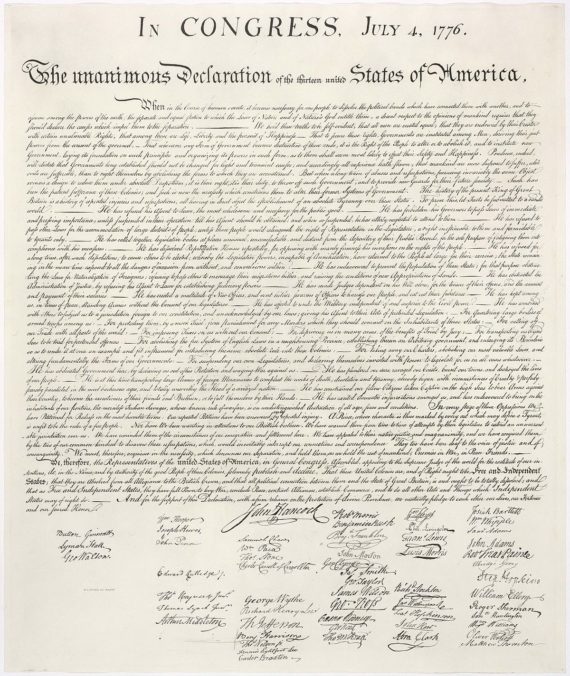
The two hundred and fiftieth anniversary of the signing of the Declaration of Independence is an appropriate moment to reflect upon how far Americans, both elites and regular people, have strayed from the principles of the movement for American independence from Britain. At its worst, the popular culture will celebrate the country’s “birthday” with celebrity entertainers performing in “kitschy” Hollywood splendor. More serious commentators will perhaps decry the unfinished revolution of social and economic equality they believe to be the founding principle of the United States. Historians in particular have an opportunity to offer an important corrective to these misconceptions and misunderstandings of a world we have now almost lost. Most of the profession, however, will offer a meaning of the Declaration of Independence emphasizing its “radical” nature and its profession of egalitarian values. This is a pity. The mid eighteenth-century American resistance to Great Britain is among the best documented in American history. Yet, the temptation to project modern political values into the nation’s founding is too great for many scholars. Thus, the movement for independence that viewed itself as first and foremost as preserving the inherited rights of Englishmen, a fact beyond dispute, has too many historians combing the patriot movement’s statements and declarations searching for the seeds of egalitarianism and radicalism, hoping perhaps to find something of contemporary times, or even their own ideological commitments in the thought and declarations of the men of 1776. The story, as usual, is more complex and illustrates how far most contemporary Americans are from the principles of the patriot movement.
The historical interpretations of the Declaration can be grouped into five major schools. The Progressive historians of the first half of the twentieth century and their close kin, the Social historians who emerged in the 1960s can be grouped together. Historians from both camps tended to base their studies in empiricism, focusing on economic incentives, class and social divisions, and both had a strong skepticism of textual evidence of letters, diaries, journals and the like when it came to revealing motivation, The operating principle was that actions and interests spoke louder, and more truthfully, than words. Two representative works in this tradition are Charles Beard, An Economic Interpretation of the Constitution of the United States (1913) and Gary B. Nash, The Unknown American Revolution (2005). In the view of these scholars, the American War for Independence resulted from the pursuit of economic, class, and social interests, particularly of some elite Americans, who resented Parliamentary interreference in their internal affairs. Nash goes further and argues that radical resistance to British rule among the elite, professional, and wealthy classes inspired or proved a catalyst for demands of greater democracy and equality among the artisans and mechanics of colonial American cities.
The second interpretative school is the Imperialists. These scholars focused intensely on state papers, legal documents, and party politics in both Britain and America with the aim of discerning the complex relationship between Britain and America in the imperial regime. From the perspectives of these scholars, the War for Independence resulted from an Anglo-American constitutional conflict resulting from unresolved dilemmas and tensions brought to a head by the fiscal and political crises of the 1760s and 1770s. British and American statesman tended to argue past each other as both sides had very different conceptions of how the British empire was supposed to function, and where the boundaries of authority lay between the King, the Parliament, and the colonial assemblies. Representative of this group are works by Charles Howard McIlwain, The American Revolution: A Constitutional Interpretation (1923) and Jack P. Greene, The Constitutional Origins of the American Revolution (2011).
In some respects, the Liberal school has wielded the most influence upon the popular mind on the meaning of the Declaration and the War for Independence. These scholars directly tied the internalization of the liberal ideas of the Enlightenment upon the American colonial elite, most especially John Locke’s Second Treatise, to an American revolutionary movement deigned to bring about a new government founded upon the principles of the Enlightenment, at least as read through John Locke’s Second Treatise. Carl L. Becker’s, The Declaration of Independence: A Study in the History of Political Ideas (1922) and Louis Hartz’s, The Liberal Tradition in America (1955). The intellectual world of the eighteenth century has proven to be more complex than Becker and Hartz portrayed it, but the influence of their views resonates strongly, particularly with those advocates of the United States as a proposition nation.
One school of history that has not fared as well in terms of influence is the Reformed Protestant school. These historians assign a decisive role for Calvinism and its covenant theology in the formation of the American mind, especially in New England, which they view as the dominant intellectual region in colonial America, as well as the center of the independence movement. Alan Heimert’s, Religion and the American Mind: From the Great Awakening to the Revolution (1966) and Patricia Bonomi’s, Under the Cope of Heaven: Religion, Society, and Politics in Colonial America (1986) represent the views of this school. Most historians concede that the work of this group has deepened the understanding of New England thought and religion during the period, but few agree the peculiar Calvinism of New England played a dominant role in shaping or directing American resistance to Britain.
Perhaps the most influential school among historians is the Republican group of scholars. These historians argue that the books, essays, treatises, and pamphlets of the Commonwealthmen, the Country Party, and the Scottish “moral sense” school formed the American colonial mind to emphasize and value public virtue and communal inherited rights which later morphed into a radical break with inherited political forms such as monarchy and embraced a radical and new republican experiment. The number books and articles produced by the adherents of the republican thesis are extraordinary; among the seminal works in this tradition, and there are Bernard Bailyn’s, The Ideological Origins of the American Revolution (1967), Pauline Maier’s, American Scripture (1997) and Gordon Wood’s, The Creation of the American Republic (1969)
Barry Shain in The Declaration of Independence in Historical Context, a work that I relied upon heavily in describing the differing schools of thought on the Declaration, identified five shared assumptions of the Liberal, Reformed Protestant, and Republican Schools.
- Ideals and theories as revealed by texts drove the independence movement.
- The second paragraph of the Declaration functions as a stand-alone statement of American political philosophy.
- The ideas contained in the second paragraph of the Declaration are worthy of praise and emulation across the globe.
- Colonial Americans are treated as unified across time, geography, social class, and intellectual bent.
- The American perspective of the conflict with Britain was accurate and without bias.
As Shain suggests, these five assumptions are historically problematic and ignore important aspects of colonial American political thought and practice. For example, the presence of strong royalist tendencies among most colonial Americans are ignored or discounted by the scholars of all three schools, even in the face of substantial evidence that royalist sentiment was stronger in America than in Britain. One need only read the many petitions and resolves of the 1760s and 1770s regarding the various Parliamentary acts of taxation and coercion to understand that the colonies officially recognized the King as ruler of the colonies, not parliament, and thus the colonial assemblies and other civic groups issued their appeals for justice and redress to the King to shield the colonies from parliament’s unjust and unconstitutional actions. For our purposes, two shall suffice. Thomas Jefferson’s, “A Summary View of the Rights of British America” (1774) was unusually assertive in its tone toward King Goerge III, as expected from the pen of one of the younger and more radical of the members of the Continental Congress, and indicted the King as well as Parliament for specific usurpations of the rights of colonial assemblies to regulate internal colonial matters. Still, Jefferson made his appeal to the King for redress. This was certainly in line with the Country Tory tradition. When the Continental Congress issued the Olive Branch Petion in 1775, the shooting had started. The language of the petition was conciliatory, one may even say fawning, due to the influence of its primary author, the moderate John Dickinson; certainly, it lacked the brash confidence of swagger of Jefferson’s “Summary View”:
Attached to your Majesty’s person, family, and government, with all devotion that principle and affection can inspire, connected with Great Britain by the strongest ties that can unite societies, and deploring every event that tends in any degree to weaken them, we solemnly assure your Majesty, that we not only most ardently desire the former harmony between her and these colonies may be restored, but that a concord may be established between them upon so firm a basis as to perpetuate its blessings, uninterrupted by any future dissentions, to succeeding generations in both countries, and to transmit your Majesty’s Name to posterity, adorned with that signal and lasting glory, that has attended the memory of those illustrious personages, whose virtues and abilities have extricated states from dangerous convulsions, and, by securing happiness to others, have erected the most noble and durable monuments to their own fame.
We beg leave further to assure your Majesty, that notwithstanding the sufferings of your loyal colonists, during the course of the present controversy, our breasts retain too tender a regard for the kingdom from which we derive our origin, to request such a reconciliation as might in any manner be inconsistent with her dignity or her welfare. These, related as we are to her, honor and duty, as well as inclination, induce us to support and advance; and the apprehensions that now oppress our hearts with unspeakable grief, being once removed. Your Majesty will find your faithful subjects on this continent ready and willing at all times, as they ever have been, with their lives and fortunes, to assert and maintain the rights and interests of your Majesty, and of our mother country.
Such language as contained above would not be out of place in Lord Bolingbroke’s writings on the patriot king. At the very least it seems odd behavior for radical, republican Whigs. The British viewed the paradox in a similar fashion. Lord North, seeking to undercut Whig sympathies for the Americans and to blunt the Whigs’ criticism of his administration observed in 1770, “The language of America is we are the subjects of the king; with Parliament we have nothing to do. Five years later he stated in Parliament, the “administration contended for the right of parliament, while the Americans talked of their belonging to the Crown. Their language therefore was that of Toryism . . . .” As the Imperial school argued, the British government and the colonial assemblies were at great odds on the nature of the imperial regime and the legitimate use of power within that regime. 
Muddying the waters a bit more was the eclectic and pragmatic way in which many Americans navigated the world of political ideas. It was common for Americans to cite or repat the arguments of the Commonwealthmen of the seventeenth century, John Locke, the Country Tories, and Old Whigs regardless of how well the ideas of these people kept house together. Hidden behind colonial appeals to John Trenchard’s and Thomas Gordon’s Cato’s Letters, Viscount Bolingbroke’s pamphlets, the writings of Locke, Sydney, and the Commonwealthmen was a constant and consistent colonial appeal in colonial state papers to the retention of the colonists of their rights as Englishmen. The literature relied upon by the patriot colonists, which by the way was the same as use by the loyalists in their writings, was used to provide an intellectual framework for the assertion of traditional rights, “antient constitutions,” and prerogatives, as well as the colonial theory of empire that excluded parliament from any internal governance of the colonies.
The argument between the colonists and the British empire was a complex tangle of issues concerning local governance, trade, taxation, and the limits of colonial self-determination. It did not help matters that imperial policy regarding the colonies through the seventeenth and early eighteenth centuries was at best inconsistent due to the emergence of political crises in England. The Civil War, the Protectorate under Oliver Cromwell regime, the Restoration of the Stuart monarchy and the Glorious Revolution meant that regime change was the norm every few decades. Combined with the slowness of communications and the ability of the Court to really know what was occurring on the ground in the colonies at any given moment resulted in colonial policies of long-term neglect punctuated by brief periods of attempting to reign the colonies back in line and in concert with whatever regime existed at the moment. The Navigation Acts, combined with internal trade regulation as contained in the Woolens Act of 1699, the Hat Act of 1732, and the Iron Act of 1750, suggest a long term and coherent imperial policy trade policy. Enforcement, however, was often haphazard and during the early eighteenth century the unofficial policy of salutary neglect rendered it almost nonexistent. The attempts of the last two Stuarts, Charles II, and James II to reign in and control what they viewed as defiant New England and New York via the policy of installing governors-general came to an end with the Glorious Revolution 1688 and the removal of James II. After the expulsion of James II and for the next sixty years, Britain’s attention was primarily focused on internal or continental matters: the eradication of Jacobite resistance in Ireland and Scotland and the establishment of a stable Hanoverian succession to the throne, as well as attempting to constrain the continental ambitions of France. When certain members of Parliament called for greater regulation of the colonies’ internal affairs and external trade, Prime Minister Robert Walpole quipped that it was best to “let sleeping dogs lie.” Walpole surmised correctly that His majesty’s Government had more than enough on their plate without adding a potential conflict with the colonies.
The imperial regimes’ misfortunes and instability were in many respects the colonies’ opportunity. The primary feature that emerged in colonial political development, too often ignored or downplayed by the advocates of the radical nature of the independence movement, was the long history of self-government enjoyed by the colonies, some (Virginia, Massachusetts, Maryland, Connecticut, and Rhode Island) reaching back more than one hundred years. Especially in the southern colonies, de facto legislative supremacy was as much a feature of the political life of the colonies in their internal affairs as it was in England, and in Connecticut and Rhode Island it was arguably de jure as those colonies retained their corporate charters until the War for Independence and elected their governors by vote of the freeholders of each respective colony, the very same electorate who voted for the members the colonial assemblies. What had emerged over time in the colonies was a political culture where a heightened sense of the inherited rights of Englishmen, freehold representation in the colonial assemblies, local governance, and the legislative supremacy were not mere theories or aspirations but lived daily realities for the political class. This last point is often ignored by those scholars seeking a radical revolution in the words and events leading to independence.
Of course, a close reading of the champions of the radical nature of the American Revolution, Gordon Wood, Pauline Maier, and Gary Nash come to mind, demonstrate that they go to great pains to find radical and egalitarian precedents in the independence movement. Maier, for example, concedes that colonial Virginians viewed equality as an individual characteristic only in the state of nature, but not in society which by nature was hierarchical. Some of the writers read by colonial Virginians and their fellow colonists, Adam Ferguson, David Hume, John Trenchard, and Thomas Gordon asserted as much, and proposed that inequality was a characteristic peculiar of societies. Nevertheless, Maier is convinced that the revolution per se set in motion egalitarian impulses as evidenced by the rise of egalitarian principles and arguments in the politics of the nineteenth century. Gary Nash’s urban crucible is populated with mechanics and artisans whose concerns about government preference leading to dangerous concentrations of wealth mirrored the concerns of Country Tories and Old Whigs, not exactly proto-Marxists. Nash’s Boston laboring folk made no demands for a greater role in the political process, nor did the mechanics of New York and Philadelphia issue calls for equality. Curiously, Nash ignored Charleston, SC, the fourth largest city in the colonies, but in that town the Sons of Liberty were not merely comprised of Nash’s nascent radical mechanics and laborers but included some of the town’s wealthiest merchants and shipbuilders. Gordon Wood who argues for the complete transformation of politics and society via the Revolution seems oblivious to the fact that monarchy after the Stuarts was little more than a word; in reality Parliamentary supremacy after the Glorius Revolution meant that the British government functioned like a republic, even George III viewed himself as a King in parliament. The colonials were already practical republicans in their daily political culture, and the colonists viewed Parliamentary favors and grants as at least as great a source of corruption as those that the monarchy might grant. It is tempting to think that Americans entered the revolution with strong Tory leanings and came out convinced republicans, until we remember the number of folks who wished to make George Washing a king. Old institutions and habits die hard. As for egalitarianism, the egalitarians of the nineteenth century invoked the Declaration in their calls for equality, but this was a full two generations removed from the events of the War for Independence, was located primarily in the northern states, and may have had its roots in such new movements as romanticism and nationalism. As Thad Tate argued, even when colonial Americans were in their Whig persona, they placed the greatest emphasis upon the contract between the ruler and the ruled, rather than upon the condition of man in the state of nature or any ideological commitments to egalitarianism, which was haphazard at best as it only applied to white males in the nineteenth century. Those commitments came later and were not a part of the American experience of the eighteenth century.
When attempting to discern the intention of the colonial Americans in declaring independence, the temptation exists to focus solely upon intellectual history, while ignoring the important tendency of events to outpace policy. As the colonists debated the best ways to resist what they viewed as unconstitutional Parliamentary encroachments upon local governance and inherited rights, the war got underway. More than a year before the Declaration was issued, fighting broke out at Lexington and Concord. By May of 1775 Boston was under siege by colonials in arms, a colonial force under Ethan Allen and Benedict Arnold had captured Fort Ticonderoga and Crown Point, and Mecklenburg County, NC issued the first declaration of independence, though this last is disputed among historians. The following month in June, the Continental Army began to be organized, the battle of Breeds’ and Bunker Hill was fought, and a colonial force invaded Canada.
In December 1775, the empire struck back. His Majesty’s government issued the Prohibitory Act in response to these provocations; this was the point of no return. The act shut down the commerce of the colonies with a blockade, American vessels were treated as enemy vessels, impressment of American seaman was authorized, and Royal Commissioners were empowered to only offer pardons and receive submission from the rebellious colonials. Virginia Governor John Murray, Lord Dunmore, offered emancipation to all slaves who took up arms for the Crown. British troops destroyed the port of Falmouth Massachusetts and burned Norfolk, Virginia one month later. The Prohibitory Act and British military retaliation placed Americans outside the protection of the Crown according to George Wythe, the leading legal mind of Virginia, thereby absolving Americans of their allegiance to the Crown. Wythe cited such English authorities as, Robert Viscount Moleswort and Judge Blackstone for support, and Wythe’s position did have the merit of being a tidy Whig argument; the Crown had withdrawn its protection, the colonies no longer had a contractual obligation of obedience. Witnessing these events, the moderate North Carolina Quaker and member of the Continental Congress, Joseph Hewes wrote, “I see no prospect for a reconciliation.”
Even before July 4, 1776, colonial governments began to take matters into their own hands. Virginia and New Jersey declared independence from the Crown in the preambles to their new state constitutions. Rhode Island’s legislature passed laws declaring that colony’s independence. Maryland declared its independence on July 6. Meanwhile towns, counties, and municipal organizations in Virginia, Massachusetts, Maryland, New York, Pennsylvania, and South Carolina issued their own declarations of independence from the Crown.
To understand the multiplicity of these declarations and what the colonies and other organizations believed they were doing, it is important to examine the legal nature of a declaration in Anglo-American law the eighteenth century. Declarations were legal claims served at the start of a civil action summarizing the wrongs committed by the plaintiff. The language is supposed to be simple, plain, clear, and stated with certitude. They also function as appeals for public support. For the generation alive at the time of the Declaration, the civil action of declaring independence was more important than the words of the document itself. When people of the eighteenth and early nineteenth century quoted the document at civic functions, it was the last paragraph announcing the dissolution of the colonies’ allegiance to the Crown. A telling admission from Pauline Maier is that in none of these the various declarations of independence and state papers to the first decade of the nineteenth century is there any evidence whatsoever that the Declaration of Independence lived in men’s minds as a classic statement of American political principles.
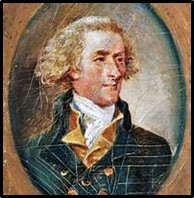
Thomas Jefferson, the primary author of the Declaration, and a man who was familiar with and sympathetic to the political and philosophical principles of the Enlightenment would seems the best hope for those seeking for an egalitarian or radical intention in the Declaration of independence. Yet it is not so. Jefferson wrote to Madison on Aug. 30, 1823, and stated that the Declaration contained no innovative ideas or sentiments; no pamphlets or books were used as references for the document. On May 8, 1825, Jefferson wrote to Richard Henry Lee concerning the intention of the Declaration. That intention was not “to find out new principles, or new arguments, never before thought of . . .. but to place before mankind the common sense of the subject [in] terms so plain and firm as to command their assent. . . . it was intended to be an expression of the American mind as found in the sentiments of the day” letters, essays, thinkers such as Aristotle, Cicero, Locke, Sydney etc.” Here was American pragmatism in political thought. As Forrest McDonald’s observed in his book Requiem, the American mind is pragmatic, not concerned with reconciling disparate schools of thought or contradictions between them. American political thinkers used what best expressed their idea or sentiment, even if they disagreed with the author’s politics or social views. McDonald’s insight captures better the nature of the American colonial mind than the “incoherence” thesis argued by some of the adherents of the imperial school of historians and Lord North’s cabinet. But this pragmatic bent of Americans with respect to the world of ideas can lead to the distortion of memory and as a result alter the interpretation and meaning of the Declaration and the intentions of the political society that produced it.
The most significant alteration to the Declaration’s meaning concerned the phrase “all men are created equal.” Originally understood by the colonial Americans as applying to men in the state of nature, it morphed over time into a moral standard of what ought to be. The early appeals to equality as a moral standard, especially with respect to slavery appeared in Massachusetts in the early 1780s. In the “Quock Walker” case, actually three related cases, the plaintiffs’ attorneys successfully argued before the Massachusetts Supreme Judicial Court that the equality clause in the state bill of rights, “all men are born free and equal,” made slavery illegal in that commonwealth. It was not until 1789 when Josiah Parker, a Federalist from Isle of Wight, VA, invoked the “principles of the Revolution” in his speech against the slave trade, asking his fellow congressmen to avoid the charge of inconsistency. In 1796 James Hillhouse of CT, a prominent Federalist and a slaveholder, opposed the slave trade in Congress on the grounds of the natural right of equality regardless of race.1806 John Smilie, an antifederalist and Jeffersonian Republican from PA appealed to the “principles of 1776” in calling for an end to the slave trade. These early examples were indirect attempts to bring the principle of equality into political discussions regarding slavery and the slave trade. None, however, directly appealed to the Declaration’s equality clause and as political and moral arguments they were outliers.
The movement toward the Declaration becoming a “sacred text” begins in the second decade of the nineteenth century. The rise of the West in the councils of the Union, especially John C. Calhoun and Henry Clay, brought to the fore a national consciousness favorable to a more activist foreign policy, defense of the nation’s honor, and a more activist government with respect to economic development and infrastructure buildout. The War of 1812 was at best a stalemate, but Americans chose to believe they had won the conflict. The Federalist opposition to the war doomed that party to obscurity, ushering in the short lived “Era of Good Feelings” during the Presidency of James Monroe. Effectively, the Union was under one party rule, though significant divisions persisted among the Union’s geographic sections. This was a much different world than the one which existed just twenty years before. John Randolph quipped that the wardrobe of his old friend, fellow Old Republican Nathaniel Macon who persisted in wearing the clothes of decades past, was as much out of fashion as his Jeffersonian principles. As the sectional tensions of the time broke out with a fury during the Missouri Crisis, invocation of the Declaration’s equality clause would be tried as an argument to restrict slavery from Missouri as the price for its admission into the Union. The cultural and political shift in the country also gave this tactic some impetus. J. H. Elliot suggested this was due to the rise of nationalism and romanticism as significant cultural movements in the West provided a fertile ground for winning adherents to the cause of equality, no matter how its champions might define it.
The new Era of Good Feelings also witnessed a vibrant interest in all things concerning the War for Independence, especially as the fiftieth anniversary of the Declaration approached. An outpouring of artwork and literature celebrating the period occurred: John Turnbull’s famous painting, Declaration of Independence, several books appeared on the signers, Jared Sparks began a collection of George Washington’s papers, Peter Force editor of American Archives, began compiling this important collection of state papers and documents from the Revolutionary era in response to the high demand among the reading public for the sources and history of the movement for independence. Signers such as Thomas Jefferson, Richard Henry Lee, and John Adams were inundated with inquiries from correspondents interested in the Declaration and its meaning.
As the Declaration’s status in the American imagination became elevated, the temptation to use it as, in Philip Detweiler’s words, “a ready weapon, a convenient and expansive buttress for a point of view” was too hard to resist. During the Missouri Crisis of 1819-1820, Congressmen James Tallmadge of New York, Timothy Fuller of Massachusetts, John Taylor of New York, Walter Lowrie of Pennsylvania, and Arthur Livermore of New Hampshire all invoked the Declaration’s equality clause to justify restricting slavery from Missouri. Livermore went so far as to describe slavery as a “sin” against equality. The irony of elevating equality to an abstract moral principle was that these men lived in “free” states where equality was not practiced in politics or society. Many Northern states, especially in the old Northwest, placed significant restrictions upon free African residents, denied them political rights such as the franchise, and restricted their liberty of movement. Southern responses in the Congress to the invocation of equality varied. Senator William Pinckney of Maryland, one of the most respected legal minds of his generation, called the equality clause a meaningless truism. Senator Nathaniel Macon of North Carolina reminded the Congress that the Declaration had no standing as law, Constitutional or otherwise. Representative and future president. John Tyler of Virginia, argued in perfect eighteenth century form that it was impossible to erase distinctions emerging in a state of society after men left the state of nature. Representative Richard Mentor Johnson also reminded the Congress that the equality clause referred to collective right of Americans to form a government independent of the British empire. These arguments were much closer to the mind of the men who signed the Declaration, but in a twist of irony Northern members of Congress attacked their opponents from the South, accusing them of attacking the “sacred” Declaration. The damage was done, and once the equality genie escaped the bottle, it was not going to be contained.
The split regarding the Declaration was present also among literary men. Upon the death of Thomas Jefferson, eulogies were solicited from prominent citizens representing each of the original thirteen states. Peleg Sprague of Maine, which had been part of Massachusetts during the American Revolution, and John Seargeant of Philadelphia placed an emphasis upon the equality clause. Sprague wrote that, “the . . . equality of the human race, [w]as the true foundation of all political, of all human institutions.” Eulogies composed in the Southern states emphasized the act of declaring independence to secure liberty and self-government.
Twenty years later, prominent Southern thinkers abandoned the position that there was a state of equality in the state of nature. An example of this occurred during the debate on the Oregon Bill; John C. Calhoun argued that Jefferson’s conception of the state of nature was mistaken, hypothetical, and non-existent. Men are not created equal, Calhoun argued, they are born as dependent infants. Indeed, the equality clause was unnecessary to the argument for independence. Men were born into a society, are social creatures, and society is necessary to human development which proceeds at unequal places due to the conditions of people and the circumstances in which they find themselves. Calhoun staked out his ground on Aristotle rather than the Enlightenment. When it came to the men of the Declaration, Calhoun stood with the men of 1776. The Declaration’s main intention, according to Calhoun, was addressing the “breach of the colonists’ chartered privileges and encroachment of our own acknowledged and well-established rights by the parent country . . ..” As for the political order created the Declaration, the new republican governments of the states were formed “by old materials and on practical and well-established principles, borrowed for the most part from our won experience and that of the country from which we sprang.” Calhoun rejected the fundamental tenets of eighteenth-century musings on the state of nature, but importantly he retained the history and intention of the patriots of 1776.
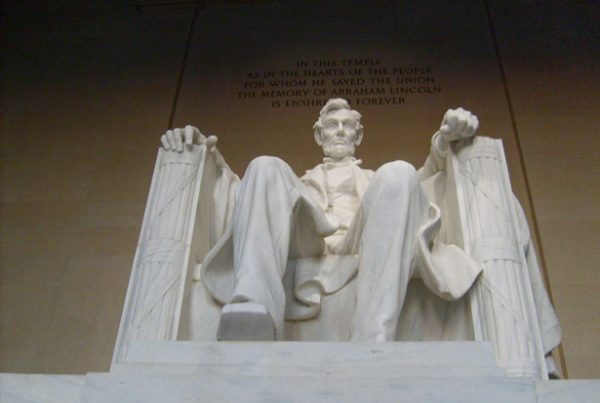
Abraham Lincoln resurrected the equality arguments of Northern politicians during the Missouri Crisis but did not solve the dilemmas that invoking equality as the Union’s chief political principle raised. In the debates Lincoln had with Senator Stephen A. Douglas during the Senate election of 1858, Lincoln used the Declaration as a weapon and buttress to attack any extension of slavery into the territories. At Chicago, Douglas asserted the traditional meaning of the Declaration which elicited the charge from Lincoln that Douglas would deny white, non-Englishmen their rights. Douglas argued no, only Indians and people of African ancestry were to be excluded, positions that were politically popular at that time, forcing Lincoln at Springfield into an incoherent position of arguing that the equality clause argued against slavery, but not against the existence of severe restrictions upon political life, residency, and movement, of people of African ancestry. As Lincoln stated, “I do not understand the Declaration to mean that all men were created equal in all respects.” Lincoln did secure the presidency two years later, and from that bully pulpit he issued the Gettysburg Address. The Address was brief, clear, and distinct which were advantageous when appealing to the pragmatic American mind. Lincoln appealed to an American character where equality was the central moral principle, even though this was an ahistorical and fanciful interpretation completely at odds with the history of 1776 and the intentions of the Continental Congress. Whatever else the men of 1776 had in mind, it was not the erection of a propositional nation. Nevertheless, Lincoln shared with other Americans the unfortunate ability to hold divergent and contradictory views at the same time and not be bothered by it.
For the present, Mr. Lincoln and his disciples hold the field. Lincoln’s interpretation has won over most of academia and the popular American mind. Scholars who ought to know better but share Lincoln’s view that equality is the proposition which creates the American nation, continue to scour the historical record in the hopes of finding someone from the days of the imperial crisis who holds the views they hold. Many who call themselves conservatives are guilty of adhering to this ahistorical reading of the Declaration, an odd position for men of the Right to take. While the egalitarians do tap into the American desire to be something new, to be the city on the hill committed to the equality of all people, and to justify the course of development of American society down to our time, it is important to remember that these tendencies had their birth in the North. Southerners remained committed in their memory to the original meaning of the Declaration for much longer. That original meaning carries within it real, if latent, states’ rights and limited government principles that have a powerful and venerable history, tradition, and arguments in their favor.
The views expressed at AbbevilleInstitute.org are not necessarily those of the Abbeville Institute.






“During the Missouri Crisis of 1819-1820, Congressmen James Tallmadge of New York, Timothy Fuller of Massachusetts, John Taylor of New York, Walter Lowrie of Pennsylvania, and Arthur Livermore of New Hampshire all invoked the Declaration’s equality clause to justify restricting slavery from Missouri. Livermore went so far as to describe slavery as a “sin” against equality.”
Slavery or no slavery, the real “sin” is the concept of equality. I suggest that God made nothing, nor no two items equal. A Rose is not equal to a Magnolia. But then no two Roses or two Magnolias are equal.
For those who believe in such nonsense as “equality” (in any aspect) why do we refer to a group such as “The Founding Fathers”? Wouldn’t one be enough?
The “united” in the Declaration is in small letters. Even an idiot like lincolon ought to be able to figure out what that means.
There is NO idiot like Lincokn,
Fine effort, John! Thank you for your effort.
So much discussion of “egalitarianism” without defining it. I don’t exactly think of it as “egalitarian” to say that all people should be equal before the law. Maybe compared to the hierarchical world that prevailed everywhere before 1776. But not in the sense a leftist would use it at all.
I really think equality before the law was all Jefferson meant. And “men” meant citizens, which excluded slaves, Indians, etc. They were rebelling against a big, corrupt, intrusive, and hierarchical government.
King, Duke, Marquess, Earl, Viscount, Baron, Baronet, gentleman, yeoman, husbandmen, servant, and slave…all faced different prospects before the law in Britain, never mind their differing prospects for advancement. While not necessarily Jefferson’s intention in the Declaration itself, his words started the destruction of the hierarchical nature of the world that had obtained forever and virtually everywhere.
NOt what TJ meant, J. “Men” did not exclude slaves, Indians, woman. I fully discuss this in my newest book…
I: Jefferson’s Years as Barrister
II: Jefferson’s Summary View
III: Declaration of Independence
IV: Jefferson Comes under Attack
V: In Defense of Thomas Jefferson
VI: Are All Men Really Created Equal?
VII: Jefferson on Natives & Blacks
VIII: Jefferson on Women
Epilogue
Appendix I: The Declaration of Independence
Appendix II: Jefferson’s (First) Draft of the Declaration
Appendix III: Signatories of the Declaration of Independence
Appendix IV: The Mecklenburg Declaration of Independence
What is the title of your newest book? Is it available yet? I looked on Amazon and the latest book of yours was the one published in 2014 (TJ: …Philosophy and Vision…) and the TOC did not match this one. Thanks.