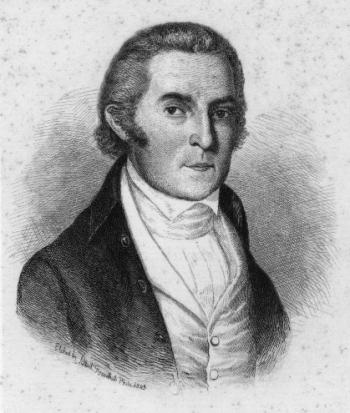
When the Constitutional Convention met in Philadelphia in 1787, North Carolina elected Willie Jones as a delegate, but he declined to accept his seat, recognizing that the gathering intended to create a centralized government that would diminish state sovereignty.
A wealthy planter, radical Jeffersonian, and the foremost Anti-Federalist leader in North Carolina, Jones is remembered chiefly for blocking his state’s ratification of the U.S. Constitution in 1788 and helping force the adoption of the Bill of Rights.
Jones was born on May 25, 1741, in Surry County, Virginia, and moved with his family to Northampton County, North Carolina, sometime before 1753. His father, Robert, also known as “Robin”, Jones was a prominent colonial lawyer who served as attorney general of North Carolina from 1756, agent of Lord Granville, and one of the largest landowners on the Roanoke River. The family sent Willie to England to study at Eton College, his father’s own alma mater, from 1753 to 1758. Upon returning home to Halifax, he was described as “peculiarly thoughtful and eccentric” and built a magnificent plantation estate called “The Grove,” which became the center of social and political life in the region.
Jones began his public career in the early 1770s as a representative of Halifax in the colonial House of Commons. In his early years he was an ally of royal authority who participated in suppressing the Regulator rebellion of 1771—a movement of backcountry farmers who protested lavish royal governance and taxation. He served as aide-de-camp to Governor William Tryon, marched with Tryon’s militia, and fought in the decisive Battle of Alamance. By 1774, however, growing disenchanted with British colonial rule, he refused an appointment to the Royal Council and pivoted sharply toward the revolutionary cause, joining North Carolina’s Provincial Congress that year.
Historians have debated the causes of this political transformation, but his actions indicate he interpreted the imperial struggle as a vehicle for establishing direct political democracy. He rejected the conservative Whig view that sought merely to replace British administrators with American elites, aiming instead to construct a state government highly responsive to the common agrarian citizenry.
Once committed to independence, Jones became one of North Carolina’s most powerful revolutionary figures. Royal Governor Josiah Martin noted that Jones was “one of the loudest voices encouraging secession from Britain and the establishment of an independent state,” per the North Carolina History Project. He was elected to all five of North Carolina’s Provincial Congresses, served as President of the Council of Safety in 1776—which briefly made him the de facto head of state until Richard Caswell was elected the first governor— served as a member of the commission that drafted North Carolina’s first state constitution, served as Superintendent of Indian Affairs for the southern colonies, and represented the state in the Continental Congress in 1780. He also fought militarily as a lieutenant colonel under General Nathanael Greene, leading 300 men in the pursuit of Lord Cornwallis.
During the Fifth Provincial Congress, Jones served on the commission that drafted the state’s first constitution and its accompanying declaration of rights, successfully navigating a compromise that established a highly democratic, powerful legislature. Jones was widely recognized as the most politically powerful individual in North Carolina, effectively managing state affairs through his networks of patronage and local organizing. He was the acknowledged leader of North Carolina’s “radical” republican faction, opposing the more conservative wing led by figures like William Hooper, Samuel Johnston, and his own brother Allen Jones.
Jones’s most enduring political act was his leadership of the opposition to the U.S. Constitution’s ratification. When elected as a delegate to the Federal Convention in Philadelphia in 1787, he declined to accept his seat, telling Governor Caswell that he did not “think it will be in my power to attend there at the Time appointed”—a telling sign of his skepticism toward the entire project of constitutional consolidation. Recognizing that the convention intended to create a powerful centralized government that would diminish state sovereignty, Jones assumed the role of field marshal for the Anti-Federalist forces in North Carolina.
Jones’s critique of the Constitution was rooted in a distinct political philosophy regarding republican governance and civic virtue. He believed that true civic virtue and self-governing liberty could only survive where citizens held direct, face-to-face relationships with their representatives. He saw the Constitution as a dangerous instrument of centralization that would transfer sovereign authority from the states to a distant, powerful federal government.
He argued that only the states, not the federal government, should have the power to tax citizens directly. He believed the federal government should not control the time, place, or manner of elections, fearing manipulation to favor wealthy gentry. Jones feared the Constitution permitted the creation of a permanent standing army, which he viewed as a tool of tyranny. In addition, he was alarmed by the prospect of a Supreme Court empowered to overrule state court decisions. He worried the federal government would regulate the economy to benefit a small class of commercial and mercantile interests over common citizens. Most critically, Jones demanded an enumerated declaration of individual rights before any ratification could proceed. Restart
Jones articulated a philosophy rooted in the belief that small republics best protect individual liberty, that genuine civic community and self-governance could only flourish at the state and local level, not in a vast, consolidated national government. As political scientist Herbert J. Storing characterized Anti-Federalists broadly in What the Anti-Federalists Were For, Jones believed that “the American polity had to be a moral community if it was to be anything, and that the seat of that community must be the hearts of the people.”
To block ratification, Jones coordinated closely with the broader American Anti-Federalist movement, utilizing materials from John Lamb’s Federal Republican Committee in New York. He also aligned his strategy with Thomas Jefferson’s position from Paris—that while enough states should ratify to establish a functioning union, a group of states should withhold ratification to force the inclusion of a Bill of Rights. Jones resolved to make North Carolina one of those holdouts.
At the Hillsborough Convention in July 1788, where Anti-Federalists held a commanding majority, Jones coordinated the opposition. He largely remained silent on the convention floor, allowing Samuel Spencer to act as the primary debater, while he focused on keeping the Anti-Federalist delegates united. Despite a vigorous campaign by Federalist leaders such as James Iredell and William R. Davie, the Hillsborough Convention voted 184 to 84 to neither ratify nor reject the Constitution. Federalist Archibald MacLaine later lamented, “We might have carried our point… but for Willie Jones.”
Jones’s famous declaration captured his stance perfectly: “I would rather be eighteen years out of the Union than adopt it in its present defective state.” North Carolina remained outside the Union for over a year. The Hillsborough holdout achieved its primary goal. Faced with resistance from North Carolina and Rhode Island, the first United States Congress drafted the federal Bill of Rights and submitted it to the states for ratification. North Carolina’s refusal to ratify directly pressured the First Congress to act. When Congress passed the Bill of Rights in 1789, North Carolina ratified the Constitution at Fayetteville by a vote of 195 to 77. Jones, realizing the Federalists now had the votes, did not attend the 1789 Fayetteville convention and quietly withdrew from politics.
The Anti-Federalists’ pressure across all 13 states, with Jones as one of its key orchestrators, compelled James Madison to draft the first ten amendments. The freedoms of speech, religion, press, assembly, protection from unreasonable searches, and the reservation of unenumerated powers to the states under the Tenth Amendment all owe a direct debt to Anti-Federalist insistence.
In 1791, Jones was appointed to the state commission tasked with selecting the permanent site for North Carolina’s new capital, within ten miles of Isaac Hunter’s tavern in Wake County. Thanks to his efforts in purchasing and plotting the land, he is historically recognized as the “real founder of Raleigh.” Jones Street in Raleigh, where the North Carolina General Assembly building is located at 16 W. Jones Street, was named in his honor—he was the at-large commissioner on the nine-member board that selected Raleigh as the state capital and plotted its streets.
Willie Jones died on June 18, 1801, having spent his final years in quiet retirement at “The Grove.” He understood what most politicians today have forgotten, that centralized power is the enemy of liberty, and that the closer the government remains to the people it governs, the more accountable it will be. His insistence on a Bill of Rights before ratification was not a mere act of obstruction but a principled stand that secured the freedoms Americans now take for granted.
The views expressed at AbbevilleInstitute.org are not necessarily those of the Abbeville Institute.





Thanks for this featuring of important founding father Willie [pronounced ‘Wiley’; he was named for a Rev. Willie] Jones.
It is really too bad that Jones, Richard Caswell, Robt. Yates of NY, and other libertarian founders (who could have) did not participate in that conspiracy behind locked doors in Philadelphia in the Summer of 1787. They could have improved the Constitution in the direction of guarding state autonomy and individual liberty. George Mason’s requirement of 2/3 majority to regulate commerce might have survived, which could have prevented the Tariff of Abominations, Lincoln’s War, and Obamacare.
They were also unfortunately conspicuously absent in the 1st couple of year of the Federal govt’s life, resulting in a more limited Bill of Rights from Madison (who at that point was a nationalist).
When Willie Jones wrote North Carolina’s Constitution in 1776, he started with a Bill of Rights.
This quote “the American polity had to be a moral community if it was to be anything, and that the seat of that community must be the hearts of the people” is from Storing rather than Jones, right?