

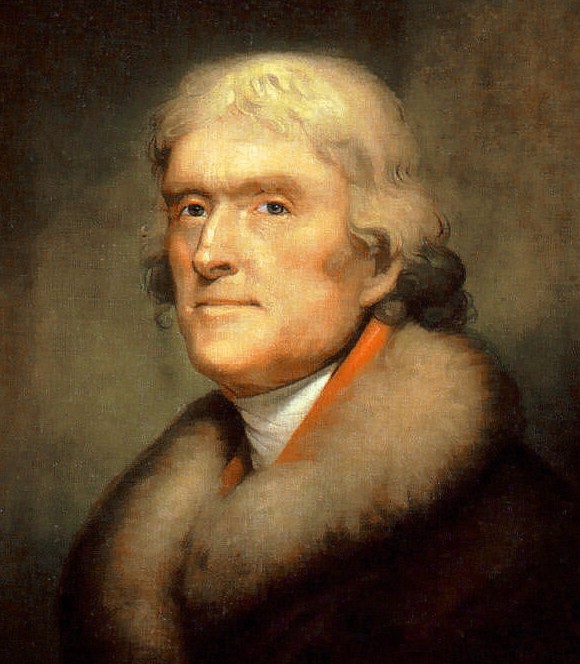
In American Scripture: Making the Declaration of Independence (1997), Pauline Maier takes herself to advance the points that Karl Becker wanted to advance in his book on the Declaration, some 70 years earlier, but was prohibited from advancing, because of the conservative time in which he lived. She begins with astonishment that the Declaration of Independence is today treated as a religious relic and that Thomas Jefferson is seen by many as another Moses. There is nothing of originality, she asserts, in the document. Declarations of independence were common when Jefferson took up his quill to create his draft. She argues too that Thomas Jefferson was not the author, but merely the drafter, of the Declaration. The other four members of his committee made important additions to his “draft,” and the copy that was submitted to the Continental Congress was heavily edited, so much so that Maier claims some members made more substantive contributions than did Jefferson. Maier’s overall thesis, I aim to show, is false.
Maier begins by warning against ascription of authorship to Jefferson. He was not the author of the document, but he was its “designated draughtsman.” Even as designated draftsman, Jefferson was grotesquely unoriginal. Also, Congress revised the document before its publication.
The remaking of the Declaration of Independence no less than its original creation was not an individual, but a collective, act that drew on the words and thoughts of many people, dead and alive, who struggled with the same or closely related problems.
Maier starts the argument for Jefferson as designated draftsman with the statement that between April and July 1776, there were some 90 “declarations of Independence,” including Virginia’s Declaration of Rights, which Jefferson certainly used in his draft. Thus, crafting a declaration of independence was nowise novel, but it merely showed continuancy of a long tradition of decades of British addresses, petitions, and declarations. She sums:
The draft Declaration of Independence submitted to congress by the Committee of Five was so much the work of Thomas Jefferson that it can justly be called ‘Jefferson’s draft.’ But within the committee and, above all, later, when Congress let loose its collective editorial talent on Jefferson’s prose, other men made more substantial and constructive contributions to the Declaration of Independence than pleased Jefferson at the time, and far more than he remembered in the 1820s.
Maier discusses the changes made by the Continental Congress in section four of chapter 3. She includes nine illustrations in 10 paragraphs. She compares in her analysis the draft that Jefferson submitted to Congress with the Declaration after the Congress’ heavy edits.
First, there were verbal changes, such as “inherent and inalienable rights” becoming “certain inalienable rights.” Second, “extreme and untenable assertions” (why “and” and not “or”?) of the fair copy were “cut back or eliminated.” Third, the Congress sometimes softened the language and in one instance hardened the language concerning Jefferson’s charges against George III. Fourth, from Jefferson’s “our judges dependent on his will alone,” Congress excised “our.” Fifth, they removed Jefferson’s lengthy passage condemnatory of slavery. Sixth, they removed two insurrectionary charges against the king—one concerning Colonists; the other, Native Americans.
Maier prefaces the final four changes as follows.
By then the delegates seem to have built up steam, [they] and really ripped into the rest of the document.
Seventh, they changed “a people who mean to be free” to “a free people.” Eighth, they streamlined Jefferson’s Anglophobic language concerning the British people, she concedes, but “the rewritten section remained severely critical of the British people.” Last, the Congress instantiated key words from Richard Henry Lee’s resolution of July 2 and it also “added two references to God.”
Jefferson, Maier notes, became increasingly nervous as the Congress worked through his document and “built up steam.” His anxiety, however, was unwarranted. Maier triumphantly sums:
He had forgotten, as has posterity, that a draftsman is not an author, and that the ‘declaration of independence,’ as Congress sometimes called it, was not a novel, or a poem, or even a political essay presented to the world as the work of a particular writer, but a public document, an authenticated expression of the American mind.
Maier’s claim that Jefferson was one of many authors of the Declaration is a conclusion which functions as a premise of a larger, compound argument that there is nothing timeless or even unique about the Declaration and that neither it nor Jefferson ought to be sanctified.
To illustrate, Maier begins her book with a short history of the physical document. It was “not even copied onto a particularly good sheet of parchment” and in its early years, it had become “one of the most abused documents in the history of preservation.” Housed in New York, it removed to Philadelphia, then Washington, DC., then Leesburg, Virginia, during the War of 1812, and back to Philadelphia, and so on. She tells, thus, of the continual process of natural decay of the Declaration, and the ever-anxious attempts to preserve it, despite it being a relatively disregarded document at the time of its composition. The implication, subtle, is that the real significance of the document and its natural process of decay over many decades is in inverse proportion to the general perception of its significance, of its increasing greatness. As the actual physical document decays, it increasingly comes to be seen as holy writ.
At a meeting at the Woodrow Wilson International Center for Scholars on July 24, 1995 (Washington, DC), Maier waited in line to see, at “the shrine,” some of the key documents in the National Archives. In the “tabernacle,” there were housed the Declaration, the Bill of Rights, and the Constitution, with the first as the “centerpiece.”
To me the vital documents themselves seemed pretty dead. In fact, the spectacle had the air of a state funeral.
Following the lead of her title, American Scripture, Maier’s thesis is “bedizened” in the religious language of her Catholic childhood. She aims to tell the story about how,
after a period in which the Declaration of Independence was all but forgotten, it was remade into as sacred text, a statement of basic, enduring truths often described with words borrowed from the vocabulary of religion.
She then turns to pontification. She warns against regarding the document as a “sacred text” and against championing Jefferson as “the father of all moral principles.” Jefferson was
no Moses receiving the Ten Commandments from the hand of God, but a man who had to prepare a written text with little time to waste, and who, like others in similar circumstances, drew on earlier documents of his own and other people’s creation, acting within the rhetorical and ethical standards of his time, and producing a draft that revealed both splendid artistry and signs of haste.
She sums,
The Declaration of Independence was the work not of one man, but of many.
Maier’s chapter 3 is titled “Mr. Jefferson and His Editors.” In that lengthy chapter, she discusses the formation of the committee of five, Jefferson’s fair copy, and the resultant document after the Congress’ edits. Jefferson, she asserts without justification, had with him in the Graffe House both the preamble to the Virginian Constitution—the preamble, we recall, was written by Jefferson—and Mason’s Virginian Declaration of Rights. “This [the work of the Congress] was no hack editing job,” she says emphatically, for members of the Congress had “a splendid ear for language.” They did more than edit, some “made more substantial and constructive contributions.”
Maier’s overall argument, relatively complex, can be stated thus as two separate arguments, each of which argues for the same conclusion.
First, there is the Argument from Unoriginality.
1) The Declaration of Independence was the culmination of much discussion and debate on independence.
2) There were some 90 declarations of independence from April to July 1776.
3) So, independence itself was no novel concept (1 & 2).
4) Jefferson had with him, when writing the Declaration, the preamble to the Virginian constitution and Mason’s Virginian Bill of Rights.
5) So, there is nothing original in Jefferson’s draft of the Declaration (3 & 4).
6) “Authorship” implies some significant amount of original content.
7) So, Jefferson was not the author of the Declaration of Independence (5 & 6).
I begin with premise 2 of the argument: that there were some 90 declarations of independence from April to July 1776. As David Armitage notes and even Maier concedes in chapter 2 of her book, “declarations” by the time of Jefferson’s had had a relatively long history in England. Not all the 90 to which she refers were declarations of “independence.” In her Appendix B, she limns six illustrations of “local resolutions on independence: Buckingham County, VA; Cheraws District, SC; Charles County, MD; Natick, MS; Topsfield, MS; and Ashby, MS. None are declarations of independence. The first, second, third, and fifth are recommendations of independence. The Cheraws document says,
Under these convictions, and filled with these hopes, we cannot but most earnestly recommend it to every man, as essential to his own liberty and happiness.
The fourth and sixth are declarations of support for the Congress, in the event that they should decide on independence. The Natick document says,
Should the honourable Continental Congress declare these American Colonies independent of the Kingdom of Great Britain, we will, with our lives and fortunes, joins the other inhabitants of this Colony, and with those of the other Colonies.
Thus, premise 2 is false, which is problematic for the argument, though not damning.
There is no need for any penetrating analysis, however. Disqualification of authorship on account of unoriginality is unpersuasive, for Jefferson himself acknowledged his unoriginality—originality was not expected of him in his instruction—and yet he claimed to his dying day (e.g., on his gravestone) to be author of the Declaration.
“Originality” is, however, a greasy term.
First, there is, for instance, originality of form and originality of content. Jefferson’s finished product, though each part drew inspiration from other sources, was structurally unique, and, thus, formally original. And so, the unoriginal content of Jefferson’s Declaration can be found in originality of structure.
Formal originality might be better grasped as logical originality—a strange way of stating that the argument of the document is tight and compelling. Jefferson gave, to the world, a declaration of independence in the form of a logically coherent and logically persuasive argument. The finished product moves coherently and cogently from the philosophical to the descriptive. Given human equality, based on each being in possession of a moral sense, all have the natural rights of life, liberty, and pursuit of happiness (this last being pursuit or “dis-pursuit” of virtue), and when any government perpetually encroaches on those rights, the people have a right, even a duty, to overthrow that government and establish another government in keeping with their designs on human thriving. Thus, it is, pace Maier, a political philosophy. It does not merely declare; it argues.
Second, the finished product was unique or original because of the prosaical artistry of Thomas Jefferson—originality of style. He aimed to craft the document in language meetly simple, yet Jeffersonianly elegant, for all Americans and all others across the globe. The argument for the right to revolution, given consistently corrupt government, was expressed simply, coherently, and in stepwise fashion to make it too accessible for all readers.
Given the ambiguity of “originality,” we can acknowledge the truth premise 6 and still deny the conclusion by denial of premise 5. Thus, given his originality of form and originality of style, Jefferson is the author of the Declaration.
Next, there is left to consider the Argument from Editorship.
1) Jefferson was the sole author of the first draft of the Declaration of Independence.
2) Before submission of the Fair Copy to the Congress, the other members of the Committee of Five edited Jefferson’s first draft much more substantively than Jefferson’s recollections indicate.
3) The Congress edited heavily the Fair Copy.
4) Some members of the Congress “made more substantive and constructive contributions” than did Jefferson.
5) So, Jefferson was not the author of the Declaration of Independence (1–4).
The Argument from Editorship deserves greater scrutiny, given Maier’s posit of premises 2, 3, and 4.
I begin with critical discussion of premise 2. Just how much did other members of the committee alter Jefferson’s First Draft?
Maier scrutinizes cautiously the available evidence for an answer. On a certain “Friday morning” between June 11 and June 28, Jefferson writes to Franklin, who had been suffering much from gout, he said on June 21, that kept him from attending the Congress. And so, he was not in Philadelphia on June 26
The inclosed paper has been read and with some small alterations approved of by the committee. Will Doctr. Franklyn be so good as to peruse it and suggest such alterations as his more enlarged view of the subject will dictate? The paper having been returned to me to change a particular sentiment or two, I propose laying it again before the committee tomorrow morning, if Doctr. Franklyn can think of it before that time.
The possible Fridays are June 14, 21, or 28. The most plausible date, argues Julian Boyd, in June 21. That seems reasonable. Jefferson, we recall, was tasked with participation in other committees on June 20 and 24.
Maier makes much of that passage—at least, enough to show that members of the committee other than Franklin and Adams had commented on his original draft. She says that there were “other revisions that seem to have gone beyond simple adjustments in wording.” That, says she, “contradicts Jefferson’s 1823 account” that only Franklin and Adams made suggestions, both slight and few.
Jefferson’s note to Franklin seems to contradict Jefferson’s later recollection (TJ of James Madison, 30 Aug. 1823). Jefferson writes:
Before I reported [the Declaration] to the committee, I communicated it separately to Dr. Franklin and mr. Adams requesting their corrections; because they were the two members of whose judgments and amendments I wished most to have the benefit before presenting it to the Committee; and you have seen the original paper now in my hands, with the corrections of Doctor Franklin and mr. Adams interlined in their own hand writings. Their alterations were two or three only, and merely verbal. I then wrote a fair copy, reported it to the Committee, and from them, unaltered to Congress.
There is, pace Maier, no contradiction. Jefferson said that prior to giving the document to “the Committee,” here the Congress, he enlisted the recommendations of Franklin and Adams and “I communicated it separately” to each. The “small alterations approved of by the committee,” here the committee of five is the unquestionable reference, could have been merely alterations by Adams alone. Livingston and Sherman might have perused the document and had nothing to say. Also, “small alterations” could have been made by Jefferson himself. He might have made a few alterations and asked for the others’ input about their worth. These are possibilities that Maier does not consider.
No input from Livingston and Sherman is consistent with their status. New Yorker Robert Livingston (1746–1813), at 30, was the youngest member of the Continental Congress. Educated in law at King’s College (now Columbia University), he was admitted to the bar in 1773 and he would become Jefferson’s minister to France in 1801. Roger Sherman (1721–1793) was a Connecticuter cobbler-turned-politician without the benefit of formal education. Dumas Malone, in his short book on the Declaration, says that his sole contribution was “his signature.”
John Adams’ recollections are consonant with Jefferson’s.
Adams, in his August 6, 1822, letter to Pickering, says this of his impression of Jefferson’s draft:
A meeting we accordingly had and conn’d the paper over. I was delighted with its high tone, and the flights of Oratory with which it abounded, especially that concerning Negro Slavery, which though I knew his Southern Bretheren would never suffer to pass in Congress, I certainly never would oppose.
Yet there were certain things to which Adams objected: e.g., calling George III a tyrant:
I thought this too personal, for I never believed George to be a tyrant in disposition and in nature; I always believed him to be deceived by his Courtiers on both sides the Atlantic, and in his Official capacity only, Cruel.
Adams adds:
But as Franklin and Sherman were to inspect it afterwards, I thought it would not become me to strike it out. I consented to report it and do not now remember that I made or suggested a single alteration. We reported it to the Committee of Five. It was read and I do not remember that Franklin or Sherman criticized any thing. We were all in haste; Congress was impatient and the Instrument was reported, as I believe in Jefferson’s hand writing as he first drew it.
Scholars typically weigh Adams’ letter (6 Aug. 1822) to Timothy Pickering against Jefferson’s corrective account in his Autobiography and most settle on Jefferson’s corrective, for Jefferson mentions that Adams is going merely by memory, while Jefferson had “taken notes, written by myself and on the spot.” Both he and Adams are too aged for any report based on memory alone to settle the issue.
Maier concedes, however, that Adams in his diary of 1779 confirms Jefferson’s sole authorship (June 23). Adams writes in reply to a question by a certain chevalier:
Who, said the Chevalier, made the Declaration of Independance?— Mr. Jefferson of Virginia, said I, was the Draughtsman. The Committee consisted of Mr. Jefferson, Mr. Franklin, Mr. Harrison, Mr. R. and myself, and We appointed Jefferson a subcommittee to draw it up.
For Mr. Harrison and Mr. R., Adams should have written Robert Livingston and Roger Sherman. That is an egregious mistake for a recollection so short after the event. The Adams’ editor tendentiously sloughs off that mistake:
But these may have been lapses only of JA’s pen and not of his tongue or memory; there is plentiful evidence that he wrote his notes of this conversation when he was sleepy.
It, thus, seems reasonable to reject premise 2 of the Argument from Editorship.
Next, we can, and must, acknowledge that the Congress much edited the document (premise 3). However, all the changes, except perhaps for Jefferson’s lengthy passage on slavery, are in essence cosmetic. Even the heavy excisions toward the end of the document were for the sake of simplicity and clarity and had no bearing on the formal structure of the document. There is nothing in this analysis of the changes to Jefferson’s draft that shows that the draft was so substantially altered that the edited text was no longer true to the narrative thread of the submitted text. Jefferson’s overall structure is, till the end, maintained and his argument is left untouched. There is no evidence of anyone making “more substantial and constructive contributions” than did Jefferson. Thus, Premise 4 is false. The conclusion goes unsupported.
Nonetheless, it is not Maier’s overall aim merely to show that Jefferson was not the author of the Declaration or even its sole draftsman of the Fair Copy. It is to show, given that the Declaration was group-crafted project, that it merely captured the sentiments of the day, and so, it is only a timely and mundane, not a timeless and sacred, text. That is why her fourth chapter, and the book, are titled “American Scripture.”
That returns us to the abundant use by Maier of religious terminology in her manuscript. I have often, in my YouTube videos on Jefferson (The Real Thomas Jefferson), expressed by detestation for metaphors, and analogies, in writing history. Both do more to mislead than to assist understanding. Both aim at human emotions and imagination, not human intellect. Consequently, such language is typically used for political, not for veridical, effect. History ought to concern itself with the past, not the present. Yet historians today typically use prejudiciously the past to lecture us on how to use our grasp of the past for betterment today. That is historical overreach.
Why is it so important for Maier to infuse the book with religious language?
A plausible inference is this. Using Catholic terminology to tell her story—and it is a story of her bafflement about the esteem, even religious reverence, with which Jefferson and the Declaration are today held—it is likely that as Maier matured, her Catholicism proved to be a stunning disappointment, hence her employ of Catholic jargon to tell her story. As the blinkered and clueless Catholics defend and revere, come what may and with irrational fervor, their Catholicism and its sacred relics, so too do blinkered and clueless Americans defend and revere the documents of the Founders—the Declaration especially. If that is true, it explains Maier’s feelings of emptiness—her funereal feelings—when she viewed the Declaration, the Constitution, and the Bill of Rights in Washington, DC, in 1995. No historical document per se can invoke peculiar feelings. If one knows nothing about a document, one feels nothing. If one feels emptiness, or disgust, that is what one brings to viewing it.
Yet a close reading of her manuscript does not single out Jefferson. Her target is as much the document, as it is the man. It was a group effort and the product of decades of similar documents, and so, the question of originality is unnecessary. Maier blames everyday Americans. She ends her book:
Why should the American people file by, looking up reverentially at a document that was and is their creation, as if it were handed down by God or were the work of superhuman men?
Reverence suggests
a tradition locked in a glorious but dead past, reinforced the passive instincts of an anti-political age, and undercuts the acknowledgement and exercise of public responsibilities essential to the survival of the republic and its ideals.
In short, people who revere a past, live in that past and look to that past for solutions to current nodi. No republic rooted in dead mawkishness can be healthy. The Declaration’s strength lies in the readiness of a people to make straight “crooked ways,” not in worship of “mummified paper curiosities.”
Nonetheless, Maier singles out Jefferson in her introduction. Jefferson was the “most overrated person in American history,” Maier says clownishly. She then adds bafflingly that she has no animus for Jefferson. However, her use of the superlative in her assessment betrays animus, large animus. Sensing that, she qualifies thus her assessment: “but only because of the extraordinary adulation (and, sometimes, execration) he has received and continues to receive” on account of his Declaration. Why scholars are seldom challenged for making such outrageous, and false, claims is unclear. Historians cannot merely do history; they must have a political slant and one that is outrageous. Each must outdo all others in outrageousness, for outrageousness puts them in the limelight. Her attack on Jefferson sullies Maier’s otherwise fine effort and makes the book roorback and not history.
According to Murray Rothbard in his essay “Modern Historians Confront the American Revolution,” Maier, like Carl Becker, was in the Progressive school of history. Progressive historians are treadmill relativists, who maintain that there are no historical facts, and so, no true generalizations based on those facts. History is not about narratives based on truths of the past. In the epigrammatic words of Carl Becker, “Everyman his own historian.” He adds: “Every generation, our own included, will, must inevitably, understand the past and anticipate the future in the light of its own restricted experience, must inevitably play on the dead whatever tricks it finds necessary for its own peace of mind.” By “trick,” Becker does not mean “malicious invention,” but unconscious effort to grasp what we are doing given what we have done and given what we aim to do. And so, we seek to use “Mr. Everyman’s mythological adaptation of what actually happened.” In short, there is no way for anyone to access the past in the manner of the timeless words of Leopold von Ranke, “wie es eigentlich gewesen ist” (“as it actually occurred”). We are forever prisoners of the present and of our own constitution and experiences that shape our perspective of things. Modernism is passé; we are, in today’s language, post modernism, hence Postmodernist historiography.
Becker’s argument is bunkam.
Happy July 4, y’all! Enjoy the video below, which includes a reading of the Declaration by me, the Cap’n, and three friends….
The views expressed at AbbevilleInstitute.org are not necessarily those of the Abbeville Institute.




We, therefore, the Representatives of the united States of America, in General Congress, Assembled, appealing to the Supreme Judge of the world for the rectitude of our intentions, do, in the Name, and by Authority of the good People of these Colonies, solemnly publish and declare, That these United Colonies are, and of Right ought to be Free and Independent States; that they are Absolved from all Allegiance to the British Crown, and that all political connection between them and the State of Great Britain, is and ought to be totally dissolved; and that as Free and Independent States, they have full Power to levy War, conclude Peace, contract Alliances, establish Commerce, and to do all other Acts and Things which Independent States may of right do……..i guess the group effort didnt tamper with this part too much.
I could not disagree more wholeheartedly with Ms. Maier!
I do not ever recall being taught that Thomas Jefferson, alone, was the writer or framer of the Declaration of Independence in any draft, and I have never been taught that Jefferson was the author, in its entirety, of the Constitution of These United States of America.
If anything, Thomas Jefferson is one of the most underrated men of his time, and today he is one of the most savagely maligned.
“Scholars” get notoriety for maligning the great man. Little people become big, at least for a day….
Indeed, those scholars in name only, SINO, may be another newly exposed type of AI slop?
There is more than enough ‘scholarly information’ out there that says Lincoln was the most overrated person in that questionable area of what is purported to be ‘American history’, so let’s take a poll. So called Peer review is no better than a public poll at this point in time.
To my understanding, the claim that the Declaration of Independence was nothing original, is correct. It was, for all intents a standardized legal document of the time.
That Thomas Jefferson was not the original, primary “author”, again, to my understanding, is false. In fact, it was suggested that John Adams be its primary author, but he refused on the account that he believed Jefferson to be a superior writer than he.
Adams was busy on other commees, and thought it beneath him to write the document. No thought it would amount to much. It was more than a legal document. It was nascent expression of TJ’s political philosophy.
Thank you!
“[A]fter a period in which the Declaration of Independence was all but forgotten, it was remade into as sacred text, a statement of basic, enduring truths often described with words borrowed from the vocabulary of religion.”
Whatever else she may or may not get wrong, this is an important point. We live in an era where the Declaration is often confused with law which it is not. It was more or less a press release of justification but too many school children and adults who should know better take their eye off the actual laws that came out of the Revolution, the Constitution and its predecessors, and imagine that the Declaration informs the construction of those laws; this is an overstatement. The Articles of Confederation deserve far more attention than does the Declaration in this regard and they receive virtually none.
J, the Declaration, though there were similar documents prior to it, set a precedent, and it was eloquently expressed with concision and logical flow. That it has become so significant is due to its second paragraph (mostly). It speaks to all of us.
This is like theologians arguing over how many angels can sit on the top of a pin.