

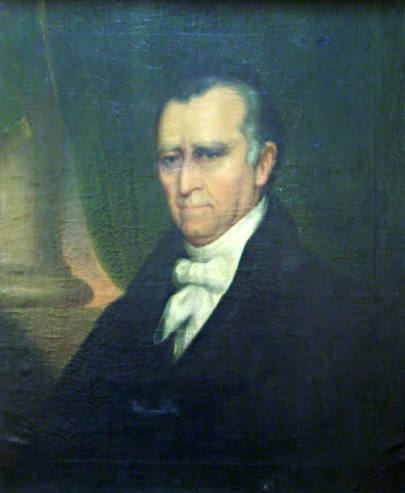
If anyone in Dixie is worthy of the title ‘Teacher of the South’, it is Reverend Moses Waddel. A summary of the major Southern figures who attended the academy he established at Willington, South Carolina, as students would be convincing enough:
‘Among the names are William H. Crawford, a pupil in the Appling school and an assistant at Willington; John C. Calhoun, A. B. Longstreet, George McDuffie, and Patrick Noble, [the latter two] governors of South Carolina; Henry W. Collier, governor of Alabama; George R. Gilmer and Thomas W. Cobb, governors of Georgia; and Hugh Swinton Legaré, James L. Pettigru, and Andrew Pickens Butler, U.S. senators.’
But as Aristotle reminds us in his Politics, there is more to education than merely learning a trade; it is also a matter of becoming virtuous. And here Rev Waddel also excelled. Augustus Baldwin Longstreet said in his eulogy for him in 1841,
‘The remarkable distinction of his pupils, cannot fairly be ascribed to chance. The immense number whom he taught, amounting to nearly four thousand, accounts in part, for the number who rose to distinction; but upon what principle are we to account for the number whom he taught? The question naturally presents itself, here where lay the secret of his success over others of equal abilities. I should say in the his sleepless vigilance over the conduct and morals of his scholars; the equity and impartiality of his discipline, and his firmness in enforcing it—his ready insight into the character of youth, and his skill in improving it, either by prompt correction or speedy commendation as seemed to him best; and in his well regulated familiarity with them, which made him at all times accessible to them, without lessening their respect for him.’
Such were the formative powers of Moses Waddel (the stress is on the first syllable, like in ‘throttle’ or ‘bottle’), whose own education was somewhat tumultuous.
His family emigrated from County Down, Ireland, to Charleston, South Carolina, in 1767, and from thence to Rowan County, North Carolina. Moses was born in 1770. At age six he began his schooling, which was interrupted in 1780 due to the presence of British soldiers. In 1782, he began again, studying a classical set of studies including mathematics, Latin and Greek languages, and ethics, which continued for two years more. Such was the promise that he showed that, upon the completion of his courses in 1784, he was offered a teaching position at the age of fourteen, which he accepted, teaching Latin and English subjects.
He taught also for a short time in Georgia before entering Hampden-Sydney in Virginia in 1790 to study to become a Christian minister. The following year he graduated, and in 1792 received his license to preach, which he did in various places in Georgia and South Carolina. He resumed teaching again about 1801 in South Carolina first at Appling then at Vienna, in each of which he organized a school. The school at Vienna he moved to Willington, South Carolina, which became the academy where he trained so many – and such prominent – young men of the South.
The character of the school may be descried in the following:
‘The school was a collection of student-built study cabins arrayed on a dirt street with a log-constructed recitation hall that doubled as a chapel. Boys boarded with nearby planters or in small cabins near the school. Ambitious youths, from the red hills of the upcountry to the tidelands of the coast, flocked to Willington . . . .
‘Waddel’s teaching of the classics, especially by the recitation method, attracted the attention of educators throughout the nation. Students learned to read ancient Greek and Latin and studied the great classical works. They also honed their oratorical skills, which were vital to politically ambitious members of society. Students were called to class by Waddel’s hunting horn, and recitations were not complete until he was satisfied. With such thorough preparation, Willington graduates entered colleges such as Yale and Princeton as juniors.’
One may certainly admire the accomplishments of these students in their rude cabins. They give the lie to all those who grouse about the underfunding of schools today, whose sports facilities alone cost millions of dollars to build and maintain.
Faithful to the Southern Tradition, he and his students were devoted to the sovereignty of the States, which Judge Longstreet describes in winsome language:
‘To them all, the most beautiful emblazonry on their country’s banner, was the Constellation of distinct, separate and equal stars. They regarded it with something of a Sabean devotion, because they saw in it the guaranty of their States’ independence, and the pledge of their fireside joys. They therefore resisted, with becoming spirit and sensitiveness, every attempt to bedim or to eclipse those stars, by expanding the glory which encircles the Eagle’s crest.’
Perhaps it is not surprising, given those views, that Moses should marry the sister of John Calhoun, Catherine. This happy event occurred in 1795, but the joy was ended prematurely only a year later when Mrs Catherine died due to complications from giving birth to their daughter, who sadly would also die not long afterwards. Rev Waddel would marry again in 1800 to Elizabeth, and with her had six children. Three of his sons would follow their father’s vocations as either a teacher or a minister – James Pleasants, professor at the University of Georgia, John, chancellor of the University of Mississippi, and Isaac, the minister.
Moses Waddel would himself spend a decade at the University of Georgia as her president, leaving Willington with some hesitation in 1818 to take up a post he had not actively sought. The university prospered during the ten years of his administration. In 1829, he stepped down from the presidency and returned to his home and his plantation, to preaching, and to his teaching in Willington. In 1818, he would also publish a book about the life of a pious woman, Memoirs of the Life of Miss Caroline Elizabeth Smelt, that would become quite popular.
More difficulties would come, as they sometimes do, to disrupt the joys of his later life. In 1830 his wife Elizabeth died; in 1836 he himself suffered a debilitating stroke upon returning home after time away preaching. From 1839 onward he lived with his son James in Athens, Georgia, where he fell asleep on July 21st, 1840.
So ended the life of a formidable man of the South. His achievement of successfully forming men of Christian virtue across the decades is noteworthy in Southern history, one might even say in Western history, particularly given the rough, unrefined nature of many of the places in Dixie at the time. That achievement of his is even more remarkable given the moral atmosphere in the world at the time. It was the era of the French Revolution, when the world was being flooded with immoral, atheistic, rebellious ideas. Judge Longstreet describes the atmosphere:
‘Montesquieu . . . infused into their minds the poison of his “Persian Letters.” Voltaire . . . brought the whole armory of literature to bear upon evangelical truth, with a strategy, which in some of its exhibitions, must hit every taste. In Dederot and D’Alembert, he found auxiliaries less versatile, but more august and irresistible than himself—the first, the projector and chief conductor of the grand Encyclopedia, the admiration and the bane of the world—the second, a master-mathematician of his day, and eloquent upon every subject. While these were laying waste the moral world, Buffon, the great naturalist, was exerting all the weight of his imposing character, to recommend a substitute for it, in exclusive materialism.’ And so forth.
The South today faces a moral atmosphere quite as toxic: Public education has largely been reduced to career training, from which virtue and religion are explicitly excluded. Artificial intelligence threatens to take the place of Christ as deity. Sexual perversion and confusion are pervasive thanks to smart phones, social media, and the like.
But with a firm trust in Christ our True God, and through the remembrance and imitation of our great teacher Rev Moses Waddel, it is not impossible that we may witness before the elapse of too many years a restoration and proliferation of the kind of school and teacher that shaped one of the finest generations of men Dixie has ever known.
******************************************
Sources:
1 https://www.ncpedia.org/biography/waddel-moses
2 https://confessional.org/archives/19th-century/waddel-1841-eulogy-of-the-life-and-public-services-of-the-late-rev-moses-waddel
3 https://www.presbyteriansofthepast.com/2020/08/21/moses-waddel/
4 https://www.logcollegepress.com/moses-waddel-17701840/
5 https://www.scencyclopedia.org/sce/entries/willington-academy/
The views expressed at AbbevilleInstitute.org are not necessarily those of the Abbeville Institute.







Thank you so much for this excellent article, Walt. I had never heard of Reverend Waddell until I read your submission. He was and should be an inspiration to all educators and they should all aspire to follow his example of imbuing their students with a strong moral code as well as academic rigor.
Agreed on all accounts. May God bless us with many more Moses Waddels.
Thanks for telling us of Rev. Waddell. I believe “The school at Vienna he moved to Willington, North Carolina…” should be corrected to Willington, SC. Wilmington, NC probably caused the mistake; there is no Willington, NC.