

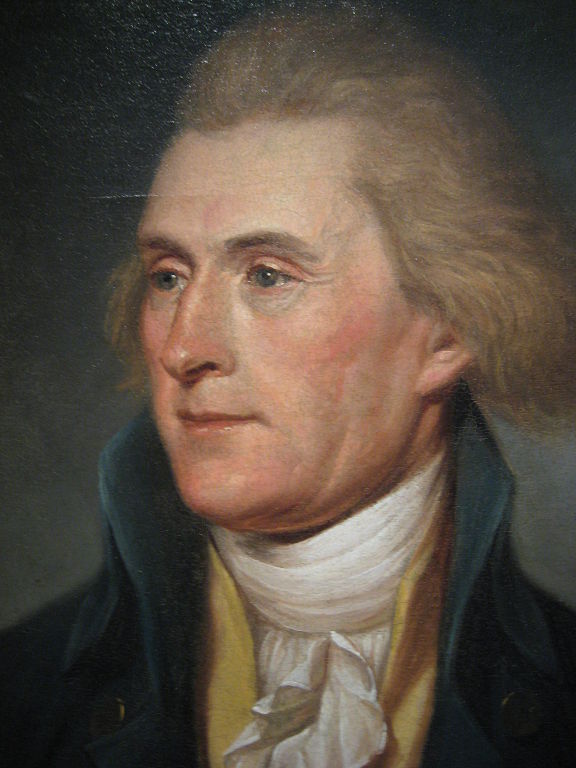
Joe Ellis, of Mount Holyoke College, has made a career of being controversial. At one point, his tenureship was in jeopardy, as he claimed falsely to his students at Mt. Holyoke College to have fought in the Vietnam War. He did not.
Ellis has also been unfriendly to Thomas Jefferson. Yet that, Jefferson-unfriendliness, has been happening at least since the 1960s, when scholars began to look for skeletons in closets. Ellis’ contribution to that brand of historiography has been to create phantom skeletons when he does not find them in closets. His criticism of Thomas Jefferson vis-à-vis the latter’s Summary View of the Rights of British America is a sterling illustration.
According to Ellis in American Sphinx, Jefferson’s Summary View is illustrative of Jefferson’s fecund, ungrounded imagination. The Summary View has “an otherworldly, almost fairy-tale quality,” revelatory of Jefferson’s “reclusive pattern of behavior”—a form of “childhood play adopted to an adult world” or a form of “juvenile romanticism.” They are
glimpses of a very vulnerable young man accustomed to constructing interior worlds of great imaginative appeal that inevitably collided with the more mundane realities. Rather than adjust his expectations in the face of disappointment, he tended to bury them deeper inside himself and regard the disjunction between his ideals and worldly imperfections as the world’s problem rather than his own.
In short, Jefferson repressed his visionary disappointments and blamed reality for them. A mythomane and visionary, Jefferson did not fit into the real world.
The assessment—which seems at the surface to be trenchant—invites critical analysis. Ellis asserts that the Summary View, in effect, is symptomatic of Jefferson’s severe neurosis, bordering on psychosis. When reality collides with Jefferson’s imaginative view of it, imagination trumps reality, for the ideal cannot be compromised. Jefferson retreats comfortably to the inner recesses of his mind.
Jefferson’s ideals, I show in Jefferson’s Political Philosophy and the Metaphysics of Utopia were not reality-neglectful. They were instead guided by a robust notion of progress—scientific, political, and moral—observable throughout history, especially in the many advances of Jefferson’s time. Thus, Jefferson’s optimism was similar to that of Sir Thomas More, of Immanuel Kant, of James Harrington, of Louis Sébastien Mercier, of Comte de Volney, and of Condorcet, inter alii. All were moved to imagine better, easier, and more prosperous days ahead because of advances observed in Enlightenment times that allowed for ease of living (e.g., the Spinning Jenny and agricultural innovations like Jefferson’s own improved plow mold-board), for greater scientific understanding (e.g., Harvey on the circulation of blood and Newton on the fundamental principles of dynamic physics), and for considerations of moral improvement (e.g., more humane treatment of prisoners of war).
Yet if we follow Ellis’ assessment to the letter, Jefferson, ever burying conflicts deeper inside himself, could never have held together himself and could never have been capable of his numerous extraordinary accomplishments, most singularly through his pen. Psychotic withdrawal from the real world, of the Quixotic sort, would have been imminent. Moreover, how could a borderline psychotic, at the time of writing the Summary View, pull everything together so remarkable to compose the Declaration of Independence two years later?
From a logical tack, Ellis’ account of Jefferson’s psychotic withdrawal, evidenced by his Summary View, shows Ellis’ prodigious perplexity. Ellis notes that Jefferson’s expectations of reality were often, it not customarily, disappointed. Hence, he repressed, and severely so. That implies that Jefferson held firmly to his mistaken ideals and controverted incommodious aspects of reality—that is, he shut out reality and lived in cloud-cuckoo-land. If so, he merely lived with a ponderously distorted view of reality, based on delusional fantasies. If so, however, Jefferson could not have had any realization, at least not consciously, of any discordance of his perception of reality and reality per se. Therefore, there would have been no need to project—viz., to blame reality for the “disjunction of his ideals and worldly imperfections.” Psychotics are incapable of projection, which is essentially a defensive measure.
If there is any projection here, it is Ellis’. Ellis’ harsh condemnations of Jefferson are very likely “confessional”—that is, projections of his own discomfiture with reality onto Jefferson. Perhaps Ellis really believes that he fought in the Vietnam War?
Why is it that US scholars today find so much enjoyment in aiming to bring down large American figures? Moreover, why are they typically so handsomely rewarded for that (consider Henry Weincek on the cover of Smithsonian)?
In the decades to come, figures like Ellis will be forgotten. Thomas Jefferson will never be forgotten.
Below I include a discussion with Prof. Courtney Crowley and the general depiction of Jefferson by American historians. Enjoy!
The views expressed at AbbevilleInstitute.org are not necessarily those of the Abbeville Institute.





Thanks for this article and video, Dr. Holowchak!
Ellis long since proved himself a liar and, therefore, not to be trusted. Why would I – or anyone else – give serious consideration to anything he writes, however skillfully wrought? This says everything we need to know about the state of much of academia today, that mainstream historians would actually treat with him!
Thank you, William.
Why? Because these “scholars” have a bare understanding, therefore NO enjoyment except when they face a mirror. JMO
Ellis is too silly to give that much consideration. Summary View of the Rights of British America was very popular because it expressed well what Americans were perceiving. It struck a chord with readers. It is the very reason Jefferson was asked to be the primary author of the Declaration of Independence.
Agreed. He is, despite his politicking and deceptious history, mainstream.
“Jefferson retreats into the inner recesses of his mind”
We should all be so lucky, and so fortunate he may have done so.
Let those flatter whor fear Sire, it is not an American Art
Who darn it
Bold words by TJ, but sorely needed at the time.